Construction Company Website Cost and Project Pages That Win Contracts
Hosting a construction firm's site costs $119 a year, or $19 on each monthly bill, with the domain registered separately. This guide covers who hires builders, services, case studies, the build process, pricing, credentials and warranties, commercial capability, honest claims, search and the budget.
- No coding required
- Live in minutes
- Blog, SEO and chatbot tools included
Hosting a construction firm's site costs $119 a year, and firms keeping cash in the business can pay $19 monthly instead, with the domain registered separately. While the firm lays out its project pages and reviews them on screen, AI Web Maker sends no bill. Project pages like these can be judged on the construction company website design sample, which follows an invented building firm from plans to handover across a complete site made in AI Web Maker. One extension or renovation contract pays for decades of hosting, so the fee is not the factor that matters. What matters is whether the website convinces homeowners, developers and commercial clients that this firm will deliver on time, on budget and to a high standard. Those clients are committing large sums to someone they may never have met, and they look hard for evidence before requesting a price. The sections below cover the services, case studies, process, pricing, credentials and enquiry route that provide that evidence, along with the yearly budget.
This article is part of our complete guide: Home Services Website Builder.
Who hires a construction company, and what do they need to see?
Construction companies are hired by several distinct groups, and each needs different evidence before making contact. Homeowners planning an extension, a loft conversion or a major renovation want to see similar finished projects and understand how disruptive the work will be. Developers look for firms that can build multiple units to specification and keep to a programme. Commercial clients, such as shop owners or businesses fitting out offices, care about capacity, safety records and working around their operations. Architects and designers want reliable contractors who respect drawings and communicate well. A website that addresses each group separately turns more visitors into serious enquiries.
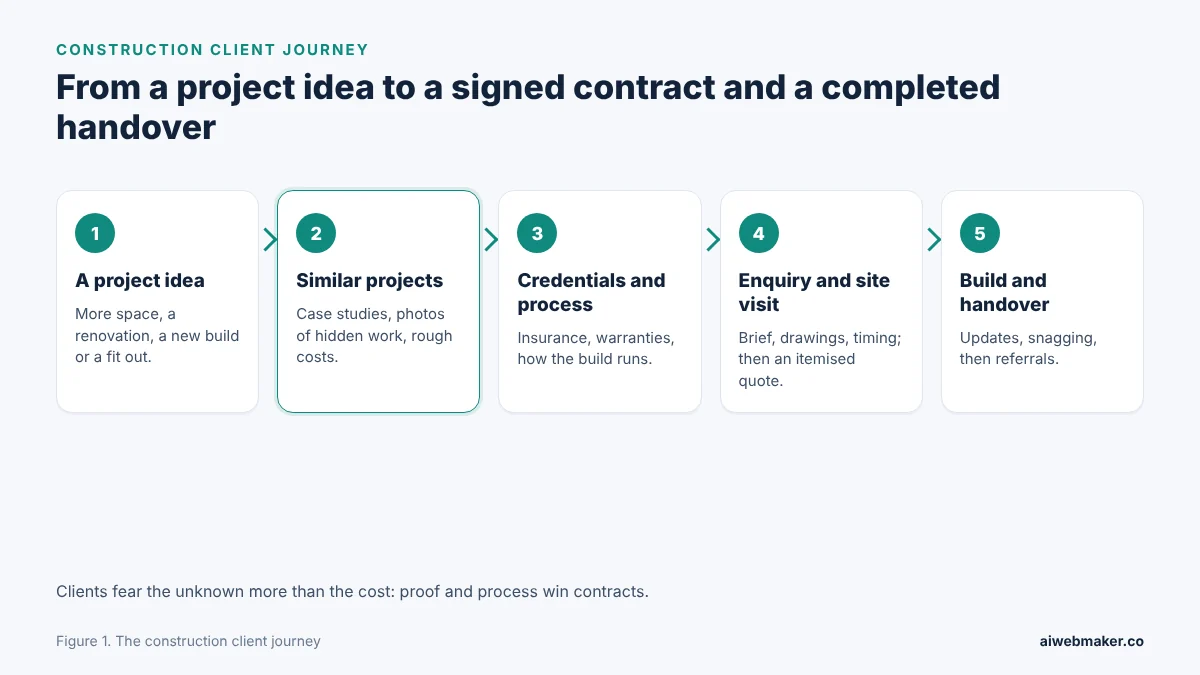
The figure follows a homeowner from the first idea of an extension to the handover of the finished space. Research starts with photos of similar projects and a rough sense of cost. The visitor then checks credentials, insurance and reviews, because the risk of choosing the wrong builder is high. An enquiry and a site visit follow, leading to a detailed quote. Trust grows or falls during the build, and a tidy handover makes the client an advocate who recommends the firm. The website supports each stage, from the first photo to the final review.
What types of building work deserve their own page?
A construction company website should list each type of work separately, because clients search for a loft conversion or an office fit out rather than for construction in general. Residential services, such as extensions, loft conversions, renovations and new builds, attract homeowners. Commercial services, such as fit outs, refurbishments and small commercial builds, attract business clients. Specialist work, such as structural alterations or groundworks, can appear where the firm has real expertise. Each service page should show relevant projects, typical timescales and what the firm handles directly. Clear service pages help each visitor see quickly whether the firm fits their project.
| Service | Typical client | What the page should show |
|---|---|---|
| Extensions | Homeowners needing more space | Single and double storey examples, typical timescales |
| Loft conversions | Homeowners in growing families | Types of conversion, access, insulation |
| Renovations | Owners of older properties | Phased work, living on site, finishes |
| New builds | Self builders and developers | Project management, specifications, warranties |
| Commercial fit outs | Shops, offices, restaurants | Working hours, programme, compliance |
| Structural alterations | Owners opening up spaces | Engineering, approvals, temporary works |
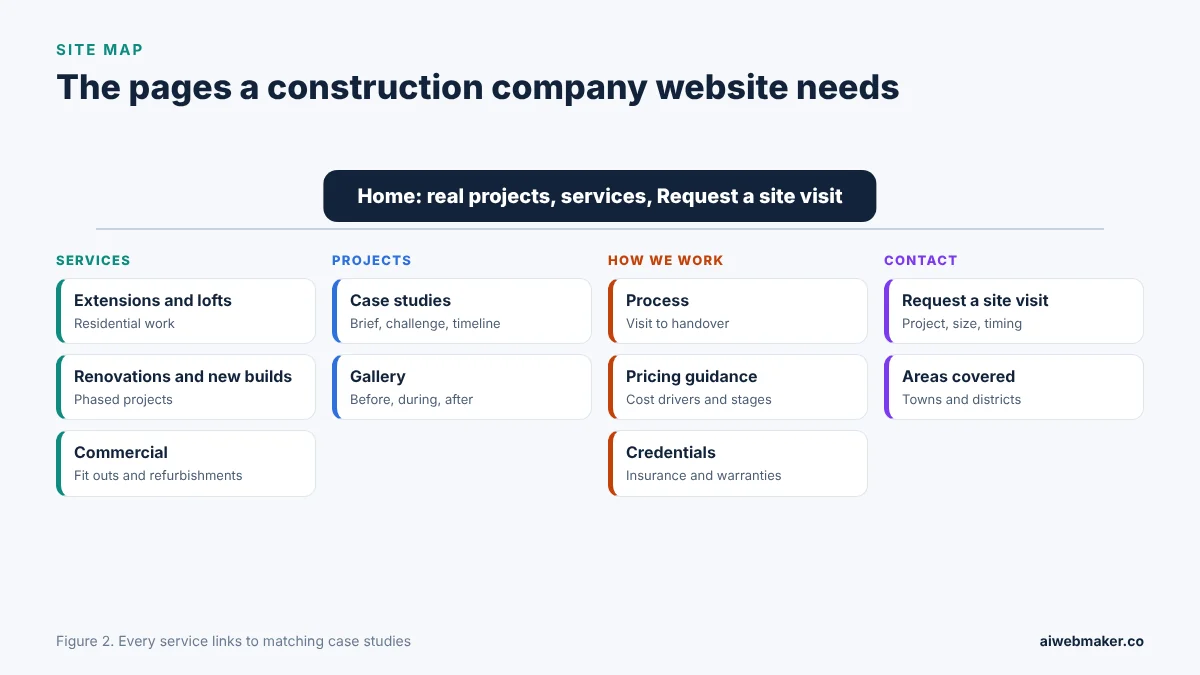
Organised as a site map, a builder's website separates services, projects, the way the firm works and the contact route. Service pages describe each type of work, while project pages hold detailed case studies linked back to them. Process pages explain how a project runs, how pricing works and what credentials the firm holds. Contact pages carry the enquiry route and the areas covered. The AI website builder that construction firms use for enquiry and project pages creates this structure once the firm describes its work in a few lines. Our sample firm, Stonebridge Builders, covers homes, commercial buildings and renovations, and presents a two storey extension built to match an existing home; the construction company website example with a completed projects page took 50 seconds to generate.
What should a construction case study include?
A construction case study should include the brief, the challenges, the solution, the timeline and plenty of photographs taken before, during and after the work. The brief explains what the client wanted, such as a kitchen extension that matched an older house. Challenges, such as a sloping site, a party wall or tight access, show how the firm solves real problems. Progress photos prove the quality of hidden work, such as foundations and steel beams, that clients will never see once the job is finished. A budget range and the actual time taken, where clients agree to share them, help visitors set realistic expectations. A short quote from the client, used with permission, completes the story.
| Case study element | What to include |
|---|---|
| The brief | What the client wanted and why |
| The site | Access, constraints, existing structure |
| Challenges | Problems met and how they were solved |
| Timeline | Planned and actual duration |
| Budget range | Where the client agrees to share it |
| Photos | Before, during and after, from several angles |
| Client words | A short quote used with permission |
How should the build process be explained?
Laying out the build process stage by stage matters, because clients fear the unknown more than they fear the cost. The page can describe what happens from the first enquiry to the final handover, including site visits, design, approvals, quotes and contracts. Clients living in their homes during work want to know about access, noise, dust and how the site is kept tidy. A named project manager and regular updates reassure clients that someone is accountable. A clear snagging process, where small defects are listed and fixed after completion, shows commitment to finishing properly. A well described process often decides which of several similar quotes a client accepts.
| Stage | What happens | What the client should know |
|---|---|---|
| Enquiry and visit | The site and the brief are discussed | When the visit happens and who attends |
| Design and approvals | Drawings and any permits | Who is responsible for each approval |
| Quote | Detailed, itemised price | What is included and excluded |
| Contract and programme | Terms, start date, stages | Payment stages and how changes are handled |
| Build | Work on site with regular updates | Working hours, protection, communication |
| Handover and snagging | Final inspection and fixes | How defects are listed and resolved |
How should a construction company talk about pricing?
A construction company should talk about pricing by explaining what drives the cost of each type of project, even when it cannot publish fixed prices. Size, specification, site access, ground conditions and the level of finish all change the final figure, and a short explanation of each helps clients understand quotes. Typical ranges for common projects, presented honestly as guidance rather than promises, help homeowners judge whether their budget is realistic. An itemised quote, with clear inclusions and exclusions, builds more trust than a single total. Payment stages linked to completed work, rather than large sums in advance, reassure clients. Honest pricing guidance attracts serious enquiries and filters out those with unrealistic budgets.
Which credentials, insurance and warranties should a builder show?
A builder should show the credentials, insurance and warranties that give clients confidence their money and property are protected. Membership of recognised trade bodies, where it exists, can be stated with a link to the body's own register. Public liability and employer's liability insurance, or local equivalents, reassure clients about accidents and damage. Warranties on workmanship, and any insurance backed guarantees available in the firm's country, protect clients if problems appear later. Compliance with building regulations and the firm's approach to inspections show professionalism. Each credential should be accurate and verifiable, because inflated claims destroy trust quickly.
What do commercial clients look for on a builder's website?
Commercial clients look for capacity, safety records and evidence of working around live operations. A capability page can summarise the size of projects the firm handles, its team, its equipment and its typical programme lengths. Health and safety policies, accreditations and accident records matter greatly to businesses with their own legal duties. Case studies of fit outs completed outside trading hours, or phased to keep a business open, are especially persuasive. Commercial clients also want clear communication, named contacts and reliable reporting. A focused commercial section helps a firm win contracts that are often larger and more regular than residential work.
Why do honest claims and reviews matter for a builder?
Honest claims and reviews matter because construction attracts more complaints than most trades, and clients are wary of exaggeration. Consumer protection law in many countries treats misleading claims, hidden charges and fake reviews seriously. In the United Kingdom, for example, the Competition and Markets Authority has new powers to enforce consumer protection law directly, including action against fake reviews. Reviews should come from real clients and appear without selective editing. Timescales and prices should be described as estimates when they are estimates. A reputation for honesty is worth more to a builder than any slogan.
What do people type when hunting for a local builder?
Clients searching locally find construction companies through phrases such as builders near me, house extension builders, loft conversion company or commercial fit out contractor, usually followed by a town. Those exact phrases belong in the service page headings and opening lines. Project pages that name the town or district where each job took place help with local searches. Map listings with accurate details, project photos and the website address support local results. Guides to planning an extension or understanding renovation costs attract homeowners early in their research. Firms that publish steadily become the familiar name when clients are ready to build.
Which recurring costs does a builder's website carry?
Only hosting and a domain recur each year for a builder, and credit drafted articles add very little. A firm with a full order book saves by paying annually. A newly formed firm may prefer monthly billing while it builds a track record. Adding projects, services or photos never changes the bill. The table compares both routes with the $189 tier listed too.
| Cost item | Annual route | Monthly route |
|---|---|---|
| Hosting the firm's pages | $119 | $228 over twelve months |
| Domain for the firm | Priced by the ending | Priced by the ending |
| Higher plan, for comparison | $189 a year | Not needed |
| Twelve project and planning articles at about $0.65 | About $7.80 | About $7.80 |
| New projects, services and photos | No charge | No charge |
| Year before the domain | About $126.80 | About $235.80 |
Why do clients pass over a builder's website?
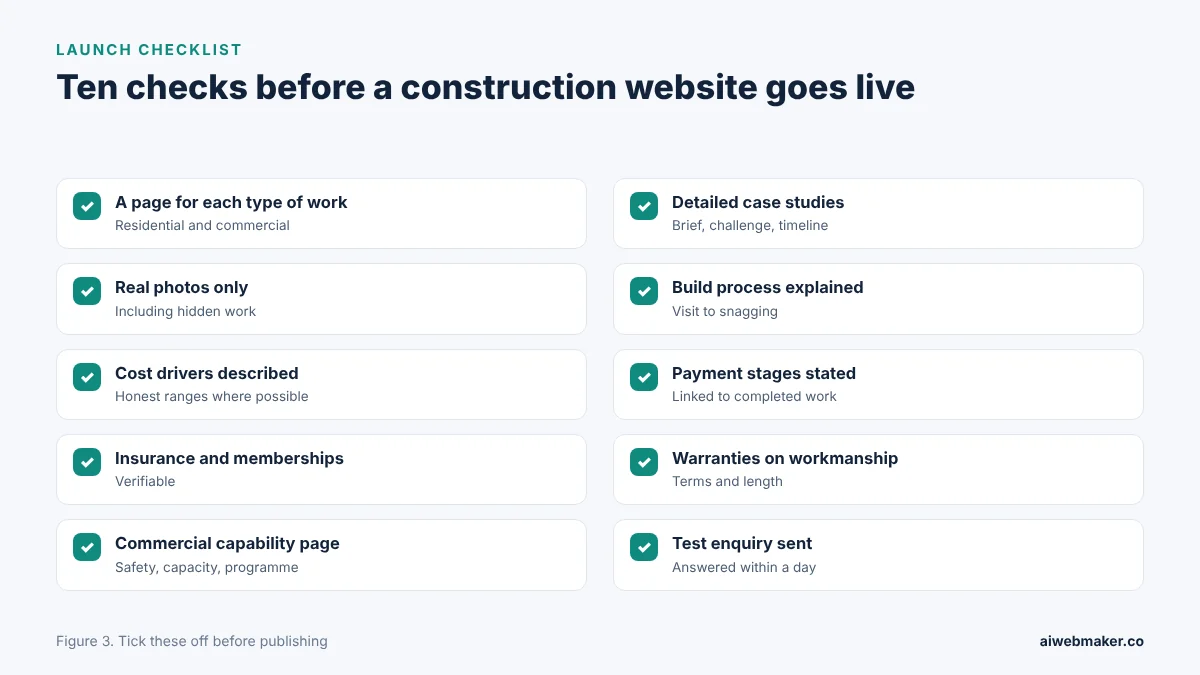
Clients pass over a builder's website when it shows stock photos instead of real projects. A vague description of services leaves them unsure whether the firm handles their type of work. No information about the process makes the project feel risky. Missing credentials and insurance details raise doubts about protection if something goes wrong. An enquiry form that asks for nothing useful produces poor quotes and slow responses. The next figure sets out ten checks that address each of these doubts.
Frequently asked questions
Are typical price ranges worth showing for extensions?
Publishing typical price ranges for common projects helps clients judge whether their budget is realistic, provided the ranges are honest and clearly labelled as guidance. The page can explain what pushes a project towards the top or bottom of the range. Exact prices always depend on a site visit and a detailed specification. Clients who see ranges in advance tend to make better prepared enquiries. Honest guidance builds trust before the first meeting.
How many projects should a construction website show?
A handful of well documented case studies usually persuades more than dozens of single photos with no explanation. Each case study should show a different type of work or a different challenge. New projects can be added as they are completed, keeping the portfolio current. Older projects can move to an archive page. Quality and detail matter far more than quantity.
Can residential and commercial work share one website?
Residential and commercial work can share one website, provided each has its own clear section with relevant projects and language. Homeowners want reassurance about disruption and finishes, while commercial clients want capacity and safety records. Separate service and project pages let each visitor find relevant information quickly. One website also means one domain and one hosting bill. Clear navigation keeps both audiences comfortable.
What should a construction enquiry ask for?
A construction enquiry should ask for the type of project, the location, the rough size, the intended timing and whether drawings or approvals already exist. Photos of the existing space help the firm prepare for the site visit. A budget range, if the client is willing to share it, helps the firm suggest realistic options. The page should explain how quickly the firm responds and what happens next. Good enquiries lead to useful site visits and accurate quotes.
Will one contract pay for the construction website?
One modest renovation contract earns many times the $119 that hosts a construction firm's website for a year. Under monthly billing, part of a single day's labour pays the $19. Each project won after a client studies the case studies adds income the site helped to secure. Detailed projects, a clear process and honest credentials persuade more clients than any advertisement. Firms that keep their case studies current find that enquiries arrive better prepared and more serious. A forward order book filled through the website is the clearest return on the investment.
Build your website in Minutes and get the AI Tools that work
Start Building Your Website →