Sports Massage Website Cost, Timed Around Races and Training Blocks
A sports massage practice can host its website for $119 a year, or $19 a month, plus its domain. Covered: who books around training, timing sessions to events, warning signs, licensing, club and race work, requests, search and the yearly budget.
- No coding required
- Live in minutes
- Blog, SEO and chatbot tools included
AI Web Maker hosts a sports massage therapist's site at a yearly rate of $119, or at $19 per month for those who prefer, with the domain as its own small purchase. Arranging the session cards, the timing table and the warning signs, then viewing them in the preview, generates no invoice at all. Two or three post event sessions, or one regular client's visits across a training block, pay for the year. The real challenge is a contradiction at the heart of the trade, because athletes want help with sore, tight bodies while a massage therapist must avoid sounding like a clinician who treats injuries. A website that times sessions around events, says plainly what massage is not and lists the signs that need a doctor earns the trust of serious athletes. The guide runs through who books, sessions timed to the calendar, warning signs, licences and insurance, club and race work, requests, search and the yearly budget.
This article is part of our complete guide: Healthcare Website Builder.
Runners, players and desk bound weekend athletes: who lies on the table
Sports massage clients are defined by their calendar more than their complaint. Runners book in the lighter week of a marathon build or a few days before a half, and team players come between matches through a long season. Cyclists and triathletes spend hours in one position and want time on hips and backs, while lifters ask for shoulders after heavy weeks. Dancers and climbers work around rehearsals and climbing days, and plenty of office workers stiffen through the week before a weekend game. Every one of them asks when to book relative to their event, how firm the pressure will be and whether the therapist knows their sport.
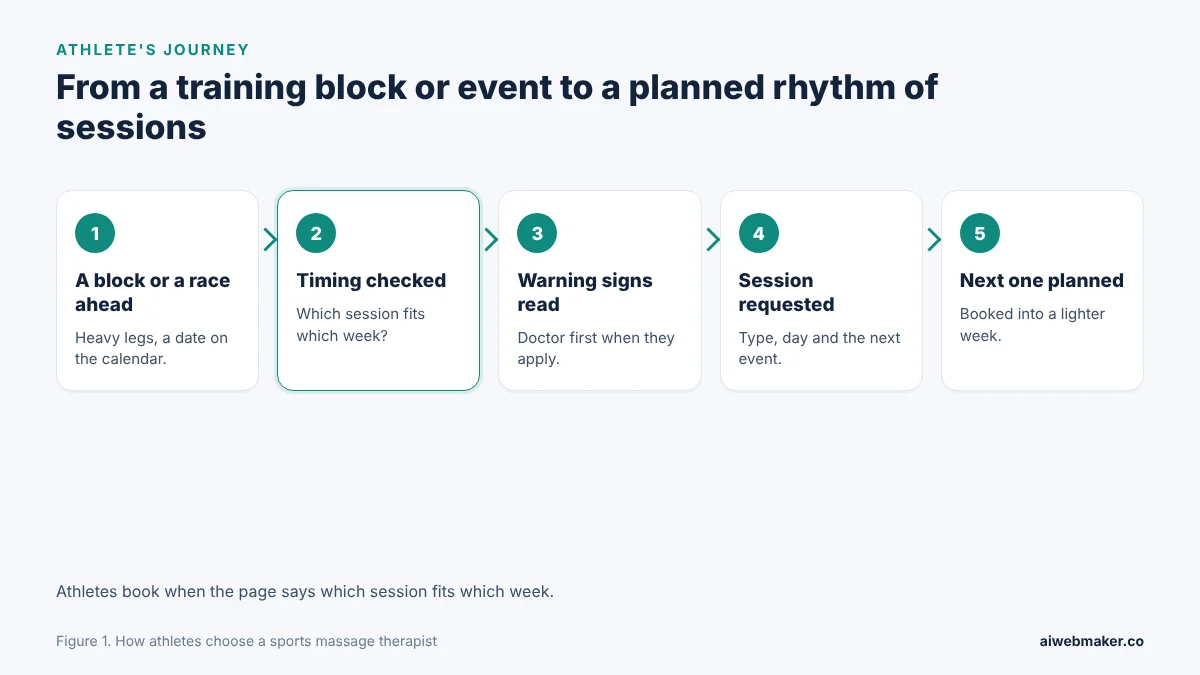
The second step carries the most weight, because an athlete's first question is when, not what. Someone with a race in ten days needs to know whether a deep session now would leave the legs sore on the start line. The warning signs come next, and a careful athlete reads them before booking anything. The request follows with the session type, a day and the next event. The last step, planning the next session around the training plan, is how one appointment becomes a standing rhythm across a season.
Session cards, a timing table and limits: pages a sports massage practice needs
Sports massage websites should be organised around time rather than technique. The home page states who the practice treats and that sessions are planned around training and events. A sessions page lists each type with its length, its usual timing and its price, and a timing table shows how massage fits around a race. A clear section on what massage is not, with the signs that need a doctor, protects clients and therapist alike. Pages on clients by sport, the first session and the request close the route.
| Page | Athlete's question | What it should include |
|---|---|---|
| Home | Does this practice understand sport? | Sports treated, timing around events, a request button |
| Sessions | Which session, and how long? | Pre event, post event, block and long sessions with prices |
| Timing | When is the right moment before a race? | A table from training weeks to the days after an event |
| Not medical treatment | Is this the right place for an injury? | Warning signs and where to go instead |
| Clients by sport | Does the therapist know this sport? | Typical areas worked for runners, players and cyclists |
| First session | What happens first? | Health questions, pressure agreed, aftercare |
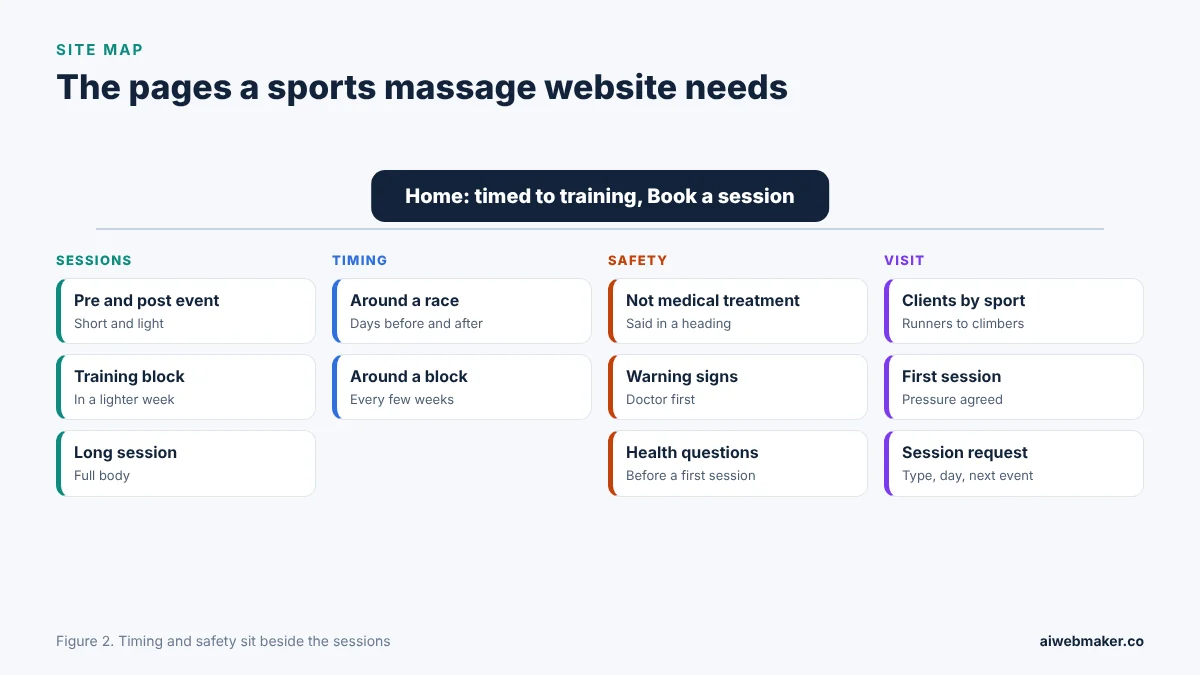
Sessions and timing take the first two columns of this plan, with safety pages next and the visit pages at the end. The session group sets out pre and post event work, training block visits and longer full body sessions, while the timing group places each one around a race or a hard week. Safety pages state that massage is not medical treatment and list the warning signs and health questions. Recovery Room Sports Massage, the invented practice behind our sample, prices Pre event, Post event, Training block and Long session appointments, and describes its clients as Runners, Team players, Cyclists and triathletes, Lifters and gym regulars, Dancers and climbers, and people with Desk weeks, weekend games. The sports massage website example with sessions timed around events sets out its timing table on one page and ends with a booking request.
Sessions named by the calendar: before, after and between events
Naming sessions by when they happen, rather than by technique, matches how athletes think. A short, light session two or three days before an event loosens the legs without leaving anything tender on race day. A gentle session two or more days after an event helps the athlete feel more comfortable while the body recovers, and longer sessions belong in lighter training weeks. Many therapists avoid new treatments on the event day itself, since unfamiliar sensations are best kept away from competition. The page should present this as the practice's own habit rather than medical advice, and say that a coach's or physiotherapist's guidance comes first.
| When | Session | Pressure | Why then |
|---|---|---|---|
| A lighter training week | 60 minutes | Moderate, agreed as it goes | Time for the legs to settle before the next block |
| Two or three days before an event | 30 minutes | Light and brisk | Loosening up without tenderness on the day |
| Event day | None | None | New sensations are best avoided |
| Two or more days after | 45 minutes | Gentle | Comfort while the body recovers |
| After an injury or illness | Ask first | None until cleared | A doctor or physiotherapist decides |
Signs that send an athlete to a doctor instead of the table
A sports massage website must say clearly that massage is not medical treatment and that the therapist does not diagnose injuries. It should list the signs that mean a doctor comes first, such as a sudden sharp pain, a joint giving way, numbness that spreads, or pain at night or with a fever. A calf that is swollen, warm and red without a clear cause deserves its own line, because it needs a doctor promptly rather than a massage. A recent fracture, operation or blow to the head, pregnancy or a health condition calls for a doctor's agreement before booking. Therapists who send clients away when these signs appear earn a reputation that brings whole squads to their door.
| Sign | What the page should say |
|---|---|
| Sudden sharp pain, a pop or a joint giving way | See a doctor or physiotherapist before any massage |
| A swollen, warm, red calf without a clear cause | See a doctor promptly, and do not book |
| Numbness, tingling or weakness that spreads | A doctor first |
| Pain at night, at rest or with a fever | A doctor first |
| Chest pain, collapse or sudden breathlessness | The local emergency number at once |
Licences, registers and insurance where massage is regulated
Massage regulation is a patchwork, and the website should reflect the rules where the practice works. Some states, provinces and countries license massage therapists and require a licence number on advertising, while others rely on voluntary registers run by professional bodies. Sports massage qualifications vary in level and length, so naming the qualification and the body that awarded it is more useful than a string of letters. Professional indemnity and liability insurance are widely expected, and event organisers often ask to see both. Because rules differ so much, the practice should check its local requirements and state only what applies.
Clubs, races and finish line recovery areas
Event and club work can fill quiet weekday evenings and raise a practice's profile, so the website should invite it. Clubs may book a therapist for a training night, while organisers of local races sometimes want a recovery area near the finish. The page should state what the practice brings, such as couches, towels and a set number of therapists, and what the organiser provides, such as space, shelter and power. Insurance, the organiser's permission and any venue rules should be agreed in writing beforehand. A short events section can turn a single race weekend into introductions to many local runners.
Requests timed to the next race or hard week
Athletes book around dates, so the request route should start from the session and the day rather than a long questionnaire. The page should say that health questions come before every first session, and that anyone with a warning sign on the list should see a doctor before booking. Cancellation terms, such as a day's notice to move a session, belong beside the button. Clubs and event organisers deserve a separate route for their enquiries, since their dates are often months ahead. A clear process makes the booking feel as planned as the training it serves.
On the booking website builder for sports massage therapists and event timing, the athlete's chosen session and day arrive as a request awaiting a reply. The therapist confirms it, offers another slot nearer the right point in the training week, or declines when the diary is full. Fees are paid at the appointment, straight to the practice, and the platform keeps none of the money. Session, timing and warning sign pages are drafted by the builder once the therapist has outlined the practice and its sports. Since nothing is fixed until the therapist replies, a session booked too close to an event can be moved before it happens.
Phrases athletes type in the week before a race
Athletes search with phrases such as sports massage near me, sports massage for runners, pre race massage, post marathon massage or massage for cyclists. Many add a district or the name of a race. Pages for each kind of client, with the sport in the heading, catch those searches better than one general page. The map listing should show early and late hours, since athletes train around work. Reviews that mention timing, pressure checked throughout and honest referrals reassure careful readers. Articles about when to book before a marathon or what to expect after a first sports massage reach athletes weeks before they need the table.
Couch, linen and the website: a sports massage practice's yearly costs
Set beside the couch, the linen and the insurance premium, the website barely dents a sports massage practice's accounts. One payment of $119 covers the year, twelve of $19 do the same job monthly, while the domain costs whatever its chosen ending, one of roughly 400, happens to cost. Credits for a dozen articles on race timing and recovery come to under eight dollars. Changing session prices or adding an event costs nothing. The $189 tier is set down in the table for comparison and is not needed.
| Item | Yearly | Monthly |
|---|---|---|
| Hosting the sports massage pages | $119 | $228 over twelve months |
| Domain | Depends on the ending | Depends on the ending |
| Higher plan, for comparison | $189 a year | Not needed |
| Twelve timing and recovery articles at about $0.65 | About $7.80 | About $7.80 |
| Session, price and event updates | No charge | No charge |
| Year before the domain | About $126.80 | About $235.80 |
Injury claims, vague pressure and other reasons athletes book elsewhere
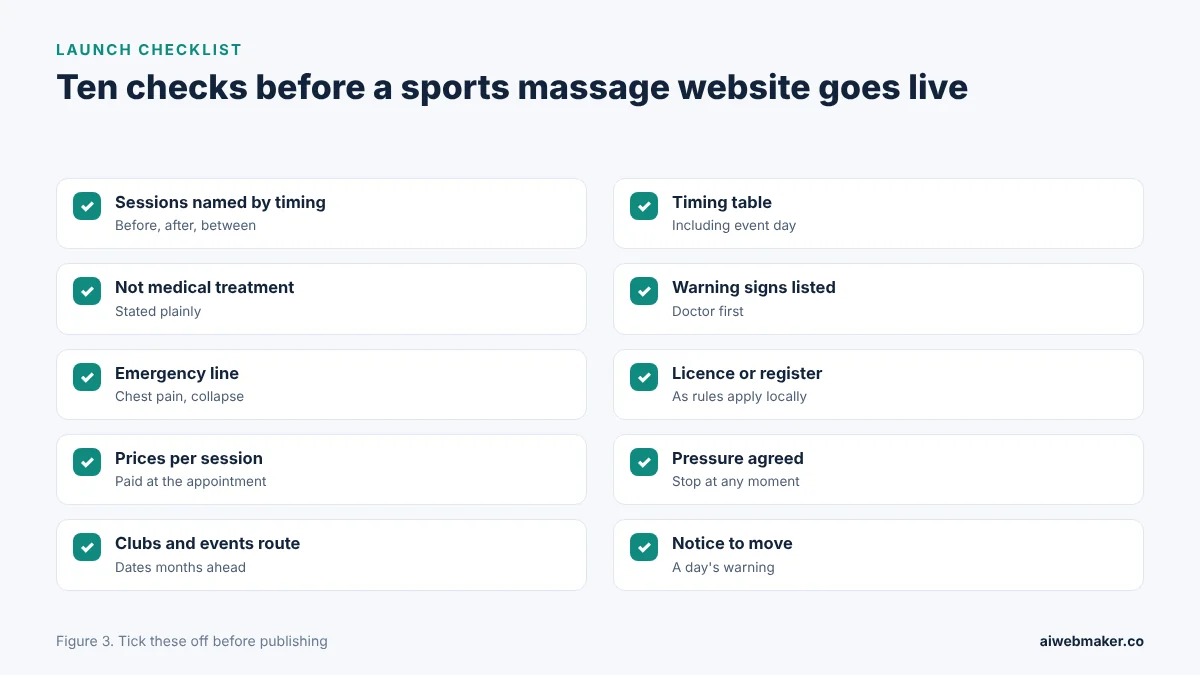
Athletes leave a sports massage website when it promises to fix injuries, because experienced competitors know that massage is not a diagnosis. Sessions listed only by length, with no word on timing around events, leave them guessing whether a booking will help or hinder a race. Missing warning signs suggest a therapist who might work on something that needs a doctor. Prices hidden until the end of a session feel like a trap for people who book every few weeks. Ten tasks in the checklist that follows put each fault right.
Frequently asked questions
Will a sports massage hurt?
Sports massage can feel firm, but it should never be firmer than the client agrees to. The therapist checks pressure throughout, and the client can ask to ease off or stop at any moment. Some people feel a little tender for a day or so afterwards, especially after a first session. The page should say this honestly and explain that pressure is lighter before events. Clear expectations make the first session far less daunting.
How often do athletes in a training block book a session?
Many athletes in a training block book every two to four weeks, usually in a lighter week rather than before a hard session. Those preparing for a single event might add a short session a few days before and a gentle one a few days after. The right rhythm depends on training load, budget and how the body responds, and a coach's view counts. The website can suggest typical patterns while saying they are not a prescription. A planned rhythm suits both the athlete's plan and the therapist's diary.
Shorts, a vest or a towel: what do athletes wear on the table?
Shorts and a sports top or vest suit most sessions, and towels cover everything not being worked on. Layers can stay on at any time, and the therapist works around them. Athletes coming straight from training may appreciate a shower, and the page should say whether one exists. Any preference about draping or pressure can be mentioned before the session starts. Practical details like these make a first visit feel straightforward.
Can a sports massage therapist work alongside a physiotherapist?
Many sports massage therapists work alongside physiotherapists, doctors and coaches, especially with injured or returning athletes. The massage therapist does not diagnose and follows the clinician's advice on when massage is suitable. With the client's agreement, notes can be shared so everyone works from the same plan. The website can explain this relationship in a sentence or two. Clear roles reassure athletes that their care is joined up rather than contradictory.
Post event sessions against the practice's hosting year
A few post event sessions after one race weekend usually outweigh the $119 that hosts a sports massage website for a whole year. The monthly figure of $19 sits below a single pre event session fee. Every runner who returns each training block, and every club that books a therapist for its next race, adds income that clear timing pages helped win. Honest limits, a timing table and named warning signs persuade athletes better than claims of faster recovery. A diary that fills around the local race calendar shows the pages speak the language of the people on the table.
Build your website in Minutes and get the AI Tools that work
Start Building Your Website →