Sleep Clinic Website Cost and Calm Pages for Readers Awake at 3am
A sleep clinic keeps its pages live through a yearly $119 payment, or twelve monthly steps of $19, with its domain bought apart. Covered here: patients and how they choose, condition pages, the home test, fees and referrals, treatment wording, signposting, requests, search and a yearly budget.
- No coding required
- Live in minutes
- Blog, SEO and chatbot tools included
On AI Web Maker, a sleep clinic keeps its pages online for a yearly $119, or twelve monthly steps of $19, with its domain bought apart. Writing the condition cards, the home test walkthrough and the fee panels, then reading every screen back in the preview, happens before AI Web Maker bills anything at all. One first consultation booked through the site usually outweighs the whole hosting year, so money is rarely the obstacle. The obstacle is the reader, who is often awake at three in the morning and worried about a partner's breathing or their own failing concentration. That person needs symptoms in everyday words, a clear picture of the test, visible fees and careful language about treatment. Covered here are the patients, the pages, the home test, fees and cover, treatment wording, signposting, requests, search and a yearly budget.
This article is part of our complete guide: Healthcare Website Builder.
Who reads a sleep clinic's pages in the middle of the night?
Many visitors reach a sleep clinic's website because someone else noticed the problem first, or because months of bad nights have started to wear down the days. A partner describes loud snoring broken by pauses, snorts or gasps, and the sleeper remembers none of it. Another reader has lain awake on most nights for a whole season and has tried every remedy on the pharmacy shelf. Shift workers want to know whether a clinic understands night rotas, early starts and a body clock that runs late. Some arrive after nodding off in a meeting or, more worryingly, at the wheel. Each of them judges the clinic on three questions: does my problem belong here, what will the test involve and who will explain the result.
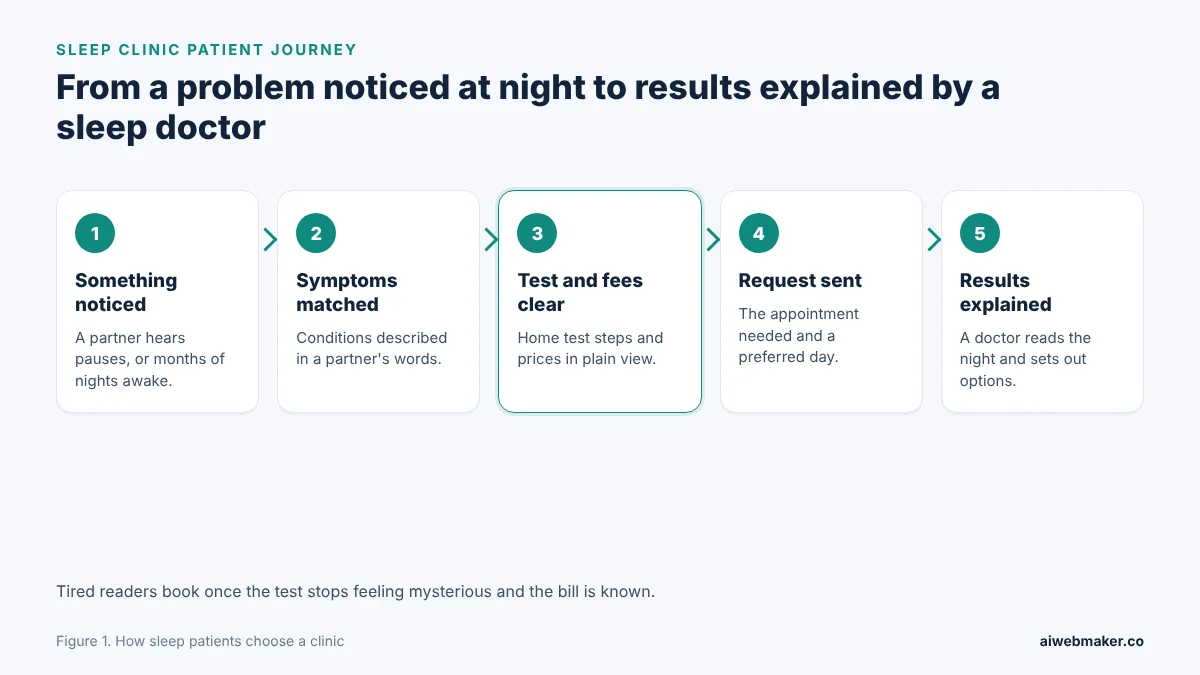
Five moments shape a patient's choice, and the third is where a clinic most often wins or loses the request. It starts with a sign that someone notices, frequently a partner rather than the sleeper. Matching that sign to a named condition comes next, which is why condition cards should use a partner's words rather than clinical labels. The highlighted step is understanding the test and the fees, because an unknown procedure with an unknown bill is easy to postpone for another month. The final step, a doctor explaining the recording, decides whether the patient trusts the clinic with the next stage of care.
Conditions, tests and appointments a sleep practice should set out
A sleep practice needs fewer pages than most clinics, but each one has to settle a specific worry in plain language. Conditions come first, in the words patients and partners use. A walkthrough of the home test follows, then the fees and an honest section on how results are read. A table of common patterns helps a hesitant reader decide whether a consultation is worth the time. The request and the directions close the route, with evening hours shown as text.
| Page or section | The patient's question | What it should say |
|---|---|---|
| Conditions assessed | Does my problem belong here? | Each condition in everyday words |
| Home sleep test | What happens on the night? | Each sensor named, fitting time and who scores it |
| Fees | What will it cost? | A price per appointment and a note on cover |
| Results | Who explains the night? | Physiologist scoring, doctor review, options with limits |
| Common patterns | Is it worth booking? | Signs paired with what is checked first |
| Request and directions | Where does booking start? | Appointment type, hours, step access and parking |
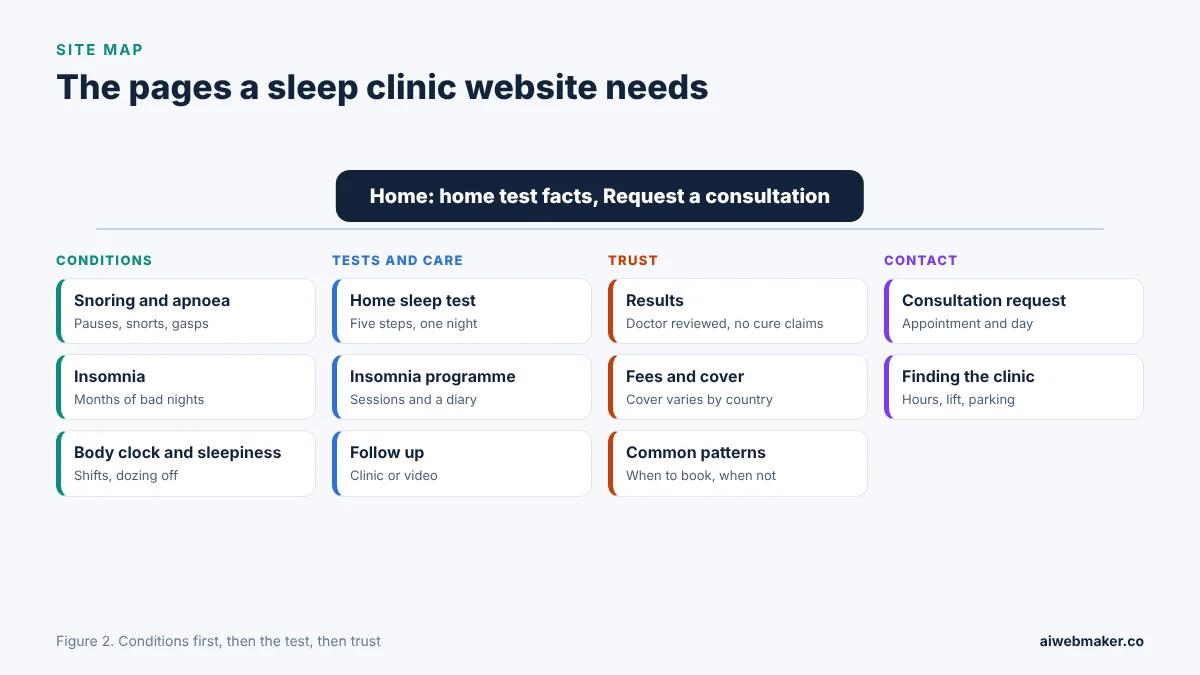
Grouped by purpose, a sleep clinic's pages form four clusters that follow the patient's questions. Condition pages carry snoring and apnoea, insomnia, and body clock problems with daytime sleepiness. Test and care pages describe the home sleep test, the insomnia programme and follow ups, while trust pages hold results, fees and common patterns. Our sample practice, Quiet Hours Sleep Clinic, fits all of this onto one calm page with condition cards for snoring, sleep apnoea, insomnia, restless legs, shift work and body clock and daytime sleepiness. Fee cards cover a first consultation, a home sleep test, an insomnia programme and a follow up; the sleep clinic website example with a home sleep test walkthrough ends with a consultation request and directions to the clinic.
Explaining the home sleep test before anyone wears the sensors
A home sleep test sounds daunting until someone describes it, so the walkthrough deserves as much care as any page on the site. The page should name each part of the kit: a finger clip that reads oxygen levels and pulse, a soft chest band that tracks breathing effort and a thin nasal tube that measures airflow. It should say how long the fitting takes and that the recorder runs by itself while the patient sleeps in their own bed. Returning the kit, scoring by a physiologist and review by a sleep doctor complete the sequence. The page also needs to be honest about limits, because home testing is mainly used to check adults for suspected sleep apnoea. Other conditions, or an unclear home result, usually call for an overnight study in a hospital or specialist sleep unit.
| Feature | Home sleep test | Overnight study in a sleep unit |
|---|---|---|
| Where the night is spent | The patient's own bed | A monitored room in a hospital or sleep centre |
| What is recorded | Airflow, breathing effort, oxygen levels, pulse, position | The same, plus brain waves, eye and muscle activity and video |
| Usually used for | Suspected sleep apnoea in adults | Unclear home results, suspected narcolepsy, complex cases |
| Staff present overnight | None | A technologist through the night |
| Points to consider | Easy to arrange, no brain activity measured | A fuller picture, but waiting lists |
Fees, insurance cover and referral letters across different health systems
Patients hesitate to book anything medical when they cannot guess the bill, so each appointment needs a visible price and a plain account of its contents. A first consultation can name its length, who leads it and the questionnaires involved, such as a sleepiness scale. The home test price should say whether the kit, the scoring and the results appointment are included. Insurers and public health schemes treat sleep testing very differently from one country to the next, and some want a letter from the patient's own doctor before they contribute. The page should say so in a sentence, invite patients to check their own policy and offer an itemised receipt. A short line on moving an appointment, with the notice the clinic needs, prevents arguments at the desk.
| Appointment | What the price should include | Line worth adding |
|---|---|---|
| First consultation | Length, clinician, questionnaires, written plan | Whether a referral letter is needed |
| Home sleep test | Kit, fitting, scoring and results appointment | What happens if the recording fails |
| Insomnia programme | Sessions, sleep diary, therapist's role | Whether sessions run by video |
| Follow up | Length, in person or by video | The same doctor where possible |
| Moving an appointment | The notice the clinic asks for | Any fee for late changes |
Careful wording about apnoea treatment, CPAP and insomnia therapy
Treatment pages are where a sleep clinic's honesty is tested, because tired people want a promise and responsible clinicians cannot give one. CPAP is best described as keeping the airway open while the mask is worn, which treats apnoea night by night rather than curing it. Dentist made mouth guards, changes in sleeping position and general advice on alcohol can be listed as options, each with limits. For long running insomnia, many clinical guidelines recommend cognitive behavioural therapy as the first approach, built on a sleep diary and small weekly changes. Sleeping tablets deserve a balanced line about short courses, side effects and sharing any prescription with the patient's own doctor. Rules on health advertising and testimonials differ by country, so words such as cure or guaranteed belong nowhere on the site.
Drowsy drivers, snoring children and when to send a reader elsewhere
A responsible sleep practice tells some readers that its request form is not the right place for them. Anyone who feels drowsy at the wheel should be told plainly to stop driving and speak to a doctor soon. In some countries a driver diagnosed with certain sleep conditions must inform the licensing authority, so the page can say that the doctor explains what applies locally. A clinic that sees adults only should send parents of a child who snores loudly or seems to stop breathing to the child's own doctor. Insomnia that arrives with very low mood or thoughts of self harm needs a doctor or a crisis line first. Clear signposting protects patients and keeps the request list for problems the clinic can actually assess.
| Situation | Where the page should point the reader |
|---|---|
| Drowsiness while driving | Stop driving and see a doctor soon |
| A child who snores loudly or stops breathing in sleep | The child's own doctor |
| Chest pain, sudden breathlessness or collapse | The local emergency number |
| Very low mood or thoughts of self harm | A doctor or a local crisis line, without waiting |
| Questions about current medicines | The prescribing doctor or a pharmacist |
How a consultation request reaches the clinic and gets answered
The request should feel like a small step, because tired readers abandon anything resembling paperwork. On the booking builder, the patient sends a request for the appointment they need, and the clinic decides what happens next. Reception may approve that request, shift it to a better hour in the diary or refuse it, and the patient pays the clinic directly, while the platform claims no part of that fee. The booking website builder for sleep clinics and their appointment requests places that request beside the condition and test pages, and nothing is billed while the clinic drafts and previews them. A note beside the form should ask patients not to send detailed medical history, since many countries protect health information by law, the European Union among them. A promise to reply within a stated number of working days sets expectations honestly.
Words typed by people who cannot sleep or cannot stop snoring
People looking for help type phrases such as sleep clinic near me, sleep apnoea test, home sleep study, snoring clinic or help for insomnia, often adding a district. Spelling varies by country, so a page can use both apnoea and apnea where it reads naturally. Each condition card and the home test section should carry the patient's own words in its heading. The map listing should show evening hours and step access, and replies to reviews should never confirm that a reviewer is a patient, because confidentiality rules in many countries forbid it. Articles on what a night with the kit feels like or how snoring differs from apnoea give tired readers something useful. Calm, accurate writing earns the trust that a busy waiting list depends on.
The annual outlay behind a sleep practice's pages
A sleep practice's recurring website bill is hosting plus the domain, with twelve articles from AI credits adding less than eight dollars. Yearly billing at $119 suits a clinic with a settled patient list. A newer practice still gathering referrals might rather pay $19 each month. Changing fees, adding an evening clinic or updating a doctor's profile is not charged. Yearly and monthly columns sit side by side below, and the $189 tier is listed purely as a reference point.
| Item | Yearly | Monthly |
|---|---|---|
| Hosting the sleep clinic pages | $119 | $228 over twelve months |
| Domain | Depends on the ending | Depends on the ending |
| Higher plan, for comparison | $189 a year | Not needed |
| Twelve sleep health articles at about $0.65 | About $7.80 | About $7.80 |
| Fee, hours and clinician updates | No charge | No charge |
| Year before the domain | About $126.80 | About $235.80 |
Gaps that make a sleepless reader close the tab
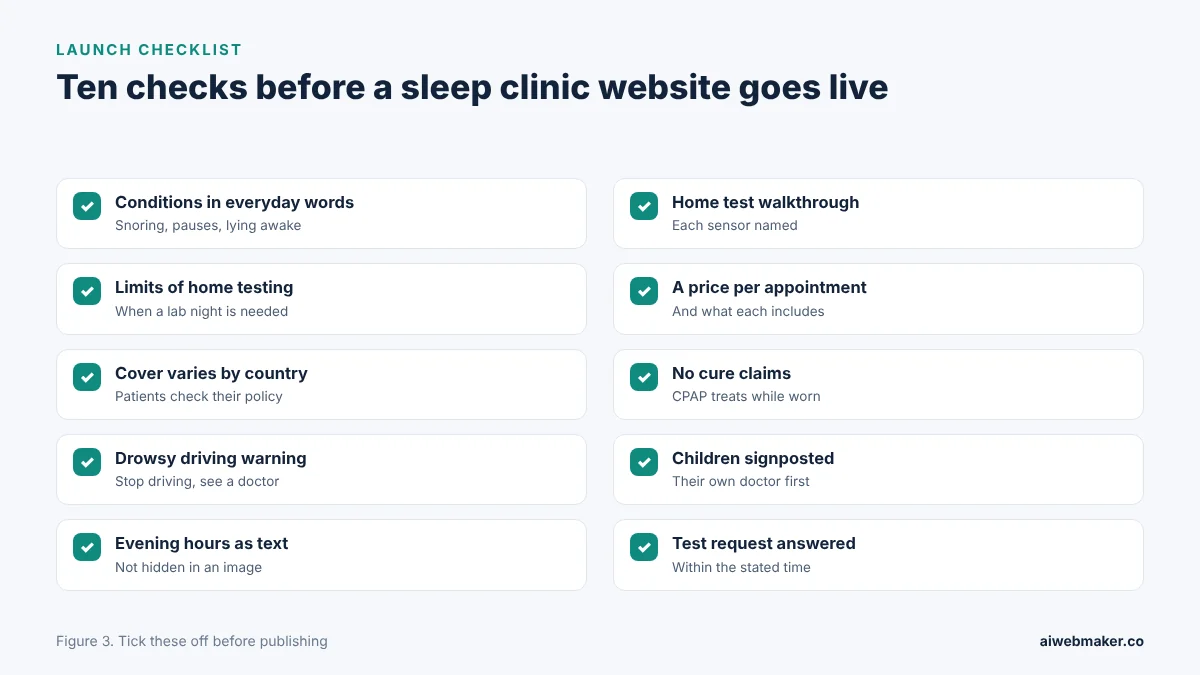
A sleepless reader leaves a clinic's website quickly when conditions are described only in clinical terms they do not recognise. A home test with no explanation feels like an ordeal, and a fee section that says only contact us suggests a frightening bill. Treatment pages that promise a cure make careful patients doubt everything else on the site. Missing evening hours lose people who work through the day, and a form that demands a full medical history feels intrusive in the small hours. No word on drowsy driving or on where children should go leaves gaps that a responsible clinic must close. Ten checks that close those gaps fill the next figure.
Frequently asked questions
Does a patient need a referral letter before a sleep consultation?
Many sleep clinics accept patients directly, while others, like many insurers and public schemes, want a referral from the patient's own doctor first. The rule depends on the country, the health system and the individual policy, so the website should state the clinic's own position plainly. Patients can still be asked to bring a list of current medicines. A line asking them to check their cover before the first appointment avoids disappointment at reception. Clear guidance on referrals removes a common reason for a delayed booking.
Can a home sleep test replace a night in a sleep laboratory?
For many adults with suspected sleep apnoea, a home test gives the doctor enough information to decide on the next step. It records breathing, oxygen levels and pulse but not brain activity, so it cannot assess every sleep disorder. Suspected narcolepsy, unusual behaviour during sleep or an unclear home result usually need an overnight study in a sleep unit. The website should explain this so that nobody feels misled if a second test is recommended. Honest limits make the home test more credible, not less.
Are patient reviews appropriate on a sleep clinic site?
Reviews can reassure new patients, but rules on testimonials in health advertising differ by country and some regulators restrict them. Where they are allowed, reviews should describe the experience, such as a clear explanation, rather than claiming that a treatment works. Consent comes before publishing any patient's words, and no condition details should be added. Replies on map listings should stay general and never confirm that the reviewer was seen. Careful handling of reviews protects both privacy and the clinic's standing.
Should health questions sent through the request form be answered by message?
The request form is best kept for arranging appointments rather than giving medical advice in writing. A short reply can confirm the slot and invite the patient to raise their questions at the consultation, where a clinician has the full picture. Anything that sounds urgent, such as chest pain or breathing trouble while awake, should be met with a reply pointing to the patient's own doctor or the emergency number. The note beside the form can say this in advance. Clear boundaries keep patients safe and keep reception out of clinical decisions.
Consultations needed before the pages pay for themselves
The fee for one first consultation is usually larger than the $119 a sleep clinic spends on a year of hosting. Spread across monthly bills, $19 is smaller than almost any appointment fee a sleep clinic charges. Every home test that follows, and every insomnia programme that runs its full course, is work the site helped arrange. Plain condition cards, an honest test walkthrough and visible fees persuade tired readers better than any slogan. A clinic that keeps these pages accurate gives worried partners a page they can forward with confidence. An evening list filled with first consultations shows the pages are reaching the right readers.
Build your website in Minutes and get the AI Tools that work
Start Building Your Website →