Plastic Surgeon Website Cost and the Case for Saying Less
A plastic surgery practice's website costs $119 across a hosting year, or $19 in each month, and a domain besides. Topics: who researches surgery, the consultation, procedures, quotes, recovery, registration and photos, search and the yearly sums.
- No coding required
- Live in minutes
- Blog, SEO and chatbot tools included
Hosting a plastic surgery practice's website is billed as $119 once a year or as $19 every month, and the practice buys its own domain on top. Procedure pages, the fee table and recovery guides can be refined in preview for weeks without AI Web Maker charging anything. A single consultation fee goes a long way towards the year, and one procedure covers it many times over. What makes surgical marketing difficult is that the most valuable patients are the most cautious ones, reading slowly for any sign of pressure, hidden risk or promised result. A website that leads with the consultation and names risks plainly earns their trust, while a glossy sales page loses it. In turn, this piece looks at who researches surgery, the pages, the consultation and reflection period, procedures and funding, quotes, recovery and risks, registration and photos, search, yearly sums and what loses a cautious patient.
This article is part of our complete guide: Healthcare Website Builder.
Who researches surgery late at night, and what are they looking for?
People considering plastic surgery often research for months, and they read a practice's website looking for reasons to trust or doubt it. Some want a cosmetic change, such as eyelid surgery or a tummy tuck after pregnancy or major weight loss. Others seek functional relief, such as a breast reduction for back and shoulder discomfort or eyelid surgery that clears the field of vision. Reconstructive patients, including people facing breast reconstruction or skin cancer removal, need calm, detailed information alongside their wider care team. Family members often read the same pages, looking for signs that the practice is careful. All of them look for who will operate, what can go wrong and what the whole journey will cost.
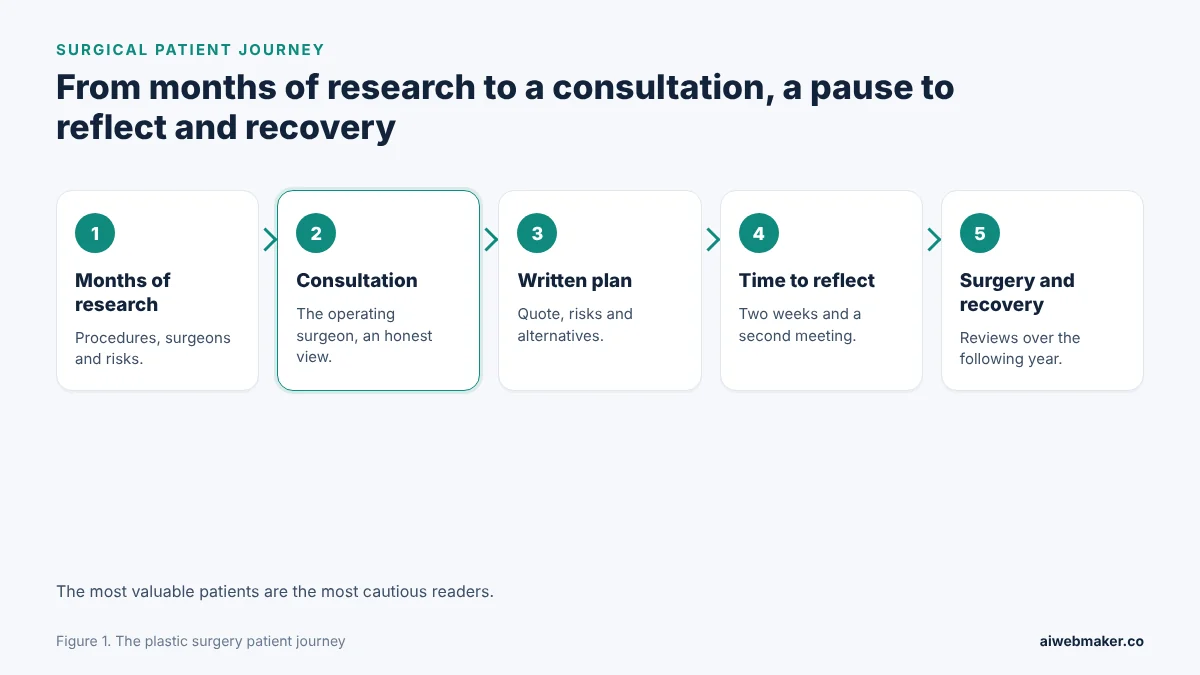
The consultation is the step this journey singles out, because it is where months of research meet a real surgeon and an honest opinion. Research begins with a concern and a search, often late in the evening, comparing practices and procedures. A website that names its surgeons, describes the consultation and sets out risks and fees earns the request. The consultation brings a written plan and quote, followed by time to reflect and often a second meeting. Surgery comes only after that pause, with recovery support and reviews over the following months. Every page should help a patient move through this path without feeling hurried.
Pages that lead with the consultation, not the procedure list
A plastic surgery website should lead with the consultation, because patients need to understand the process before they can judge any procedure. A procedures page groups operations the way patients ask about them, with what each changes and the usual stay. A fees page states what each quote includes, and a recovery page sets out the stages after surgery. A surgeons page shows training, areas of work and registration. Questions and the consultation request complete a site that informs rather than persuades.
| Page | What patients look for | What it should hold |
|---|---|---|
| Consultation | Who they will meet and what happens | Length, examination, written plan, reflection period |
| Procedures | Whether surgery fits their concern | What each changes, usual stay, alternatives |
| Fees | The whole cost | Surgeon, anaesthetist, hospital, reviews |
| Recovery | Life after surgery | Stages, time off work, advice line |
| Surgeons | Who operates | Training, areas of work, registration |
| Request | A first appointment | Area to discuss, surgeon, day |
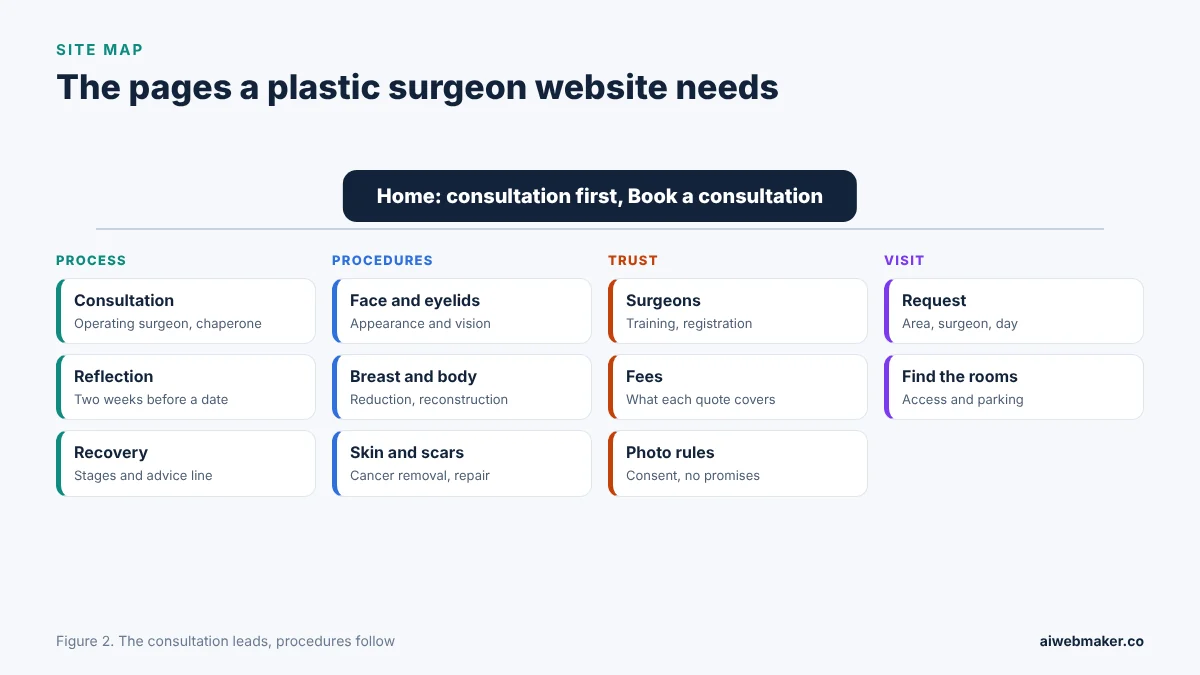
Branch by branch, this surgical site keeps the consultation, the risks and the fees in the same view as the procedures. The process branch holds the consultation, the reflection period and the recovery stages. The procedures branch groups face, breast, body and skin work, with reconstructive surgery given equal weight. The trust branch introduces the surgeons, their registration and the rules on photos, while the final branch holds the consultation request and the way to the consulting rooms. Our sample practice, Halden Plastic Surgery, lists eyelid surgery, nose reshaping, breast reduction, breast reconstruction, a tummy tuck and skin cancer and scar repair, and builds around them a consultation section, a guide fee table, recovery in stages, a surgeons section, questions and a consultation request; the plastic surgeon website example with risks, fees and recovery puts the consultation before any procedure.
Two weeks to reflect: why the consultation comes first
The consultation page tells a reader that the practice cares more about the right decision than a quick booking, so it deserves the first place in the navigation. The appointment itself runs to roughly an hour with the surgeon who would operate, never a sales adviser. The surgeon asks about health, medicines, smoking and expectations, and examines the area with a chaperone present if the patient wishes. A written plan and quote follow, and a pause of at least two weeks before any surgery date, with a second consultation included, removes pressure. Using the booking website builder for plastic surgeons who start with a consultation, a patient requests a consultation about an area of concern on a chosen day. The practice agrees the slot, proposes the nearest time the surgeon has open or explains why it cannot help, and fees pass between patient and practice directly, with none going to AI Web Maker.
Cosmetic and reconstructive procedures, and who pays for each
Procedure pages should describe what each operation changes and the usual stay, never a promised result. Eyelid surgery and nose reshaping can serve appearance, function or both, and the page should say when breathing or vision is part of the reason. Breast reduction often relieves physical discomfort, while breast reconstruction is planned with the patient's breast care team. A tummy tuck is often considered after pregnancy or major weight loss, and skin cancer removal with repair is medical work first. Reconstructive surgery may be funded by a public health system or an insurer in some countries, so patients should check before paying privately. Grouping procedures this way helps every patient find their situation quickly.
| Procedure | Usual stay | What the page should explain |
|---|---|---|
| Eyelid surgery | Day surgery | Appearance, vision, scars in the crease |
| Nose reshaping | Day surgery | Shape, breathing, swelling that settles slowly |
| Breast reduction | Often one night | Relief of discomfort, scars, recovery |
| Breast reconstruction | Planned with the care team | Timing with other treatment, possible funding |
| Tummy tuck | One or two nights | Muscle repair, scar length, time off work |
| Skin cancer and scar repair | Often local anaesthetic | Removal, repair, revision of tight scars |
Quotes that name the surgeon, the anaesthetist and the hospital stay
A price without its contents invites suspicion, especially when sums are large, so the fees page should say exactly what a quote covers. A guide figure per procedure, alongside the usual stay, lets readers budget while knowing the written quote follows the consultation. The quote itself can cover the surgeon, the anaesthetist, the hospital stay and reviews for a set period. Medicines to take home and support garments are often listed separately, and the page should say so. Any payment arrangement is agreed directly with the practice before surgery. Itemised, illustrative fees help readers plan without mistaking any number for a final bill.
Recovery in stages, risks in plain words
Patients worry about the weeks after surgery as much as the day itself, so recovery deserves a staged outline. The day of surgery involves meeting the anaesthetist, the operation and rest, with someone to take the patient home and stay overnight. The first week brings rest, gentle walking and a dressing check, and weeks two to six a gradual return to work. Reviews at around six weeks, three months and a year follow, because swelling and scars keep changing for months. Every operation carries risks, including bleeding, infection, poor healing, scarring, changes in sensation and the effects of anaesthetic, and each procedure has its own. Heavy bleeding, chest pain or trouble breathing should be treated as an emergency, with the patient ringing the local emergency number at once.
| Stage | What usually happens |
|---|---|
| Day of surgery | Anaesthetist, operation, rest, someone to stay overnight |
| First week | Rest, gentle walking, a dressing check |
| Weeks two to six | Gradual return to work, no heavy lifting yet |
| Around six weeks | Review of healing and scars |
| Three months to a year | Further reviews as swelling settles |
Specialist registration, results photos and advertising limits
Registration and advertising rules for medical practitioners vary by country, so a careful surgical website states what applies and invites patients to check. Each surgeon's page can name their specialist training and areas of work, and the practice can show registration details at every consultation. Patients should be encouraged to verify registration with the medical regulator where they live. Before and after photos are tightly controlled in many places, and many careful practices keep them for the consultation, shown only with consent and never as a promise. Cosmetic procedures are commonly restricted to adults, and the page should state the practice's own age policy. Being this precise about who operates protects patients first and the practice's standing second.
Eyelid surgery, breast reduction, scar revision: searches by procedure
Patients search by procedure and place, typing phrases such as eyelid surgery, breast reduction consultation, tummy tuck recovery or skin cancer removal with a city name. Searches for a named surgeon are common too, so each surgeon deserves a clearly worded profile. The map listing for a surgical practice benefits from the correct medical category, accurate consulting hours and photos of the consulting rooms rather than bodies. Reviews that describe an unhurried consultation, honest advice and careful aftercare carry far more weight than comments on appearance. Articles on recovery, choosing a surgeon or what a consultation involves reach patients early in their research. Steady, factual writing positions the practice as a source of information rather than a seller of procedures.
Hosting a surgical practice for a year, in four lines
A surgical practice's website year comes down to hosting, the domain and, if wanted, about $7.80 of article credits for twelve recovery guides. A practice planning to stay online for years settles $119 in one payment. One that prefers small, predictable amounts can pay $19 monthly instead. Adding a surgeon, a procedure or a revised fee changes nothing on the bill. The $189 tier appears purely for reference.
| Item | Yearly | Monthly |
|---|---|---|
| Hosting the practice pages | $119 | $228 over twelve months |
| Domain | Depends on the ending | Depends on the ending |
| Higher plan, for comparison | $189 a year | Not needed |
| Twelve recovery guide articles at about $0.65 | About $7.80 | About $7.80 |
| New surgeons, procedures and fees | No charge | No charge |
| Year before the domain | About $126.80 | About $235.80 |
Countdown offers and nameless surgeons: why careful readers leave
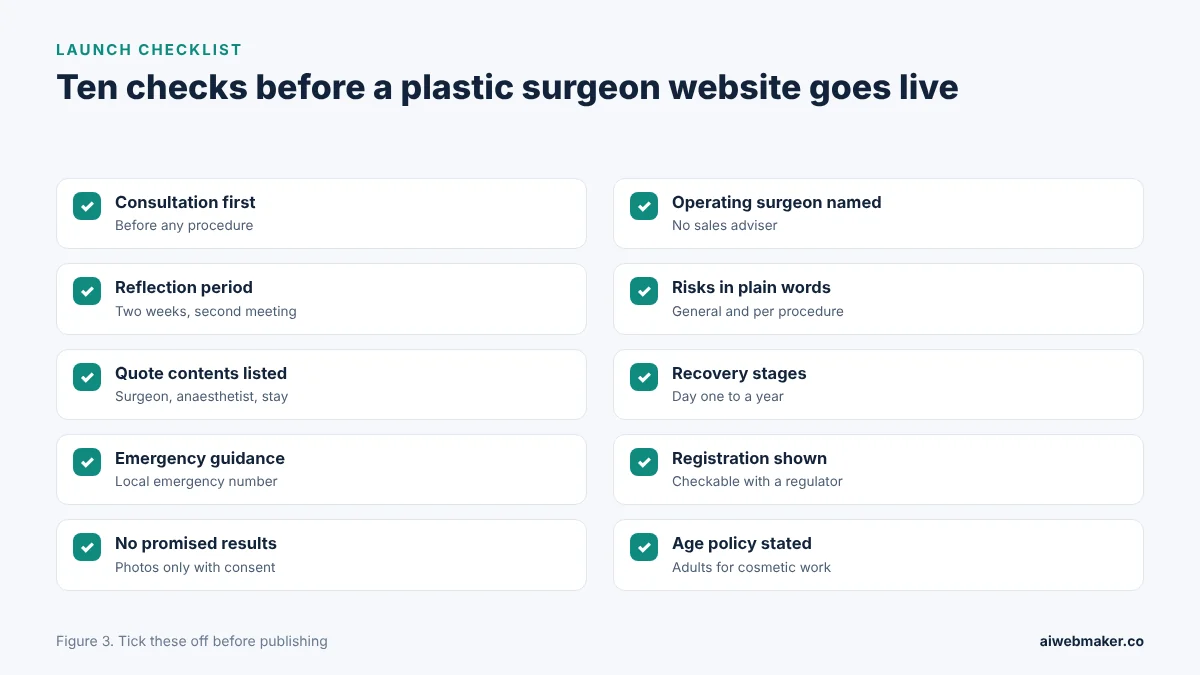
Cautious patients leave a surgical website the moment it promises a result or shows a discount with a deadline. Pages that never name the operating surgeon suggest the patient may meet someone else on the day. Risks hidden in small print, or left out entirely, tell a careful reader the practice cannot be trusted. Fees shown without their contents make every figure feel like a hook. A request form that pushes for a surgery date before any consultation confirms the worst fears. Each of those losses is avoidable, and the ten checks in the following figure show how.
Frequently asked questions
How long should someone wait between consultation and surgery?
Many careful practices build in a reflection period of at least two weeks between the first consultation and any surgery date. That pause lets patients read their written plan, think about the risks and ask further questions. A second consultation before surgery is a common and sensible step. Professional guidance in some countries recommends such a period for cosmetic procedures, though rules vary. A website that explains the pause shows patients the practice values the right decision over a quick one.
Are results photos allowed on a practice's pages?
Whether results photos may appear online depends on the advertising rules for medical practitioners where the practice operates, and those rules vary by country. Plenty of surgeons reserve them for the consulting room, where a past patient's written permission and a frank talk about risk come first. Any photo should be presented as one person's outcome rather than a promise. Retouched or selectively chosen images can mislead and may breach local rules. Careful handling of photos protects patients and the practice's reputation.
Is reconstructive surgery ever publicly funded?
In some countries, reconstructive surgery such as breast reconstruction after mastectomy or skin cancer repair may be funded by a public health system or covered by insurance. Rules differ widely, and purely cosmetic procedures are rarely funded. Patients should check with their own health system or insurer before paying privately. The procedures page can note this possibility without promising any outcome. Clear guidance helps patients make the right financial decision for their situation.
What should a patient do if something feels wrong after surgery?
Patients should contact the practice's advice line or nurse team if a wound, pain or swelling worries them after surgery. Heavy bleeding, chest pain or difficulty breathing count as emergencies, so the patient should call for emergency help straight away instead of phoning the practice. The website should list the advice line's hours and explain these differences on the recovery page. Written recovery guides for each procedure help patients recognise what is normal. Clear instructions give patients confidence during the weeks at home.
Would one eyelid operation fund the practice's site for years?
One eyelid procedure is worth many times the $119 a practice needs for twelve months of hosting, and the consultation fee alone outweighs a month at $19. Every patient who reads the consultation page, studies the risks and requests an appointment arrives better prepared for an honest conversation. Those patients are more likely to accept careful advice, including advice to do less or not to operate. Reviews from well informed patients then strengthen the practice's reputation for years. Practices that keep their surgeons, fees and recovery guides current receive calmer and more serious requests. Consultations booked by patients who already understand the risks are the most valuable return the pages can bring.
Build your website in Minutes and get the AI Tools that work
Start Building Your Website →