Physical Therapy Website Cost and a Clear Path for Self Referrals
Physical therapy clinics settle hosting with $119 per year or $19 in every month, choosing a domain separately. Also covered: who seeks care, referrals, sessions by condition, first visits, payment, credentials, urgent symptoms, search and costs.
- No coding required
- Live in minutes
- Blog, SEO and chatbot tools included
For a physical therapy clinic, AI Web Maker hosting costs $119 across a full year or $19 on a monthly basis, with a domain chosen separately. The session list, the first visit page and the team profiles can be drafted and read through in the preview, and nothing is charged during that stage. One new patient completing a course of sessions typically covers the year several times over. Bookable sessions and recovery goals come together on the physical therapy clinic website sample, an invented practice's complete AI Web Maker site and one worth studying before you draft your own. The real challenge is that people in pain are unsure whether they may book without a referral, worried about cost and often reading on a phone with limited patience or mobility. A clinic website has to answer those worries plainly and stay accurate, because health information carries more responsibility than most trades. This page then turns to who books, the pages a clinic needs, referrals, booking by condition, the first visit, paying, credentials, urgent symptoms, search and what a year online costs.
This article is part of our complete guide: Healthcare Website Builder.
Who looks for a physical therapist, and what stops them booking?
People looking for a physical therapist usually arrive with a problem rather than a diagnosis, such as a sore back, a stiff shoulder or a knee that will not settle. Some have been sent by a surgeon or doctor after an operation and need rehabilitation on a schedule. Others are runners and players who want to return to sport safely. Older adults and their families often look for help with balance and confidence after a fall. Many hesitate for practical reasons, unsure whether they need a referral, whether insurance will contribute or how much a session will cost. A clinic site that removes those doubts helps people start care sooner.
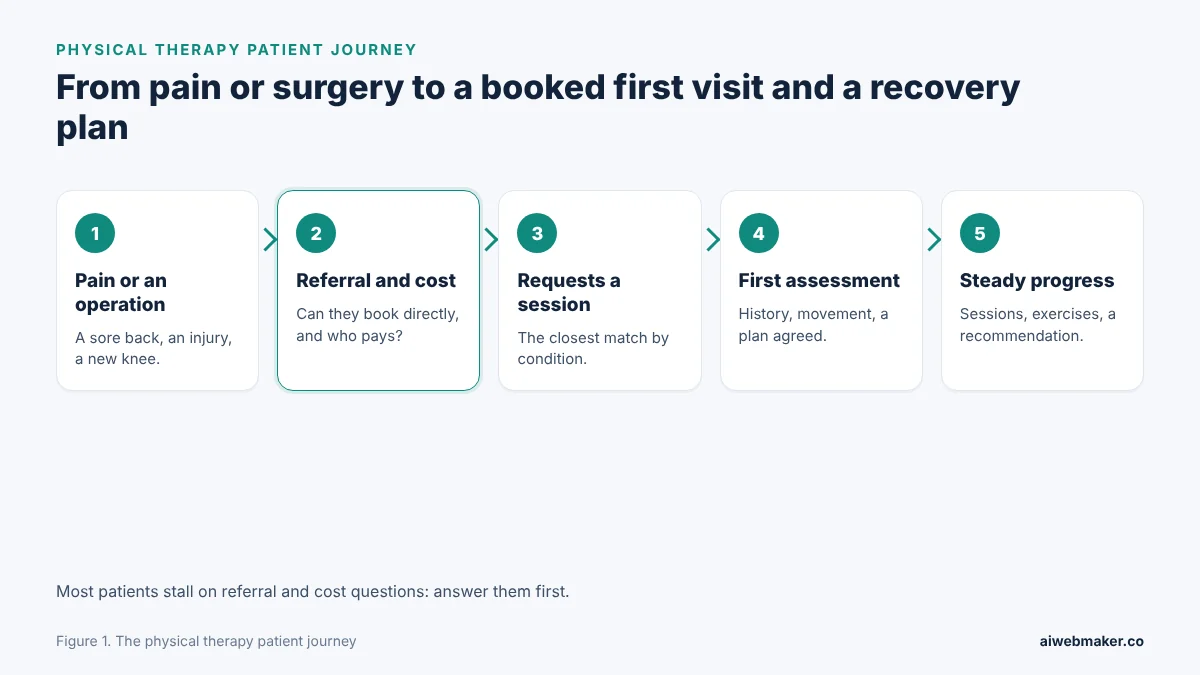
Referral and cost questions carry the highlight here, since that is where most people stall before booking. Pain, an injury or a recent operation starts the search. The patient then checks whether the clinic treats their kind of problem and whether they can book directly. A request for a first visit follows, often for the session that most closely matches their situation. Assessment and a treatment plan come next, and steady progress through that plan is what earns a recommendation to friends and family. No patient in pain should have to hunt for the answer that moves them to the next step.
Pages a clinic needs before the first patient books online
A clinic website needs pages that explain the care honestly and the practical steps clearly, without promising outcomes. The home page should say what the clinic treats, where it is and how to request a first visit. A sessions page lists the bookable appointments by condition, each with a price. A first visit page explains the assessment, while a referrals and payment page answers the questions that delay most bookings. A team page, an accessibility and location page and a contact page complete the set.
| Page | Patient question | What it should hold |
|---|---|---|
| Home | Can this clinic help with this problem? | Conditions treated, location, request a visit |
| Sessions | Which appointment fits? | Sessions by condition, each with a price |
| First visit | What happens at the assessment? | History, examination, plan, what to bring |
| Referrals and payment | Is a referral needed, and who pays? | Direct access, insurers, self pay, receipts |
| Team | Who will treat me? | Registration, training, areas of focus |
| Access and location | Can the clinic be reached easily? | Step access, parking, transport, lifts |
| Contact | How can a question be asked? | Phone, email, reply times |
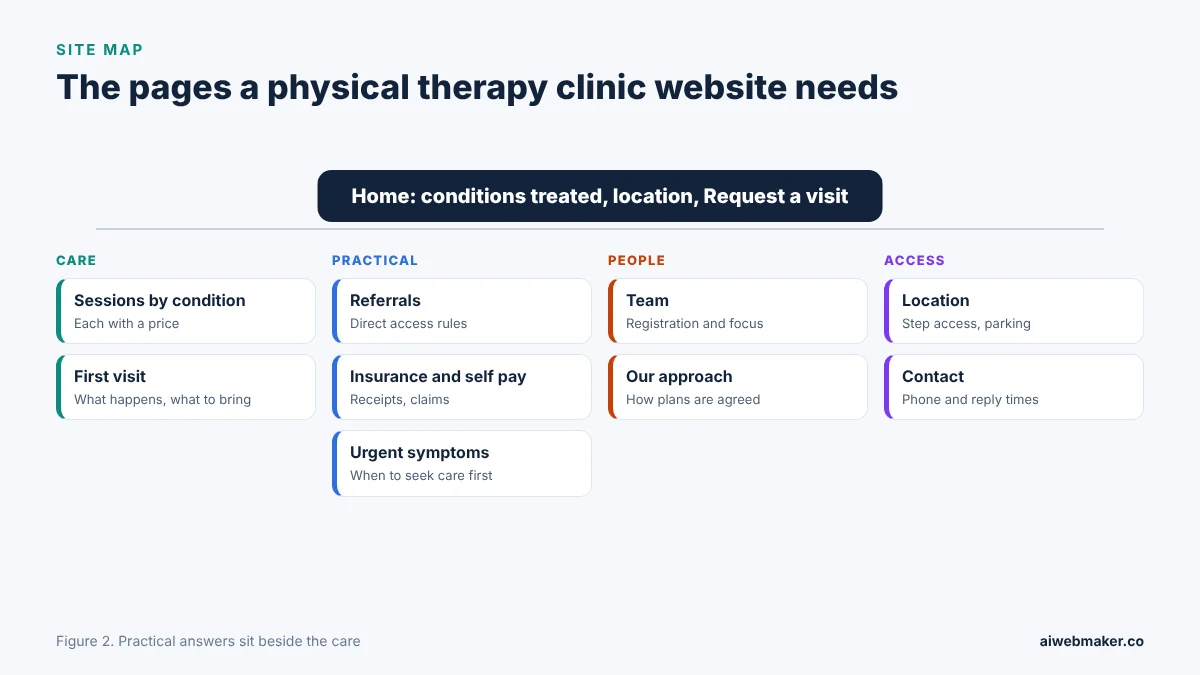
This site map groups the clinic's pages around the questions patients ask in the order they ask them. The care branch holds the sessions by condition and the first visit explanation. The practical branch covers referrals, insurance and self pay, which is where many patients decide whether to book. The people branch shows the team and the clinic's approach, while the access branch gives location, step access and contact routes. Our sample clinic, Steady Stride Physical Therapy, offers five bookable sessions, injury recovery, back and neck pain, rehabilitation after surgery, sports and activity, and balance and mobility, each shown with a price, and its services page includes a section on whether a referral is needed. A first visit page and a team page describing the clinic's care philosophy and the team's areas of focus and experience complete the physical therapy clinic website example with session requests, which was built in 49 seconds.
Referrals, direct access and the rules that differ by country
Direct access, meaning a visit to a physical therapist with no doctor's note, is decided country by country, sometimes by state or province, and often by the insurer. In many places patients may book directly, while some insurers or public health systems still require a referral before they contribute. The title itself varies too, with physical therapist common in some countries and physiotherapist in others. A clinic should explain its own position in plain words, so a patient knows at once whether they can request a visit today. Patients recovering from surgery should follow their surgeon's guidance, and the clinic can say how it works with surgical teams. Accurate referral information is one of the most useful paragraphs a clinic can publish.
| Situation | What the page should explain |
|---|---|
| Booking directly | Whether patients can book without a referral |
| Insurer requires a referral | Which insurers, and what document to bring |
| After surgery | Working with the surgeon's plan and timing |
| Workplace or accident claims | Paperwork the claim may need |
| Public health referrals | Whether the clinic accepts them, where relevant |
| Not sure | A phone number to ask before booking |
Booking by condition, with requests the clinic confirms
Patients describe their problem, not a clinical treatment name, so sessions named by condition make choosing far easier. A patient with a stiff neck recognises a back and neck session immediately and can request it without phoning. The patient chooses a session and a preferred time and sends the request, which the clinic can approve, reschedule or decline if no therapist is available. Payment, whether self pay or an insurer's share, is arranged between the clinic and the patient, and the platform takes no percentage. The booking website builder for physical therapy clinics with session requests sets up the sessions, the first visit page and the team page after the clinic outlines its services in a few lines. Since nothing is fixed until the clinic confirms it, a patient can be moved to a more suitable session before the visit.
History, movement tests and the documents to bring
A first visit page reduces anxiety by describing the assessment step by step, without suggesting any particular diagnosis. It can explain that the therapist will ask about the problem, past injuries, general health and goals, then examine movement and strength. Patients want to know how long the visit lasts, what to wear so the affected area can be assessed, and whether treatment starts on the same day. Bringing a referral letter, scan reports, a list of medicines and insurance details saves time at the desk. The page should also say that the treatment plan is agreed with the patient and reviewed as they progress. Clear expectations help patients arrive calm and prepared.
| Before the visit | Helpful detail to give |
|---|---|
| Length | How long the first assessment usually takes |
| Clothing | Loose clothes that allow the area to be seen |
| Documents | Referral letter, scan reports, medicine list |
| Insurance | Policy details and any approval needed |
| Questions | Goals and concerns to raise |
| Afterwards | How the plan and later sessions are agreed |
Self pay, insurance and a price beside each session
Patients paying for themselves usually appreciate seeing a price beside each session before they book. Patients claiming through insurance need a different explanation, such as which insurers the clinic works with, whether it bills them directly and what receipts it provides. Rules on insurance, public funding and workplace claims vary between countries, so the page should describe the clinic's own arrangements rather than general promises. A note on cancellation notice protects therapist time without surprising patients. Clear payment information reduces the questions reception answers every day.
| Payment route | What to explain |
|---|---|
| Self pay | Price per session, how payment is taken in the clinic |
| Private insurance | Insurers accepted, direct billing or receipts |
| Workplace or accident claims | Paperwork and approvals |
| Public funding | Whether the clinic accepts referrals under it |
| Cancellations | Notice needed and any charge |
Registration, training and what the team page should show
A team page helps a patient comparing clinics by showing who will treat them, how they are qualified and what they focus on. Many countries protect the professional title and require registration with a regulator, so stating registration details where they exist lets patients check them. Areas of focus, such as sports injuries, rehabilitation after surgery or balance in older adults, help patients match themselves with a therapist. Some regulators restrict how health services may use patient testimonials in advertising, so the clinic should check the rules before publishing any. Health privacy rules also apply to anything a patient shares through the website, for example HIPAA in the United States and GDPR in the European Union. Accurate, modest team profiles build more trust than claims of guaranteed results.
When physical therapy is not the first stop
A responsible clinic website explains that some symptoms need urgent medical care rather than a physical therapy appointment. Sudden severe pain after a serious fall or accident, new numbness or weakness, loss of bladder or bowel control, chest pain or unexplained swelling are examples that should send someone to emergency services or a doctor first. The page should give the local emergency number where it serves patients in one country, or advise contacting local emergency services where it does not. Therapists can still help later, once a doctor has assessed the problem. Safety signposting is part of good care, not a sign of weakness in the service.
Phrases patients search, and pages everyone can use
People hunting for treatment online tend to enter phrases such as physical therapy near me, physio for back pain, sports physiotherapist or rehabilitation after knee surgery, often with a town. Session pages headed with those exact phrases meet the search halfway, while the map listing should show hours, step access and a link to request a visit. Many visitors are in pain or have limited mobility, so large text, strong contrast and easy buttons matter, and the US Department of Justice publishes guidance on web accessibility that explains why accessible websites matter for businesses serving the public. Other countries set their own accessibility rules, but the practical steps are much the same everywhere. Reviews, where the clinic's regulator permits them, should mention care and communication rather than promised cures. General education articles, such as how a first assessment works, attract readers without offering diagnosis.
The clinic's website bill over a year
Hosting plus a domain is the whole recurring bill for a clinic site, and neither grows as the patient list grows. A yearly payment of $119 covers hosting, while $19 monthly helps a practice that has only just opened its doors. Patient education articles drafted with AI credits cost around $0.65 apiece, though each should be reviewed by a clinician before it goes live. Adding sessions, updating prices or introducing a new therapist adds nothing to the bill. Both billing routes are shown, with the $189 tier present only for comparison.
| Item | Yearly | Monthly |
|---|---|---|
| Hosting the sessions, first visit and team pages | $119 | $228 over twelve months |
| Domain | Depends on the ending | Depends on the ending |
| Higher plan, for comparison | $189 a year | Not needed |
| Twelve patient education articles at about $0.65 | About $7.80 | About $7.80 |
| Sessions, prices and team updates | No charge | No charge |
| Year before the domain | About $126.80 | About $235.80 |
What makes a patient in pain give up on a clinic's site?
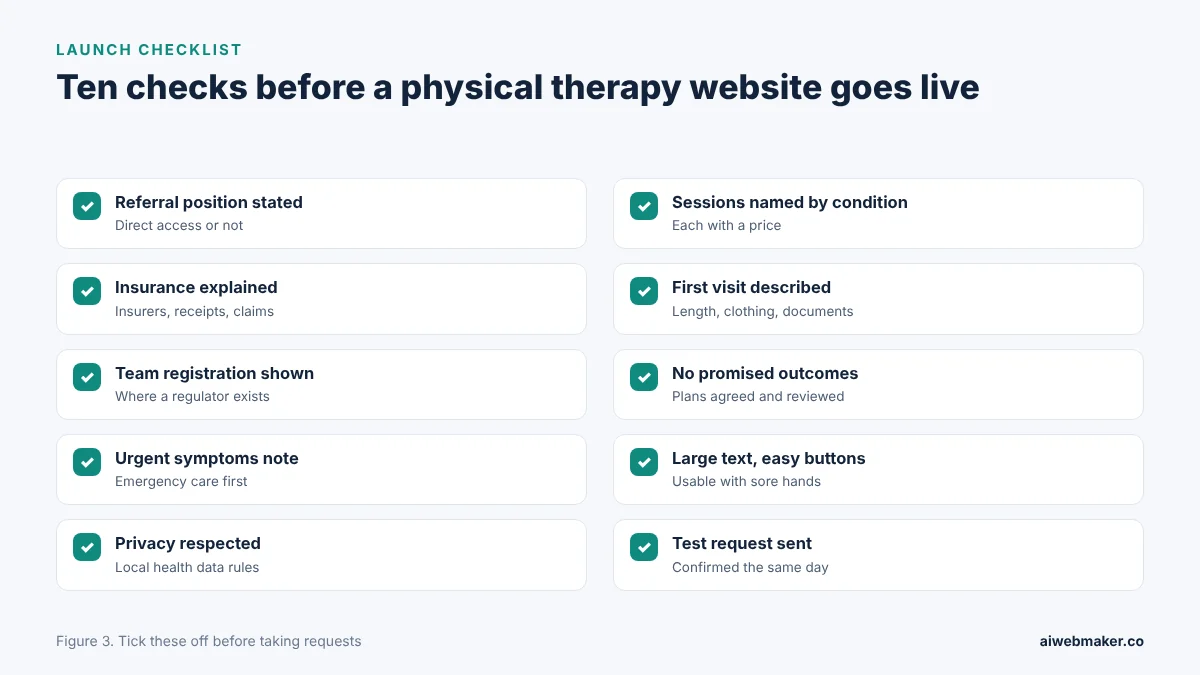
A patient in pain gives up when the site cannot tell them quickly whether they may book, what it costs and whether the clinic treats their problem. Without referral information, many people postpone the call they would need to make. No prices and no explanation of insurance leave people fearing an unknown bill. Tiny text and fiddly buttons defeat visitors with sore hands or poor eyesight. Team pages with no registration details make careful patients wonder who will treat them. The ten checks drawn in this image answer each of those concerns.
Frequently asked questions
Can patients book without seeing a doctor first?
Whether patients can book without seeing a doctor depends on local rules and on any insurer involved, and the clinic's own stance belongs in plain view. In many places patients may book a physical therapist directly. Some insurers and public systems still require a referral before they contribute to the cost. Patients recovering from surgery should follow the plan agreed with their surgeon. A phone number for questions helps anyone unsure before they request a visit.
What if a patient picks the wrong type of session?
A patient who picks the wrong session can simply be moved to the right one when the clinic reviews the request. Nothing is final until the clinic confirms it, so a close match is good enough. A short note on the sessions page inviting patients to choose the nearest option reassures those who are unsure. The first assessment then confirms the right plan, whatever was requested. This flexibility lets patients book quickly without worrying about choosing perfectly.
How many sessions does a patient usually need?
The number of sessions varies widely with the problem, its history and the patient's goals, so no honest clinic can give a single figure in advance. The therapist usually suggests a plan after the first assessment and reviews it as progress is made. Some patients need only a few visits and exercises to continue at home, while recovery after surgery can take longer. The website can explain how plans are agreed without promising a particular outcome. Clear, modest guidance builds more trust than a fixed number.
Can the clinic publish patient testimonials?
Whether a clinic can publish patient testimonials depends on the regulator and advertising rules where it works, and some places restrict them for health services. Where they are allowed, written consent from each patient is essential, and personal health details should be left out. Testimonials should describe the experience of care rather than promise results. Reviews on independent platforms follow their own rules. Checking the local requirements first protects both patients and the clinic.
New patients, full courses of care and the year's hosting
One new patient who completes a course of sessions generally outweighs a year of hosting at the $119 rate, and a single session covers a $19 month. Every patient who later recommends the clinic to a friend or relative adds to that return. Clear referral information, honest prices and a calm first visit page are what make people comfortable enough to book. Accessible pages and accurate team profiles keep that trust through a long course of care. Safety signposting shows patients that the clinic puts their wellbeing before a booking. Patients who arrive prepared and stay for the full plan show a website serving them well.
Build your website in Minutes and get the AI Tools that work
Start Building Your Website →