Pediatric Physical Therapy Website Cost and the Parents Who Read It
A pediatric physical therapy practice hosts its pages for $119 a year, or $19 a month, plus a domain. Covered: how parents choose, concerns and red flags, consent and safeguarding, registration and cover, requests, search and the yearly budget.
- No coding required
- Live in minutes
- Blog, SEO and chatbot tools included
For a children's physiotherapy practice, AI Web Maker hosting appears on the accounts as $119 a year, or as $19 a month, beside a domain chosen separately. The concern cards, fee panels and signposting can be rewritten in the preview until the clinicians are satisfied, with nothing billed by AI Web Maker along the way. One first assessment for one child usually exceeds the cost of the whole year. What makes the work delicate is the reader, a parent who is often anxious, comparing a toddler with other toddlers and afraid both of overreacting and of waiting too long. That parent needs concerns in everyday words, an honest line about what physiotherapy cannot do and clear signs that point to a doctor first. Below: how parents choose, the pages needed, concerns and red flags, consent and safeguarding, registration and cover, requests, search and the yearly budget.
This article is part of our complete guide: Healthcare Website Builder.
Worried parents, nursery staff and young athletes: who looks for a children's physio
Most visitors to a paediatric physiotherapy website are parents, and many arrive after someone else raised a concern. A health visitor or doctor may have mentioned a baby's head turning one way, or a nursery may have noticed a toddler who walks on tiptoe. Parents of school children often come because running, catching or riding a bike looks harder for their child than for friends. Teenagers with knee or heel pain from sport arrive with a parent who wants them back on the pitch without risking a growing body. Each family wants to know whether their concern belongs here, what an assessment involves and who stays in the room.
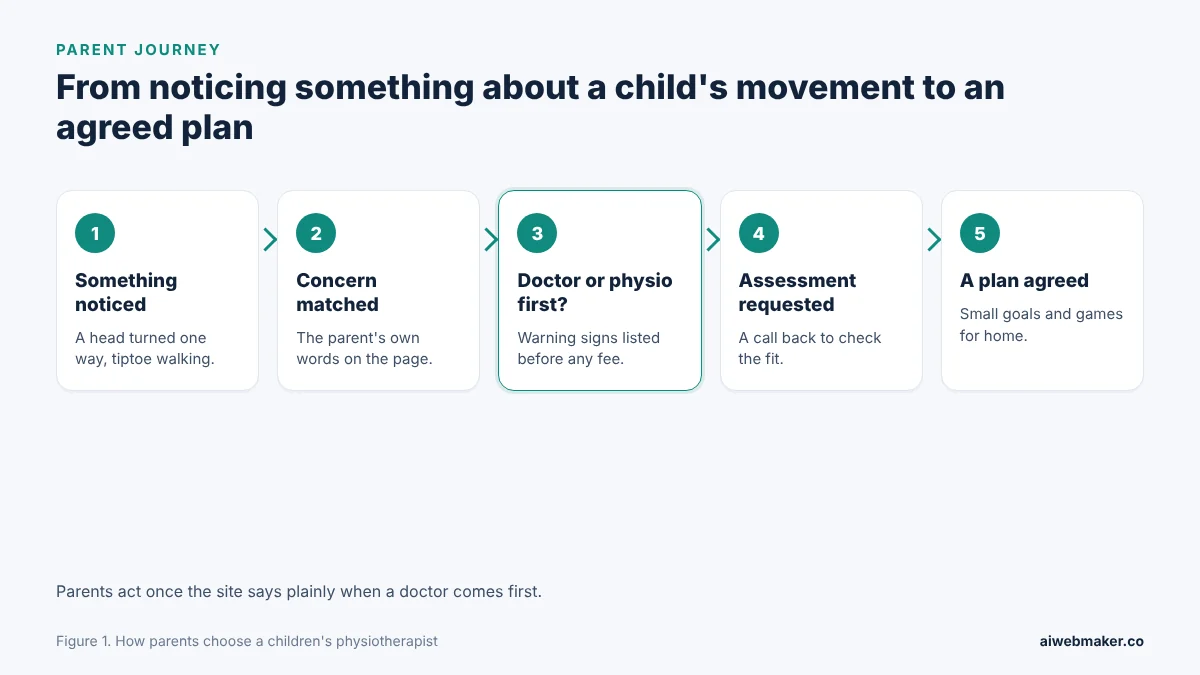
The third step in this journey is where a careful practice earns a parent's trust. Parents notice something, search the page for their own words, and only then ask whether a physio or a doctor should see the child first. A website that lists the warning signs needing medical attention, before any fee or form, shows that the practice puts the child ahead of the diary. The request follows, often with a call from a physiotherapist to check that the practice is the right fit. The final step is a plan the parent understands, with small goals and games for home.
Concerns, ages, fees and signposting: pages a children's practice needs
A children's physiotherapy site should be written for parents, with clinical words explained rather than used as headings. The home page should say which ages the practice sees and that a parent or carer stays for every session. A page of common concerns, in everyday words, helps a parent decide whether to get in touch. A sessions by age page, fees per appointment and a doctor first section make up the rest of the core. The request, the hours and directions with buggy access close the route.
| Page | Parent's question | What it should say |
|---|---|---|
| Home | Do you see children like mine? | Ages seen, parent present, a request button |
| Concerns | Is this worth an appointment? | Common reasons in everyday words |
| When a doctor comes first | Is this urgent? | Warning signs and where to go |
| Sessions by age | What will actually happen? | Play for babies, games for children, rehab for teenagers |
| Fees and cover | What will it cost? | Price per appointment, a note on insurance and public schemes |
| Request and visit | How do we start? | Appointment type, child's age, preferred times, access |
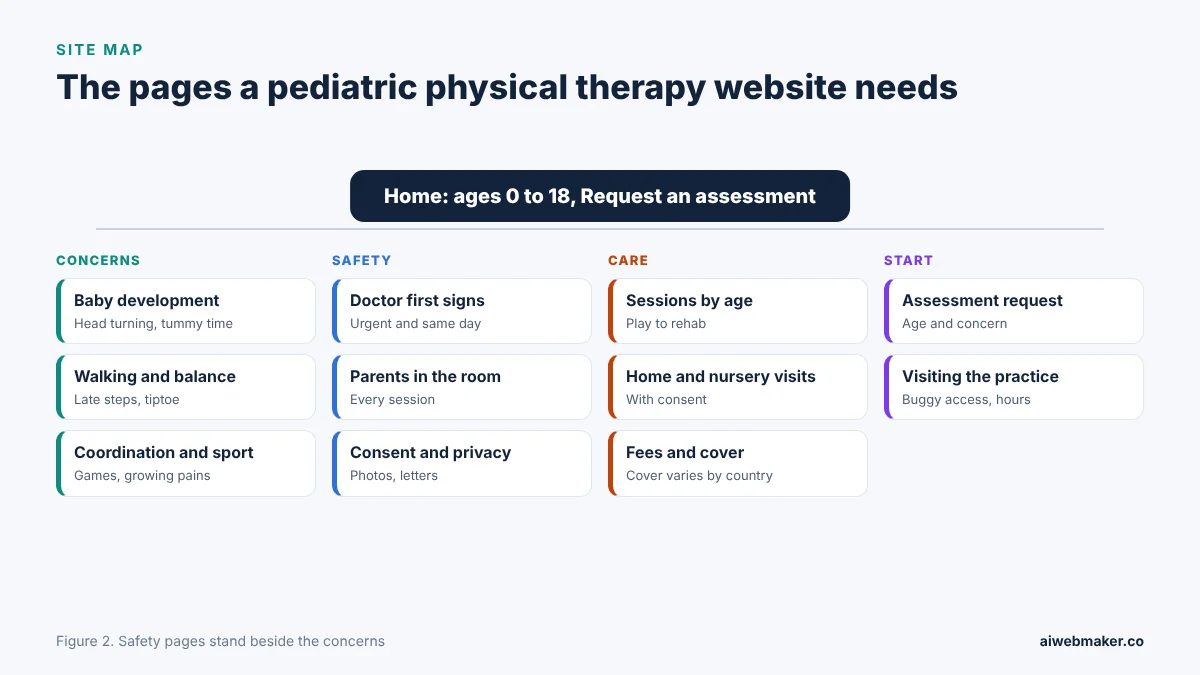
Concerns stand at the left of the plan, with safety pages beside them so that no parent reads about a service before seeing the warning signs. Care pages explain sessions by age, visits at home or nursery and the fees, and the start pages carry the request and the directions. Little Steps Physiotherapy, the invented practice behind our sample, lists Baby development, First steps and balance, Coordination and confidence, Sports injuries while growing, care After a fracture or an operation and Long term conditions. Its fee cards cover a First assessment, a Follow up session, a Home or nursery visit and a Young athlete check. The page puts an urgent note near the top, and the pediatric physical therapy website example with a parent in every session closes with a request for families.
Concerns written the way parents describe them
Parents rarely search for clinical labels, so each concern should be described in the words a family would use at the kitchen table. A baby who always turns their head one way, a toddler who walks on tiptoe and a child who avoids playground games are typical examples. Each card should say what the physiotherapist looks at and, just as clearly, what the practice cannot promise. Children develop at their own pace, and physiotherapy cannot cure a condition or set a date for a milestone. Pages that admit this sound more expert, not less, to the parents reading them.
| Parent's words | What the page can explain | Who else may be involved |
|---|---|---|
| Always turns their head one way | How positioning and play are assessed | The family doctor or health visitor |
| Walks on tiptoe most of the time | What is checked in walking and balance | The family doctor where other signs appear |
| Finds running and catching harder than friends | How coordination is observed through games | School staff, with the family's agreement |
| Knee or heel pain from sport | How growth and training load are considered | The coach, if the family wishes |
| Back to play after a fracture | Starting once the doctor or surgeon agrees | The treating hospital team |
Warning signs that come before any appointment
Some parents should be told not to book at all, and a responsible children's practice says so above every fee and form. A child who is badly hurt, struggling to breathe or hard to wake needs the local emergency number at once. A sudden limp with a fever, a hot swollen joint or pain that wakes a child at night needs a doctor promptly, as does a baby who stops moving an arm or a leg. Parents who are unsure should be told that asking a doctor first is never a wasted step. Listing these signs openly shows that the practice puts a child's safety ahead of filling appointments.
| Situation | Where to point the parent |
|---|---|
| Badly hurt, struggling to breathe or hard to wake | The local emergency number, straight away |
| A sudden limp with a fever | A doctor the same day |
| A hot, swollen joint or pain that wakes the child at night | A doctor before any physiotherapy |
| A baby who stops moving an arm or a leg | A doctor the same day |
| A baby who seems unwell or feeds poorly | The family doctor first |
Parents in the room, consent and safeguarding
Parents want to know who will be with their child, and the answer should appear on the first screen. A parent or carer present at every session, including home and nursery visits, reassures families and helps them learn the games that matter between appointments. Consent for assessment, for any photos or videos used in treatment and for letters to schools or doctors should be explained in plain words. Teenagers deserve a say too, and the page can describe how their views are heard while a parent stays close. Background checks for anyone working with children are required in many countries, though the details vary, and the practice can state that its clinicians meet the local requirements.
Protected titles, direct access and children's cover
In many countries only clinicians on a national register may call themselves physiotherapists, yet the regulator and its rules change from one border to the next. Naming the register that applies locally, and telling parents how to look a clinician up, turns a claim into something checkable. Some health systems let families book a physiotherapist directly, while others, or particular insurers, want a doctor's referral first. Public services and insurers treat children's physiotherapy very differently between countries, so the fee page should say that cover varies and invite parents to check their own scheme. A note that the practice writes to the child's doctor, with the family's agreement, shows it works inside the wider care around the child.
An assessment request and the phone call that follows
Parents often want to talk before committing, so the request page should explain what happens after the button. Families choose the appointment they need, and a physiotherapist calls back within a stated time to hear the concern. That call checks whether the practice is the right first step and points elsewhere when it is not. A line asking parents not to send detailed medical records with the request is wise, since health information about children is protected by law in many countries. A clear sequence turns a worried evening search into a booked assessment.
Through the booking website builder for pediatric physical therapy practices and family requests, the parent's choice of appointment reaches the practice as a request rather than a fixed slot. The practice may approve it, propose another hour or say no and point the family towards a better first stop, such as their doctor. Families pay the practice for each appointment directly, with AI Web Maker taking no portion. Concern, fee and signposting pages come from the same builder, drafted once the practice has summed up its work in a paragraph. Nothing is confirmed until a clinician agrees, which keeps unsuitable requests out of the diary.
Words parents type after a health check or a nursery chat
Parents search with phrases such as children's physiotherapist near me, paediatric physio, baby physiotherapy, toe walking help or physio for teenage sports injuries, often adding their town. Spelling differs, since pediatric physical therapy is the usual term in the United States while paediatric physiotherapy is common in Britain and elsewhere, so headings can follow the wording of the region served. The map listing should show buggy access, parking and Saturday hours where they exist. Replies to reviews must never confirm that a child is a patient, because health privacy rules in many countries rule it out. Articles explaining tummy time, toe walking or growing pains in plain words reach parents long before they need an appointment.
Toys, mats and the website: the practice's yearly hosting line
Among therapy toys, mats, insurance and room rent, the website is one of the cheapest things a children's practice keeps going. Paid annually, hosting is $119, and paid month by month it is $19, with the domain priced by whichever of some 400 endings the practice picks. Twelve articles for parents, drafted with AI credits, cost under eight dollars. Updating fees, adding a Saturday clinic or rewriting a concern card is never charged. A $189 tier is printed underneath for comparison alone.
| Item | Yearly | Monthly |
|---|---|---|
| Hosting the pediatric physical therapy pages | $119 | $228 over twelve months |
| Domain | Depends on the ending | Depends on the ending |
| Higher plan, for comparison | $189 a year | Not needed |
| Twelve articles for parents at about $0.65 | About $7.80 | About $7.80 |
| Fee, hours and concern card updates | No charge | No charge |
| Year before the domain | About $126.80 | About $235.80 |
Clinical jargon, hidden fees and other reasons parents keep searching
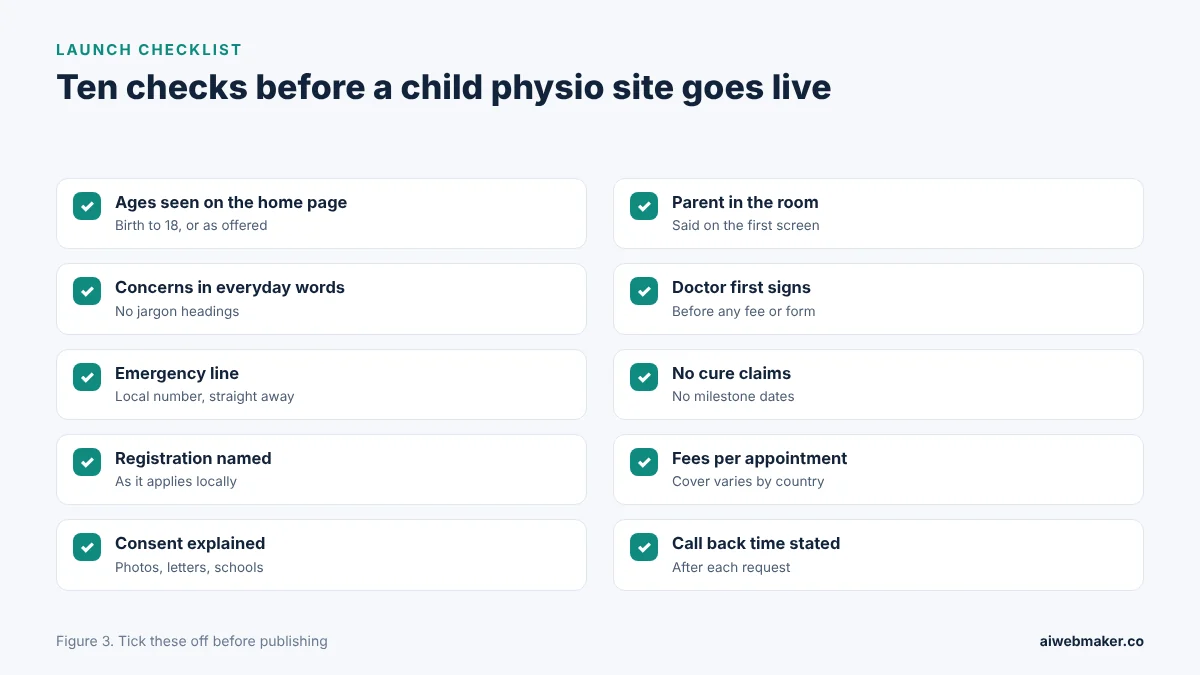
Parents leave a children's physiotherapy site quickly when concerns are listed only as diagnoses they have never heard. A page that never says whether a parent stays in the room makes families picture a child handed to strangers. Fees hidden behind a phone call suggest a large bill, and silence on referrals leaves parents unsure whether they may even book. Promises about walking by a certain age or curing a condition alarm careful parents more than they reassure them. The checklist pictured beneath closes each gap with one plain line.
Frequently asked questions
Can parents book a children's physiotherapist without a referral?
The answer turns on the country, its health system and the family's insurer, if there is one. Many private practices accept families directly, while some public services and insurance plans want a doctor's letter before they contribute. The website should state the practice's own position and suggest that parents check their cover first. Where a physiotherapist sees something that needs medical attention, the family should be told and, with consent, the doctor informed. A plain answer here stops families from waiting weeks for a letter they may not need.
How many sessions does a child usually need?
There is no typical number, because children differ and plans depend on the concern, the child's age and how things change. Many practices begin with an assessment and then agree a few goals, reviewing them every few sessions with the family. Some children need a short course and others are seen over months alongside their medical team. The website should explain the review process rather than promise a total. Honest wording about length helps parents plan without feeling misled.
Can a physiotherapist visit a child at nursery or school?
Many children's physiotherapists offer home, nursery or school visits, because seeing a child move in familiar places can be useful. Visits to nurseries or schools need the family's agreement and the setting's permission, and a parent or carer often joins. The page should state the area covered, the fee and how long a visit lasts. Rules on sharing information with schools vary, so consent should be settled before anything is discussed with staff. A short visits section helps families and nurseries alike know what to expect.
What should a child wear to an assessment?
Comfortable clothes that allow rolling, crawling and running suit most assessments, with bare feet or socks on the mats. Young athletes can bring the trainers they wear for their sport. Parents of babies might bring a spare nappy, a favourite toy and anything that helps the baby settle. The website can list these points so families arrive prepared and relaxed. Small practical details make the first appointment feel easier for everyone.
Why one family's first visit outweighs the hosting bill
The fee for one child's first assessment is normally larger than the $119 that keeps the practice's site up for a year. Even the monthly $19 amounts to a small slice of one follow up fee. Every family that returns for follow ups, and every nursery that mentions the practice to another parent, reflects pages that explained things well. Plain concern cards, honest limits and visible red flags reassure anxious parents far better than confident claims. Parents who forward the site to a partner or a grandparent, saying this place sounds right, are the real measure of its value.
Build your website in Minutes and get the AI Tools that work
Start Building Your Website →