Pediatric Occupational Therapy Website Cost and a Report Parents Read
A children's occupational therapy practice can host its assessment, session and school visit pages for $119 a year on annual billing, or $19 in each single month, and adds a domain. The guide runs through families' worries, the first assessment, report words, session blocks, school visits, funding, requests, searches and annual costs.
- No coding required
- Live in minutes
- Blog, SEO and chatbot tools included
A children's occupational therapy practice can host its assessment, session and school visit pages on AI Web Maker for $119 over a year, or $19 in each single month, plus a domain. Writing the assessment story and the fee card, and trying them out in the preview until they read well, brings no charge from the platform. One first assessment at the sample practice's $260 fee covers more than two years of that hosting. The real difficulty is that parents rarely search for occupational therapy by name, because they are worried about a pencil grip, a meltdown at the hand dryer or a coat that never gets buttoned. They then meet a report full of terms such as motor planning and sensory processing that nobody has explained. This guide covers who looks, the first assessment, report words, session blocks, school visits, funding, requests, search and the yearly budget.
This article is part of our complete guide: Healthcare Website Builder.
Handwriting that tires, socks that itch and a teacher's note: who looks for a children's OT
Families usually find a paediatric occupational therapist after a specific everyday task has become a daily battle. A teacher may mention that handwriting tires the hand after a few lines or that cutting along a line is still hard. Parents notice a child who will only wear certain socks, covers both ears at parties or takes an hour to settle after school. Some families arrive with a diagnosis and a recommendation from a doctor, while many have no label at all. Grandparents, nursery staff and teachers also read the pages, often before suggesting the idea to a parent.
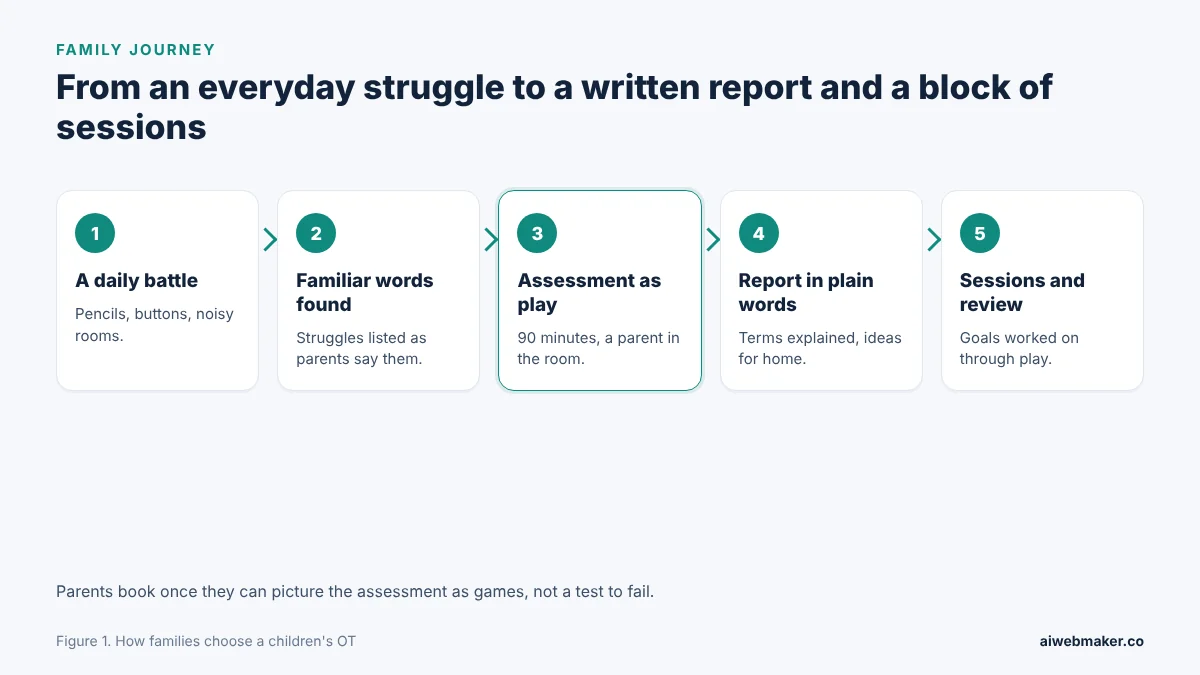
The third box is marked because parents decide to book once they can picture the assessment as play rather than as a test their child might fail. A daily struggle starts the search, and a page listing familiar problems in a parent's words tells the family they are in the right place. The description of a 90 minute assessment, with games, breaks and a parent in the room, removes the biggest fear. A request follows, then the assessment itself and a written report in plain words. Sessions with a review after a set number come next, and the family judges the practice by how clearly progress is explained.
Everyday struggles, the assessment and the fee card: pages for a children's OT practice
A paediatric OT site needs pages that start from what parents notice, explain what the therapist does and say what each step costs. Its home page should give the age range, promise that a parent stays in every session and say how soon the report follows. A page of things parents notice uses ordinary language, such as buttons, scissors and noisy rooms. Service pages explain handwriting, dressing, sensory needs, coordination and routines, while an assessment page describes the first visit. Fees, funding notes, a page for teachers and the request close the site.
| Page | Parent's question | What it should include |
|---|---|---|
| Home | Does this practice see children like mine? | Ages, a parent in every session, report time |
| Things parents notice | Is this worth asking about? | Everyday struggles in plain words |
| What sessions work on | What would therapy actually involve? | Handwriting, dressing, sensory needs, play |
| First assessment | What happens on the first visit? | Length, games, tests, a parent present |
| Report words | What do the terms mean? | Plain meanings and home examples |
| Fees and funding | What will it cost, and who might pay? | Assessment, session and school visit fees |
| Teachers | Can the school be involved? | Consent, classroom visits, shared ideas |
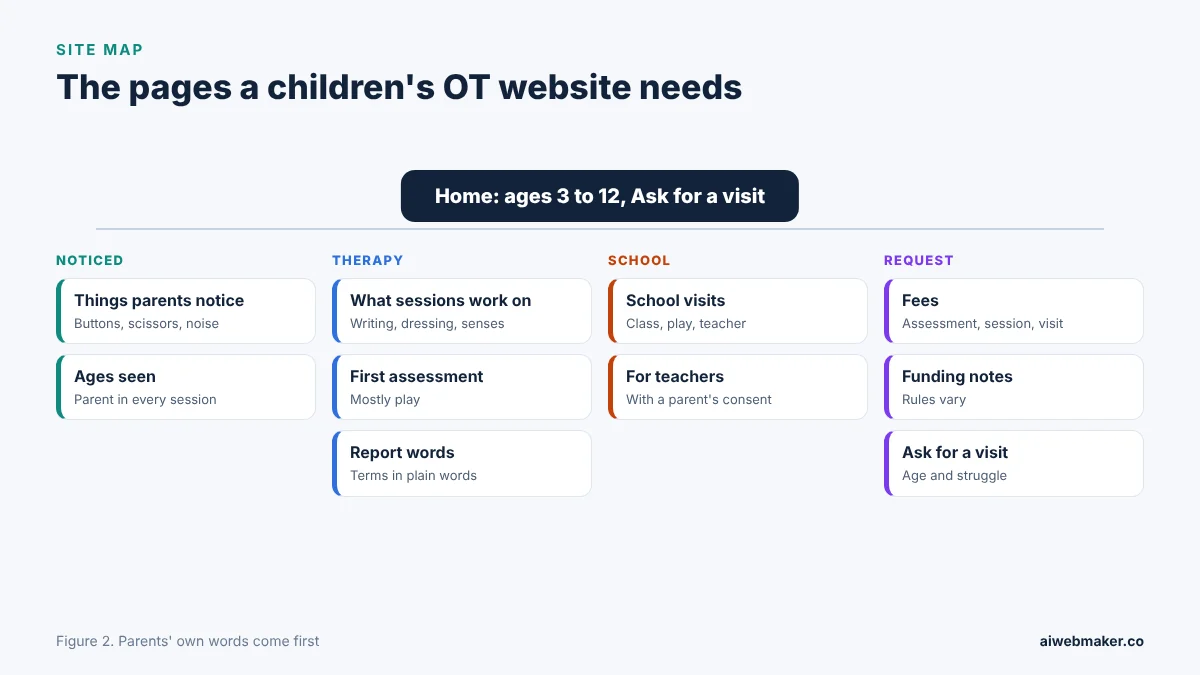
Parents' own words fill the first column of this map, and the therapy, school and request columns line up behind it as a family's questions tend to arrive. Therapy pages hold the services, the assessment and the guide to report words. Small Hands Occupational Therapy, the invented practice in our pediatric occupational therapy website example with a play based assessment, works on handwriting and pencil control, cutting, cutlery and tools, dressing and getting ready, sensory needs, coordination and play, and routines and organisation. Its fee cards list a first assessment, a therapy session and a school visit. A note on the services section adds that its therapists do not diagnose conditions such as autism or ADHD and explains who can look into such questions.
Ninety minutes of play: what the first assessment fee buys
The first assessment is the most expensive single appointment and the one parents fear most, so its page should break the fee into what the family receives. The sample's $260 assessment lasts about 90 minutes in the therapy room, with a parent present throughout. It begins with a questionnaire completed beforehand and a chat while the child settles, then moves through drawing, threading, building, balancing and a little writing. Some of the games are standardised tests, which simply means every child does the same tasks so a score can be compared with others of the same age. On the booking website builder for paediatric therapists who start with an assessment, parents send a request for the first assessment, and the sample's own request form adds the child's age, what they have noticed and the days that suit school. The therapist can confirm it by phone, rearrange it or decline it, with fees paid to the practice on the day and none of them shared with the platform.
| Part of the assessment | What happens | What parents receive |
|---|---|---|
| Questionnaire beforehand | Everyday life, often a sensory profile | Their view counted alongside the tests |
| Settling chat | Parent and therapist talk while the child plays | Time to raise worries privately |
| Play based tasks | Drawing, threading, building, balancing | Breaks whenever the child needs them |
| Standardised tests | Same tasks for every child of that age | Scores compared fairly |
| Summary before leaving | What the therapist noticed | First ideas to try at home |
| Written report | Within 10 working days at the sample | Plain words schools and doctors can use |
Report words decoded for the kitchen table
A report written for schools and doctors uses professional terms, and a page translating them earns its place on a children's OT site more than almost any other. Fine motor skills are the small movements of hands and fingers, while gross motor skills involve the whole body. Motor planning describes working out the steps of a new movement, and bilateral coordination means both hands or both sides of the body working together. Visual perception and sensory processing cover how a child makes sense of what they see, hear and feel. Parents who understand their report can share it with a school confidently and ask better questions at the review.
| Term in the report | Plain meaning | Where parents might see it at home |
|---|---|---|
| Fine motor skills | Small, precise hand movements | Buttons, a pencil, picking up peas |
| Gross motor skills | Big movements of the whole body | Stairs, catching a ball, a scooter |
| Motor planning | Ordering the steps of a new movement | A new playground game, dressing in order |
| Visual perception | Making sense of what the eyes take in | Copying from the board, finding a shoe |
| Sensory processing | How the brain answers sound, touch and movement | Bothered by labels, always climbing |
| Bilateral coordination | Both hands working together | Holding paper still while cutting |
Blocks of sessions, a review and one short home game
Ongoing therapy is where most of a practice's income comes from, so the session page should explain how blocks, reviews and home practice fit together. The sample charges $95 a session, works on goals from the report through play and reviews progress with parents after six sessions. Five minutes at the end of each session shows the parent a game to repeat at home, usually with things the family already owns. Nobody can promise that a child's handwriting or dressing will improve by a set date, and the session page ought to admit as much. A review that compares progress honestly with the goals gives parents a fair point to continue, pause or stop.
Classroom visits and the teacher who wants ideas
School visits extend a therapist's work into the place where many struggles show up, and they deserve their own page and price. The sample charges $180 for a visit that includes seeing the child in class and at play, a short talk with the teacher and written classroom ideas. A parent's written consent should come before any information is shared, and the page should say how teachers can contact the practice with a parent copied in. Some schools fund visits or sessions themselves, while others expect parents to pay, so the page can invite schools to ask. Clear school terms often bring further referrals from the same staff room.
Insurers, schools, public schemes and the limits of an OT assessment
Funding for children's therapy varies greatly between countries, insurers and school systems. The fee page ought to give the practice's own prices and leave each funder's rules to the family to confirm. Some insurers and public schemes ask for a doctor's referral or a diagnosis before they contribute, and families should check before the first visit if they hope to claim. Occupational therapist is a regulated title in many countries, so the practice should show the register where each therapist can be checked. An OT assessment does not diagnose conditions such as autism or ADHD, and a family worried about growth, health or development should also talk to their own doctor. A child who is unwell or hurt needs their doctor, and anything urgent calls for the local emergency number rather than a request.
Handwriting help, sensory OT and other phrases parents and teachers type
Parents rarely type the word occupational, and search instead for handwriting help for children or a sensory processing therapist. Others type occupational therapy for kids near me, help with dressing skills or child OT assessment, often adding a town. Service pages titled with those ordinary phrases meet families where they already are. A map listing that mentions buggy space, a quiet waiting corner and Saturday sessions helps parents planning around school. Reviews from parents who describe calmer mornings or a report that finally made sense persuade other families more than any list of qualifications. Articles on pencil grips, getting dressed for school or planning a trip around hand dryers bring parents months before they book.
Swings, putty and the yearly web bill
Therapy equipment, assessment kits, professional registration and insurance all cost a children's OT practice far more than its website does. Choosing the yearly $119 keeps the total lowest, and $19 a month suits a therapist who has just opened a practice. Each of the 400 or so domain endings carries its own price. A year of monthly parent guides uses around $7.80 of AI credit, and updating fees or adding a Saturday clinic adds no charge. The $189 tier is listed for comparison only.
| Item | Yearly | Monthly |
|---|---|---|
| Hosting the pediatric occupational therapy pages | $119 | $228 over twelve months |
| Domain | Depends on the ending | Depends on the ending |
| Higher plan, for comparison | $189 a year | Not needed |
| Twelve parent guides at about $0.65 | About $7.80 | About $7.80 |
| Fee, hours and service updates | No charge | No charge |
| Year before the domain | About $126.80 | About $235.80 |
Unexplained scores, no fee card and silence on schools: why parents look on
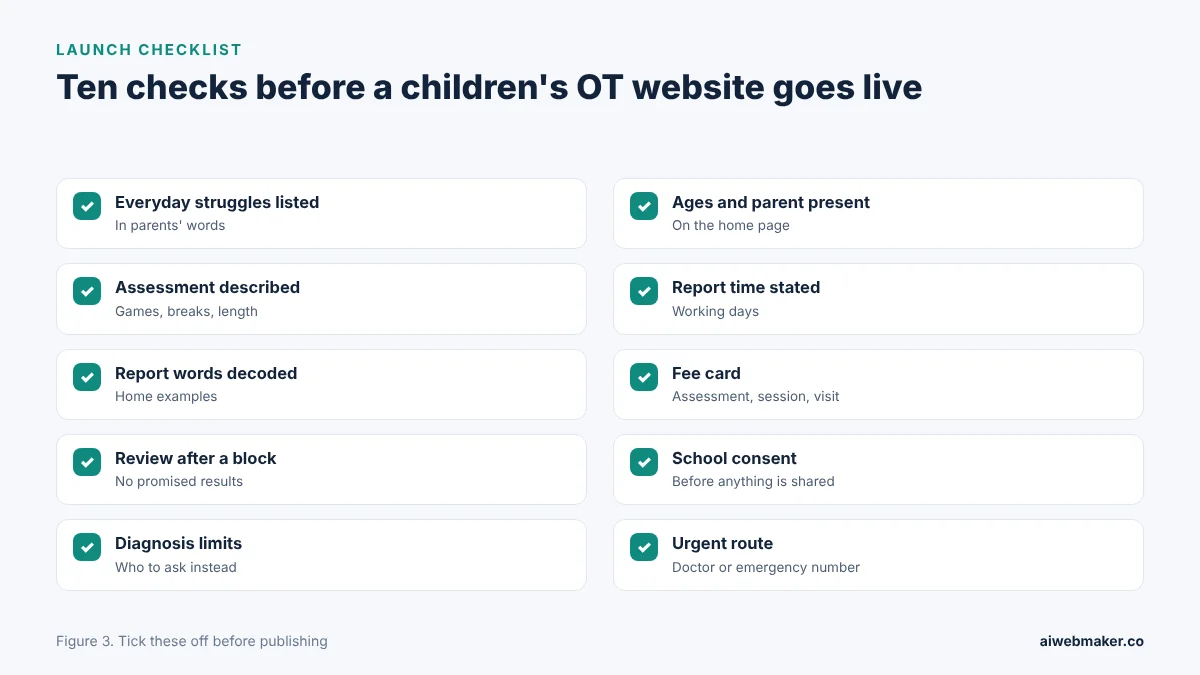
Parents leave a children's OT site that describes therapy in professional terms without a single everyday example. A missing fee card for the assessment and sessions suggests a bill that will only be explained later. Pages that skip what happens on the first visit leave anxious parents unable to prepare their child. Silence about schools, funding or what the therapist cannot diagnose leaves families guessing whether to start here at all. The figure after this paragraph pairs each worry with one of ten checks.
Frequently asked questions
Is a diagnosis needed before a child's first OT assessment?
Many children seen by occupational therapists have no diagnosis at all, only an everyday task that has become a struggle. A practice can usually see a child directly, but some insurers and public schemes ask for a doctor's referral or a diagnosis before they pay. Those rules differ between countries and funders, so families should check first if they plan to claim. The website should state whether the practice accepts direct requests. Clear guidance helps parents start without waiting for a label.
Will a child realise the sessions are therapy?
Younger children usually experience sessions as play with dough, tweezers, swings or treasure hunts. Older children often like to know why they are there, so the therapist explains the goals in words they understand. Letting a child choose some of the games builds cooperation and confidence. The website can describe a typical session from the child's point of view. Parents then know how to talk about it at home.
How much practice happens at home between sessions?
Most therapists suggest a short activity each day using things families already own, such as dough, pegs or a ball. The sample practice shows parents one short game at the end of each session and never sends worksheets. Busy weeks happen, and the website can reassure parents that missing a day is fine. Small, regular practice tends to suit family life better than long sessions. Realistic expectations keep home practice a pleasure rather than a chore.
Can the therapist share the report with a school?
With a parent's written consent, a therapist can share the report or ideas with a child's teacher and may visit the classroom. Without that consent, information stays between the practice and the family. The website should explain how consent is given and how teachers can contact the practice. Sharing the same ideas at home and at school often helps a child more than either setting alone. Clear consent rules protect the child and reassure parents.
A $260 assessment set against the practice's hosting
One first assessment at the sample's $260 fee covers the $119 hosting twice over, with change left. Under the monthly option, a single $95 session covers five $19 payments. A family that stays for a block of sessions and a school visit covers many years of hosting, and parents often pass the practice's name around the playground. Everyday words, a play based assessment described step by step and a report guide that parents can actually use win the trust children's therapy depends on. Requests that begin with a parent describing a specific struggle in their own words show the pages are reaching the right families.
Build your website in Minutes and get the AI Tools that work
Start Building Your Website →