Nutritionist Website Cost and the Credentials Clients Check First
Hosting a nutrition practice's pages runs to $119 when paid yearly, or $19 each month for those who spread it, with the domain on top. This guide covers services by concern, credentials and scope, the first consultation, prices and packages, health privacy, honest client stories, useful articles and the yearly budget.
- No coding required
- Live in minutes
- Blog, SEO and chatbot tools included
Hosting a nutrition practice's pages runs to $119 when paid yearly, while practitioners who would sooner spread the cost pay $19 a month, and the domain is bought on top. Designing the consultation pages and reviewing them in the preview carries no charge on AI Web Maker. One initial consultation usually earns more than the yearly fee, so cost is rarely the obstacle for a nutritionist. Consultation booking sits at the heart of the nutritionist website examples page, where an imaginary practice's sample site, built with AI Web Maker, shows one way to present a practitioner and a first appointment. The harder task is persuading a stranger, often one who has tried several diets already, that this practitioner is qualified, realistic and worth a first appointment. Clients arrive with very different goals, from managing a digestive condition to fuelling a marathon or feeding a fussy toddler. What follows covers the pages, policies and evidence that turn that scepticism into a requested consultation.
Why do people look for a nutritionist, and what holds them back?
People look for a nutritionist when general advice has stopped working for them, or when a health change makes eating feel complicated. Some have a diagnosis, such as type 2 diabetes, high cholesterol or irritable bowel syndrome, and want practical help putting a doctor's advice into daily meals. Others are athletes chasing performance, parents worried about a child's eating, or people who simply want more energy. Many have tried apps and diets before and are wary of anyone promising quick results. Cost, confusing credentials and fear of being judged hold many of them back. A nutritionist's website has to answer those doubts before it asks for anything.
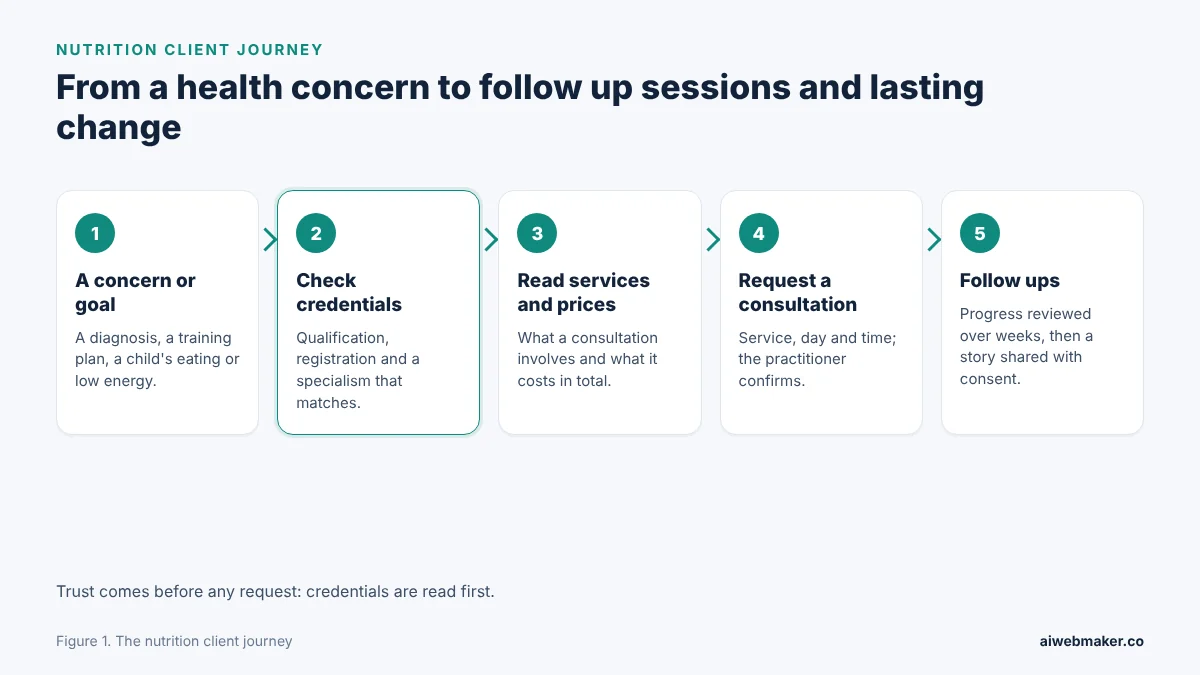
The figure shows how much reading happens before a nutrition client ever gets in touch. Visitors check the practitioner's qualifications, then look for someone who works with their particular concern. Prices and the shape of a consultation come next, because people want to know what they are committing to. Only then does a first appointment request feel safe. After the consultation, follow ups and practical resources decide whether the client stays for the months that real change usually needs. Each step of that path corresponds to a page or section described below.
Which services should a nutrition practice describe?
A nutrition practice should describe each service by the problem it helps with, since clients search for help with a concern rather than for a type of appointment. One to one consultations, in person or by video, are the core offer for most practitioners. Specialist areas, such as digestive health, sports nutrition, pregnancy, children's eating or managing blood sugar, deserve their own pages when the practitioner has real training in them. Group workshops and courses suit people who want to learn alongside others at a lower price. Workplace talks and wellness programmes bring in employers as clients. Stating clearly which concerns fall outside the practice saves both sides a wasted appointment.
| Service | Who it usually suits | What the page should state |
|---|---|---|
| Initial consultation | New clients with any goal | Length, format, what to prepare |
| Follow up session | Clients putting a plan into practice | Typical spacing and length |
| Digestive health support | People with diagnosed gut conditions | Training held and how it fits with medical care |
| Sports nutrition | Athletes and active people | Sports covered, event preparation |
| Pregnancy and family eating | Expectant parents and families | Ages covered, practical focus |
| Group workshop | People who learn well in a group | Topics, dates, group size |
| Workplace programme | Employers and teams | Talks, clinics, how pricing works |
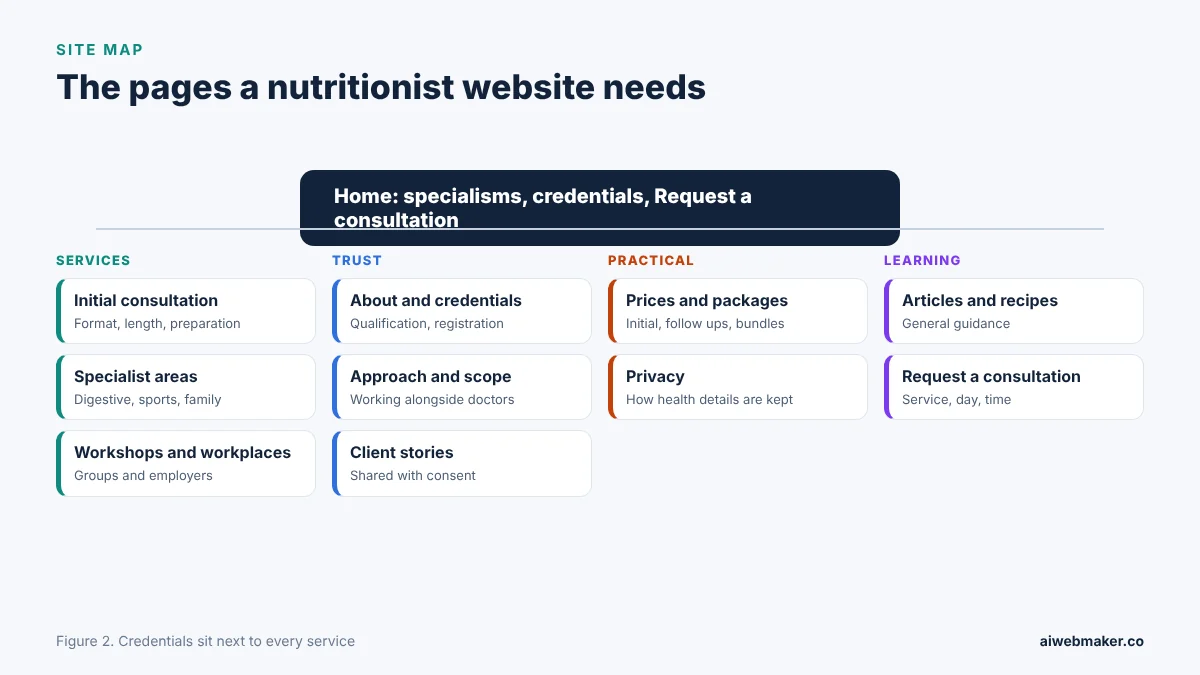
Seen as a site map, a nutrition practice needs four groups of pages that follow the order of a client's doubts. Service pages describe the initial consultation, each specialist area and the workshops or workplace sessions on offer. Trust pages carry the practitioner's credentials, the approach to working alongside doctors and client stories shared with consent. Practical pages hold prices, packages and a short note on how health details are kept private. Learning pages gather articles and recipes, which bring readers in long before they are ready to book. The consultation request should be one tap away from every specialist page.
How should credentials and scope of practice be presented?
Credentials should be presented plainly and early, because nutrition is a field where titles mean different things from one country to another. In many places the title dietitian is protected by law and requires registration, while nutritionist may cover a wide range of training. Clients cannot be expected to know these differences, so the website should state the qualification held, any registration or professional body, and the years of practice. A clear statement of scope, such as working alongside the client's doctor rather than replacing medical care, builds confidence. The practice can also explain when it refers clients on, for example to a doctor or a specialist service. Honesty about limits makes the practitioner look more professional, not less.
| Trust detail | Why clients look for it | How to show it |
|---|---|---|
| Qualification | Proves formal training | Degree or course named, with the awarding body |
| Registration or membership | Confirms professional standards | Body named, number where it is public |
| Specialist training | Matches the client's concern | Areas listed with the courses completed |
| Scope statement | Shows the practitioner works safely | A plain note on working alongside medical care |
| Referral policy | Reassures clients with complex needs | When and to whom clients are referred |
| Insurance | Signals professional practice | A short statement, with details on request |
What happens in a first consultation, and how should the page explain it?
The consultation page should walk a nervous client through the appointment from start to finish, because uncertainty is a major reason people delay. A first session usually begins with questions about health history, medication, routine, sleep and current eating. The practitioner then discusses the client's goals and agrees realistic priorities. Many practices send a short questionnaire or ask for a food diary beforehand, and the page can say so. The session often ends with a few practical changes rather than a rigid meal plan. Describing this flow in plain language shows clients they will be listened to rather than lectured.
| Stage | Typical timing | What happens | What the page should say |
|---|---|---|---|
| Before the visit | A few days ahead | Questionnaire or food diary | How long it takes to complete |
| Initial consultation | Usually the longest session | History, goals, first priorities | Length, format, what to bring |
| Written summary | Within a few days | Key points and agreed changes | Whether a summary is included |
| Follow ups | Spaced over several weeks | Progress reviewed, plan adjusted | Typical number and spacing |
| Between sessions | As agreed | Short questions answered | How and when clients can get in touch |
How should a nutritionist price consultations and programmes?
Pricing should give clients a clear picture of the total commitment, because most nutrition goals need more than one appointment. Listing the price of the initial consultation and of each follow up lets visitors work out a realistic budget. Packages that bundle an initial session with several follow ups encourage the continuity that produces results. Some practices offer a shorter review at a lower price for existing clients who only need a check in. Where health insurance or employer schemes contribute to nutrition care in the client's country, a note on how receipts or invoices work helps. A transparent price list removes the guesswork that delays many first appointments.
| Option | What it usually includes | Who it suits |
|---|---|---|
| Single initial consultation | One long session and a summary | People wanting a starting plan |
| Follow up session | A shorter progress review | Clients already seen |
| Package of several sessions | Initial session plus follow ups | Clients with a longer term goal |
| Group workshop seat | One session in a small group | People exploring a topic |
| Workplace programme | Talks or clinics for a team | Employers |
How can clients ask for a first appointment without phoning?
A consultation request works best when the client chooses the service, picks a day and time, and sends it for the practitioner to confirm. The nutritionist then accepts the slot, proposes a different one or declines it if the concern falls outside the practice. Fees are settled however the practice prefers, with no part of any consultation fee taken by the platform. Built with the booking website builder for nutritionists and dietitians, every consultation type becomes a request a visitor can send in under a minute. Video and in person sessions can appear as separate lines, so clients choose the format that suits them. A simple request route lowers the barrier for people who would never phone a stranger about their eating.
How should health information and privacy be handled?
Health information deserves careful handling, because clients share details about conditions, medication and habits that they may not tell their friends. The website should not invite a detailed health history through a general contact form, since the full history is better gathered in the consultation or through a secure method the practice already uses. A short privacy note can explain what is collected, why, how long it is kept and who can see it. Rules on health data vary by country, and the practice should follow the ones that apply where it works. Reassurance about confidentiality matters especially to clients with sensitive concerns. Careful privacy practice is part of the trust a nutritionist builds.
What should testimonials and results claims avoid?
Testimonials and results claims should avoid promises that no practitioner can keep, such as a set amount of weight lost in a set time. Health claims draw close scrutiny from regulators, and the US Federal Trade Commission, for example, expects them to rest on competent and reliable scientific evidence. Client stories can still be powerful when they focus on what changed in daily life, such as more energy, calmer digestion or easier family meals. Stories need the client's permission, and identifying details stay out unless the client asks to be named. Before and after photos are best avoided, since they invite comparisons that may not help other clients. A measured tone attracts clients who want lasting change rather than a quick fix.
Which articles help a nutrition practice get found?
Articles that answer specific, practical questions help a nutrition practice reach the people it serves best. Searches such as nutritionist for IBS, sports nutritionist near me or dietitian for diabetes show how precise clients are when they look. Putting those exact phrases into the heading of each specialist page helps the right searcher land there. Articles that explain a topic clearly, such as reading food labels or planning meals around training, bring readers who later get in touch. Map listings with the practice address, hours and a photo of the consulting room support local searches. One well researched article a month builds authority that short posts cannot.
How much does a year of the nutrition website add to practice costs?
Over twelve months the website adds hosting and a domain to a nutrition practice's costs, plus a few dollars for article drafts. An established practice pays least by settling the year at once. Monthly billing helps a practitioner who is still building a client list around other work. Edits to prices, services and articles never add to the bill. The figures sit in the table below, beside the $189 tier.
| Expense | Yearly billing | Monthly billing |
|---|---|---|
| Hosting the consultation pages | $119 | $228 across twelve months |
| Domain for the practice | Set by the ending chosen | Set by the ending chosen |
| Higher plan, shown for comparison | $189 a year | Not needed |
| Twelve nutrition articles at about $0.65 | About $7.80 | About $7.80 |
| Price and service edits | No charge | No charge |
| Year before the domain | About $126.80 | About $235.80 |
Where do nutrition websites lose a hesitant visitor?
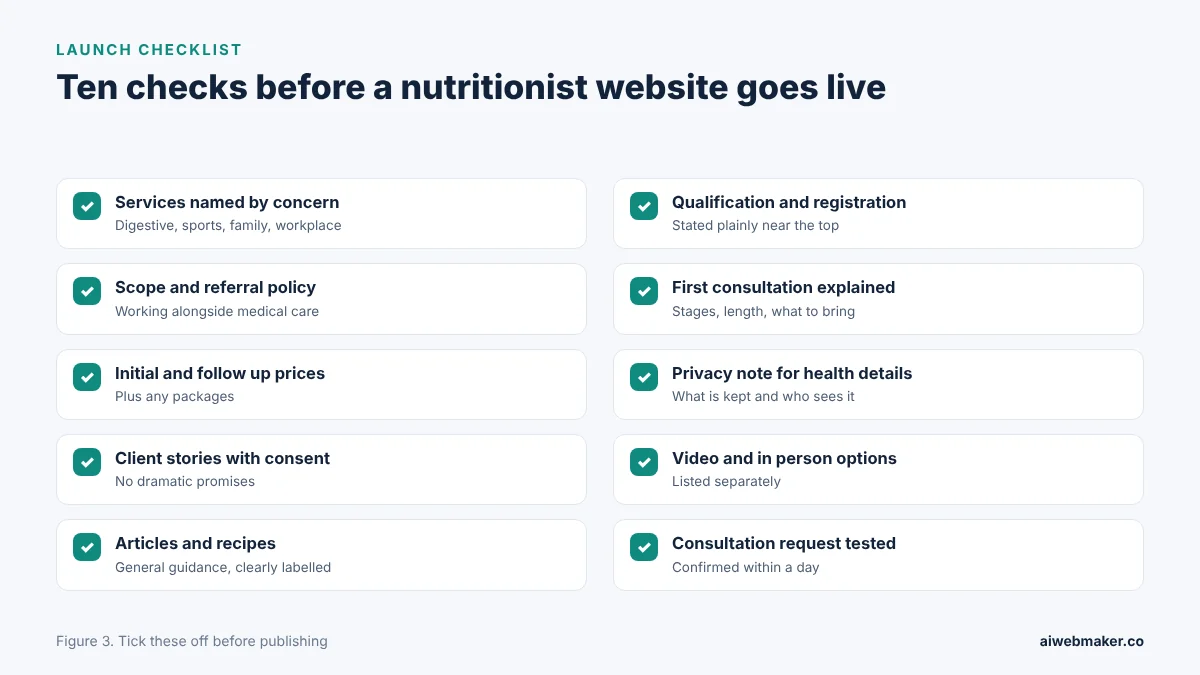
Nutrition websites lose hesitant visitors when credentials are vague, because people with health concerns want to know whom they are trusting. A practice that claims to help everyone with everything seems less expert than one with clear specialisms. Missing prices make visitors assume the worst and leave. Dramatic transformation claims put off the careful clients who tend to stay longest. A consultation request buried at the bottom of a long page loses people who were ready to act. The checklist pictured here closes each of these gaps.
Frequently asked questions
Should a nutritionist offer video consultations?
Video consultations widen the practice beyond its town and suit clients with busy schedules, young children or limited mobility. Most of a nutrition consultation is conversation, so it adapts well to a screen. The website can list video and in person sessions separately, with any difference in price or length. A short note on what clients need, such as a quiet room and a recent food diary, helps the session run smoothly. Some assessments, such as body measurements, may still need an in person visit, and the page can say so.
Can a nutritionist work with clients who have a medical condition?
Many nutritionists work with clients who have medical conditions, usually alongside the client's doctor rather than instead of them. The website should explain which conditions the practitioner has training in and how they coordinate with medical care. Some conditions, and some countries, require a registered dietitian, and an honest practice says when it will refer on. Clients appreciate knowing that the practitioner will not change medication or contradict a doctor's instructions. This clarity protects both the client and the practice.
How many sessions does a typical client need?
The number of sessions varies with the goal, and the website can give a realistic range rather than a fixed number. A client wanting a general review may need one consultation and a single follow up. Someone managing a long term condition or changing family habits often benefits from several sessions over a few months. Packages can reflect these common patterns. Setting expectations early helps clients budget and stay committed.
Should a nutritionist publish recipes on the website?
Recipes and general meal ideas make useful, shareable content, while personalised meal plans belong in paid consultations. Simple, balanced recipes show the practitioner's approach to food and give readers a reason to return. Articles can explain principles, such as building a balanced plate, without prescribing amounts for individuals. A note that the content is general information rather than personal advice keeps expectations clear. Good recipes often become the pages that bring the most visitors.
How many consultations does the website need each year?
One initial consultation usually earns more than a year of hosting at $119, so the website pays for itself almost at once. On monthly billing, part of a single follow up covers the $19. Each client who stays on for a full programme adds months of steady work that began with one page visit. The healthcare website builder for nutritionists and wellness practices section shows how clinics, therapists and other health practitioners set out their pages. Practitioners who state credentials clearly, price honestly and write useful articles build a loyal client list. A diary of follow up appointments is the clearest sign the site is working.
Build your website in Minutes and get the AI Tools that work
Start Building Your Website →