Med Spa Website Cost, Treatment Pages and the Rules on Claims
A med spa clears its hosting with one $119 payment a year, or with $19 each month, besides the domain. Then come clients, treatments and downtime, oversight, careful claims, consultations, aftercare, search and a full year of costs.
- No coding required
- Live in minutes
- Blog, SEO and chatbot tools included
A med spa clears its AI Web Maker hosting with one payment of $119 a year, or with $19 each month for clinics that prefer it, besides the domain. Practitioners can review every treatment description while the pages sit unpublished in preview, an unbilled stage on AI Web Maker. One client's course of treatments usually covers the year several times. The med spa website sample puts consultation before treatment for a fictional clinic whose whole site AI Web Maker produced, a useful model when planning careful treatment pages. The real difficulty is that med spas sit between beauty and medicine, where several treatments involve prescription medicines, lasers or needles and advertising rules are strict. Clients are cautious, often anxious about results and safety, and they look for qualified people, honest wording and a consultation before anything else. The ground covered here runs from who books and the pages a clinic needs to treatments, oversight, claims and photos, consultations, aftercare, search and a full year of costs.
This article is part of our complete guide: Healthcare Website Builder.
Who considers a med spa, and what makes a cautious client trust one?
Med spa clients are usually careful researchers, and many read about a treatment for months before contacting a clinic. Some want help with pigmentation, acne scarring, redness or fine lines, while others are preparing for a wedding or a milestone birthday. Regular clients return for maintenance facials, peels or courses of laser hair removal. A growing number of men book skin treatments, and some clients arrive after a poor result elsewhere and are doubly cautious. What persuades all of them is evidence of qualified practitioners, medical oversight where it applies, an unhurried consultation and wording that never oversells. Prices, real clinic photos and reviews then settle the choice between two credible clinics.
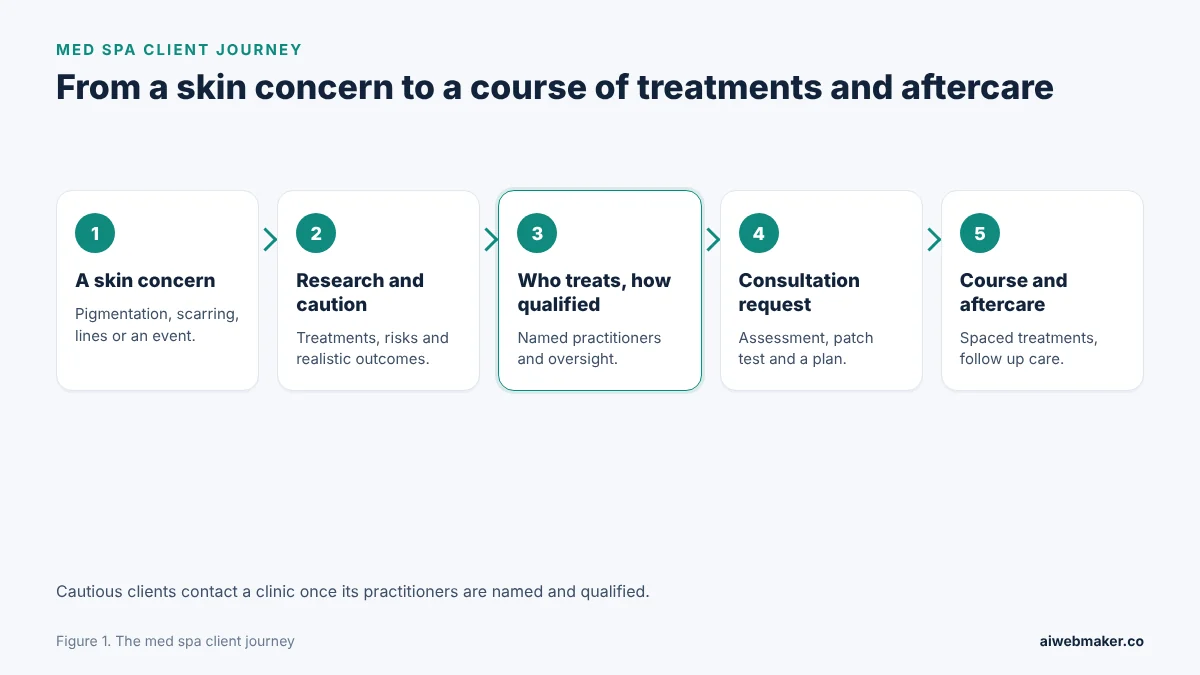
Skin clients rarely act on impulse, and this journey shows how much happens before the first appointment. A skin concern sparks the research, and the second stage is spent reading about treatments, risks and realistic outcomes. The highlighted stage, who treats and how they are qualified, is where cautious visitors decide whether a clinic is safe enough to contact. A consultation request follows, often with a patch test and a written plan. A course of treatments and careful aftercare then decide whether the client stays, returns for maintenance and recommends the clinic. Clinics whose pages answer the qualification question openly earn the consultations that matter most.
Consultation, treatment and practitioner pages for a skin clinic
A med spa site should be built around the consultation, with every treatment page leading back to it rather than straight to a purchase. Each treatment page explains the method, downtime, course length and suitability. A practitioners page names the people who treat clients and shows their qualifications and registration. Products, standards and aftercare pages answer the questions cautious clients may be too shy to ask. A contact page that states reply times completes a site that feels clinical rather than promotional.
| Page | What the client asks | What to include |
|---|---|---|
| Home | Is this clinic careful and honest? | Real clinic photos, practitioners, consultation button |
| Consultation | What happens before any treatment? | Assessment, questions, patch tests, price |
| Treatments | What does each treatment involve? | Method, downtime, course, suitability |
| Practitioners | Who will carry out the treatment? | Names, qualifications, registration, oversight |
| Products and standards | What will touch the skin? | Product ranges, hygiene, equipment care |
| Aftercare | What if something feels wrong? | Aftercare steps, whom to call, urgent signs |
| Contact | How quickly will the clinic reply? | Hours, address, reply times, parking |
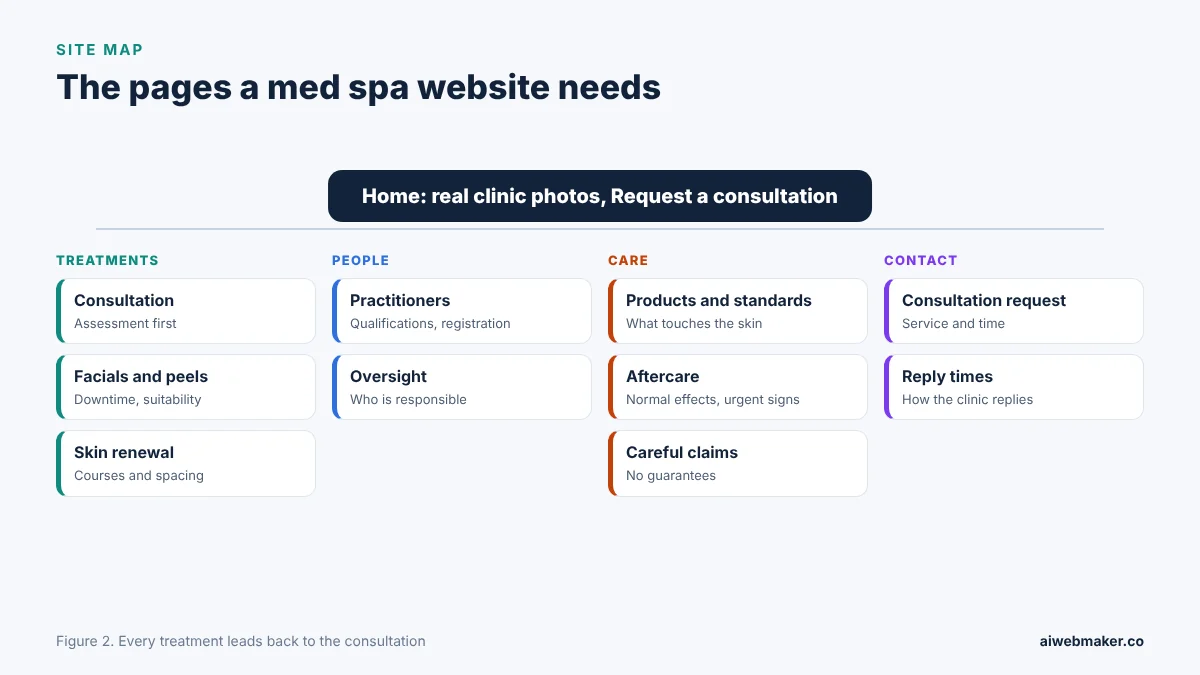
At the top of this skin clinic map sits a home page whose main button asks for a consultation, not a treatment. Treatment pages cover facials, peels, skin renewal and any medical treatments, each with downtime and suitability. People pages hold the practitioners, their qualifications and the clinic's oversight arrangements. Care pages carry products and standards, aftercare and urgent contact details, while the contact group explains reply times. Luma Skin Clinic, the sample, lists four bookable services, a skin consultation, facial treatments, targeted skin care and skin renewal, and every one carries a price, the consultation included; the med spa website example where clients book a skin consultation first was assembled in 48 seconds. Its about page introduces the practitioners in a dedicated section beside the clinic's story and approach to skin care, the site describes the products and standards the clinic stands behind along with the space and the first visit, and its contact page explains how the clinic replies.
Facials, peels, microneedling, lasers and injectables: how should each be explained?
Each treatment should be explained by what it involves, what downtime to expect and who it suits, without promising a particular result. Facials and gentle peels usually involve little downtime, while stronger peels and microneedling can leave skin red or peeling for days. Laser and light treatments depend heavily on the device, the settings and the client's skin tone, which is why patch tests matter. Injectable treatments are prescription medicines or medical devices in many countries, so they need an assessment by a qualified prescriber and careful advertising. Course lengths and spacing should be stated, because many treatments work gradually over several sessions. Plain, measured explanations attract clients whose expectations the clinic can actually meet.
| Category | What it involves | Downtime to mention | The page must cover |
|---|---|---|---|
| Facials | Cleansing, exfoliation, masks | Usually little or none | Skin types suited |
| Chemical peels | Acid solutions of varying strength | From mild redness to days of peeling | Patch test, sun protection |
| Microneedling | Fine needles stimulate the skin | Redness for a day or more | Course length, hygiene |
| Laser and light | Light energy targets hair, pigment or vessels | Varies by device and setting | Skin tone suitability, patch test |
| Injectable treatments | Prescription medicines or fillers in many countries | Possible swelling or bruising | Prescriber assessment, local advertising rules |
Who performs each treatment, and who oversees the clinic?
Clients want to know who will treat them and who is responsible if something goes wrong, so the website should name both. Rules differ sharply between countries and regions, and even between treatments in the same clinic. Some places require a supervising doctor for certain procedures, some license laser operators separately, and some regulate very little. Prescription treatments generally need a prescriber, such as a doctor, dentist or nurse prescriber where the law allows, to assess the client in person. Aesthetic therapists often perform facials and lighter peels within their training. Clear roles, with registration numbers where they exist, give cautious clients the confidence to request a consultation.
| Role | What it usually means | What the page should show |
|---|---|---|
| Supervising or medical director | Oversight of clinical treatments, where required | Name, profession, registration |
| Prescriber | Assesses clients and prescribes medicines | Profession and registration number |
| Nurse | Clinical treatments within their scope | Registration and training in aesthetics |
| Aesthetic therapist | Facials, peels and skin care within training | Qualifications and treatments performed |
| Laser operator | Laser and light treatments | Device training and any local licence |
Advertising rules, before and after photos and the words to avoid
Advertising rules for cosmetic and medical treatments are strict in many countries, and a med spa website counts as advertising. Some regulators restrict or ban promoting prescription medicines to the public, which affects how injectables can be described. Before and after photos, where allowed, should be unedited, taken in the same light and angle, and published only with the client's written consent. Time limited discounts on medical procedures are discouraged by some regulators because they pressure people into quick decisions. Words such as guaranteed, painless or permanent can mislead and invite complaints. Careful wording protects clients from false expectations and the clinic from regulators.
| Avoid | Prefer |
|---|---|
| Guaranteed results | Results vary, and the practitioner discusses what is realistic |
| Painless | Most clients describe mild discomfort, and numbing may be offered |
| Instant transformation | Changes usually develop over a course of treatments |
| Promoting prescription medicines by name | Describing the consultation and the assessment |
| Edited or filtered photos | Unedited photos in consistent light, with written consent |
| Offers that rush a decision | Clear prices and time to think |
How should consultation requests, patch tests and cooling off time work?
A consultation request should come first for most treatments, and the website can make it the main route rather than a hidden option. Clients pick the consultation and a convenient time, then submit it so the clinic can look over the request. Staff then agree to the time, propose a different one, or decline and suggest seeing a doctor when the concern needs medical care first. With the booking website builder for med spas and skin clinics, the consultation and each treatment appear as services clients can request. Fees are paid to the clinic in whatever way it arranges, and the platform takes no part of any payment. Patch tests before peels and lasers, and a cooling off period between consultation and some treatments, show that the clinic values safety over speed.
What should aftercare pages say about complications and urgent signs?
Aftercare pages should explain what is normal after each treatment, what to avoid and when to call, because clients are often alone at home when worries arise. Written instructions on sun protection, skin care products and makeup after treatment prevent many problems. The page should say which mild effects, such as redness or slight swelling, usually settle without help. It should also list warning signs, such as severe or worsening pain, spreading redness, fever, changes in skin colour or any change in vision, that call for urgent contact with the clinic or emergency medical help. A named contact route for questions after treatment reassures clients before they book. Clinics that plan for problems openly are the ones clients trust with their faces.
Which skin treatment searches lead to a clinic's pages?
Clients search for treatments and concerns, using phrases such as skin clinic near me, chemical peel, microneedling, laser hair removal or acne scar treatment, often with a city. Each treatment page should carry its own phrase in its heading, alongside an honest description. Local clients often start from the map listing, which should show the treatment rooms, list correct hours and link to the consultation page. Reviews persuade, yet testimonials about medical treatments are restricted by some regulators, so the clinic should confirm what local rules allow. Articles on what happens at a consultation, caring for skin after a peel or why laser suitability depends on skin tone reach people while they research. Calm, useful writing marks a clinic as careful long before a client visits.
Where does hosting rank among a skin clinic's lasers, products and insurance?
Against equipment, insurance, products and practitioners' fees, the website is one of the slightest costs a med spa carries. A clinic with steady consultations spends least by paying yearly. A clinic in its first months may prefer the monthly route while its client list grows. Credits for a year of monthly skin care articles total about $7.80. Both billing routes are laid out next, with the $189 plan included for nothing more than contrast.
| Item | Yearly | Monthly |
|---|---|---|
| Hosting the med spa pages | $119 | $228 over twelve months |
| Domain | Depends on the ending | Depends on the ending |
| Higher plan, for comparison | $189 a year | Not needed |
| Twelve skin care and aftercare articles at about $0.65 | About $7.80 | About $7.80 |
| Treatment, practitioner and price updates | No charge | No charge |
| Year before the domain | About $126.80 | About $235.80 |
Guarantees, filters and missing names: what loses a cautious skin client?
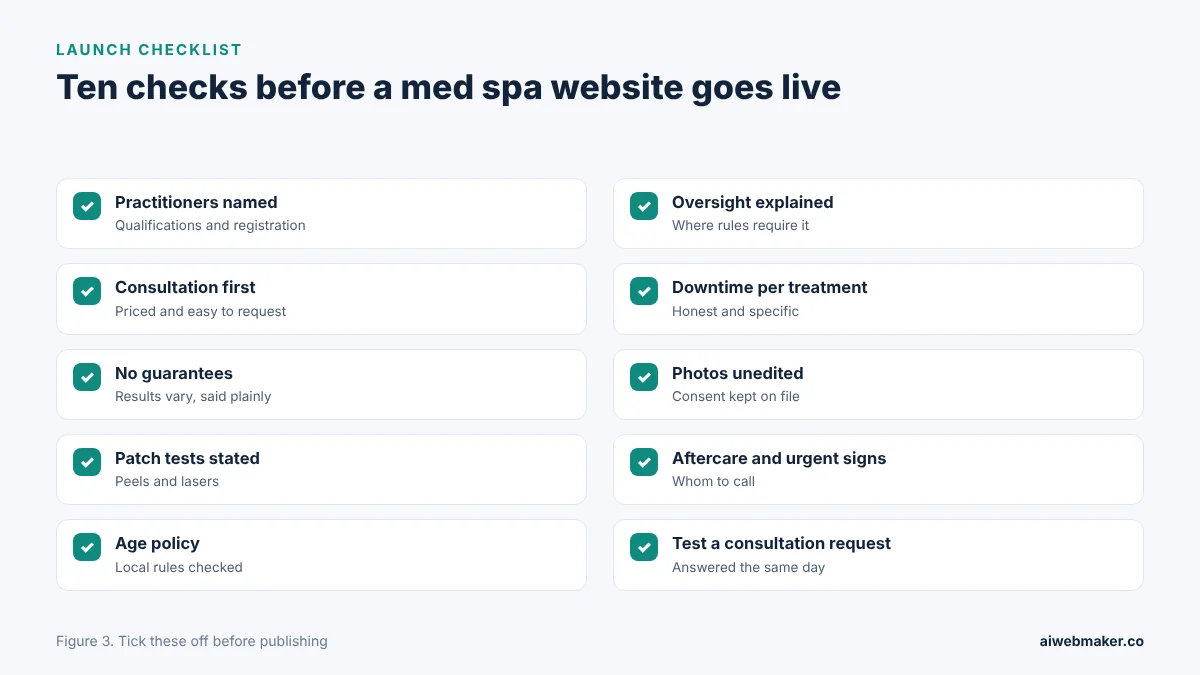
Cautious skin clients close the tab when a site feels more like a sales promotion than a clinic. No named practitioners, or no qualifications beside the names, raises immediate doubts. Guarantees, dramatic edited photos and countdown offers suggest the clinic cares more about volume than safety. Missing prices make people suspect a high pressure consultation. Silence on aftercare and urgent contact leaves them wondering who would help if something went wrong. The ten fixes pictured below answer each of those doubts.
Frequently asked questions
Is a consultation always needed before treatment?
For most treatments beyond a basic facial, a consultation is the safest first step and many clinics require one. It lets the practitioner check medical history, medication, skin type and expectations before recommending anything. Prescription treatments generally require an assessment by a qualified prescriber in many countries. A consultation can also lead to a recommendation to see a doctor or dermatologist instead. Clinics that insist on consultations show clients that suitability matters more than a quick sale.
Are laser treatments suitable for every skin tone?
Suitability depends on the device, its settings and the client's skin tone, so no website should promise that every laser suits every client. Some devices carry more risk of burns or pigment changes on darker skin, while others are designed to treat a wider range. A patch test and an experienced practitioner reduce the risk. The treatment page can explain which skin types the clinic's devices are used on and how suitability is checked. Honest guidance protects clients and builds trust in diverse communities.
How far ahead of an event should skin treatments start?
Starting weeks or months ahead is usually wise, because many treatments cause temporary redness or peeling and some work over a course. A new treatment just before a wedding or a photo shoot carries the risk of an unexpected reaction. The website can suggest booking a consultation well before the date so the practitioner can plan the timing. Gentle facials closer to the event are often a safer choice. Sensible timing helps clients look their best without last minute stress.
Can someone under eighteen book a treatment?
Many clinics do not treat clients under eighteen for cosmetic procedures, and some countries restrict certain treatments by law. Rules on age, identification and parental consent differ widely, so the clinic should state its own policy on the website. Some skin care treatments for teenagers, such as help with acne, may be offered with a parent present or after a doctor's advice. Practitioners should check age before any medical treatment. A clear policy protects young people and the clinic alike.
How many consultations does a med spa's website need to pay its way?
A single consultation that leads to a course of treatments usually earns several times the $119 that hosts a med spa's pages for a year. The $19 monthly fee is a small slice of one facial. Clients who return for maintenance treatments over several years are worth far more than the website will ever cost. Named practitioners, measured claims and an easy consultation request give careful clients the confidence to take that first step. Clinics that keep treatments, practitioners and aftercare current build a reputation for care that spreads by word of mouth. Steady consultation requests from well informed clients are the result worth tracking.
Build your website in Minutes and get the AI Tools that work
Start Building Your Website →