Kids Dentist Website Cost and the First Visit Parents Want Explained
A kids dentist can host a full website for $119 a year, or $19 a month, plus a domain. Covered: how parents choose, first visits, sealants and varnish, frightened children, knocked teeth, titles and schemes, visit requests, search and a yearly budget.
- No coding required
- Live in minutes
- Blog, SEO and chatbot tools included
A children's dental practice can publish its first visit guide, care cards and fees through AI Web Maker hosting priced at $119 yearly, alternatively $19 monthly, with a domain beside it. Shaping those pages and looking them over in the preview, on a phone as well as a desk screen, costs the practice nothing. Two check ups for one family outweigh that annual fee on their own. The tricky part sits with two nervous people at once, a child who fears the chair and a parent who remembers their own childhood visits and dreads passing that fear on. A good kids dentist website calms both, by describing the first visit step by step, explaining preventive care plainly and saying honestly what happens when a child cannot cope. The guide moves through how parents choose, first visits, sealants and varnish, frightened children, knocked teeth, titles and schemes, visit requests, search and a yearly budget.
This article is part of our complete guide: Healthcare Website Builder.
First teeth, school check ups and sports knocks: who brings children to the dentist
Parents choose a children's dentist at a few predictable moments, and the website should meet each one. The first tooth or first birthday prompts many families to look for a practice that makes early visits gentle. Parents of four or five year olds often search after a difficult visit elsewhere, wanting a dentist who will go slowly. School age children need check ups, sealants and advice on snacks, while teenagers bring sports mouthguards, crowding and gum questions. A fall in the playground or a chipped front tooth produces the most urgent searches of all.
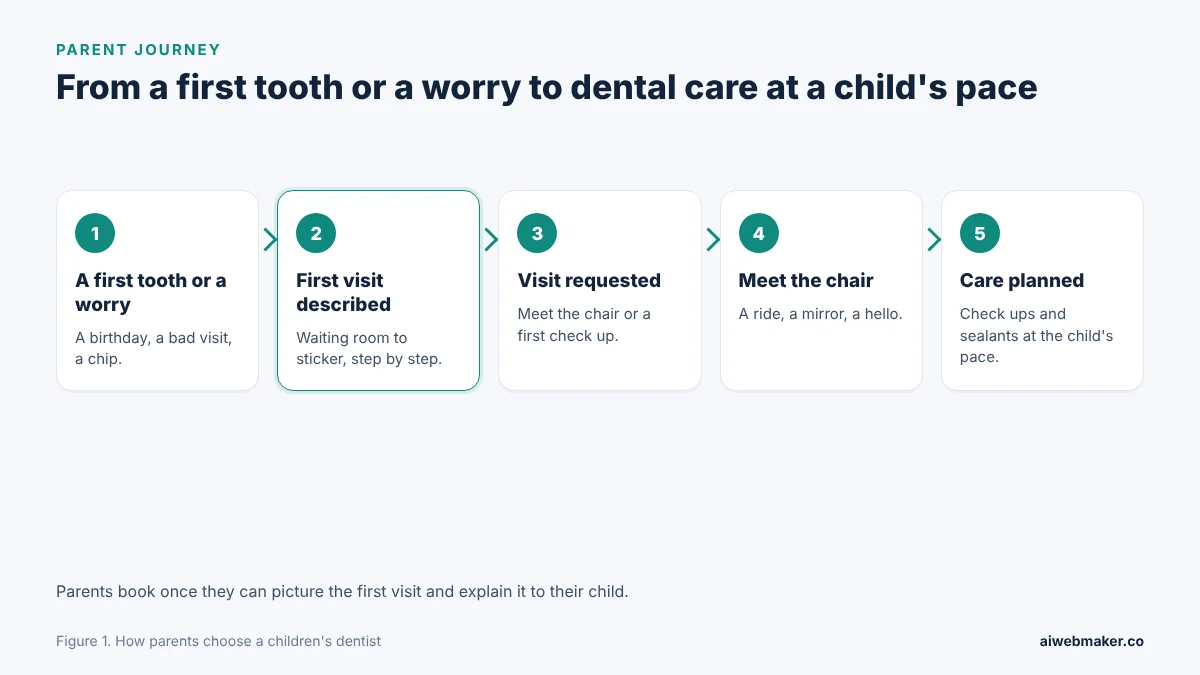
The highlighted step decides most first bookings, because parents want to rehearse the visit with their child before it happens. A family arrives with a first tooth, a worry or a bad memory of another surgery, and looks for a step by step account of the first visit. Once they can describe it to their child, they request a visit, often a short meet the chair appointment rather than a full check up. That gentle start leads to check ups and preventive care at a pace the child accepts. Websites that describe the first visit clearly make every later step easier.
First visits, care, frightened children and fees: pages a kids dentist needs
A children's dental website should be written for parents but pictured through a child's eyes. Its home page should say which ages are welcome, that a parent never leaves the room and how first visits are paced. A first visit page tells the sequence step by step, and a care page explains check ups, sealants, varnish and fillings with example prices. A page for frightened children and those with sensory needs, plus an age guide, answers questions parents rarely ask aloud. Urgent advice for knocks sits near the end, beside the request and the way in for buggies.
| Page | Parent's question | What it should include |
|---|---|---|
| Home | Is this practice gentle with children? | Ages seen, parent in the room, slow first visits |
| First visit | What will happen the first time? | Each step from the waiting room to the sticker |
| Care and prices | What treatments might be needed? | Check ups, sealants, varnish, fillings, example fees |
| Frightened children | What if a child panics? | Stop signal, short visits, sensory adjustments |
| Knocks and chips | What should happen after a fall? | Same day slots, when to call emergency services |
| Request and visit | How does a first visit get booked? | Visit type, child's age, how the child feels |
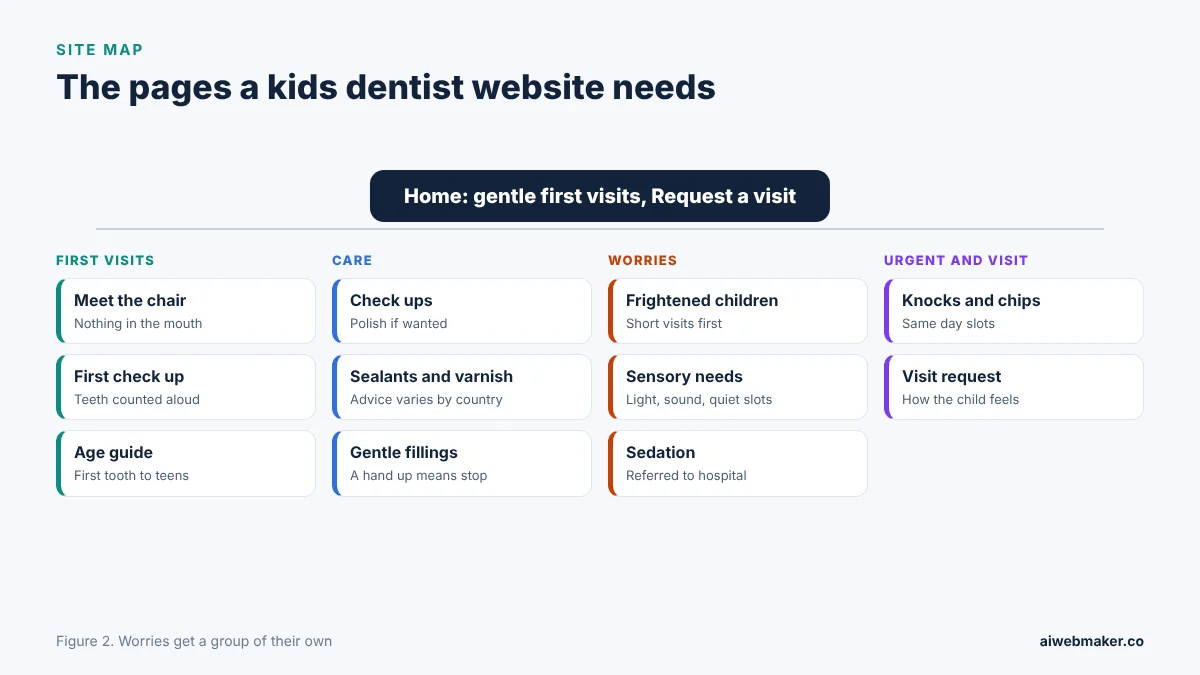
First visits take the leftmost column, care follows, and a whole group is set aside for worries, because fear shapes children's dentistry more than any treatment. Care pages explain check ups, sealants, varnish and fillings, while worry pages cover frightened children, sensory needs and how sedation is handled by referral. Toothfairy Lane Children's Dentistry, the invented practice in our sample, offers a Meet the chair visit and a First check up, then lists Check up and polish, Sealants, Fluoride varnish, Gentle fillings, Knocks and chipped teeth and Brushing coaching. Its single page adds an age guide and a section for frightened children. The kids dentist website example with a slow first visit and a stop signal ends with a request that asks how the child feels about the dentist.
Meet the chair visits and first check ups at a child's pace
The first visit is the product a children's dentist sells most carefully, and the website should describe it as a short story. A hello in the waiting room, a ride up and down in the chair, a gentle count of the teeth with a mirror and a sticker at the end make the sequence concrete. Some practices offer a meet the chair visit where nothing goes in the child's mouth unless the child wants it. The page should say how long each visit lasts and that a parent stays close throughout. Advice on when to start differs between countries, so the page can invite parents to ask what applies locally.
| Visit | Length | What happens |
|---|---|---|
| Meet the chair | About 20 minutes | A look around, a ride in the chair, a hello |
| First check up | About 30 minutes | Every tooth counted, gums and bite checked, a plain talk with parents |
| Short follow up visits | As needed | Small steps for children who need more time |
| Brushing coaching | About 15 minutes | Parent and child at the sink, the right brush and angle |
Sealants, varnish and fillings explained without jargon
Preventive care is where parents most often feel sold to, so each treatment should be explained with what it is, why it might suit a child and what it costs. Sealants are thin coatings painted into the grooves of back teeth, usually without drilling or numbing. Fluoride varnish is painted onto teeth during a check up, and advice on its use differs between countries and dental bodies, so the page can leave the local recommendation to the dentist at the visit. Fillings in baby teeth raise the question parents ask most, which the questions at the end of this guide answer. X rays should be described as taken only when needed, after a word with parents.
| Care | What it is | What the page should add |
|---|---|---|
| Check up and polish | A look at every tooth, the gums and the bite | How often the practice suggests one |
| Sealants | A thin coating in the grooves of back teeth | No drilling, and roughly how long it takes |
| Fluoride varnish | A quick paint during a check up | That advice varies by country |
| Gentle fillings | Tooth coloured fillings | Numbing explained, a pause whenever a hand goes up |
| X rays | Images between teeth or below the gum | Taken only when needed, after a word with parents |
Frightened children, sensory needs and a hand raised to stop
Fear is the main reason families switch children's dentists, and the website ought to present it as an ordinary part of childhood. A stop signal any child can use, such as raising a hand, should be explained on the page together with the promise that the dentist stops every time. Some children need three or four short visits before anything happens in the chair, and the page should say that this is planned for, not rushed. Children with sensory needs may want the light dimmed, the music off, sunglasses, headphones or the first quiet slot of the morning. Describing these adjustments in advance lets parents ask for them without feeling they are making a fuss.
Knocked teeth, chips and the same day slot
Dental injuries in children are common after falls and sport, and the website should tell parents exactly what to do. A practice that keeps same day slots for knocks and chips should say so prominently and ask parents to call as early as possible. If a child has hit their head, is bleeding heavily, seems drowsy or it is out of hours, the page should point parents to the local emergency number or the nearest emergency department. A knocked out adult tooth is time sensitive, so the instruction is to phone straight away for advice rather than send a request and wait. Clear urgent guidance turns a frightening afternoon into a manageable one.
Sedation referrals, specialist titles and children's dental schemes
Plenty of children's practices offer neither sedation nor general anaesthetic, which the website needs to admit openly, along with how families reach a hospital team when either is required. In several countries, paediatric dentist is a specialist title reserved for dentists on a specialist register, so a general practice that sees children should call itself a children's or family dental practice unless the title applies. Public schemes for children's dental care differ greatly, with some countries covering much of it and others relying on insurance or private fees. Its fee page should list the practice's prices and nudge parents to confirm what their scheme or plan will pay. Accurate titles and honest fee notes protect both the practice's registration and the family's budget.
Visit requests that start with how the child feels
The request is the moment a parent commits, so the words beside it should reassure parents that sharing a child's worries or a hard past visit helps the dentist plan. On the booking website builder for kids dentists and gentle first visits, the parent chooses a visit, such as a meet the chair appointment or a first check up, and sends it as a request. The front desk can confirm it, suggest another time when the slot is taken, or decline and point the family elsewhere, for example to a hospital team for sedation. Fees are paid to the practice at the desk, and the platform takes no cut. First visit, care and fee pages come from that builder too, written up once the practice explains how it works with children. A knocked tooth today should go by phone instead, and the page should say so beside the button.
Searches parents make after a first tooth or a playground fall
Parents search with phrases such as kids dentist near me, children's dentist, pediatric dentist, dentist for nervous children or chipped baby tooth, often naming their neighbourhood. Spelling and titles vary, since pediatric dentist is common in the United States while paediatric dentist and children's dentist are used elsewhere, and the title rules above still apply. The map listing should show after school hours, Saturday mornings, step access and buggy space. Reviews from parents who mention patience, a first visit that went well or a child who now looks forward to check ups reassure the next family. Articles on brushing a toddler's teeth, preparing for a first visit or what to do after a knock bring parents to the site long before they need an appointment.
Stickers, star ceilings and a small hosting line
Dental chairs, sterilising equipment, staff and registration make the website one of the smallest costs a children's practice carries. The hosting fee is $119 when a practice pays annually and $19 when it pays month by month, and the domain's cost follows from the ending picked out of about 400 available. AI credits for a dozen parent guides on brushing, snacks and first visits total about $7.80. Adding a Saturday clinic or changing a fee is not charged. Last, a $189 row sits in the table to show the next tier up, which the practice does not need.
| Item | Yearly | Monthly |
|---|---|---|
| Hosting the kids dentist pages | $119 | $228 over twelve months |
| Domain | Depends on the ending | Depends on the ending |
| Higher plan, for comparison | $189 a year | Not needed |
| Twelve articles for parents at about $0.65 | About $7.80 | About $7.80 |
| Fee, hours and care card updates | No charge | No charge |
| Year before the domain | About $126.80 | About $235.80 |
Clinical photos, missing prices and other reasons parents keep looking
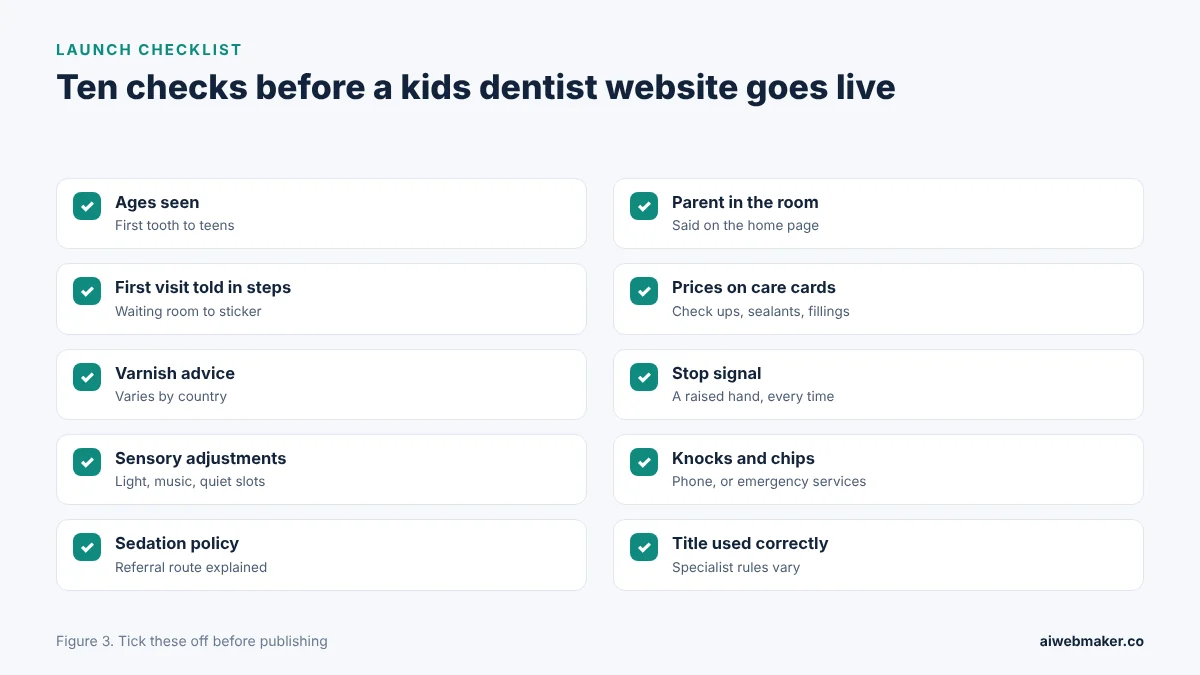
Parents close a children's dental website quickly when the photos show drills and clinical close ups instead of a friendly room. A first visit that is never described leaves them unable to prepare their child. Prices missing from check ups and sealants suggest a bill that will be explained only once the child is in the chair. Silence on sedation, knocks and sensory needs sends the families with the most at stake to search elsewhere. A matching fix for each gap appears among the ten checks that follow.
Frequently asked questions
Should a baby see a dentist before the first birthday?
Many dentists suggest a first visit when the first tooth appears or around the first birthday, though advice differs between countries. Early visits are short and mostly about getting used to the room, the chair and the dentist. Parents can ask their own dentist or child health nurse what applies where they live. The website can state the practice's suggestion and explain what a first visit for a baby involves. Starting early helps a child see the dentist as a normal part of life.
Can a parent stay in the room during treatment?
Most children's practices keep a parent or other carer in the surgery throughout every visit, sitting beside the chair or holding a younger child on their lap. Teenagers may choose a few minutes alone with the dentist while the parent waits nearby. That policy deserves a plain line on the website, because parents look for it before almost anything else. Some practices also welcome a sibling or a comfort toy. Clear rules about who stays help children feel safe from the moment they arrive.
Are baby teeth worth filling if they fall out anyway?
Baby teeth hold space for adult teeth and help children eat and speak, and a decayed baby tooth can hurt for a long time before it falls out. The dentist explains the options for each tooth, which may include filling, watching or other care, and nothing is done without a parent's agreement. The website can answer this common question in plain words without making clinical promises. A clear explanation reduces the guilt and confusion many parents feel. Honest answers build the trust that keeps families returning.
Does the practice offer sedation for anxious children?
Many children's practices do not sedate children or offer general anaesthetic, and refer families to a hospital team when treatment needs it. The website should say this plainly and describe how the referral works and how notes are shared. Practices that do offer sedation should explain who provides it, where and under which rules, since requirements vary by country. Parents of very anxious children also want to know what can be tried first, such as short visits and a stop signal. Honest information about sedation helps families plan without false hope.
How few check ups cover a kids dentist's hosting
A morning of children's check ups usually earns more than a full year of the practice's hosting at $119. On monthly billing, $19 falls short of what one check up costs a family. Each family that brings a younger sibling, and each parent who recommends the practice at the school gate, adds income that calm pages helped win. A first visit described step by step, honest prices and a stop signal any child can use persuade parents better than any promise of a perfect smile. A waiting room full of children who are curious rather than crying is the result the pages are written to produce.
Build your website in Minutes and get the AI Tools that work
Start Building Your Website →