Hypnotherapy Website Cost, and the Limits a Practice Should Publish
Twelve months of hosting for a hypnotherapy website are priced at $119, or $19 per calendar month, with the domain bought apart. Next come clients and their doubts, goals and limits, sessions, fees, regulation, search and the yearly budget.
- No coding required
- Live in minutes
- Blog, SEO and chatbot tools included
Twelve months of hosting for a hypnotherapy website are priced at $119, the monthly alternative is $19, and the domain carries its own small price. Writing the goal cards, the list of conditions that belong with a doctor and the fee section, then reviewing them in preview, is never billed. A single short course of sessions covers the year with plenty left over. The real test is credibility, because many visitors arrive half curious and half sceptical, and some arrive vulnerable. The site therefore has to be calm, modest about outcomes and clear about who should see a doctor instead. Below are who looks for help and why, the pages, goals and medical limits, what a session feels like, consultations and fees, regulation and claims, search, the yearly bill and why sceptics leave.
This article is part of our complete guide: Healthcare Website Builder.
Who looks for a hypnotherapist, and what makes them sceptical?
People who look for a hypnotherapist usually have a specific, everyday goal and a fair amount of doubt about the method. Some want to change a habit, such as nail biting or late night snacking, that they have tried to break before. Students and job seekers want help with exam or interview nerves, and performers and athletes with nerves before a match or a recital. Others want more confidence at work or a steadier voice when speaking in public. Most of their doubt comes from stage shows and television, which picture hypnosis as a loss of control. A website that answers that doubt calmly earns the first consultation.
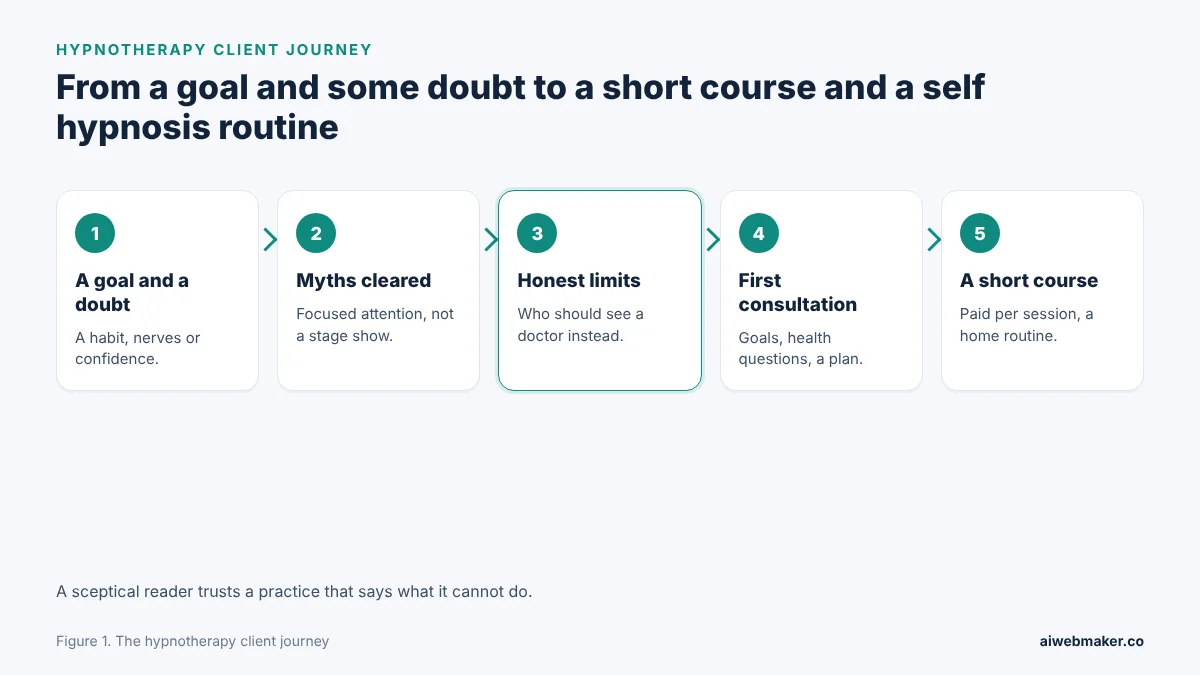
Honest limits are the step this journey picks out, because a sceptical reader trusts a practice that says what it cannot do. The path starts with a goal and a search, often after other approaches have not worked. A page that explains what hypnosis is, and is not, removes the stage show picture. The list of conditions that need a doctor instead then shows the practitioner knows their scope. A first consultation follows, and only after it does a short course begin, paid session by session. The client leaves with a self hypnosis routine and, ideally, a recommendation for a friend.
Pages that set limits before they set fees
A hypnotherapy website should show its limits before its fees, because the order of pages tells a visitor what the practice values. A goals page names the everyday problems the practice works with, without promising outcomes. A page on when to see a doctor instead sends serious conditions elsewhere. An explanation of what a session feels like clears up the myths that keep people away. Fees, the room, questions and the request route then complete the site.
| Page | What visitors look for | What it should hold |
|---|---|---|
| Goals | Whether their problem fits | Habits, nerves, confidence, self hypnosis |
| When to see a doctor | Whether hypnotherapy is suitable | Conditions that need medical or specialist care |
| What a session is like | Reassurance about control | Focused attention, not sleep or a stage show |
| Fees and courses | Cost without pressure | Consultation, single session, short course |
| About the practitioner | Training and accountability | Training, insurance, professional body |
| Request | A gentle first step | Session, date, crisis note beside the form |
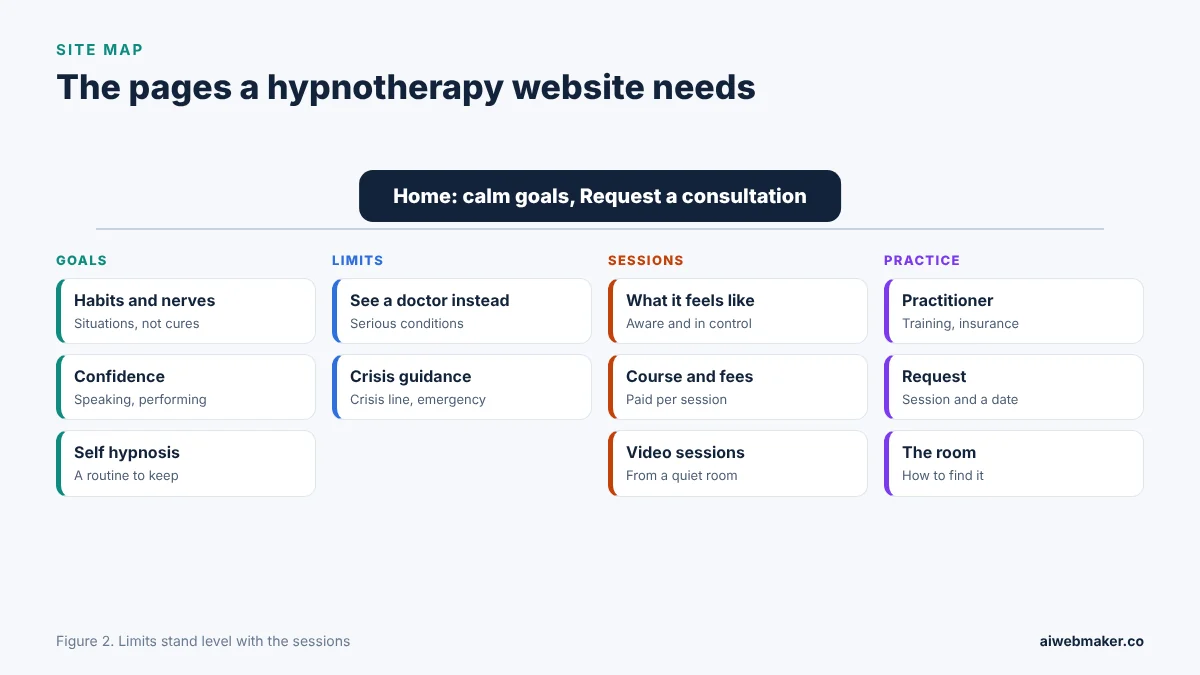
The four branches here put the practice's limits on the same level as its sessions, which is what earns a sceptic's trust. The goals branch names habits, nerves and confidence, plus the self hypnosis routine clients take home. The limits branch holds the doctor first list and the crisis guidance. The sessions branch explains hypnosis, the course and the fees, while the practice branch covers the practitioner, the room and the request. Our sample practice, Stillwater Hypnotherapy, works with habits, exam and interview nerves, performance and sport, public speaking, confidence, and relaxation and self hypnosis, offers a first consultation, a course of three and a single session, and adds a table of conditions that belong with a doctor, the steps from first consultation to last session, a section on what hypnosis is and is not, questions and a request; the hypnotherapy website example that sets out its limits before its fees keeps a crisis note beside the form.
Habits and nerves on one side, medical care on the other
The most responsible section on a hypnotherapy website draws a clear line between everyday goals and conditions that need medical care. Goal cards should describe the situation, such as nerves before an exam, rather than the outcome, because nobody can promise how hypnosis will go for a particular person. Calling the approach complementary rather than medical sets expectations from the first line. Serious mental illness, eating disorders, dependence on alcohol or drugs and unexplained pain all need a doctor or specialist service first. Anyone thinking of harming themselves needs immediate help from a crisis line or local emergency services, not a hypnotherapy appointment. A practice that draws this line clearly is far easier to trust with everything else.
| If someone is living with | The page should point them to |
|---|---|
| Depression, bipolar disorder or psychosis | Their doctor or mental health team |
| Thoughts of self harm | A crisis line or the local emergency number at once |
| An eating disorder | Their doctor, for specialist referral |
| Dependence on alcohol or drugs | Their doctor or an addiction service |
| Pain nobody has checked yet | Their doctor, so the cause is investigated |
Trance without the stage show: explaining what a session feels like
Most people's picture of hypnosis comes from entertainment, which is exactly what keeps cautious clients away. A short section can explain that hypnosis is a state of focused attention, closer to being absorbed in a book or a long quiet drive than to sleep. It should state plainly that the client hears everything, can speak, stays in control and can stop at any time. Nothing happens in a session that the client has not agreed to beforehand. Admitting that some people notice change quickly, some gradually and some not at all is honest and oddly reassuring. Clearing up these myths early lets the rest of the page be read with an open mind.
Consultation, short courses and paying session by session
Fees on a hypnotherapy website should show that the practice is in no hurry to sell, which is why paying session by session reassures more than a large package. A first consultation covers what the client wants to change, what hypnotherapy can and cannot do and a few health questions. A short course of three to five sessions, spaced a week or two apart, suits many everyday goals, with a recorded relaxation for practice at home. Through the booking website builder for hypnotherapists taking first consultation requests, a client requests an opening consultation for a date that suits. The practitioner says yes to that time, suggests another or declines, and each fee is paid to the practice directly with no cut going to AI Web Maker. Notice periods for moving a session belong on the same page.
| Option | What it usually includes | What the page should say |
|---|---|---|
| First consultation | Goals, limits, health questions | No obligation to continue |
| Short course | Three to five sessions, a home recording | Paid one session at a time |
| Single session | One focused goal, such as an exam | For clients already seen once |
| Video sessions | The same structure at home | Whether the first visit is in person |
Protected titles, professional bodies and claims to avoid
How hypnotherapy is regulated depends on the country, and the title itself often has no legal protection, so careful practitioners explain how visitors can check them. The website can offer details of training, insurance, professional body membership and how complaints are handled. Advertising rules on health claims also differ between countries, and some regulators restrict what hypnotherapy may claim to treat. The safest course is to make no medical claims at all and to describe goals rather than cures. Client details should be kept only for arranging sessions, and the request page can say so. Transparency about credentials and claims is what turns a sceptical reader into a first consultation.
Hypnotherapy for exam nerves or nail biting: phrases people type
People search for hypnotherapy by goal, typing phrases such as hypnotherapy for exam nerves, help to stop nail biting or hypnosis for confidence. Public speaking nerves is another common search, usually paired with a town or the words online sessions. A page that names each goal in everyday words, and says clearly what the practice does not treat, meets those searches honestly. A practice's map listing benefits from the right category, real session hours and a calm photo of the room rather than swirling spirals. Reviews describing a frank first consultation and a practitioner who knew their limits persuade sceptical readers. Articles on what hypnosis feels like, how to prepare for a session or self hypnosis basics attract people before they decide. Patient, modest writing builds the credibility this trade depends on.
A practitioner's hosting year, with credits for a dozen articles
Only two costs return every year for a practice site, hosting and the domain, and twelve explanatory articles produced with credits total roughly $7.80. A practitioner settled in one town will likely clear $119 at once. Someone building a practice alongside other work might prefer $19 each month. Rewriting a goal card, adjusting fees or adding video sessions brings no extra charge. The table lists the $189 tier only to complete the comparison.
| Item | Yearly | Monthly |
|---|---|---|
| Hosting the practice pages | $119 | $228 over twelve months |
| Domain | Depends on the ending | Depends on the ending |
| Higher plan, for comparison | $189 a year | Not needed |
| Twelve explanatory articles at about $0.65 | About $7.80 | About $7.80 |
| Goal, fee and session updates | No charge | No charge |
| Year before the domain | About $126.80 | About $235.80 |
Miracle claims and missing limits: why sceptics close the tab
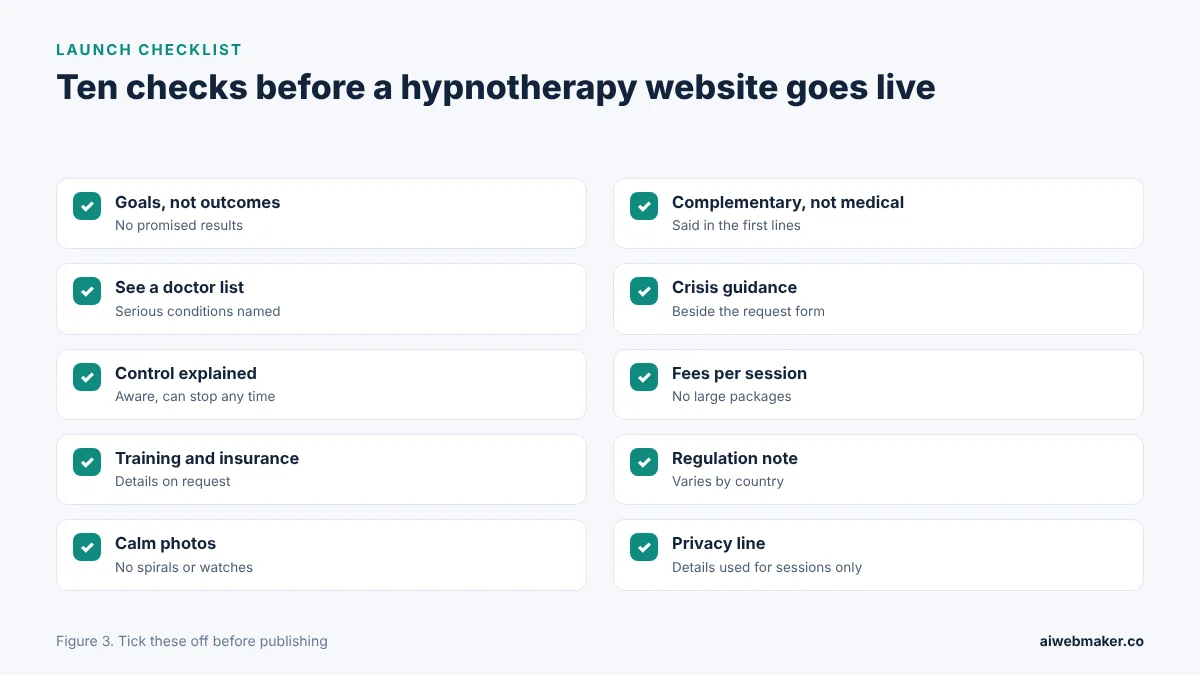
Sceptical visitors close a hypnotherapy website as soon as it promises a cure or a result in a single session. Large packages paid up front read as pressure and push careful people away. A page with no word on who should see a doctor instead suggests the practitioner does not know their limits. Missing training, insurance and membership details leave readers with nothing to check. Spirals, swinging watches and stage imagery reinforce the very myths that kept them doubtful. Ten checks that remove those doubts are gathered in the picture beneath.
Frequently asked questions
Does anyone lose control under hypnosis?
Clients stay aware and in control during hypnotherapy, and they can speak, open their eyes and stop at any time. The state is one of focused attention, which many people compare to being absorbed in a book. Nothing happens in a session that the client has not agreed to beforehand. Stage shows create a very different impression, which is why the website should explain this plainly. Plain words about control dissolve the fear that stops many first bookings.
Is a course of three sessions usually enough?
Many clients working on an everyday goal choose a short course of three to five sessions, but there is no fixed number that suits everyone. The first consultation is the right place to agree a plan, and the client can stop at any point. Paying one session at a time keeps the decision in the client's hands. A final review session can look at what has changed and what has not. Honest guidance on numbers builds more trust than a package sold in advance.
Can sessions work by video?
Many hypnotherapists offer follow up sessions by video, held from a quiet room at the client's home. Some prefer to hold the first consultation in person so they can meet the client and explain the approach face to face. The website should state which sessions are available by video and what the client needs to prepare. A reliable connection and an undisturbed space matter most. With those details in hand, a client can pick between the room and the screen without guessing.
Is hypnotherapy regulated?
Rules for hypnotherapists differ from country to country, and the job title frequently carries no legal protection. Voluntary professional bodies set training and conduct standards, and many practitioners join one and hold insurance. Visitors should ask any practitioner about their training, insurance, professional membership and complaints process. The website can answer those questions openly rather than waiting to be asked. Openness about credentials helps visitors choose a practitioner with confidence.
Would a single course of three repay the whole year?
A short course of three sessions is typically worth more to a practice than its full $119 hosting year, and a first consultation alone can cover a month at $19. Every visitor who reads the limits, understands what a session feels like and sends a request arrives with realistic expectations. Those clients engage more fully with the work and are more likely to recommend the practice. Recommendations from satisfied clients then bring new consultations without extra effort. Practitioners who keep their goals, limits and fees current receive requests from people who are a good fit for the work. A diary of first consultations from readers who already understand the method is the measure that matters.
Build your website in Minutes and get the AI Tools that work
Start Building Your Website →