Home Care Website Cost and the Pages Families Read Before They Call
Home care agencies pay one hosting fee of $119 a year, or monthly instalments of $19, plus a domain. Topics: families, services, assessments and care plans, medication support, registration and carers, rates and funding, search and the yearly budget.
- No coding required
- Live in minutes
- Blog, SEO and chatbot tools included
Home care agencies on AI Web Maker pay a single hosting fee of $119 a year, or monthly instalments of $19, and register a domain on top. Every service description, carer introduction and care plan explanation can be written, read aloud and corrected in the preview before anything is charged. A few hours of care for one new client usually exceed that yearly figure. Care descriptions written for anxious relatives can be read in full on the home care agency website sample, where AI Web Maker imagined an agency and wrote every page for families choosing carers. The real difficulty is that families choose care at a stressful moment, often after a fall, a hospital stay or a slow realisation that a parent can no longer manage alone. They read every word, they compare several agencies and they want proof that the people walking into a relative's home are trained, checked and kind. This article covers who looks for home care, the services, assessments and care plans, medication support, registration and carer checks, rates and funding, search and the yearly budget.
This article is part of our complete guide: Healthcare Website Builder.
Hospital discharge, a fall or worried relatives: who looks for home care
Home care enquiries usually come from family members rather than the person who will receive care, and they often arrive under time pressure. Adult children, sometimes living far away, search late at night after a phone call about a fall or a missed meal. Hospital discharge teams and families need support arranged quickly so that someone can return home safely. Spouses who have been caring alone may look for respite before they reach exhaustion. People living with a disability or a long term condition may search for themselves and want control over how support is given. Each of these visitors needs calm, specific information and a clear sense that the agency respects the dignity of the person receiving care.
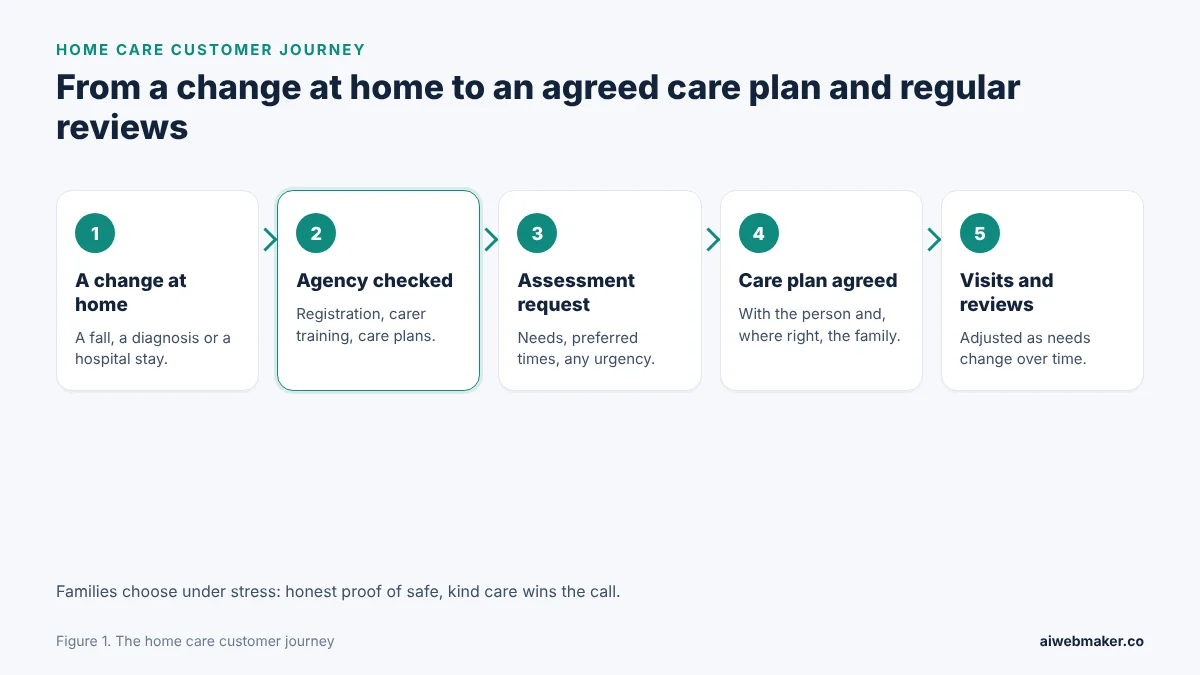
A change at home sets this journey in motion, such as a fall, a diagnosis, a hospital stay or a carer who can no longer cope. Families then research agencies, and the step that decides most choices is checking registration, carer training and how care plans are agreed. A request for an assessment visit follows, ideally with a short description of needs, preferred times and any urgency. The assessment produces a written care plan agreed with the person and, where appropriate, the family. Regular visits, reviews and adjustments as needs change decide whether the family stays with the agency and recommends it. A website that answers the deciding step honestly carries families through the rest with far less anxiety.
Personal care to respite: describing each service in plain words
Families choosing care for the first time often do not know what the professional terms mean, so each service should be described in everyday language. Personal care covers help with washing, dressing, toileting and moving around the home, delivered with privacy and respect. Companionship offers conversation, outings and simply being present for someone who is lonely. Meal preparation and light housekeeping keep a home running and make sure someone is eating well. Medication support and respite care each need their own careful explanation. A short line on what each visit includes helps families build the right mix of support.
| Service | What it usually involves | What families should be told |
|---|---|---|
| Personal care | Washing, dressing, toileting, moving safely | How privacy and dignity are protected |
| Companionship | Conversation, outings, hobbies | How carers are matched to interests |
| Meal preparation | Cooking, encouraging meals and drinks | How dietary needs are recorded |
| Light housekeeping | Tidying, laundry, keeping spaces safe | What is and is not included |
| Medication reminders | Prompts to take prescribed medicines | The level of support the agency provides |
| Respite care | Cover so a family carer can rest | Booking ahead, length of cover |
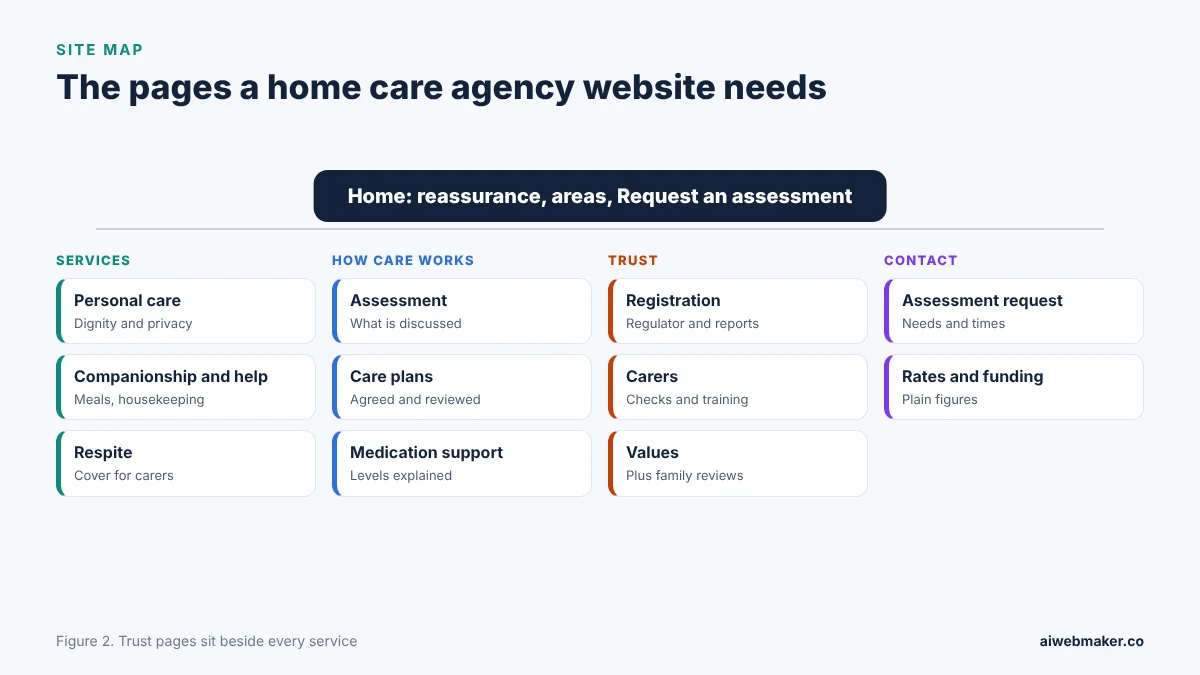
Four sections organise a home care website, and the home page should offer reassurance, the areas served and a calm route to request an assessment. Service pages cover personal care, companionship, practical help, medication support and respite. How care works pages explain assessments, care plans, reviews and what happens when needs change. Trust pages hold registration, inspection reports where they exist, carer recruitment and training, values and reviews, while the contact page invites families to describe the care they need. Comfort Haven Home Care, the sample agency, offers six bookable services, personal care, companionship, meal preparation, light housekeeping, medication reminders and respite care, each showing an hourly figure, and its how it works page explains how a care plan is agreed and what happens when needs change. The home care agency website example with care plan guidance and carer introductions also has an about page setting out the agency's values and its carers, and it was built in 53 seconds.
Assessment visits and care plans that families help shape
A clear account of the assessment and care plan process reassures families that they and their relative will stay involved in every decision. The assessment visit usually covers daily routines, health and mobility, risks in the home, preferences such as preferred names and food, and what the person wants to keep doing independently. The resulting care plan records what support is given, when and by whom, and it should be agreed with the person receiving care wherever they are able to take part. Reviews at regular intervals, and whenever needs change, keep the plan accurate. On an agency site made with the booking website builder for home care agencies and care providers, a family asks for an assessment visit, and the agency then says yes, offers a better time or explains that it cannot cover the area or the level of need. Fees are agreed directly between agency and family, and the platform keeps none of them. A transparent process often persuades a family to make that first request.
| Care plan element | What it records |
|---|---|
| Daily routine | Visit times, tasks and preferences |
| Health and mobility | Conditions, equipment, moving and handling needs |
| Risks | Falls, the home environment, safeguarding notes |
| Preferences | Names, food, faith, routines that matter |
| Independence goals | What the person wants to keep doing |
| Contacts | Family, doctors and who to call when concerned |
| Review dates | When the plan is checked and updated |
Prompting, assisting, administering: how medication support is described
Medication support needs careful wording, because families may assume a carer can do more than the agency's registration and training allow. Many agencies distinguish between prompting, where a carer reminds the person to take medicines they manage themselves, assisting, where the carer helps open packaging or pour liquids, and administering, where the carer gives medicines following a care plan. Which of these an agency may offer depends on local regulation, the agency's own policy and the training of its carers. Clinical tasks, such as injections or wound care, usually belong to nurses or other health professionals unless specific training and delegation are in place. Questions about the medicines themselves should always go to a doctor or pharmacist. Clear boundaries protect clients, carers and the agency alike.
| Level of support | What it usually means | Notes |
|---|---|---|
| Prompting | Reminding the person to take their medicines | The person manages their own medicines |
| Assisting | Help with packaging, measuring or a drink | Following the care plan |
| Administering | Carer gives the medicine as prescribed | Depends on regulation, training and policy |
| Clinical tasks | Injections, wound care and similar | Usually health professionals |
Registration, inspection reports and carer checks families can verify
Home care regulation differs greatly between countries, so an agency's site must name the registration or licence that applies and show families how to check it. In England, for example, agencies providing personal care register with the Care Quality Commission, which publishes inspection reports, while other countries and states use different regulators or licensing systems. The site can explain how carers are recruited, which background checks are carried out under local law, and what training they receive in areas such as moving and handling, safeguarding, infection control and first aid. Supervision, spot checks and continuity of carers matter to families as much as qualifications. A clear complaints and safeguarding procedure, with a named contact, shows that concerns are taken seriously. Honest statements carry more weight than any general claim of excellence.
| What families can check | Where to look |
|---|---|
| Registration or licence | The regulator's public register where one exists |
| Inspection reports | The regulator's website, linked from the agency |
| Background checks | The agency's recruitment page |
| Carer training | Topics covered and refresher frequency |
| Complaints procedure | A named contact and response times |
| Insurance | Liability cover held by the agency |
Hourly rates, minimum visits and funding routes
Families planning care need to understand the cost early, so a clear explanation of rates and funding prevents painful surprises later. Hourly rates are the usual starting point, with notes on minimum visit lengths and higher rates for evenings, weekends, nights or public holidays where they apply. Live in care and overnight care are often priced differently and should be explained separately. Funding varies greatly by country, and some families may qualify for public support, insurance or benefits, so the website can signpost local advice services rather than promise eligibility. Invoicing and payment are arranged directly between the agency and the family or funder. Plain figures, honestly qualified, reduce anxiety at a difficult time.
Home care near me, dementia care, respite: what families search
Relatives searching for support use phrases like home care near me, dementia care at home, respite care or companionship for an elderly parent, often with a town. Those exact words belong in the matching service headings. Families often search on a phone late in the evening, so the map entry should show the office, opening hours and every town the carers reach. Reviews from families that mention kindness, reliability and good communication carry particular weight in this sector. Articles on preparing a home for care visits, recognising when a parent needs support or what to ask an agency answer questions families search before they ever pick up the phone. Gentle, accurate writing builds the trust that care depends on.
Twelve months online weighed against one week of visits
Hosting and a domain are all an agency's website really costs, since each family guidance article drafted with credits is about $0.65. Established agencies spend least when they settle twelve months at once. Monthly instalments may suit a newly registered agency still gathering its first clients. Updating rates, introducing new carers and refreshing care information carry no extra charge. The two routes are tabled next, with the $189 tier present to give a sense of scale.
| Item | Yearly | Monthly |
|---|---|---|
| Hosting the home care pages | $119 | $228 over twelve months |
| Domain | Depends on the ending | Depends on the ending |
| Higher plan, for comparison | $189 a year | Not needed |
| Twelve family guidance articles at about $0.65 | About $7.80 | About $7.80 |
| Rates, carer and service updates | No charge | No charge |
| Year before the domain | About $126.80 | About $235.80 |
Vague promises and no regulator named: why families keep searching
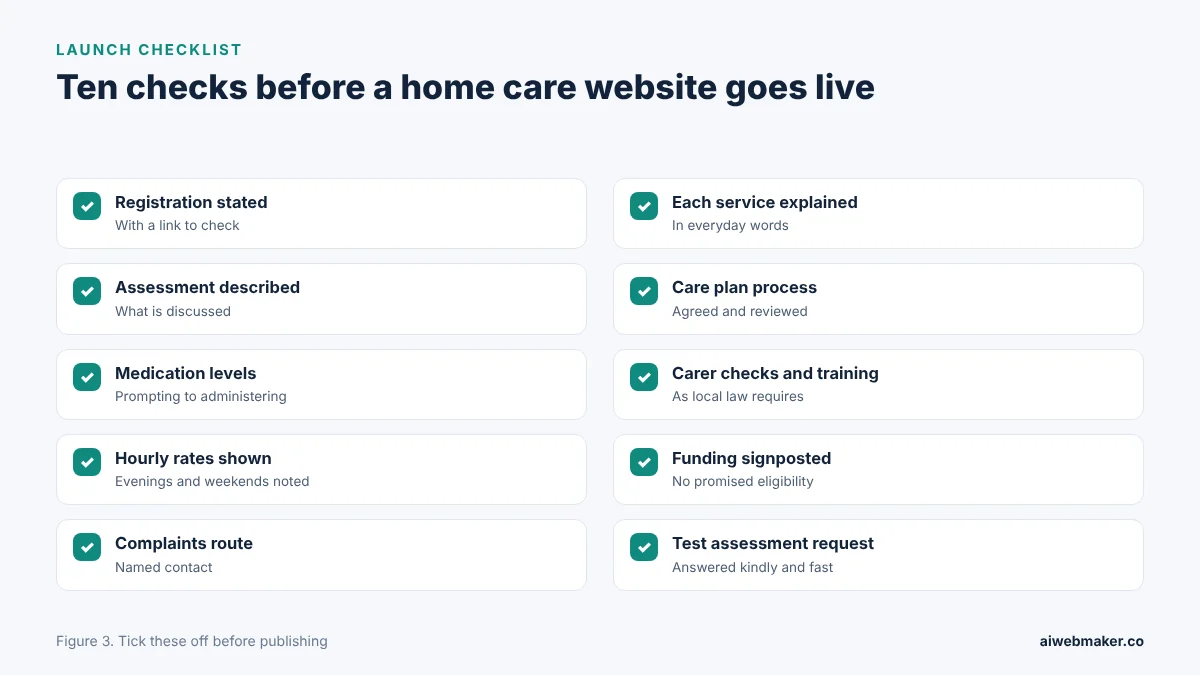
Families leave a home care site when it offers warm words but no registration details, inspection link or carer checks. Stock photos of smiling strangers make it hard to picture who will actually visit. Missing rates leave families fearing a cost they cannot meet. Vague descriptions of medication support raise more questions than they answer. A contact route that asks nothing about needs, times or urgency makes a stressed relative explain everything twice. Families should find none of those gaps once the ten points pictured below are settled.
Frequently asked questions
How quickly can care start after a hospital stay?
How quickly care can start depends on the agency's capacity in the area, the level of need and whether an assessment can be arranged before discharge. Some agencies can begin within days, while complex needs may take longer to plan safely. Families should contact agencies as early as possible once a discharge date is likely. The hospital discharge team can also advise on local options and any short term support available. Stating typical start times on the website helps families plan with realistic expectations.
Can the same carers visit each time?
Many agencies aim for continuity, so that a small, consistent team of carers visits the same person. Holidays, sickness and changes in visit times mean complete continuity cannot always be guaranteed. The website can explain how carers are matched and how the person is told if someone new is coming. Continuity matters greatly to people living with dementia, for whom familiar faces bring comfort. Clear commitments on this point reassure families more than broad promises.
What should a family do if worried about the care?
A family worried about care should raise the concern with the agency's manager first, using the complaints procedure described on the website. If the concern is not resolved, the relevant regulator or local authority can usually advise on next steps. Anyone who believes a person is in immediate danger should contact the emergency services. Concerns about abuse or neglect can also be reported to the local safeguarding team where such services exist. An agency that explains these routes openly shows it has nothing to hide.
Does public funding cover home care?
Public funding for home care exists in some countries and regions, but eligibility, assessment and the amount of support vary widely. Some families receive help through a local authority or health system, while others rely on private payment, insurance or benefits. The rules can be complex, so families should seek advice from the relevant public body or an independent adviser. An agency can explain whether it works with public funders without promising that any family will qualify. Honest signposting helps families plan without false hope.
When one family's trust repays the hosting year
Hosting the agency's site for a whole year costs $119, which is typically less than a handful of care hours for a single new client. Billed monthly, the $19 is smaller than a single short visit at most agencies. Every family who requested an assessment after reading the care plan page represents support the site helped arrange. Plain service descriptions, honest registration details and real carer introductions earn the trust that care relies on. Agencies that keep rates, carer profiles and guidance current give families confidence at a moment when they need it most. When families say the website answered their questions before they ever phoned, it has earned its place in the agency's budget.
Build your website in Minutes and get the AI Tools that work
Start Building Your Website →