Hearing Aid Website Cost and the Pair Price That Includes the Reviews
For a hearing aid centre, hosting comes to $119 paid in one go each year, or to $19 a time for months settled singly, plus a domain. Topics run from first bookings, the test and styles to pair prices, reviews, repairs, red flags, fitting rules, searches and the year's spending.
- No coding required
- Live in minutes
- Blog, SEO and chatbot tools included
For a hearing aid centre, a year on AI Web Maker costs $119 paid in one go, or $19 for each month paid as it comes, plus a domain. Shaping the test, styles and price pages and listening to how they read in the preview does not cost the centre a cent. One pair of aids at the sample centre's $1,450 from price pays for more than twelve years of that hosting. What makes the work delicate is that many clients put off a test for years and arrive at the website half persuaded by a partner. They fear a sales pitch, expensive gadgets and the stigma of wearing aids at all. This guide covers who books, the test, styles, pair prices, review weeks, repairs, red flags and the rules on fitting, then search and the yearly budget.
This article is part of our complete guide: Healthcare Website Builder.
A partner's nudge, the television volume and a work check: who books a hearing test
Most people who book a hearing test have noticed a problem for some time, and the website has to make the first step feel small. A partner who repeats every sentence or a family complaint about the television volume prompts many searches. Some clients come after a hearing check at work or a note from their own doctor. Existing wearers look for a new centre after a move, or for someone to repair aids bought elsewhere. Adult children often search for a parent and want to know whether they may come to the appointment.
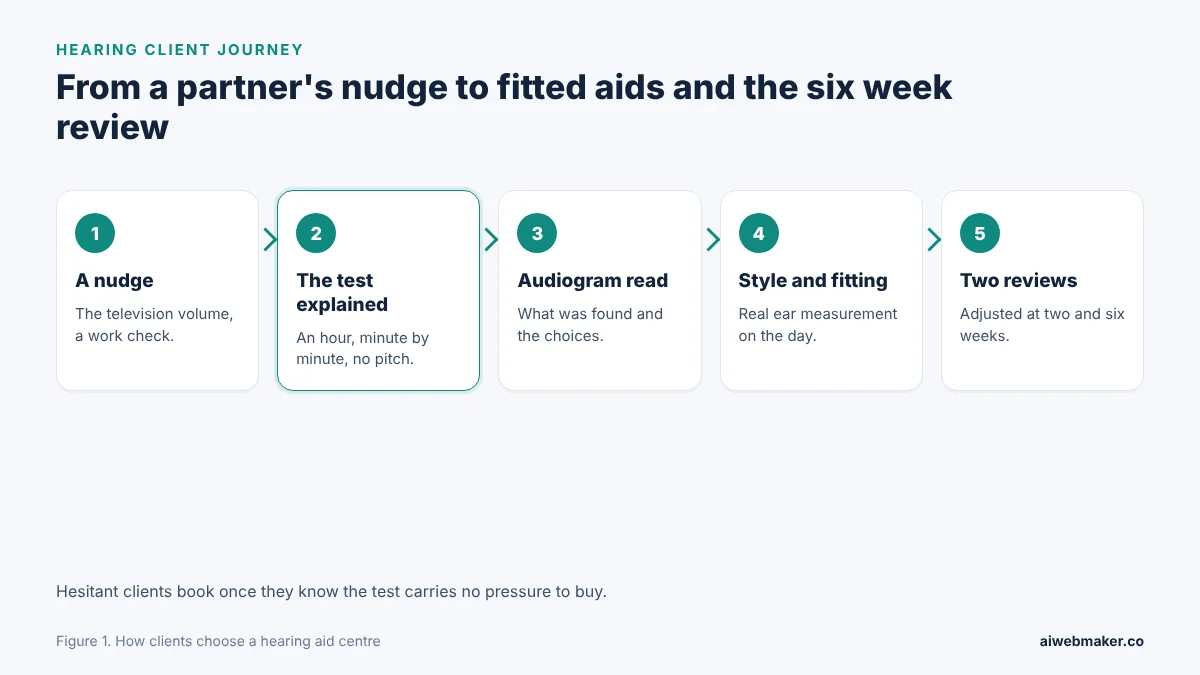
The second step is shaded because a hesitant client almost always reads what happens during the test before agreeing to book one. A nudge from a partner or a work check starts the journey, and a clear account of the test, without pressure to buy, decides whether a request follows. The audiogram explained in plain words then shows whether aids would help. Choosing a style and fitting it come next, with real ear measurement checking the result. Two reviews in the first six weeks turn a nervous buyer into a wearer who recommends the centre to friends.
Test, styles, review weeks and repairs: the pages a hearing centre runs on
A hearing centre's site should follow the client from the first test to years of aftercare, with each page answering one worry. The home page says who the centre tests and that a partner is welcome at every visit. A test page describes each part of the hour, while a styles page explains the main types of aid without brochure words. A price page sets out the test, the pair and repairs, and a fitting page explains the review weeks. Repairs, medical red flags and the request close the site, with the hearing loop and level entry noted for visitors.
| Page | Client's question | What it should contain |
|---|---|---|
| Home | Is this centre patient with first timers? | Adults tested, partners welcome, no pressure |
| The test | What happens in that hour? | Each part, how long it takes, the audiogram |
| Styles | Which aid would suit me best? | Main styles, who each suits, rechargeable or battery |
| Prices | What will a pair cost in total? | Test fee, pair price, what the price includes |
| Fitting and reviews | What happens after the fitting? | Real ear measurement, reviews, swap terms |
| Repairs | Can a whistling aid be fixed? | Drop in times, aids from elsewhere, loan aids |
| Red flags | When is a doctor needed instead? | Sudden loss, pain, discharge, dizziness |
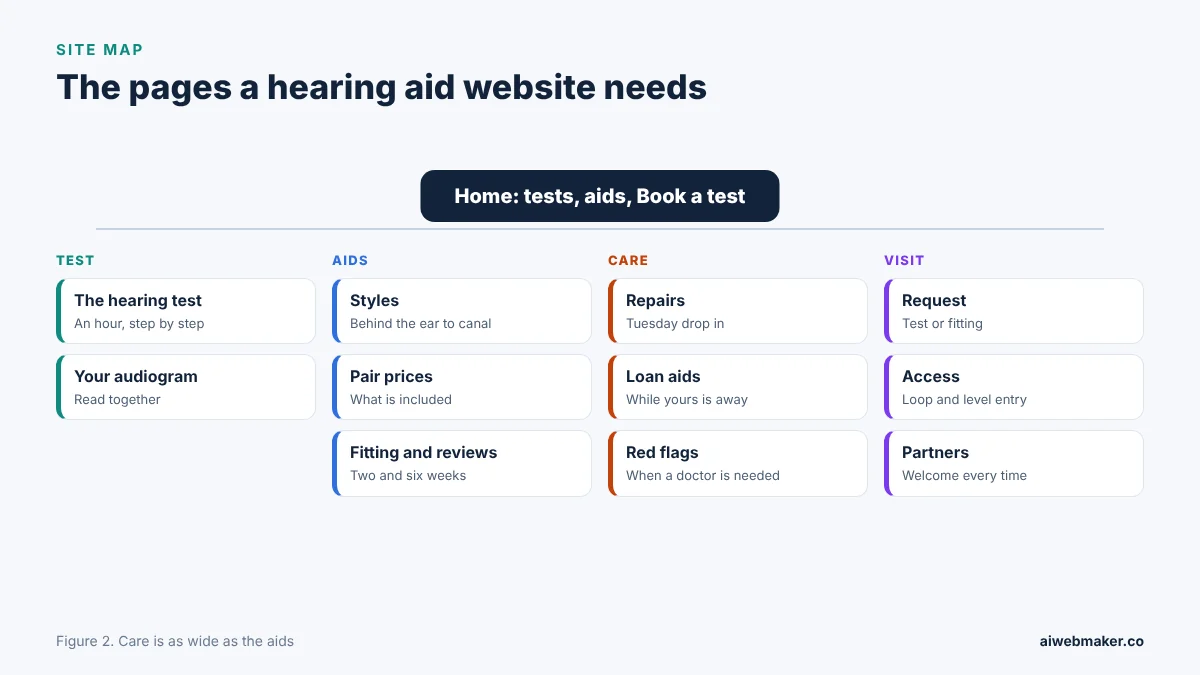
Care spreads as wide as the aids on this map, because aftercare is where wearers judge a centre over the years. Test pages hold the hour by hour description and a guide to reading the audiogram. Seashell Hearing Centre, the invented centre in our hearing aid website example that times every part of the test, describes behind the ear, receiver in the canal, in the ear and deep in the canal styles, with notes on rechargeable or battery power and on calls and television. Its prices cover a full hearing test, hearing aids as a pair and repairs and servicing. Tuesday afternoons are set aside for repair drop ins, and the request asks whether anyone is coming along.
A test that does not end in a sales pitch
The hearing test is the product that brings clients through the door, so its page should describe every minute and promise that no decision is needed on the day. A full test usually starts with questions about where hearing is hardest, followed by a look into the ears, a check of the eardrum, tones through headphones and words in background noise. The sample prices it at $75 and states that hearing aids are not discussed unless the client asks. On the booking website builder for hearing centres that test before they fit, a client chooses a test or a fitting appointment, and that choice reaches the centre as a request. Staff there can confirm the time, suggest a different one or say no, and the client pays the centre after the appointment, with the platform standing outside that payment entirely.
| Part of the test | Roughly how long | Why the page should mention it |
|---|---|---|
| Questions about daily life | 10 minutes | Shows the client's priorities shape the test |
| Look into the ears | 5 minutes | Wax or a canal problem can change results |
| Eardrum pressure check | 5 minutes | Middle ear movement, painless and quick |
| Tones through headphones | 20 minutes | Finds the quietest sound at each pitch |
| Speech in noise | 10 minutes | Shows how conversation comes through in a busy room |
| Audiogram explained | 10 minutes | The client leaves knowing what was found |
Behind the ear to deep in the canal: styles without brochure words
Clients arrive confused by model names, so a styles page should explain the main shapes of hearing aid and who each tends to suit. Behind the ear aids are sturdy and easy to handle, receiver in the canal aids are a frequent choice for mild to moderate loss, and custom styles sit inside the ear. Very small aids suit only some ears and some losses, and tiny batteries can be hard for stiff fingers. Rechargeable models suit people who dislike changing cells, while streaming of calls and television matters to many wearers. A centre that explains styles honestly helps clients choose with their audiogram, their hands and their day in mind.
| Style | Often chosen for | Point to weigh |
|---|---|---|
| Behind the ear | A wide range of losses, easy handling | More visible than smaller styles |
| Receiver in the canal | Mild to moderate losses | Small parts need regular cleaning |
| In the ear | People who wear glasses | Larger than other custom styles |
| Deep in the canal | Discretion, for suitable ears | Tiny batteries, not for every loss |
Bundled pairs and itemised care: what the price of two aids covers
The pair price is the money question every client asks, and the page should list what it includes instead of quoting a bare figure. Some centres bundle the aids with fitting, reviews and a period of aftercare, while others price the devices and the care separately, and either approach can be fair when it is explained. The sample's from price of $1,450 for a pair includes choosing, fitting with real ear measurement, reviews at two and six weeks and a year of cleaning and adjustments. After that year, the page should say what aftercare costs and whether loss or damage cover is available through the centre or an insurer. Every quote should be written down before anything is ordered, as the sample promises.
| Element | In the sample's pair price? | What any centre should state |
|---|---|---|
| Choosing appointment | Yes | Styles compared, prices in writing |
| Fitting with real ear measurement | Yes | What the measurement checks |
| Reviews at two and six weeks | Yes | What is adjusted at each |
| Swap by six weeks if the model does not suit | Yes | Any conditions attached |
| A year of cleaning and adjustments | Yes | Cost of aftercare after that year |
| Loss and damage cover | Not stated | Whether it is offered, and by whom |
Tuesday drop ins, loan aids and repairs for aids bought elsewhere
Repairs and servicing keep wearers coming back for years, and a clear repairs page often wins clients who bought their aids from another provider. Domes, filters and tubing wear out, wax blocks receivers and aids begin to whistle, so wearers need to know when they can walk in. The sample runs a Tuesday afternoon drop in with no appointment, charges repairs from $20 and offers a loan aid while an aid is sent away. Stating that most makes and styles are looked at, whoever sold them, removes a common barrier. Steady repair work also brings the centre's name to people who will need new aids in a few years.
Sudden hearing loss, ear pain and the rules on who may fit
A hearing centre's website must make clear what a hearing test cannot do, because some symptoms need a doctor rather than a fitting. Hearing that drops away suddenly over hours or days, pain, discharge, or loss in one ear only are reasons to see a doctor that same day. Facial weakness, slurred speech or sudden severe dizziness alongside hearing loss call for the local emergency number. Who may test hearing and fit aids depends on the country, with registered audiologists or hearing aid dispensers in some places. The United States, among others, now lets adults with perceived mild to moderate loss buy certain aids over the counter without a fitting. The page should name the centre's own qualifications and register, and explain when a professional fitting is the better route.
Hearing test near me, hearing aid repairs and other phrases wearers type
People search with phrases such as hearing test near me, hearing aid repairs, rechargeable hearing aids, hearing aids for tinnitus or hearing aid prices, often with a town. A page headed with the wearer's own words for each service answers those searches without jargon. A map listing that mentions the hearing loop, level entry and repair drop in times helps people choose a centre they can reach easily. Reviews from partners and family members carry special weight, because they describe the difference at home. Articles on getting used to aids, cleaning them or preparing for a first test reach people who have been putting off the decision.
Sound booths, real ear kit and a light hosting line
Test equipment, calibration, stock of domes and filters and qualified staff make the website a light line in a hearing centre's year. A yearly payment of $119 keeps the total lowest, while a centre in its first season may find the $19 months easier. The domain's price depends on the ending, with about 400 endings on offer. A dozen articles on first tests and aftercare draw roughly $7.80 in credits, and changing a price or adding a repair day is not charged. The $189 tier appears as a point of comparison and nothing more.
| Item | Yearly | Monthly |
|---|---|---|
| Hosting the hearing aid pages | $119 | $228 over twelve months |
| Domain | Depends on the ending | Depends on the ending |
| Higher plan, for comparison | $189 a year | Not needed |
| Twelve wearer guides at about $0.65 | About $7.80 | About $7.80 |
| Price, style and repair day updates | No charge | No charge |
| Year before the domain | About $126.80 | About $235.80 |
Brochure jargon, hidden pair prices and no word on repairs: why wearers keep searching
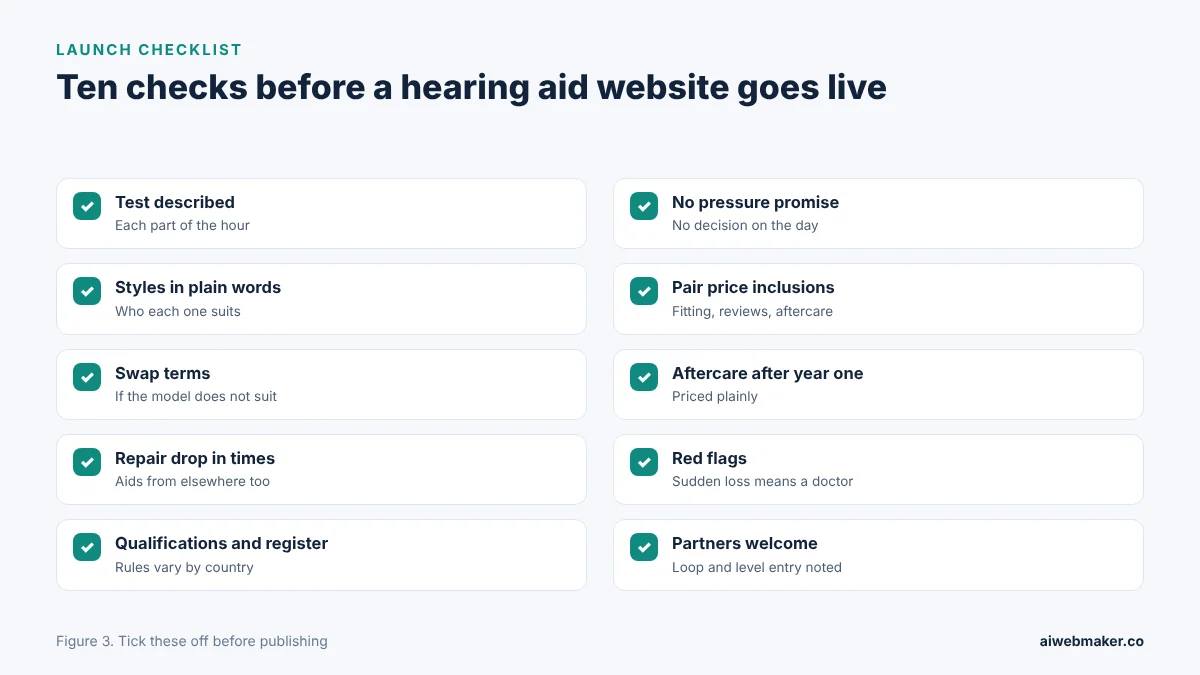
Hesitant clients close a hearing centre's site that leads with technology names and hides the price of a pair. A test page that hints at a sales appointment proves right the worry that delayed them for years. Silence on what the price includes, how many reviews follow and what happens if the aid does not suit leaves buyers unsure. Wearers with a whistling aid leave when they find no repair times or no mention of aids bought elsewhere. Ten matching fixes appear in the checklist pictured below, one per worry.
Frequently asked questions
Is a hearing test worth booking before any aids are discussed?
A test on its own tells a client how well they hear at each pitch and whether anything needs a doctor's attention. Many people learn that aids are not needed yet and simply arrange a recheck in a year or two. The website should make clear that a test does not commit anyone to buying. A printed audiogram gives the client a record to compare later. That honest starting point is often what persuades reluctant clients to book.
Who pays towards hearing aids?
That depends on the country, the client's age and sometimes their work. Some public schemes provide aids to people who qualify, some insurers contribute and some employers help where hearing loss is linked to work noise. The website should list the centre's own prices and suggest checking with a scheme or insurer before the first visit. Written quotes help clients make a claim where one is possible. Clear funding notes stop disappointment after the fitting.
When do wearers usually replace a pair of aids?
Many wearers replace their aids after several years, and around five years is a common pattern, though care and use make a big difference. Regular cleaning, new domes and filters and yearly checks help aids keep working well. Changes in hearing can also be a reason to replace them sooner. The website can explain the centre's aftercare and when a review of the aids is worth booking. Realistic expectations help clients judge the price of a pair.
Can a partner come to every appointment?
Most centres welcome a partner, friend or relative, and a line saying so belongs on the home page. A familiar voice helps during the fitting, when the audiologist adjusts aids to real speech. A second person also remembers cleaning steps and settings that slip the mind afterwards. Partners often notice changes at home that the wearer misses. Including them makes the whole process feel like a shared project rather than a test.
One fitted pair and twelve years of hosting
One pair at the sample's $1,450 from price would fund the $119 hosting for over twelve years. On the monthly route, a single repair visit plus a full test comfortably covers several $19 payments. Every wearer who returns for repairs and tells a friend about a patient fitting adds value no hosting bill can match. A test described minute by minute, a pair price with its inclusions listed and a repairs page for aids from anywhere persuade the clients who have waited longest. A diary full of first tests booked by partners together is the clearest return on those pages.
Build your website in Minutes and get the AI Tools that work
Start Building Your Website →