Fertility Clinic Website Cost: Calm Words, Written Costs, Support
A fertility clinic's website runs on $119 of hosting for each year, or $19 per month, alongside a domain. The guide covers who makes contact, the first visit, stages, costs, risks, counselling, search and the budget.
- No coding required
- Live in minutes
- Blog, SEO and chatbot tools included
A fertility clinic's website runs on $119 of hosting for each year, or $19 for each month, plus a domain whose price depends on its ending. Shaping the stage guides, cost tables and support pages in the preview can take as long as the clinic needs, and none of that time is billed. A single fertility assessment brings in more than the full year of hosting. The hard part is tone, because people researching fertility care are often tired, hopeful and wary at once. The site has to explain stages and costs plainly, avoid any promise about outcomes and keep emotional support in plain view. Discussed below are who makes contact, the pages, the first consultation, stages and programmes, costs and funding, success rates and risks, counselling and donor law, search, the yearly bill and what drives patients away.
This article is part of our complete guide: Healthcare Website Builder.
Who contacts a fertility centre, and in what frame of mind?
People who contact a fertility centre arrive carrying hope and worry together, and the website is often the first place they test whether the clinic understands that. Couples who have been trying for some time want to know where to start and what tests involve. Single people and same sex couples look for clear signs that they are welcome and that donor treatment is available. People considering egg freezing want facts about timing, storage and cost without pressure. Some arrive with a referral and results from elsewhere, while others want a second opinion after an unsuccessful cycle. All of them read slowly, often late at night, and notice any word that sounds like a sales pitch.
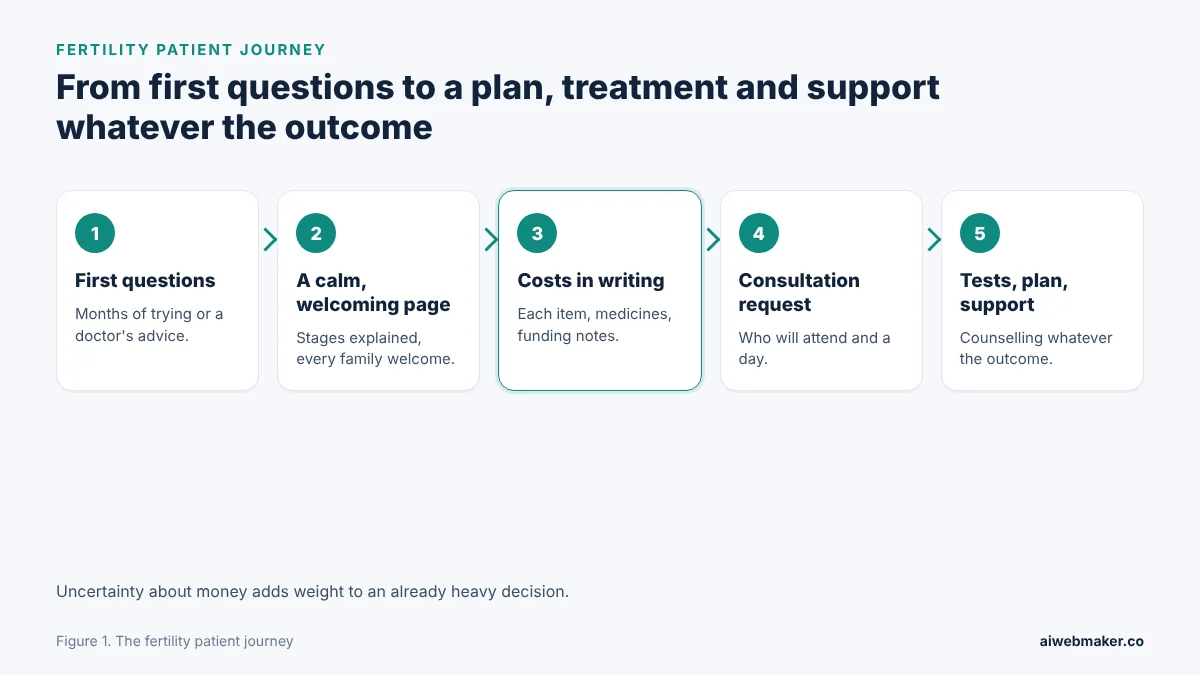
Seeing costs in writing is the moment this journey marks out, because uncertainty about money adds weight to a decision that is already heavy. The path usually starts with questions after months of trying or a conversation with a family doctor. A calm website that explains the stages and welcomes every kind of family earns the first contact. Costs set out item by item, with funding notes, then decide whether a reader feels safe requesting a consultation. The consultation leads to tests and a plan, which may or may not include treatment. Support continues afterwards whatever the outcome, and the website should say so from the start.
Pages for an anxious reader, from first visit to costs
A fertility clinic website should be built around the questions an anxious reader asks, in the order they usually arise. The first consultation page explains who attends, how long it lasts and that no decision is expected. A stages page sets out the path from tests to a plan, treatment and afterwards. Programme pages describe each option in plain words, and a costs page lists what every item includes. Support, questions and the request route complete the set, with crisis guidance clearly visible.
| Page | What readers look for | What it should hold |
|---|---|---|
| First consultation | What happens and who can come | Length, partner or support person, video option |
| Stages | The shape of the path | Tests, plan, treatment, afterwards |
| Programmes | What each option involves | Assessment, monitoring, IUI, IVF, egg freezing, donors |
| Costs | The full picture before paying | Each item, what it includes, medicines separately |
| Support | Help with the emotional load | Counselling, groups, crisis guidance |
| Request | A gentle first step | Who will attend, a day, optional notes |
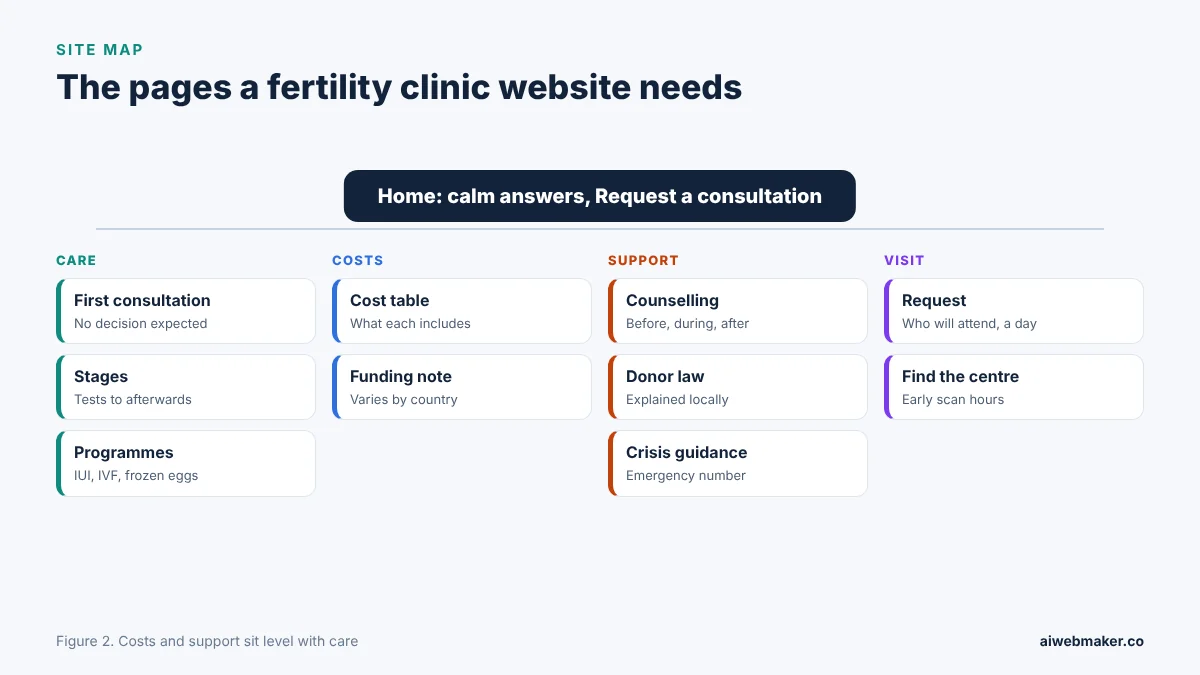
This page plan for a fertility centre places costs and support at the same level as the programmes, so nothing important is buried. The care branch holds the consultation, the stages and the programmes. The costs branch lists each item and explains funding. The support branch gives counselling and crisis guidance a place of their own, while the visit branch holds the request and directions. Our sample centre, Northlight Fertility Centre, offers a fertility assessment, cycle monitoring, IUI, IVF, egg freezing and donor programmes, and surrounds them with a first consultation section, five stages in plain words, a table of costs and what each includes, a support section with a counsellor and crisis guidance, questions and a consultation request; the fertility clinic website example with stages, costs and support never states a success rate.
A first consultation without pressure
The first consultation page sets the tone for everything that follows, so it should promise clear answers rather than quick decisions. It can explain that the appointment lasts about an hour with a fertility doctor, covering medical history, earlier tests and how long the person has been trying. Readers should know they can come alone, with a partner or with a support person, and that no treatment choice is expected that day. Medical details can wait for the consultation room rather than being demanded in a form. With the booking website builder for fertility clinics receiving consultation requests, a person asks for a first consultation on a day that suits them. The patient office confirms the time, offers a different one or declines the request, and every fee is paid to the clinic directly, with nothing retained by AI Web Maker.
Tests, IUI, IVF and egg freezing explained stage by stage
Not knowing what comes next is one of the hardest parts of fertility care, so a stage by stage outline gives readers a sense of control. Tests usually include blood tests and an ultrasound scan, with a semen analysis where a partner's sperm would be used. The doctor then explains the results and the options, which may range from monitoring cycles to IUI or IVF, or no treatment at all. Each programme has its own timetable of medicines, scans and procedures, and a nurse usually explains it beforehand. Many people stop after the first or second stage, and the page should say so to ease pressure. Plain words, with medical terms explained once, help readers follow without feeling lost.
| Stage | What usually happens | Who explains it |
|---|---|---|
| Consultation | History, earlier results, questions | A fertility doctor |
| Tests | Blood tests, scan, semen analysis | The doctor, at a results appointment |
| Plan | Options from monitoring to IVF, or none | The doctor, in writing |
| Treatment | Medicines, scans, procedures | A nurse, before each programme |
| Afterwards | A test or a review, and counselling | The care team and the counsellor |
Costs in writing, funding that varies and medicines priced apart
Costs can become very high in fertility care, and a clinic that blurs them loses trust quickly. A cost table should name each item, from the first consultation to yearly storage, with what every price includes. Medicines are often priced separately because doses differ from person to person, and the written estimate can give a likely range. Paying for each stage before it begins, rather than buying packages of cycles in advance, is easier for many people to manage. Public funding and insurance for fertility treatment are organised very differently from one health system to the next, so the page should invite readers to check their own entitlement. A clear table answers a question many people feel awkward asking out loud.
| Cost item | What the page should explain |
|---|---|
| First consultation | Its length and the written notes that follow |
| Tests | Which tests, for one or both partners |
| Treatment cycles | Scans, procedures and laboratory work included |
| Medicines | Priced separately, with a likely range |
| Storage | Yearly fees for frozen eggs or embryos |
Success rates, risks and what a clinic may honestly say
Success rates are the figure readers most want and the one most easily misused, so careful clinics explain why no single number fits everyone. Chances depend on many personal factors, including age, the cause of infertility and the treatment chosen, and the doctor can discuss each person's situation once tests are back. In some countries a national regulator publishes data about clinics, and pointing readers to it is more honest than a headline percentage. Medical advertising rules, which change from one country to another, give clinics a further reason for restraint. Risks deserve plain words too, such as side effects of fertility medicines, a rare overreaction of the ovaries that needs close care, multiple pregnancy and the small risks of procedures. Naming these calmly builds more trust than any promise could.
Counselling, donor law and crisis signposting
Emotional support should be as visible as the medical care, because fertility treatment can weigh on hope, relationships and work. A support page can describe a counsellor who listens rather than persuades, available before, during and after treatment whatever the outcome. Donor treatment raises legal questions, including what a child may later learn about the donor, and laws on donation vary by country. Counselling before donor treatment helps people understand those rules where they live. The page should also tell anyone who feels unable to keep themselves safe to contact a crisis line or the local emergency number at once, rather than waiting for an appointment. Support shown this clearly tells readers they will be cared for as people.
IVF consultation, egg freezing, donor sperm: the searches families make
People looking for fertility care type phrases such as fertility tests, IVF consultation, IUI cost, egg freezing or donor sperm treatment, often with a city name. Many also search for clinics that welcome single women or same sex couples, so those words should appear plainly on the relevant pages. A map listing earns trust with the correct category, early opening times for monitoring scans and calm photos of the waiting room rather than outcomes. Reviews that mention clear costs, patient doctors and counselling carry great weight with anxious readers. Articles explaining tests, the difference between IUI and IVF or what egg freezing involves bring readers months before they make contact. Gentle, accurate writing makes the clinic a trusted source long before the first appointment.
The centre's own website bill, kept as plain as its fees
A fertility centre's website bill has two fixed items, hosting plus the domain, while twelve plain language guides cost roughly $7.80 in article credits. A clinic that expects to stay online for years pays least by settling $119 annually. A new centre may prefer to spread hosting at $19 per month during its first year. Changing a cost table, adding a programme or updating support details never increases what the clinic pays. The $189 tier is included only so the options can be weighed.
| Item | Yearly | Monthly |
|---|---|---|
| Hosting the clinic pages | $119 | $228 over twelve months |
| Domain | Depends on the ending | Depends on the ending |
| Higher plan, for comparison | $189 a year | Not needed |
| Twelve plain language guides at about $0.65 | About $7.80 | About $7.80 |
| Cost table, programme and support updates | No charge | No charge |
| Year before the domain | About $126.80 | About $235.80 |
Headline percentages and hidden costs: what drives patients away
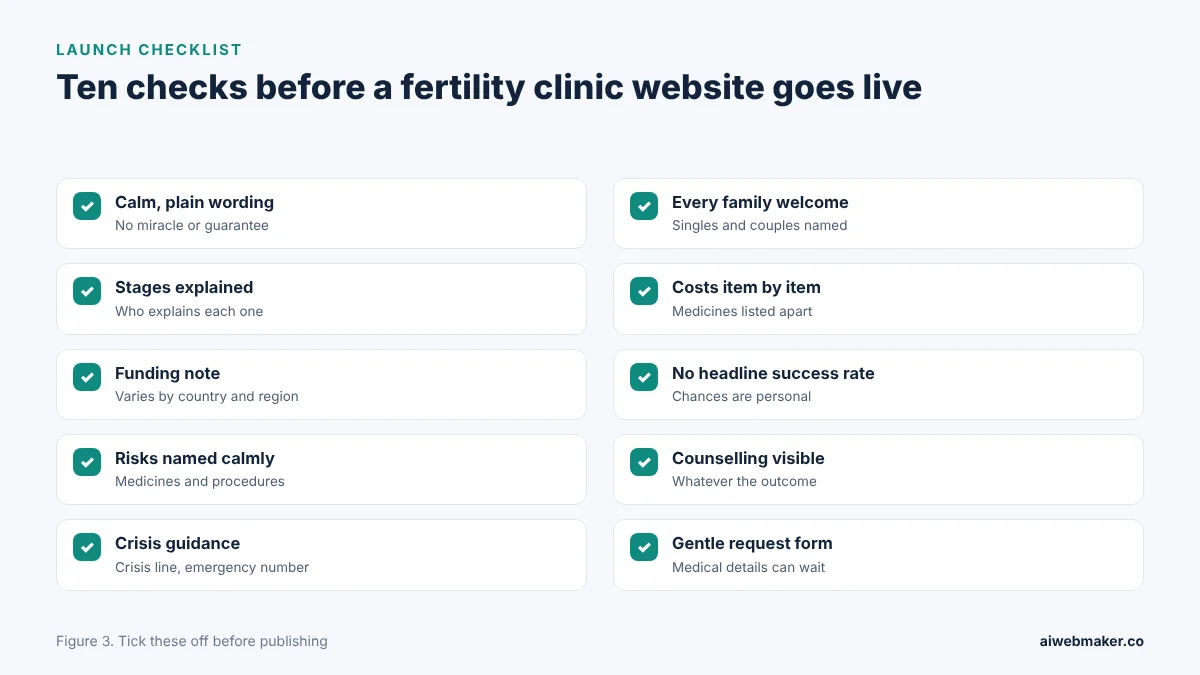
Patients leave a fertility website when a large success percentage greets them before any explanation of what it means. Costs shown only as from figures, with medicines and storage left out, feel like a trap waiting to close. Language such as guaranteed or miracle tells careful readers the clinic values sales over honesty. No mention of single people or same sex couples leaves many readers unsure whether they are welcome. A request form demanding medical history before any conversation feels intrusive at a vulnerable moment. The ten checks illustrated next give a fertility centre a way to repair every one of those weak points.
Frequently asked questions
Is a referral needed before a first appointment?
Many private fertility clinics accept people without a referral, though the clinic's own policy should be stated on the website. In some countries a referral from a family doctor is needed to access public funding or insurance cover, so readers should check before booking. Earlier test results can be useful at the first consultation, and the page can explain how to bring them. A clear answer saves people a wasted call at an already stressful time. Simple guidance like this makes the first step feel manageable.
Can single people and same sex couples be treated?
Many clinics treat single people and same sex couples, often using donor sperm or donor eggs, and a clinic that does should state it plainly. Laws on donation, consent and parenthood vary by country, so a counsellor or doctor should explain what applies where the person lives. Some countries also set rules on what a donor conceived child may later learn about the donor. Welcoming language on every page matters as much as a single line in the questions. Readers who see themselves reflected in the wording are far more likely to make contact.
Why do clinics avoid quoting one success rate?
A single success rate can mislead because chances depend on age, the cause of infertility, the treatment chosen and many other personal factors. Figures can also be calculated in different ways, which makes comparisons between clinics difficult. Careful clinics explain this and discuss each person's chances once their tests are back. In some countries a national regulator publishes data about clinics, which readers can look at independently. Honesty about what cannot be promised earns more trust than a headline number.
How long can frozen eggs be stored?
Legal limits on storing eggs and embryos vary by country, and some countries have changed their limits in recent years. Storage usually carries a yearly fee, which the costs page should list separately from treatment. Clinics often ask people to renew their consent for storage at set intervals, depending on local law. Describing the clinic's own consent process, and suggesting readers look up the storage law in their country, avoids confusion later. Clear storage information helps people plan years ahead with confidence.
Does a single assessment justify the hosting year?
One fertility assessment is usually priced well above the centre's $119 hosting year. A month of hosting at $19 costs far less than any single consultation. Every reader who understands the stages, sees costs in writing and feels welcome is more likely to request a first conversation. Those people often stay with the clinic through tests, treatment and storage over many months. Clinics that keep their costs, stages and support details current receive enquiries from calmer, better informed patients. A waiting room of people who already knew what to expect is the truest measure of the pages.
Build your website in Minutes and get the AI Tools that work
Start Building Your Website →