Dietitian Website Cost and the Doctor's Letter Patients Expect
A dietitian's website costs $119 a year to host, or $19 a month, plus a domain. Covered: who comes and why, conditions and care teams, protected titles, letters and prescribers, video appointments, limits, requests, search and the yearly budget.
- No coding required
- Live in minutes
- Blog, SEO and chatbot tools included
On AI Web Maker, the hosting for a dietitian's condition pages and appointment request comes to $119 yearly, which some clinics split into $19 monthly payments, plus a domain. While the condition table, the fee cards and the list of things the clinic will not do are drafted and previewed, nothing is billed. One first assessment covers that sum and leaves most of its fee over. The real challenge is the noise around food, because every visitor has met diets, detoxes and supplement sellers before arriving, and a clinical dietitian has to sound different from all of them. Clear conditions, a care team named beside each one and an honest list of what is not on offer make that difference visible. In order: who comes and why, conditions and care teams, protected titles, letters and prescribers, video appointments, limits, requests, search and the yearly budget.
This article is part of our complete guide: Healthcare Website Builder.
Referred patients, self referrers and parents: who arrives at a dietitian's door
A dietitian's visitors usually arrive with a diagnosis or a letter rather than a vague wish to eat better. Some have been told by a doctor or a diabetes team to see a dietitian, and others have searched after months of gut symptoms. Parents of children with food allergies want safe swaps and packed lunches that still feel normal. People with coeliac disease, kidney conditions or a poor appetite after illness need advice that fits the treatment they already receive. Each of them checks whether the practice sees their condition, whether it works with their doctor and what the first appointment involves.
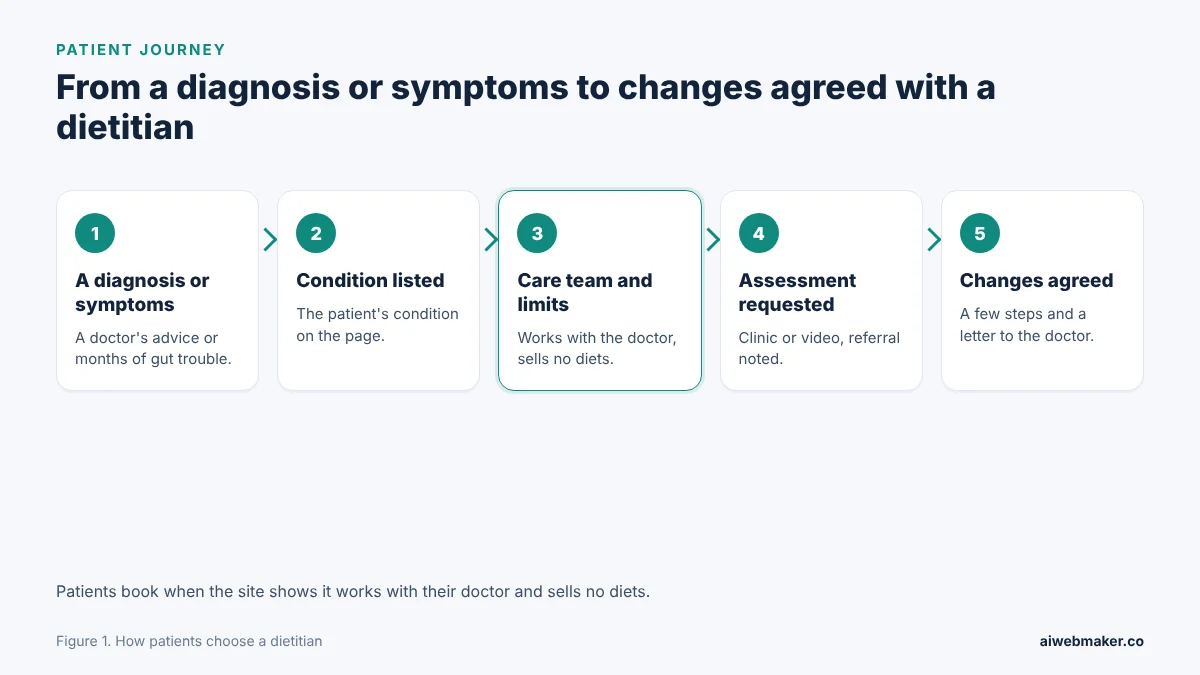
The highlighted step separates a clinical dietitian from the crowded world of diet advice. Patients first arrive with a diagnosis or a set of symptoms, then look for their condition on the page. Before booking, they want to see who else is involved in their care and what the dietitian will not do, such as sell supplements or change medicines. The request follows, often noting whether a doctor has referred them. The final step is a few agreed changes and a letter to the doctor, which many patients value most of all.
Conditions, the first hour, fees and limits: pages a dietetics practice needs
A dietitian's website earns trust by reading like a clinic rather than a lifestyle brand. The home page names the main conditions seen and whether appointments run in clinic, by video or both. A conditions page pairs each condition with the other professionals involved, and a first appointment page explains what the assessment covers. Fees by appointment type come next, followed by a frank list of services the clinic declines to offer. A request route and directions, with step access and video instructions, close the site.
| Page | Patient's question | What it should include |
|---|---|---|
| Home | Is my condition seen here? | Main conditions, clinic or video, a request button |
| Conditions | Who else is involved in my care? | Each condition with the care team beside it |
| First appointment | What happens in the first hour? | History, medicines, results, a day of eating, agreed changes |
| Fees | What does each appointment cost? | First, follow up and child appointments, cover notes |
| What we do not do | Is this another diet programme? | No diets for sale, no supplements, no test kits |
| Request and visit | How does a first appointment begin? | Appointment type, clinic or video, referral status |
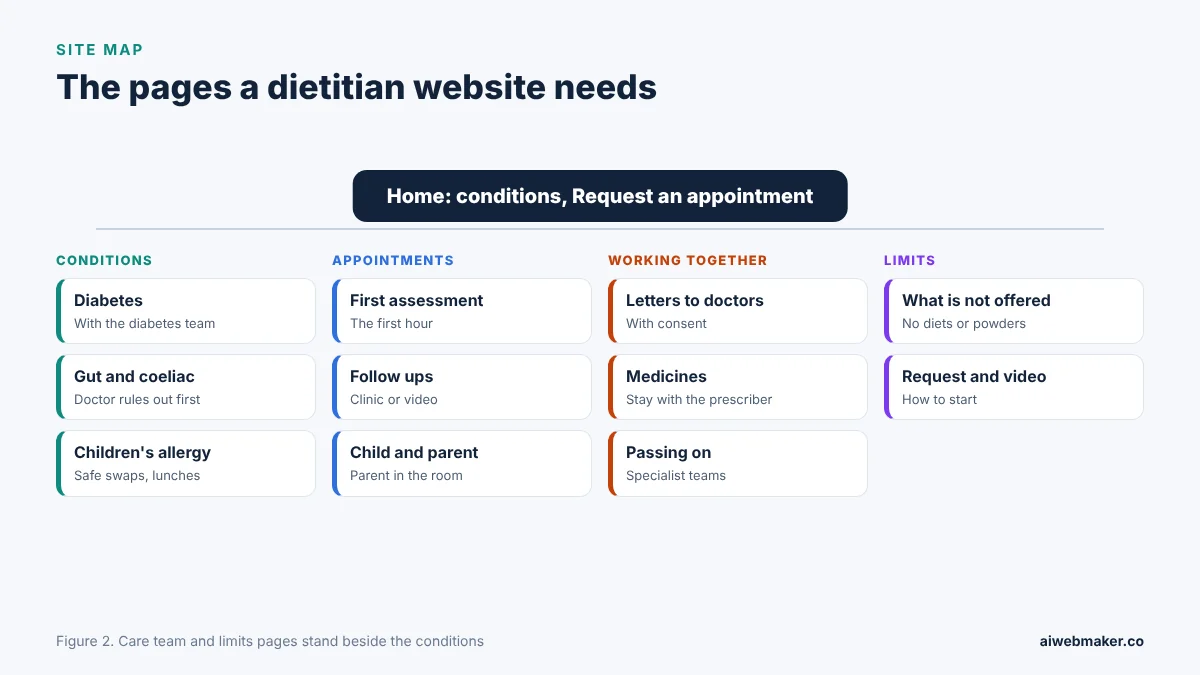
Conditions open the plan on the left, appointments follow, and two groups at the right explain how the practice works with doctors and where its limits lie. Condition pages cover diabetes, gut symptoms, coeliac disease and children's food allergy, each with its care team named. Appointment pages describe the first assessment, follow ups and sessions for a child with a parent present. Plateful Dietetics, an invented clinic created for our sample, offers a First assessment, a Follow up and a Child and parent appointment, and backs them with A letter after appointments, Results explained, Medicines stay with your prescriber and Passing you on. The dietitian website example with letters to doctors and video appointments ends with a request for clinic or video.
Conditions paired with the care team around them
A dietitian works alongside doctors and hospital teams, never instead of them, and the conditions page should make that visible. Diabetes, gut symptoms, coeliac disease, children's food allergy, kidney conditions and poor appetite after illness are common reasons people are seen. For each, the page can say what the dietitian looks at and who else is involved, such as the diabetes team or the child's allergy clinic. Some symptoms need other causes ruled out by a doctor before dietary changes are tested, which the page should say plainly. Eating disorders need a specialist team, and a responsible practice helps families find one rather than working alone.
| Condition | What the dietitian looks at | Who else is involved |
|---|---|---|
| Type 1 and type 2 diabetes | Meals and timing around medicines and the working day | The doctor or diabetes team |
| Gut symptoms | What seems to set symptoms off, tested carefully | The doctor, who rules out other causes first |
| Coeliac disease | Labels, eating out and crumbs at home | The doctor, after diagnosis |
| Food allergy in children | Safe swaps, packed lunches, growing well | The child's doctor or allergy clinic |
| Kidney conditions | Choices that fit the kidney team's advice | The kidney team |
Dietitian or nutritionist: which title the law guards
In many countries dietitian is a protected title, reserved for people registered with a national regulator or professional body, while nutritionist may be less regulated or not regulated at all. The details vary widely, so the website should name the registration that applies where the dietitian works and how patients can check it. Some countries also license dietitians at state or provincial level, which matters for anyone offering video appointments across borders. Explaining the difference calmly, without disparaging other professions, helps patients and referring doctors understand what they are booking. A single paragraph on registration often settles the question of why a patient should see a dietitian rather than a diet coach.
Letters to doctors, prescribers and the limits of food advice
Patients and doctors both value a short letter after appointments, and the website should explain when and how one is sent. With the patient's consent, the letter summarises what was discussed and what was agreed, so nothing needs explaining twice. Medicines deserve a line of their own, because the dietitian never changes a dose and asks the prescriber whenever food and medicine need to fit together. Test results brought by the patient can be explained alongside the doctor's advice, not in place of it. These boundaries reassure doctors who might refer and patients who fear conflicting advice.
Clinic or video, and seeing patients across borders
Video appointments suit many follow ups and let patients show the packets in their own cupboard, while a first appointment for a child often works better in the clinic. The page should say which appointments run by video, what equipment is needed and how the link arrives. Practising across regions or countries raises registration questions, because many regulators expect a dietitian to be registered where the patient is located, and the rules differ. The website can name the regions served by video rather than implying worldwide availability. Clarity here prevents disappointed patients and protects the dietitian's registration.
What a clinical practice refuses to sell
Naming the services a clinic turns down is among the most persuasive things a dietitian's site can do. Weight loss programmes, detox or cleanse plans, supplements for sale, food intolerance test kits and printed diet sheets are common exclusions. Each line tells a sceptical reader that the advice is not tied to a product. Urgent symptoms belong here too, since feeling very unwell, trouble swallowing or blood in the stools should go to a doctor, and anything that cannot wait to the local emergency number. A practice that names its limits looks more trustworthy than one that claims to fix everything.
| Not offered | Why the page says so |
|---|---|
| Weight loss programmes | Care is built around a condition, not a number |
| Detox or cleanse plans | They play no part in the practice's clinical work |
| Supplements for sale | Advice stays separate from products |
| Intolerance test kits | Testing belongs with the doctor |
| Urgent or emergency care | Doctors and emergency services come first |
Appointment requests from patients and referring doctors
Patients choose a first assessment, a follow up or a child appointment, and the page can remind them to bring a medicines list and any recent results. With the booking website builder for dietitians and their clinic or video appointments, that choice becomes a request the clinic answers. The dietitian accepts it, offers a different day or declines with a note pointing elsewhere when the condition needs a specialist team. Fees pass from the patient to the practice directly, and AI Web Maker has no part in that payment. The builder drafts the condition, fee and limits pages too, once the dietitian explains the practice in a paragraph. Patients should also be asked to keep full medical records for the appointment itself, because many jurisdictions give health data special legal protection.
Searches that begin with a diagnosis and a town
People search with phrases such as dietitian near me, diabetes dietitian, IBS dietitian, coeliac diet advice or children's allergy dietitian, often adding a town. Headings that repeat those exact words on each condition page catch searches a general home page would miss. The map listing should show lift or step access, evening video hours and whether a referral is needed. When answering reviews, the dietitian should stay general and avoid any hint that the writer attends the clinic, as privacy law in many countries treats even that fact as health data. Articles on reading food labels, eating out with coeliac disease or packing an allergy safe lunch bring steady readers who later book.
Scales, leaflets and the website: a dietitian's yearly web spend
Professional registration, indemnity cover and room hire all cost a dietitian more each year than the website does. Hosting costs a single $119 each year or twelve monthly sums of $19, and about 400 domain endings set the price of the address. Writing twelve articles on labels, conditions and eating out through AI credits comes to roughly $7.80. Changing fees or adding an evening video clinic adds nothing. The table lists the $189 tier so the difference can be seen, not because it is required.
| Item | Yearly | Monthly |
|---|---|---|
| Hosting the dietitian pages | $119 | $228 over twelve months |
| Domain | Depends on the ending | Depends on the ending |
| Higher plan, for comparison | $189 a year | Not needed |
| Twelve condition and label articles at about $0.65 | About $7.80 | About $7.80 |
| Fee, clinic and video hour updates | No charge | No charge |
| Year before the domain | About $126.80 | About $235.80 |
Diet sheets, miracle claims and other reasons patients look elsewhere
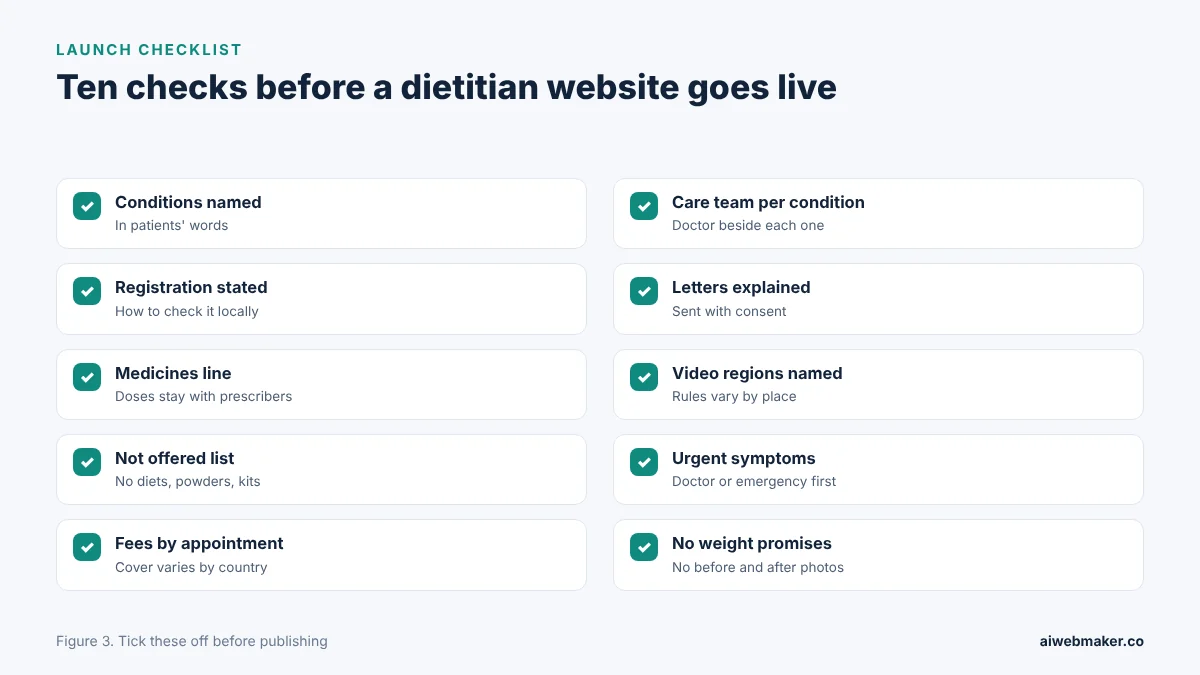
Patients leave a dietitian's website when it looks like every other diet page, with before and after photos and promises about weight. A conditions list with no care team beside it suggests advice given in isolation from the doctor. Silence on registration leaves readers unsure whether the person is a dietitian at all. Fees that appear only after an enquiry, and no word on video appointments, push busy patients towards a clinic that answers those questions. The figure after this paragraph sets ten checks against those failings.
Frequently asked questions
Can a dietitian help without a referral from a doctor?
Many dietitians accept patients directly, though some insurers and public services only contribute after a doctor's referral. Whether a letter is required varies with the country, its health system and each patient's cover, so the page should spell out what this clinic does and suggest a quick check with the insurer. Patients who already have a referral letter can bring it or send it ahead. Where symptoms need a medical check first, the dietitian should say so. A clear answer avoids wasted appointments on both sides.
Should eating change before the first appointment?
Most dietitians ask patients to carry on eating as usual unless their doctor has said otherwise. Changes made beforehand can make symptoms and test results harder to interpret. Patients can help by noting what they ate on two ordinary days and bringing a list of medicines. The website can give this advice on the first appointment page. Simple preparation makes the first hour far more useful.
Does a dietitian see children?
Many dietitians see children for food allergy, coeliac disease or worries about how a child is eating, with a parent or carer present throughout. Appointments for children often take longer and focus on family meals rather than the child alone. Growth and development are considered alongside the child's doctor. The page should state the ages seen and what parents should bring. Clear information helps families arrive prepared and relaxed.
Will the dietitian give a meal plan to follow?
Many clinical dietitians avoid printed diet sheets and agree a few changes that suit the condition, the routine and the food the patient enjoys. Those changes are reviewed at follow ups and adjusted step by step. Structured plans may be used for some conditions, but always within the care agreed with the doctor. The website should explain the approach so patients know what to expect. Advice that fits real life tends to last longer than a sheet that ends up in a drawer.
Why a handful of referrals settles the clinic's web bill
The fee for one first assessment is comfortably larger than the $119 spent keeping the dietitian's pages up until next year. Monthly, the $19 amounts to less than one follow up appointment. Each patient referred by a doctor who liked the last letter, and each parent who books after reading the allergy page, is income the website helped bring in. Plain conditions, named care teams and an honest list of limits persuade patients better than any promise about food. A referring doctor who passes the clinic's link to patients without hesitation is the strongest endorsement the pages can earn.
Build your website in Minutes and get the AI Tools that work
Start Building Your Website →