Cosmetic Dentist Website Cost, From Smile Plan to Payment Plan
A cosmetic dentist's website needs $119 of hosting per year, or $19 billed monthly, with the domain extra. Then come patients, the pages, the consultation, treatment trade offs, fees and plans, photo rules, search and the budget.
- No coding required
- Live in minutes
- Blog, SEO and chatbot tools included
For a cosmetic dentist, the website's line in the practice budget is $119 of hosting per year, or $19 billed monthly, with the domain charged on top according to its ending. Treatment pages, fee tables and the consultation route can be written and rehearsed in the builder's preview without an invoice arriving. One composite bonding appointment on a single tooth usually covers the whole year. Restraint is the real difficulty, because cosmetic dentistry sells appearance, yet patients trust a practice that puts oral health first, names every risk and keeps results photos within the advertising rules where it works. Visitors also arrive confused about which treatment fixes their concern and what it will cost. The chapters ahead cover who asks and what holds them back, the pages, the consultation, comparing treatments, fees and payment plans, photos and registration, search, yearly costs and the gaps that lose patients.
This article is part of our complete guide: Healthcare Website Builder.
Who asks about a smile makeover, and what holds them back?
People who look at cosmetic dentistry usually know exactly what bothers them, but not which treatment would fix it. Some dislike staining or yellowing, others a chipped front tooth, a gap or teeth that have crowded over the years. Couples before a wedding and people starting a new job often want a change by a particular date. Some have seen dramatic results online and arrive expecting a full set of veneers when a smaller change might suit them better. Many hold back because of cost, fear of pain or worry about damaging healthy teeth. A website that answers those three fears calmly turns hesitation into a booked consultation.
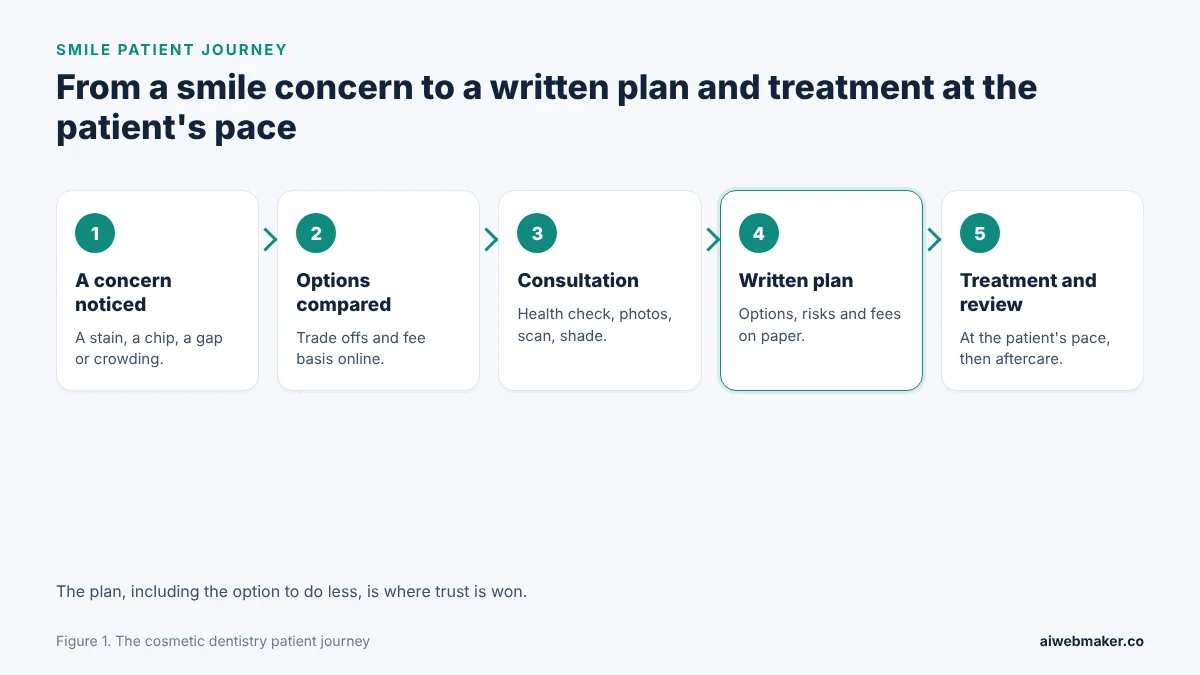
The written plan is the highlighted moment in this journey, because it is where a vague wish becomes options, risks and fees on paper. The route starts with a concern noticed in a photo or a mirror, followed by searches comparing treatments and prices. A practice that explains trade offs plainly and shows its fees earns the consultation request. At the consultation, a health check, photographs and a scan lead to the plan, including the option to do less. Treatment then follows at the patient's own pace, with reviews and aftercare afterwards. Every page should help a visitor reach that written plan without feeling pushed.
The pages a smile studio needs, from treatments to payment plans
A cosmetic dentistry website works best with a small group of pages that move from concern to plan in a logical order. A treatments page compares the main options side by side with what each can and cannot do. The consultation page explains the health check and the written plan, and a fees page states what each price includes. Separate pages on choosing between treatments and on aftercare answer the questions patients ask most. A booking request and a visit page complete the route.
| Page | What patients look for | What it should hold |
|---|---|---|
| Treatments | Which option fixes their concern | Whitening, bonding, veneers, aligners and their limits |
| Consultation | What happens first | Health check, photos, scan, written plan |
| Choosing | How options compare | Trade offs in plain words |
| Fees and plans | The cost and how to spread it | Fee basis, what is included, payment plans |
| Questions | Pain, lifespan, who treats them | Honest answers with risks named |
| Booking | A first appointment | Treatment to discuss, day, time |
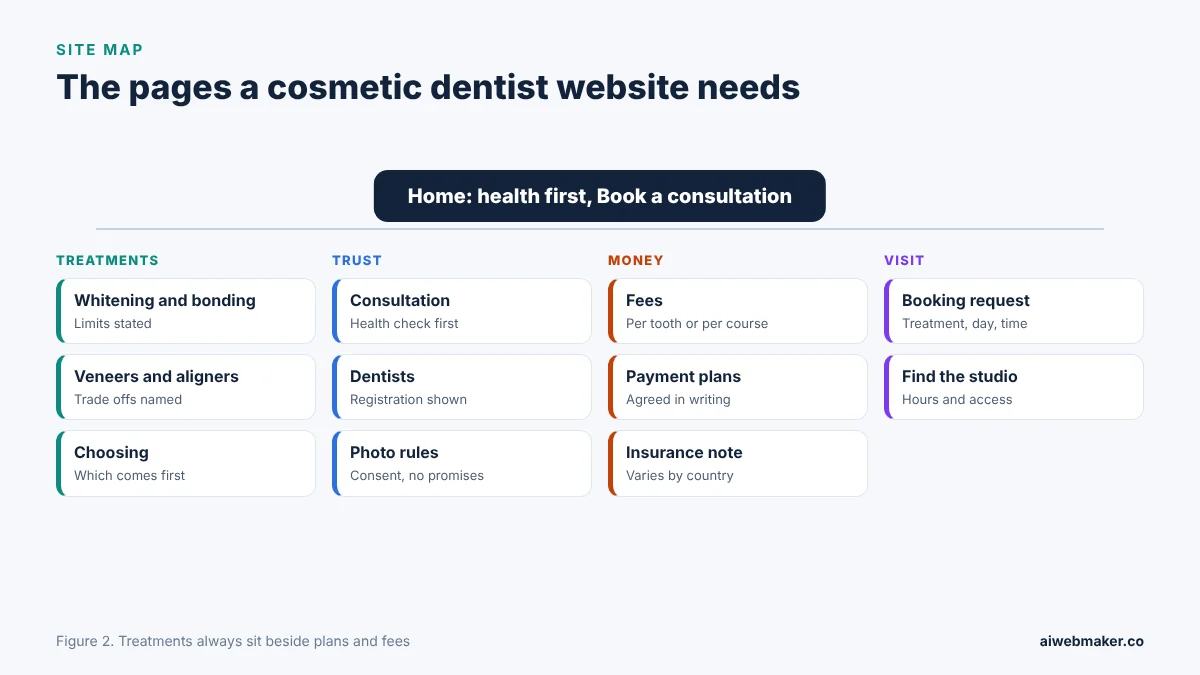
Across the four columns of this smile studio map, treatments never appear without the consultation and the fees beside them. The treatments column holds the options and a page on choosing between them. The trust column holds the consultation, the dentists and the rules on photos. The money column sets out fees, payment plans and a note on insurance, and the visit column carries the request and directions. Our sample practice, Brightline Smile Studio, offers professional whitening, composite bonding, porcelain veneers and clear aligners, explains three choices patients often face, whiten first then match, bonding or porcelain, and straighten before covering, and adds a consultation section, a veneer timeline, fees with payment plans, questions and a booking request; the cosmetic dentist website example with smile plans and fees keeps every fee and risk in writing.
A consultation that checks health before shade
The consultation page is the hinge of a cosmetic dentistry website, because it shows the practice is a dental practice first and a beauty service second. Cosmetic work only lasts on a healthy mouth, so gums, fillings and any decay should be checked and treated before anything cosmetic begins. Photographs, a digital scan and a shade reading in daylight then give the dentist what is needed to plan. The patient should leave with a written plan listing options, risks and fees, including the smallest change that would help. With the booking website builder for cosmetic dentists taking consultation requests, a patient picks a treatment to discuss and asks for a day. The practice confirms the request, moves it to a time the dentist has open or declines it, and fees are agreed between patient and practice with nothing passed to AI Web Maker.
Whitening, bonding, veneers or aligners: the trade offs patients weigh
Every cosmetic treatment involves a trade off, and patients feel misled when they discover it only after treatment. Whitening lightens natural teeth but leaves crowns, fillings and veneers at their current shade, so it usually comes first. Bonding keeps almost all of the tooth and can be repaired, but it stains and chips more easily than porcelain. Porcelain veneers hold their colour longer, yet the thin layer of enamel removed beneath them is gone for good. Clear aligners can move crowded teeth so that less covering, or none, is needed afterwards. A table setting out these trade offs does more for trust than any gallery of perfect teeth.
| Treatment | What it changes | Trade off to state | Fee basis |
|---|---|---|---|
| Whitening | Shade of natural teeth | Sensitivity for some, fades over time | Per course |
| Composite bonding | Chips, small gaps, uneven edges | Can stain or chip, needs polishing | Per tooth |
| Porcelain veneers | Shape and colour | Enamel removed permanently | Per tooth |
| Clear aligners | Position of teeth | Months of wear, retainers afterwards | Per course |
Fees per tooth, fees per course and written payment plans
Cosmetic fees confuse people because some are quoted per tooth and others per course, so each price should be labelled with its basis. A fee table should say what is included, such as trays and gel for whitening or a trial smile, temporaries and a review for veneers. A worked example showing a deposit and monthly payments turns a large total into a figure a patient can plan around. Any payment plan should be agreed in writing before treatment and paid directly to the practice. Dental insurance rarely covers purely cosmetic work, and cover differs between countries and policies, so patients should check their own. Honest arithmetic like this answers the cost question before anyone feels awkward asking it.
| Fee detail | What the page should state |
|---|---|
| Consultation | Its fee, and whether it comes off treatment |
| Per tooth fees | Bonding and veneers, with what each includes |
| Per course fees | Whitening and aligners, with reviews included |
| Payment plans | Deposit, number of months, agreed in writing |
| Insurance | Rarely covers cosmetic work, varies by country |
Smile photos, registration and advertising rules by country
Rules on how dentists may advertise, and especially on before and after photos, vary between countries, so a careful practice checks them before publishing anything. Many studios keep results photos for the consultation chair, shared only with the consent of past patients and framed as examples rather than promises. The website should state that a registered dentist plans and carries out each treatment, and invite patients to ask for registration details. Rules on the strength of whitening products, and on who may provide whitening, also differ by country. Reviews on the page should focus on honesty, planning and clear bills rather than dramatic transformations. Careful wording keeps the practice credible with patients and out of trouble with regulators.
Veneers cost, bonding near me: how smile patients search
Smile patients search by treatment and by worry, typing phrases such as teeth whitening, composite bonding near me, porcelain veneers cost or clear aligners with a town name. A treatment page that uses those words in its heading, with the fee basis in the first lines, matches the search directly. For the map listing, the dental category, evening opening times and genuine photos of the surgery rooms matter most. Reviews that mention a health check first, a clear plan and a bill matching the quote carry particular weight. Articles on whitening sensitivity, bonding against veneers or how long aligner treatment lasts attract readers months before they decide. Calm, informative writing marks the practice out from studios that only post perfect smiles.
The smile studio's website budget, line by line
A smile studio carries just two fixed website costs, the hosting and its domain, while twelve treatment guides written through credits total about $7.80. Busy practices with full consultation diaries tend to settle the $119 in one payment. A newly opened studio could spread hosting at $19 a month while its patient list grows. Updating fees, adding a treatment or rewriting the consultation page carries no further charge. Purely as a yardstick, the dearer $189 tier is listed too.
| Item | Yearly | Monthly |
|---|---|---|
| Hosting the smile studio pages | $119 | $228 over twelve months |
| Domain | Depends on the ending | Depends on the ending |
| Higher plan, for comparison | $189 a year | Not needed |
| Twelve treatment guide articles at about $0.65 | About $7.80 | About $7.80 |
| Fee, treatment and plan updates | No charge | No charge |
| Year before the domain | About $126.80 | About $235.80 |
Perfect teeth and no prices: why patients keep searching
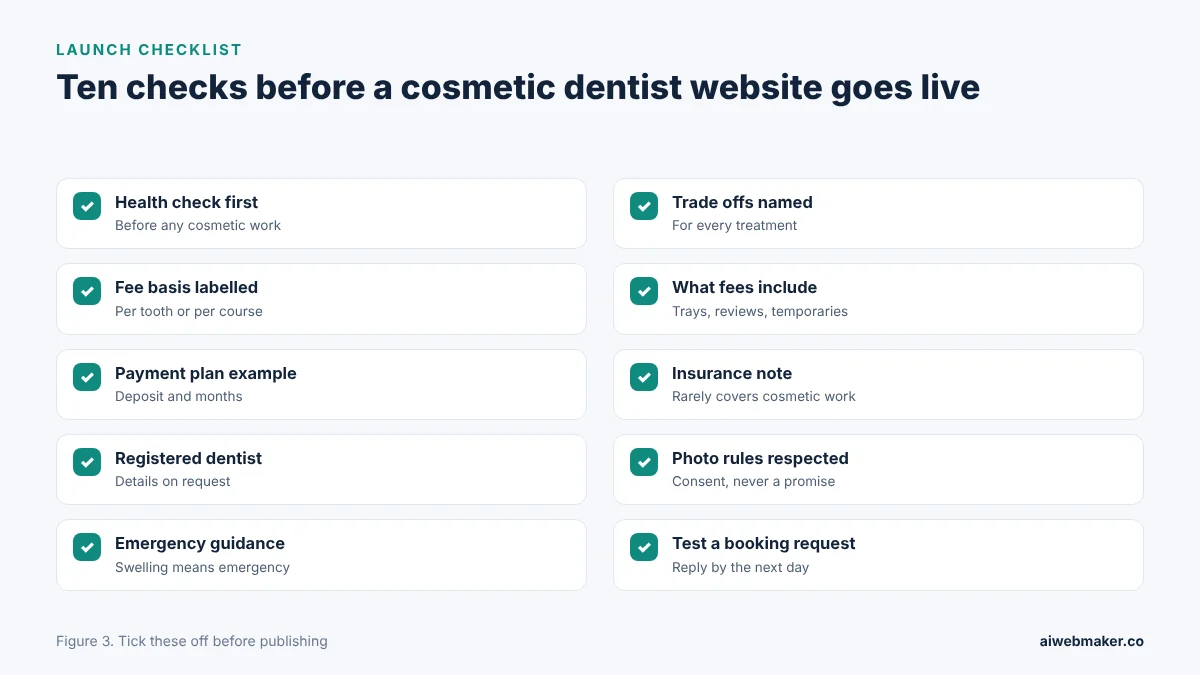
Patients keep searching when a cosmetic dentistry website shows perfect smiles but no fees, no fee basis and no payment plan. Treatment pages that skip the trade offs make careful readers suspect a hard sell. No mention of a health check before cosmetic work suggests the practice puts appearance ahead of the mouth. Missing details about who treats patients, and their registration, leave a gap that competitors fill. Pressure phrases about limited offers drive away exactly the patients who value a careful dentist. Every one of those gaps maps to a point in the smile studio checklist pictured below.
Frequently asked questions
Does teeth whitening work on crowns and fillings?
Whitening lightens natural tooth enamel and does not change the shade of crowns, fillings or veneers. That is why many dentists suggest whitening before any bonding or veneers, which are then matched to the new shade. Patients with visible fillings on front teeth may need them replaced after whitening to keep the colour even. The website should explain this on the whitening page so patients are not surprised. Clear notes on limits prevent disappointment and build confidence in the plan.
How long do veneers and bonding last?
No cosmetic treatment is permanent, and how long it lasts depends on care, habits and the patient's own teeth. Bonding may need polishing or repair after some years, while porcelain veneers usually last longer but will one day need replacing. Whitening fades gradually and can be topped up. Grinding, biting hard objects and staining drinks all shorten the life of cosmetic work. A website that sets realistic expectations wins more confidence than a lifetime guarantee ever could.
Does dental insurance pay for cosmetic treatment?
Dental insurance rarely pays for treatment done purely to change appearance, though cover varies widely between countries, insurers and policies. Some plans contribute when a treatment also repairs damage or restores function. Patients should check their own policy before relying on any contribution. The fees page can state this plainly and point to the practice's own payment plans instead. Honest guidance on insurance prevents awkward conversations at the end of treatment.
What counts as a dental emergency after treatment?
Mild sensitivity or a slightly rough edge after treatment is common and can usually wait for a call to the practice during opening hours. Swelling of the face or neck, or difficulty breathing or swallowing, needs urgent help from the local emergency number without waiting for the practice. A knocked off veneer or a broken bonded edge is usually urgent but not an emergency, and the practice can advise by phone. The website should set out these differences clearly on the aftercare page. Plain guidance protects patients and helps the practice prioritise its calls.
Could one set of veneers carry the hosting for years?
A single bonded tooth is usually priced above the $119 of a smile studio's hosting year, and a set of veneers covers many years at once. On monthly billing, one consultation fee typically outstrips the $19. Every patient who compares treatments, reads the fee basis and books a consultation arrives with realistic expectations. Those patients accept plans more readily and return for reviews, retainers and top ups. Practices that keep their fees, trade offs and photo rules current receive calmer, better informed requests. A diary of consultations from patients who already understand their options is the return worth measuring.
Build your website in Minutes and get the AI Tools that work
Start Building Your Website →