Child Psychologist Website Cost and the Parent Meeting Before Therapy
A child psychology practice can host its pages for $119 a year, or $19 a month, plus a domain. Covered: how parents choose, family concerns, consent and privacy, assessments and reports, crisis guidance, titles, requests, search and the yearly budget.
- No coding required
- Live in minutes
- Blog, SEO and chatbot tools included
A child psychology practice can run its pages on AI Web Maker at a cost of $119 per hosted year, or in monthly instalments of $19, plus a domain. Drafting the concern cards, the privacy section and the crisis lines, and rereading them in the preview, happens before any invoice exists. One parent meeting usually brings in more than all twelve months of that hosting. Tone is the difficult part, because the first reader is a worried parent, often reading late at night, who needs gentleness without vagueness and limits without coldness. The website must explain the first steps, the fees, what stays private and where to turn in an emergency, long before a child walks through the door. Inside: how parents choose, family concerns, consent and privacy, assessments, crisis guidance, titles and testimonials, requests, search and the yearly budget.
This article is part of our complete guide: Healthcare Website Builder.
Parents at the kitchen table: who searches for a child psychologist
Most searches for a child psychologist start with a parent who has watched something change for weeks. Worries that keep growing, meltdowns that shake the household, a child who refuses school or a teenager who has gone quiet are common starting points. Some parents arrive after a teacher, a family doctor or a school counsellor suggested an assessment. Separated parents may both be reading, each wanting to know how they will be involved. Each of them is quietly asking whether this practice is gentle, whether it suits their child's age and what happens first.
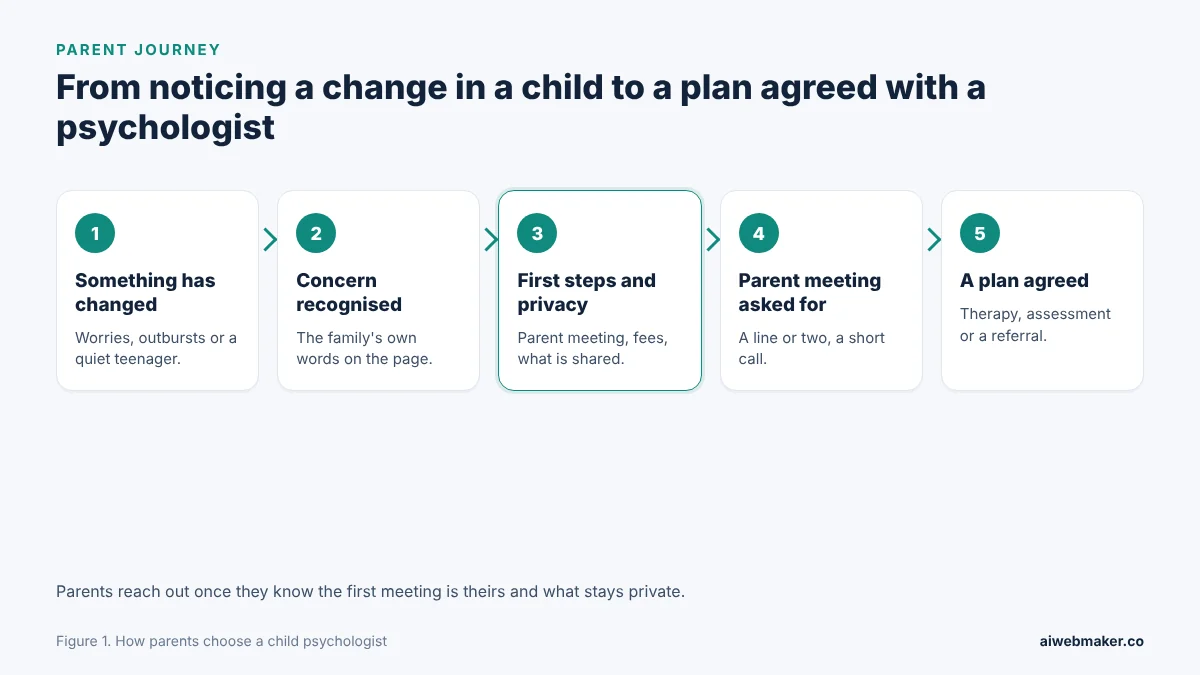
The third step is where parents decide, because they need to picture the first weeks before involving their child. They begin by noticing a change, then look for their own words among the concerns a practice lists. The highlighted step covers the parent meeting, the fees and which of a child's words will be shared, and silence here stops many requests. A request for a parent meeting follows, usually with a short call to check the fit. Last comes a plan the family agrees to, which may be therapy, an assessment or a referral elsewhere.
Concerns, first weeks, fees and privacy: pages a child psychology practice needs
A child psychology site should speak to parents first and to older children second, in plain and calm language. The home page states the ages seen, that parents meet the psychologist first and that the practice is not a crisis service. A concerns page lists the reasons families usually call, in their own words. Pages on the first weeks, fees, privacy and assessments answer questions parents are often too anxious to ask on the phone. A request for a parent meeting and a contact page with an emergency line close the route.
| Page | Parent's question | What it should include |
|---|---|---|
| Home | Is this the right place for our child? | Ages seen, parent meeting first, not a crisis service |
| Concerns | Do they help with what we are facing? | Reasons families call, in everyday words |
| First weeks | What happens before therapy starts? | Call, parent meeting, meeting the child, an agreed plan |
| Fees | What will each appointment cost? | Price per appointment, assessments priced in writing |
| Privacy | What will parents be told? | Themes shared, safety exceptions, local rules |
| Request and contact | How do we begin? | A parent meeting request and an emergency line |
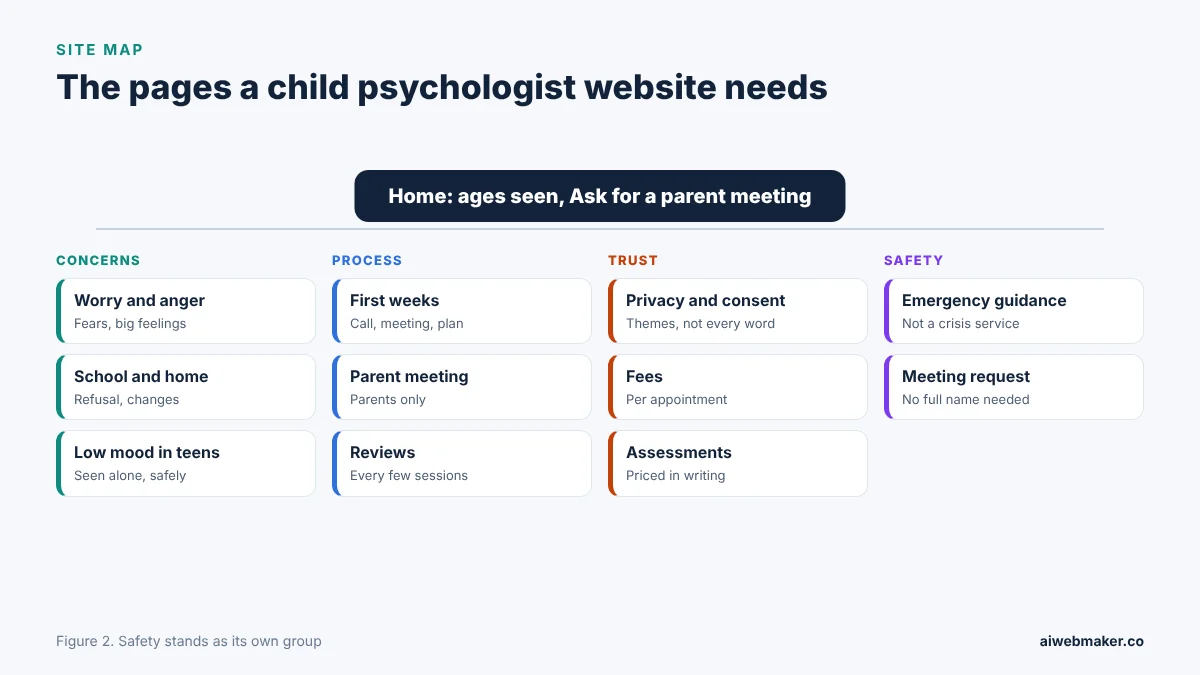
The plan opens with concerns, moves through the process and then reaches the trust pages that settle privacy, fees and assessments. Safety stands as a group of its own, so the emergency guidance is never buried inside a contact page. Kite Child Psychology, the invented practice in our sample, names Worry and fears, Big feelings and anger, School troubles, Changes at home, Low mood in teenagers and Assessments among the reasons families come. Its page begins with a meeting for parents only, sets out every fee, explains what a child says and what parents hear, and repeats that it is not a crisis service. The child psychologist website example with a parent meeting before therapy closes with a request for that first parent meeting.
Concerns described the way families say them
Parents rarely search for a diagnosis, so each concern should be written in the words a family uses at home. Separation worries, fears that keep growing, outbursts, refusing school, friendship trouble and a teenager who seems flat for weeks are typical examples. Each concern card should set out what the psychologist explores with the family and, where relevant, which other professionals might be involved. The page should also state what the practice does not offer, such as crisis support, medication or court reports, and suggest where to turn instead. Admitting limits early saves families from waiting on the wrong list.
| Concern | What the page explains | Where else families might turn |
|---|---|---|
| Worries and fears | How the psychologist explores what keeps them going | The family doctor if sleep or eating change sharply |
| Big feelings and anger | Work with the child and the family around them | School staff, with consent |
| School troubles | Settling, friendships, refusal and test strain | The school's own support team |
| Low mood in teenagers | How a teenager is seen, often alone | The family doctor, and urgent help if safety is at risk |
| Assessments | What is assessed and what the report covers | A doctor where a diagnosis lies outside the practice's scope |
Consent, separated parents and the privacy a child can count on
Confidentiality is harder to explain for children than for adults, and the website should explain it before anyone asks. Many practices agree with each family, in front of the child, what will be shared, so parents hear themes, progress and ways to help but not every sentence. The clear exception is safety, when a psychologist must pass a worry about a child's safety, or someone else's, to the people who need to know. Rules on who can consent for a child, how much say a teenager has and what separated parents may be told vary between countries, and occasionally within one country's regions. The page should say that these rules are explained at the parent meeting and that the practice follows the law where it works.
Assessments, reports and the limits on diagnosis
Assessments are often the reason a family calls, and they deserve their own page with a written price. The page should describe the steps, from the parent interview and sessions with the child to information from school, with consent, and a written report. It should be honest that which conditions a psychologist may diagnose depends on the country and the professional's training, and that some diagnoses need a medical doctor or a specialist team. Waiting times, the number of visits and when the report arrives are the practical questions parents ask most. Pricing assessments in writing before they begin prevents disputes at the end.
| Assessment step | What parents should know |
|---|---|
| Parent interview | Development, early years, school and what has been tried |
| Sessions with the child | Play, tasks or questionnaires suited to age |
| Information from school | Gathered only with the family's consent |
| Feedback meeting | Findings explained in plain words |
| Written report | What it covers, who receives it and when |
Crisis lines, emergencies and what the practice is not
Every child psychology website needs an emergency line that appears wherever a worried parent might look. Most private practices are not crisis services, and the page should say so on the home page, beside the request and on the contact page. A plain instruction to call local emergency services, or go to the nearest emergency department, when a child is in immediate danger comes first. Urgent worries that are not emergencies can be directed to the family doctor, and a note that messages are not read out of hours prevents false reassurance. Repeating this line in several places is a matter of safety, not clutter.
Protected titles, registers and the rules on testimonials
Psychologist is a protected title in many countries, reserved for people on the relevant register. Words such as counsellor or therapist are often less tightly controlled. The website should name the register that applies where the practice works and explain how parents can check it. Professional codes in many places restrict testimonials in health advertising, and some forbid them outright, so the practice should check its local rules before publishing any parent's words. Where reviews appear on map listings, replies must never confirm that a family is a client. Careful wording here protects families and the practice's registration together.
Asking for a parent meeting without telling the whole story
The request should feel small, because many parents hesitate for months before sending it. The page can say that a line or two is enough at this stage and that the child's full name is not needed yet. Through the booking website builder for child psychologists and parent meetings, that request for a first meeting reaches the practice for a reply. A psychologist may accept it, propose a different time, or decline and suggest a better first stop, such as the family doctor or a specialist service. Families pay the practice itself after each appointment, so the platform never handles or shares in those fees. The builder drafts the concern, privacy and fee pages as well, after the practice summarises its approach in a short note.
Searches parents make after a call from the school
Parents search with phrases such as child psychologist near me, therapy for anxious children, teen counselling, school refusal help or child assessment, often adding a town. Concern pages with those words in their headings help each search land on the right explanation. On the map listing, opening hours, step access and any video option for teenagers deserve a mention. Articles on talking to a child about a first appointment, supporting a worried child at bedtime or what an assessment involves give parents something useful before they are ready to call. Calm, accurate writing makes the practice a name a school counsellor feels comfortable passing on.
Sand trays, quiet rooms and a modest web bill
Rent for quiet rooms, clinical supervision, insurance and registration fees all weigh more than the website does in a child psychology practice's year. The $119 yearly hosting fee can instead be paid as $19 each month, and the domain adds whatever its ending costs, from a choice of about 400. Credits for twelve articles written for parents total roughly $7.80. Editing fees, adding a Saturday parent meeting or rewording the privacy section is never billed. The $189 tier stands in the table for comparison, not because the practice needs it.
| Item | Yearly | Monthly |
|---|---|---|
| Hosting the child psychologist pages | $119 | $228 over twelve months |
| Domain | Depends on the ending | Depends on the ending |
| Higher plan, for comparison | $189 a year | Not needed |
| Twelve articles for parents at about $0.65 | About $7.80 | About $7.80 |
| Fee, hours and privacy updates | No charge | No charge |
| Year before the domain | About $126.80 | About $235.80 |
Clinical labels, hidden fees and missing emergency lines: why parents hesitate
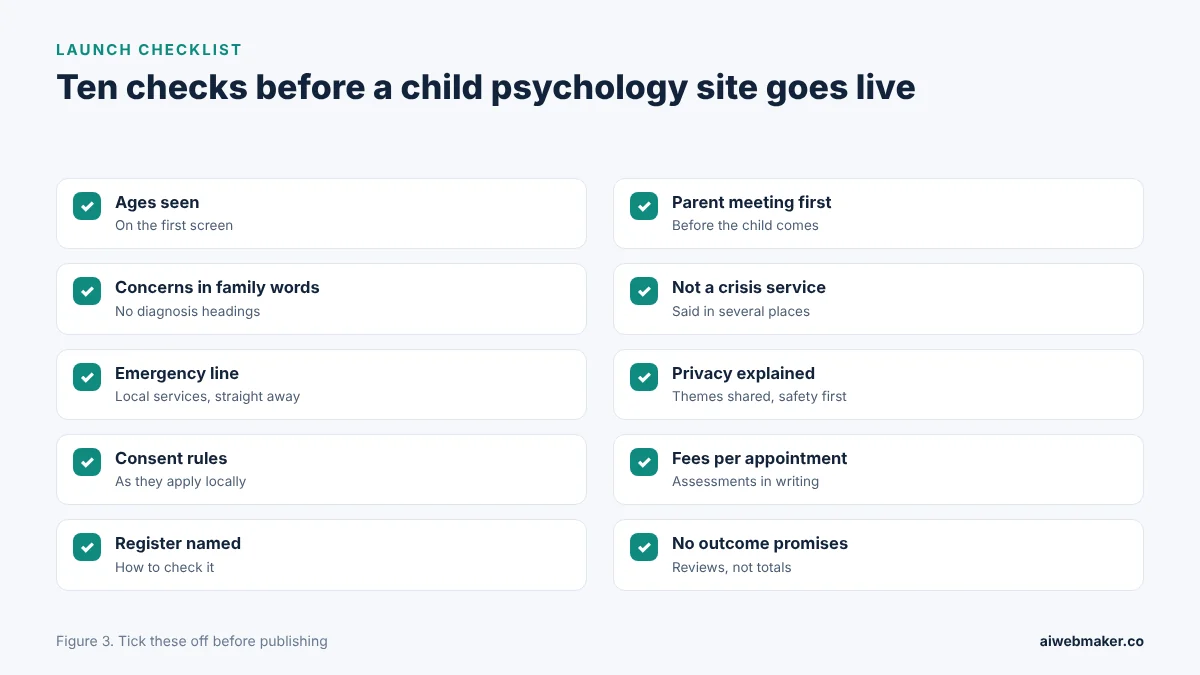
Parents hesitate when a child psychology site lists diagnoses and therapy models but never describes a family's worries in plain words. A missing note about the first meeting leaves them unsure whether their child will be questioned by a stranger on day one. Fees hidden until the call suggest an open ended bill, and silence on privacy worries teenagers and parents alike. A website without an emergency line feels careless to anyone who has lived through a frightening night. Each of these gaps meets its fix in the checklist placed after this paragraph.
Frequently asked questions
What should parents tell a child before the first session?
Most children cope better with a simple, honest explanation than with a surprise. Parents might describe the psychologist as someone who helps children with worries or big feelings, using words that suit the child's age. Practices often help parents plan what to say during the parent meeting. Teenagers usually appreciate being part of the decision to go. A calm explanation helps a child arrive curious rather than frightened.
Can a child psychologist speak to the school?
With the family's consent, and the teenager's consent when they are old enough, a psychologist can speak with a teacher or write a short letter. Nothing should reach the school without that consent, a point worth stating in black and white. Some families prefer school to stay out of the work, which is equally valid. Rules on information sharing differ between countries, so the practice should explain how they apply locally. Clear consent arrangements protect a child's trust in both settings.
Are video sessions suitable for children?
Video can suit teenagers and parent meetings well, while younger children often do better in a room with toys and space to play. The website should say which appointments are offered by video and which stay in person. Privacy at home matters, so families need a quiet room where the child cannot be overheard. Rules on providing therapy across regions or borders vary, and some registers limit where a psychologist may practise. Honest guidance helps families choose the format that suits their child.
How long does therapy for a child usually last?
There is no set length, because children, families and concerns differ. Many practices review progress with parents every few sessions and decide together whether to continue, change the plan or stop. Some families need a short piece of work and others are seen for longer. The website should describe the review rhythm rather than promise a number of sessions or a result. Describing reviews instead of totals lets families plan with their eyes open.
Parent meetings needed before the year is covered
A single parent meeting typically earns more than the practice's $119 hosting year. Paying by the month, the practice's $19 is far below the fee for one session with a child. Each family that returns for reviews, and each school counsellor who passes the practice's name to another parent, reflects pages that felt safe to read. Gentle concern cards, plain privacy rules and a visible emergency line reassure parents far better than lists of qualifications. A parent who finishes reading the website calmer than when they started is the best measure of its worth.
Build your website in Minutes and get the AI Tools that work
Start Building Your Website →