Laser Tag Website Cost: Birthday Missions, Haze Warnings, Sessions
Running a laser tag arena's website takes $119 a year of hosting or $19 in a single month, with a domain added. In this guide: who plans a game, packages, sessions, safety rules, game modes, requests, search and costs.
- No coding required
- Live in minutes
- Blog, SEO and chatbot tools included
Running a laser tag arena's website through AI Web Maker takes $119 a year, or $19 in a single month, and the arena adds a domain of its choice. The package cards, session table and safety rules can be shaped in the preview, game after game, without anything being billed. One birthday mission for ten at the sample's price covers the year twice. The harder job is convincing parents that a dark arena full of haze, flashing light and excited children is safe, supervised and suitable for a seven year old. Team organisers, meanwhile, need to see that adults will enjoy it too. In this guide come who plans a game, the pages, packages and prices, session times, vests and rules, game modes, requests and deposits, search, a year of hosting sums and the gaps that lose parties.
This article is part of our complete guide: Food Business Website Builder.
Parents, team captains and teenagers: who plans a laser tag game
Laser tag is mostly booked by parents, and the parent reading the website weighs safety, supervision and value before fun. A parent planning a birthday checks the minimum age, the party room, the food, the times and whether they can watch. Team organisers compare team nights on price per head and whether adults have the arena to themselves. Teenagers look for late sessions, competitive modes and a scoreboard that settles arguments. Families on a weekend look at open play times and the price of a single game. Each group needs its answer within a scroll or two.
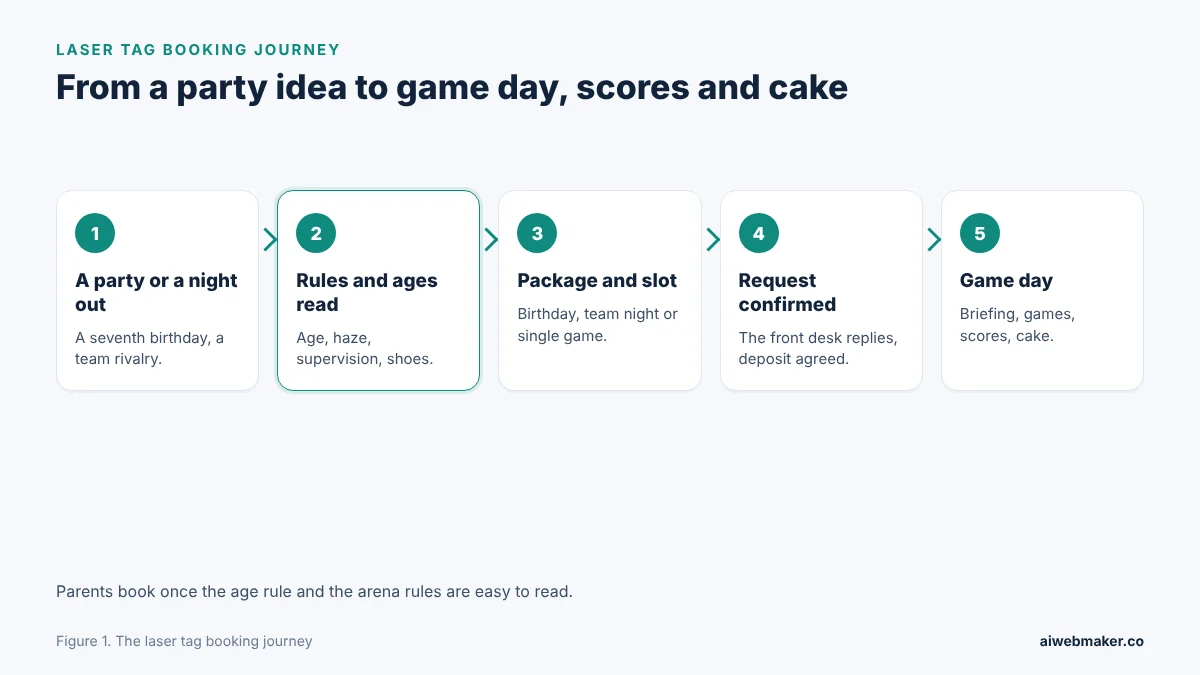
The rules and ages step is the one this laser tag journey turns on, since no parent books a dark arena for a child without reading how it is run. A birthday or a team night starts the path, often planned weeks ahead. Choosing a package and a slot follows, and a session table makes that quick. The front desk then confirms the slot and agrees any deposit directly with the organiser. Game day brings the briefing, the games, the printed scores and often a party room with cake. Served in order, those steps can turn one anxious seventh birthday into a family tradition.
Packages, sessions and safety pages a laser tag arena publishes
A laser tag arena's site needs only a handful of pages, provided each settles a parent's or a captain's question. Packages explain single games, birthday missions and team nights with what each includes. A sessions page shows days, start times and who each session suits. Safety and age rules cover the briefing, the marshals, haze and flashing light, shoes and behaviour. A game modes page describes what happens once the vests are on, while the request page and directions close the loop. Parents who find all of this together forward the link to other parents without needing to call.
| Page | Parent or captain's question | What it shows |
|---|---|---|
| Packages | What do we get for the price | Games, players, party room, food, host |
| Sessions | When can we play | Days, start times, ages per session |
| Age and safety | Is it safe for my child | Minimum age, supervision, haze, shoes, behaviour |
| Game modes | What happens in the arena | Modes by age and group size |
| Booking request | How do we hold a slot | Package, day, time, players, youngest age |
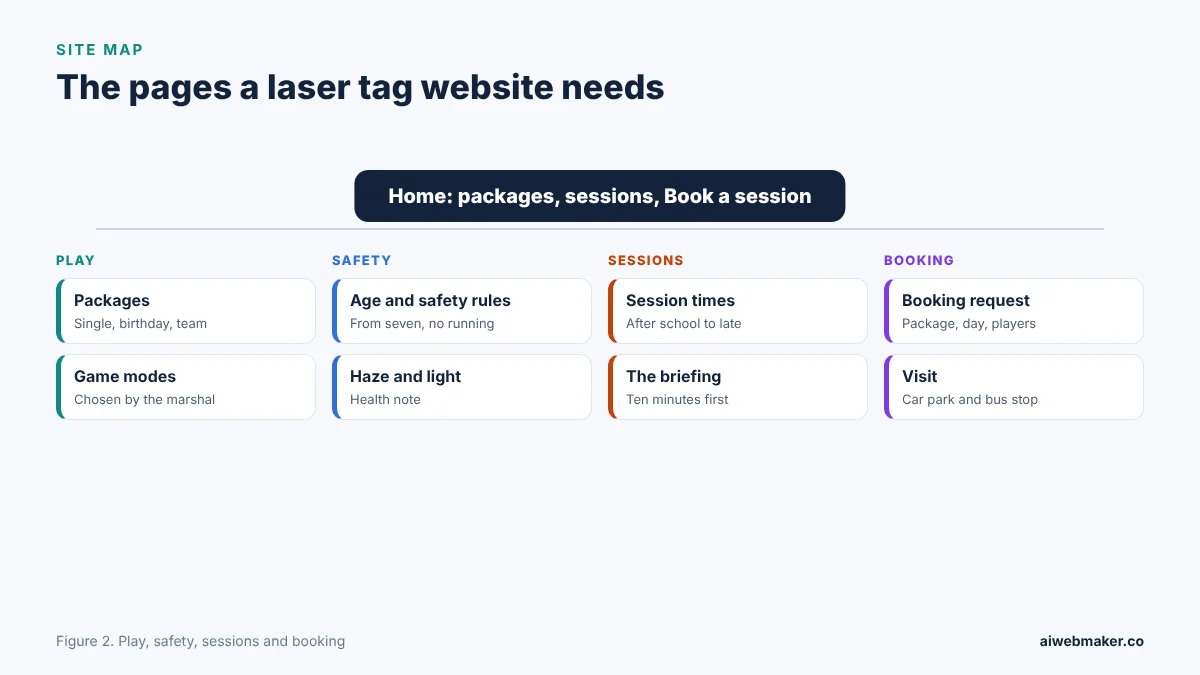
In this laser tag plan, the home page opens onto four branches: play, safety, sessions and booking. Our sample arena, Neon Fort Laser Tag, offers three packages, a single game, a birthday mission and a team night, then sets out its week in a sessions table. Its age and safety section is written as six short rules: from seven years old, walk never run, haze and flashing light, closed shoes and empty pockets, sitting a game out, and one warning then a rest. A list of game modes the marshals run follows, from team against team to a sudden death final. The laser tag website example with age rules, session times and birthday missions closes with a request for the slot, the head count and the age of the youngest player. That order lets a parent check the rules within a scroll of the prices.
Single games, birthday missions and team nights, priced clearly
Laser tag pricing should show what one game costs, what a party includes and how a team night is priced, because each audience reads a different line. Single games are usually priced per player for a game of a set length, often with a lower price for a second game straight after. Birthday packages bundle games with the arena kept for the group, a host and time in a party room with food. Team nights reserve the arena for a larger group across several games, often with captains and a final scoreboard. Extra players, cakes and longer party room times should each have a stated price or rule. A package table that covers these lines lets parents compare like with like.
| Package | Usually includes | What parents and captains check |
|---|---|---|
| Single game | One timed game after a briefing | Price per player, second game price, walk ins |
| Birthday party | Private games, a host, party room, food | Players included, extra guests, cake rule |
| Team night | Several private games, captains, scoreboard | Group size, price, evenings available |
| Late session | Games for older players only | Minimum age, identification |
Session times and the half hour rhythm of the arena
Laser tag arenas run to a rhythm of games on the hour or half hour, and a session table helps families arrive at the right moment. After school sessions, weekend open play, birthday slots and evening team nights each suit different groups. Late sessions for older teenagers and adults, with the haze up and the lights down, need their own minimum age. School holidays rearrange the whole week, so holiday opening hours need their own line. The table should also say how early to arrive for vests and the briefing. A clear timetable cuts the calls asking when the next game starts.
Vests, phasers, haze and the rules in a dark arena
Safety in laser tag is less about the equipment, which fires only infrared light, and more about moving around a dark, crowded space. The page should explain that phasers send a beam to sensors on other players' vests, so nothing physical is fired and a hit does not hurt. Rules against running, climbing, lying on the floor and physical contact matter because ramps and corners are hard to see under ultraviolet light. Haze, ultraviolet light and flashing effects should be named clearly, with advice for anyone with photosensitive epilepsy, asthma or a heart condition to ask a doctor first. Closed shoes and empty pockets prevent trips and lost phones, and a viewing gallery lets parents watch without entering. Marshals inside every game, giving one warning and then a rest, let parents relax in the café.
| Rule | Why it matters in the arena |
|---|---|
| Walk, never run | Ramps and corners are hard to see in the dark |
| No physical contact | Players of different sizes share the arena |
| Haze and flashing light warning | Photosensitive epilepsy, asthma, heart conditions |
| Closed shoes, empty pockets | Prevents trips and lost belongings |
| A marshal in every game | Play stops if anyone feels unwell |
| One warning, then a rest | Keeps rough play away from younger players |
Game modes that suit seven year olds and office rivals
Game modes keep a group coming back for a second and third round, so each one earns a short description. Younger groups usually start with team against team, which keeps friends together and rarely leaves anyone isolated. Capture the base, hold the tower and protect the captain add objectives that reward teamwork over speed. Older groups enjoy every player for themselves, hidden traitor rounds and a sudden death final, where one hit ends a player's game. The page can explain that marshals choose modes to suit the ages and size of the group, and that birthday groups may get a vote. A sentence on each mode turns an abstract activity into a plan players look forward to.
Slot requests, birthday deposits and the front desk
A laser tag request works best when it gathers the package, the day and a start time from the session table, plus the head count and the youngest player's age. Using the booking website builder for laser tag arenas and birthday missions, the parent or captain sends those details and the front desk responds. Staff can accept the slot, point to the nearest open game or decline when the arena is booked out. Deposits, such as a fixed sum to hold a birthday, are arranged by the arena with the family directly, and not a cent of them reaches AI Web Maker. Notes for the marshal, such as a nervous child or a guest who needs to sit out, help the game go smoothly. A request that asks for the right details makes the briefing on the day shorter and calmer.
How parents and captains search for laser tag
Families and organisers search for laser tag near me, laser tag birthday party, kids party venues, indoor activities for rainy days or team building laser tag. Headings on the party and team pages can match those phrases, alongside the suburb or town. The map listing should carry the session hours, photos of the lit arena and a link to the packages. Reviews from parents describing calm marshals, a clean party room and happy children carry the most weight with other parents. Articles on planning a laser tag party, what to wear in an ultraviolet arena or which modes suit younger children answer questions parents ask each other. Over a year, these pages help the arena become the default answer for a birthday in the area.
The arena's website budget, line by line
Hosting, a domain and some article credits make up a laser tag arena's whole website budget. The hosting is $119 when billed annually, or $19 each month for a total of $228. Each domain ending carries its own price, with about 400 to choose from. Twelve articles on parties and game modes cost about $7.80 in credits. Alongside sits the $189 tier, purely for comparison, and session, package or rule edits carry no fee.
| Item | Yearly | Monthly |
|---|---|---|
| Hosting the laser tag pages | $119 | $228 over twelve months |
| Domain | Depends on the ending | Depends on the ending |
| Higher plan, for comparison | $189 a year | Not needed |
| Twelve party and game mode articles at about $0.65 | About $7.80 | About $7.80 |
| Session, package and rule updates | No charge | No charge |
| Year before the domain | About $126.80 | About $235.80 |
Dark photos and hidden age rules that lose a party
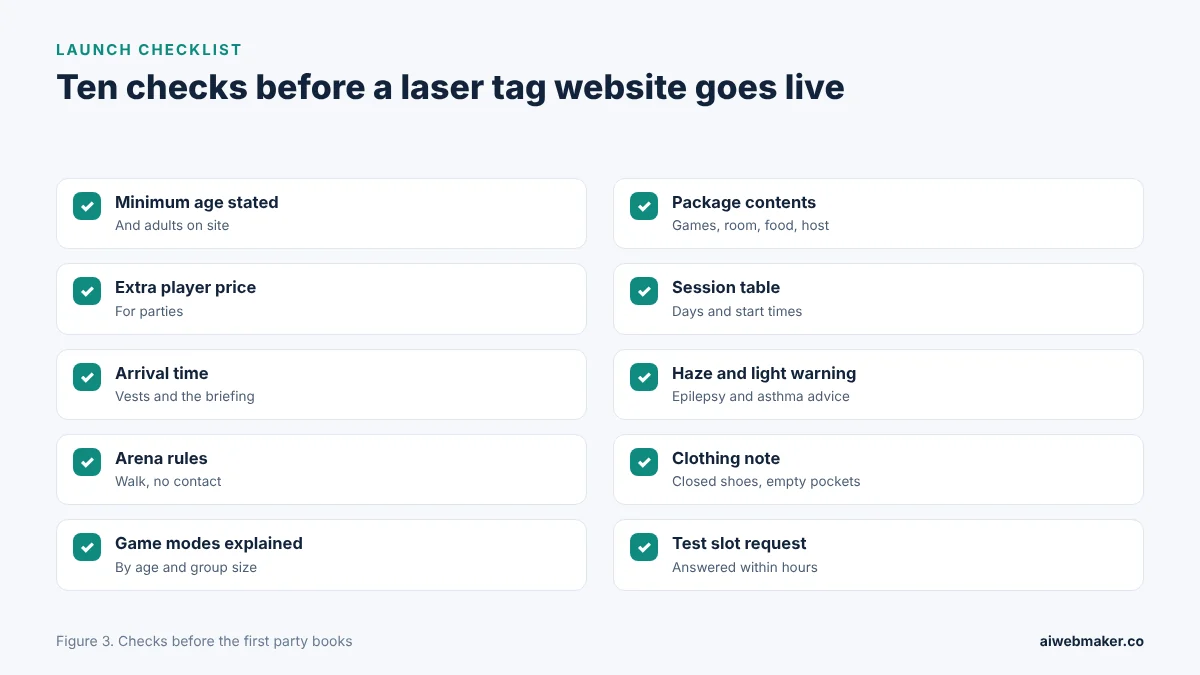
A parent closes a laser tag website the moment the minimum age, or the rule on adults staying, proves impossible to find. No mention of haze and flashing light leaves families of children with epilepsy or asthma unable to decide. Packages that hide the number of players included make party budgets impossible. A missing session table sends people to the phone or to another venue. Photos so dark that the arena cannot be seen tell visitors nothing. Each gap has its own fix in the ten tiles of the figure.
Frequently asked questions
Does being hit by a laser hurt?
Being hit in laser tag does not hurt, because phasers send an infrared signal to sensors on the vest and nothing physical is fired. Vests usually buzz or light up to show a hit, and the phaser may pause briefly. This makes laser tag suitable for younger players who would not enjoy paintball. Parents often mix up the two games, so the site should spell out the difference. A clear answer removes one of the most common worries.
How old do laser tag players need to be?
Minimum ages differ between arenas, often depending on vest size and layout, which is why each arena should print its own figure. Many arenas also require an adult on site for younger children and set older age limits for late sessions. Stating the rule beside the packages prevents disappointment at the door. Parents of mixed age groups appreciate knowing how marshals handle younger and older players together. Clear age rules keep both the party and the arena running smoothly.
What should players wear in an ultraviolet arena?
Players should wear comfortable clothes and closed shoes, since the arena has ramps and dark corners. White and pale colours glow under ultraviolet light, which some players enjoy and others avoid for stealth. Pockets should be emptied into lockers to prevent lost phones and trips. Long loose items can catch on vests and should be left outside. A short clothing note helps parents send children ready to play.
Can adults play alongside children?
Most arenas welcome adults playing alongside children, often at the same price per game. Marshals usually adjust modes and keep an eye on mixed games so younger players are not overwhelmed. The website can explain how mixed age games work and when adult only sessions run. Parents who join in often become the arena's best advocates. Clear guidance makes family visits more fun for everyone.
Ten young players and the hosting bill
One birthday mission at the sample arena's price covers the $119 hosting bill twice. Two players on a single game each, at the sample's prices, clear a $19 month between them. Team nights, after school regulars and late arena groups then add income that a quiet weekday would never bring. A plain age rule, honest notes on haze and light and a quick slot request reassure parents more than neon photos. Arenas that keep sessions, packages and modes current become the place local children ask to go. A Saturday of back to back birthday slots is the result to aim for.
Build your website in Minutes and get the AI Tools that work
Start Building Your Website →