Karting Website Cost, Height Limits and Grids That Fill Themselves
A karting circuit buys a year of hosting for $119, or a single month for $19, and adds a domain. Inside: who books, race formats, limits, flags, health, parties and leagues, session requests, search and the yearly bill.
- No coding required
- Live in minutes
- Blog, SEO and chatbot tools included
Next to tyres, fuel and helmets, a karting circuit's website barely registers: the hosting invoice reads $119 for a year, or $19 for one month, before a domain. Drafting the session pages, the limits table and the booking request, and testing each on a phone through the preview, never appears on that invoice. A single grid of twelve arrive and drive drivers covers the year and leaves change for fuel. Trickier is the fact that parents, first timers and team organisers each arrive with a worry the track must settle before anyone books: how tall, how old, how fast and how safe. Coming up are the people who book track time, the pages to build, race formats, limits, flags and briefings, health notes, groups and leagues, session requests, search, the yearly bill and the omissions that lose drivers.
This article is part of our complete guide: Food Business Website Builder.
Who books track time, from first timers to league drivers?
Karting bookings arrive from very different people, and each reads the site hunting for a different fact. Parents planning a birthday check the minimum age and height first, then the length of the race and whether there is a room for food afterwards. Groups of friends compare arrive and drive prices and how many minutes on track they get for the money. Office organisers want a grand prix or endurance format that mixes skilled and nervous drivers fairly. Keen drivers look for league rounds, weight balancing and printed lap times they can improve on. Each of these readers leaves quickly if the one fact they came for is buried.
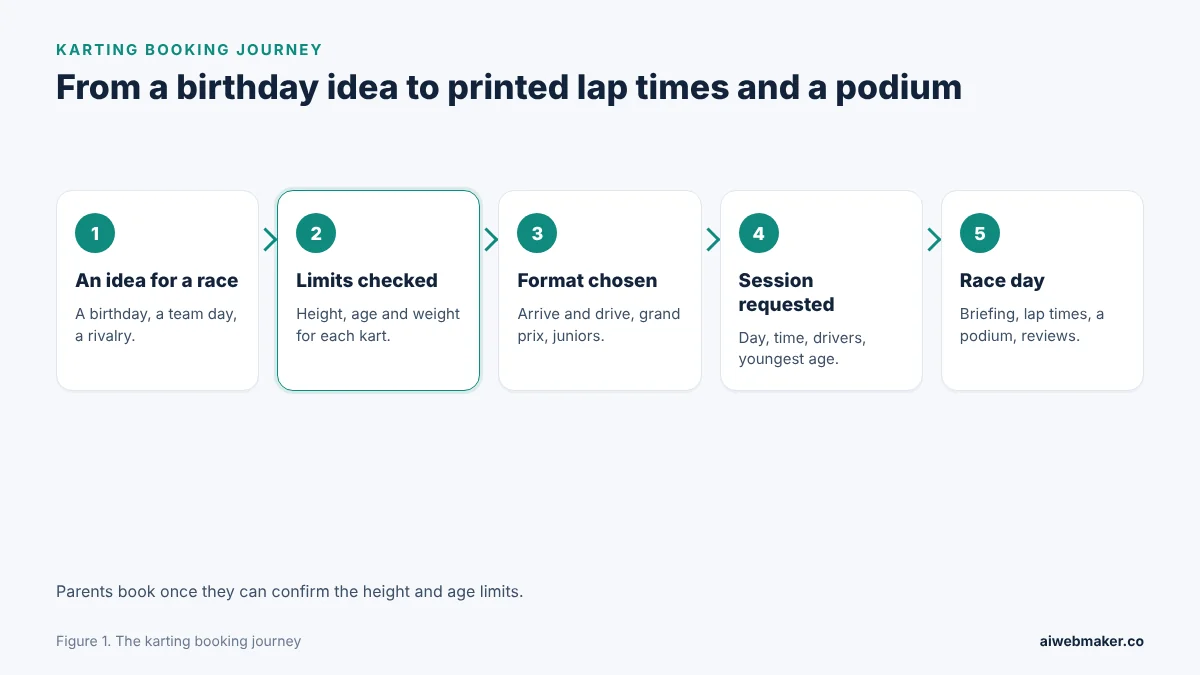
Checking the limits is the glowing step in this journey, because a parent who cannot confirm that a nine year old may drive will not risk a booking. Choosing a format comes next, from a quick session to a full grand prix with qualifying. A session request then pins down the day, a rough start and how many karts are needed. Race day ends with printed times and a podium, which is where reviews and repeat bookings begin. Pages that serve each of these steps in order shorten the distance between curiosity and a full grid.
Session, limits and party pages a circuit's website carries
A karting site should carry one page per decision a driver or organiser has to make, rather than one long page of everything. Sessions describe the formats with time on track, kart type and price per driver. A limits page sets out height, age and weight rules in a table, because these decide who can drive at all. Party, team day and league pages speak to organisers and regulars, while the request and visit pages close the route. Together they answer the questions the desk would otherwise field by phone all week.
| Page | Who reads it | What it must state |
|---|---|---|
| Sessions | Friends and first timers | Minutes on track, kart type, price per driver |
| Height, age and weight | Parents and organisers | Minimums by kart, weight limit, who signs |
| Safety and kit | Nervous drivers and parents | Helmets, overalls, briefing, flags, marshals |
| Parties and team days | Organisers | Grid sizes, formats, rooms, trophies |
| League and academy | Regular and junior drivers | Rounds, points, coaching, entry rules |
| Session request | Everyone ready to book | Session, day, time, drivers, youngest age |
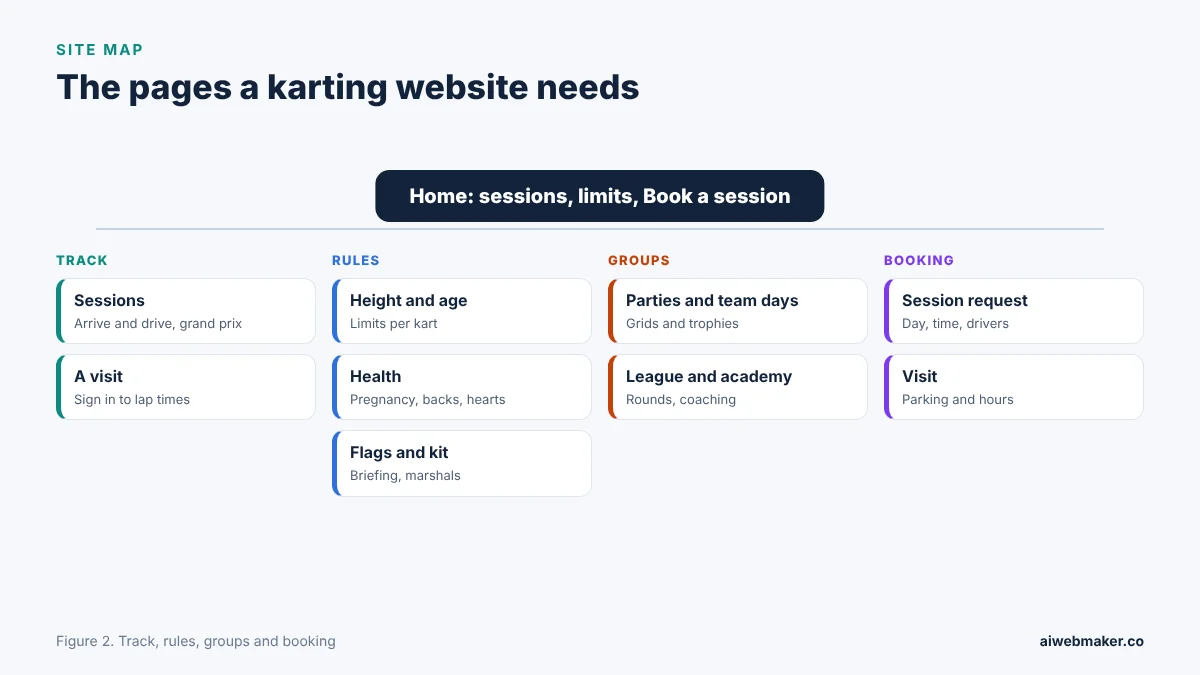
Branching from the home page, the circuit's plan splits into track, rules, groups and booking. Sessions and the run of a visit sit under track, the limits table and health note under rules, parties, team days and the league under groups, and the request with directions under booking. Our sample, Apex Karting Circuit, runs an outdoor track of 800 metres and lists arrive and drive, grand prix and junior sessions, followed by birthday parties, team race days, a monthly league and a junior academy. Its limits table gives a minimum age, a minimum height and extra conditions for each kart or event, and a short section explains health and pregnancy in plain words. The karting website example with a height and age table and session requests ends with a request for the session, day, start time, number of drivers and the age of the youngest. That order lets a parent reach the limits before the prices, which is exactly where the doubt sits.
Arrive and drive, grand prix or endurance: describing each race format
Race formats should be described by what a driver actually does on track, since a name like grand prix means little to a first timer. Arrive and drive is the simplest, a timed session of several minutes in a mixed group, with the fastest laps shown on a screen afterwards. A grand prix adds practice, qualifying, heats and a final, which takes longer and suits groups who want a winner. Endurance races put teams of drivers into one kart for an hour or more, with driver changes in the pit lane. Junior sessions use slower karts and keep young drivers on track only with others of their size. Stating the length, the group size and the minimum age for each format lets organisers choose without calling.
| Format | What happens on track | Best for |
|---|---|---|
| Arrive and drive | A timed session in a mixed group | Friends, first timers, a quick visit |
| Grand prix | Practice, qualifying, heats and a final | Birthdays, celebrations, rivalries |
| Endurance race | Teams share karts with pit stops | Team days and competitive groups |
| Junior session | Slower karts, juniors only, an extra marshal | Children within the height limit |
Height, age and weight limits, set out kart by kart
These three numbers decide whether a booking is accepted or refused at the desk, so they earn a table rather than a sentence. Karts are built for drivers within a size range, so a driver who is too short cannot reach the pedals safely or sit correctly in the seat. Minimum ages usually differ between junior karts, adult karts and adult group events, and some tracks add a maximum weight for every kart. Rules for karting differ by country, by governing body and by track, so the page should present each limit as the circuit's own. A note on how heights are checked, and what happens if a driver is close to a limit, prevents arguments on arrival. Many tracks also ask a parent or guardian to sign for younger drivers, which belongs in the same table.
| Limit | Why it exists | How to present it |
|---|---|---|
| Minimum height | Reaching the pedals and sitting correctly | A figure per kart, checked at the desk |
| Minimum age | Maturity and kart speed | A figure per kart and per event |
| Maximum weight | Kart handling and seat fit | One figure for every kart |
| Consent for minors | Responsibility for younger drivers | Who signs, and whether they stay on site |
Flags, marshals and the briefing before the green light
The safety briefing is the part of a karting visit that first timers remember, and the website can prepare them for it. A good page lists the kit provided, usually a helmet, a balaclava for hygiene and overalls, and says whether drivers may bring their own approved helmet. Flag meanings are worth a small table, since most beginners recognise only the chequered flag. Long hair tied back, scarves left in a locker and no loose cords are rules with a serious reason, because anything loose can catch in moving parts. Flag signals and procedures can vary between circuits and countries, so the table should mirror the track's own briefing.
| Flag | Usual meaning on a karting track |
|---|---|
| Green | Session started or track clear |
| Yellow | Hazard ahead, slow down and hold position |
| Blue | A faster kart is behind, keep a steady line |
| Red | Session stopped, slow down and follow the marshals |
| Black | Return to the pit lane |
| Chequered | Session over, ease off and come in |
Health, pregnancy and the driver declaration
Health guidance on a karting site should be short, plain and careful, because karts have no suspension and every bump runs through the driver's back and neck. The page can ask anyone who is pregnant not to drive, and suggest that people with heart conditions, epilepsy, back or neck problems, recent injuries or recent surgery speak to a doctor before booking. It should avoid sounding like medical advice and simply explain why the track asks. Many circuits ask each driver to sign a declaration on arrival, and the website can say what that covers. Requirements for declarations, and how much weight they carry in law, change from one country to the next, so general wording is safest. Honest health notes protect drivers and spare everyone a difficult conversation at the desk.
Birthday grids, team race days and a monthly league
Parties, team days and leagues usually bring a karting track its most predictable income, so each one needs more than a line on a price list. A birthday page should explain the grid size, junior or adult karts, the trophy and whether there is a room for food. Team race days suit companies when the page describes the format, the lunch break and how mixed abilities are balanced. A league page sets out the rounds, the evening, the points system and any weight balancing that keeps heavier drivers competitive. Clear group pages lift the weekday and off season bookings that open sessions rarely fill.
Requests for a session, a grid or a party
A session request should collect enough to plan the grid and nothing that slows the organiser down. The sample's form takes the session, the day, a rough start time, the number of drivers and the age of the youngest driver. Using the booking website builder for karting tracks and race day groups, the organiser submits that request and the track office replies. The office can hold the slot, suggest a different time or decline when the grid is already full. Any party or grand prix deposit passes straight from organiser to track, with AI Web Maker claiming no slice of it.
Phrases drivers and party planners put into search
Drivers and organisers search with phrases such as go karting near me, karting birthday party, indoor karting, corporate karting day or minimum age for go karts. Each format page deserves a heading built on the phrase its drivers use, plus the region the track serves. On the map listing, opening hours must agree with the website, and photos should show this track and these karts, with a link to the sessions. A review praising the marshals, the state of the karts or a printed lap sheet persuades more than a bare five stars. Articles on what to wear for karting, how a grand prix works or how rain changes the racing answer questions people ask before they commit. Over a season, this writing helps the circuit appear for the searches that bring real grids.
Hosting, domain and credits for a season of racing
A circuit's website spending fits on three lines: hosting, a domain and race day articles drafted with credits. Hosting is $119 on yearly billing, against $228 when twelve monthly payments of $19 are made instead. Domain prices follow the ending picked from roughly 400 on offer. Twelve articles on racing tips and race day advice come to about $7.80 in credits. The $189 tier is printed alongside purely to compare, and editing prices, limits or league dates is never charged.
| Item | Yearly | Monthly |
|---|---|---|
| Hosting the karting pages | $119 | $228 over twelve months |
| Domain | Depends on the ending | Depends on the ending |
| Higher plan, for comparison | $189 a year | Not needed |
| Twelve race day articles at about $0.65 | About $7.80 | About $7.80 |
| Session, limit and league updates | No charge | No charge |
| Year before the domain | About $126.80 | About $235.80 |
Omissions that send drivers to the next track
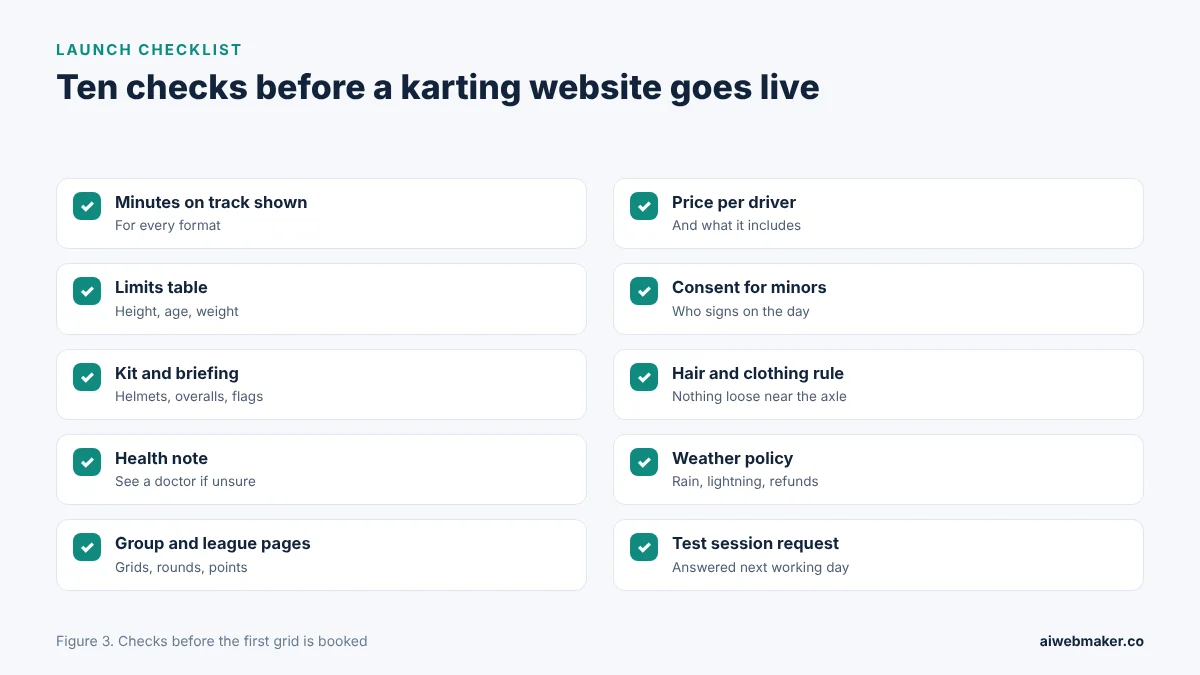
Parents close a karting site when they cannot find the minimum height or age for the kart their child would drive. Prices shown without minutes on track or what is included look like a trap. Missing health guidance leaves cautious adults unsure whether they should drive at all. A request page with no word on confirmation makes organisers wonder whether the grid is really theirs. Pictured below are ten fixes worth making before the first grid is booked.
Frequently asked questions
How fast should the website say the karts go?
Kart speeds vary widely between tracks, kart types and indoor or outdoor circuits, so the website should state its own figures rather than borrowing anyone else's. Adult karts are faster than junior karts, and many tracks can lower speeds remotely for a nervous group or a wet session. Giving an approximate top speed for each kart type helps parents and first timers judge whether a session suits them. Speed figures also help organisers pick between junior and adult sessions for a mixed age group. Specific, honest figures settle one of the most common questions before anyone calls.
Can someone who has never driven a car take part?
Most tracks welcome drivers who have never driven a car, because karts have only an accelerator and a brake and no gears. The briefing and a slow sighting lap behind a marshal cover what a first timer needs to know. The website should say this plainly, since many adults and teenagers assume a licence is required. It can also suggest a shorter session for a first visit. Reassurance on this point brings in drivers who would otherwise never book.
What happens to a session when it rains?
Outdoor circuits usually keep running in the rain with karts set up for wet conditions, while lightning or standing water stops the track. The website should explain the track's own policy, including whether sessions are moved or refunded when racing cannot go ahead. Many drivers enjoy wet sessions, and saying so turns a worry into part of the appeal. Indoor tracks can mention that they run in any weather. A clear weather note prevents calls and cancellations on grey mornings.
Is lap timing worth explaining to first timers?
Explaining lap timing is worth it, because printed and on screen times are a large part of why people return. Many tracks time every lap with a transponder on each kart, and drivers receive a printed sheet or an on screen summary after the session. Showing an example sheet, or explaining best lap and gap to the leader, helps first timers read their results. League drivers then use those sheets to measure progress round by round. Lap times give a casual visit a reason to come back and go faster.
A single grid of drivers set against the yearly bill
At the sample circuit's starting price, four arrive and drive drivers already exceed the $119 that hosts the track's pages for a year. One junior session at the sample's price more than pays a $19 month. Birthday grids, team race days and league rounds then add income that would otherwise have gone to another circuit. A clear limits table, honest health notes and a quick session request settle the doubts that stop parents and organisers booking. A packed pit lane on a school holiday morning is what those pages are built to produce.
Build your website in Minutes and get the AI Tools that work
Start Building Your Website →