The Ice Cream Shop Website Cost, From Summer Queues to Winter Tubs
An ice cream shop's pages cost $119 on AI Web Maker hosting for twelve months, or $19 a month through the seasons, with the domain extra. Inside: visitors, pages, the tub shop, frozen delivery, flavours and allergens, event carts, seasonal hours, search and the budget.
- No coding required
- Live in minutes
- Blog, SEO and chatbot tools included
Twelve months of hosting an ice cream shop's pages on AI Web Maker cost $119, or a parlour can spread it at $19 a month through the seasons, with the domain extra. No bill arrives while flavour lists, tub listings and event details are assembled in the preview. One summer wedding cart, or a few weeks of tubs sold online in winter, usually covers the year. Flavour boards, tubs and party bookings all appear on the ice cream shop website of a fictional parlour, a full sample whose pages came from AI Web Maker and are worth browsing before you plan your own. The real challenge is the calendar, with long queues on warm evenings and quiet weeks once the weather turns. A website that sells tubs for home freezers and books event carts months ahead smooths those swings. The topics run through visitors, pages, the tub shop, frozen delivery, flavours and allergens, ice cream against gelato and sorbet, event carts, seasonal hours, search and money.
This article is part of our complete guide: Food Business Website Builder.
Who looks up an ice cream shop, and when?
People look up an ice cream shop at very different moments, and each moment calls for a different page. Families on a warm evening want the opening hours, the location and a glimpse of today's flavours. Visitors to a seaside town or a city centre compare parlours by photos and reviews. Hosts planning a dinner party or a birthday look for tubs to collect or have delivered. Couples and event organisers want a cart or a van for weddings, launches and summer fairs. Guests avoiding dairy, eggs or nuts check the flavour list carefully before they make the trip.
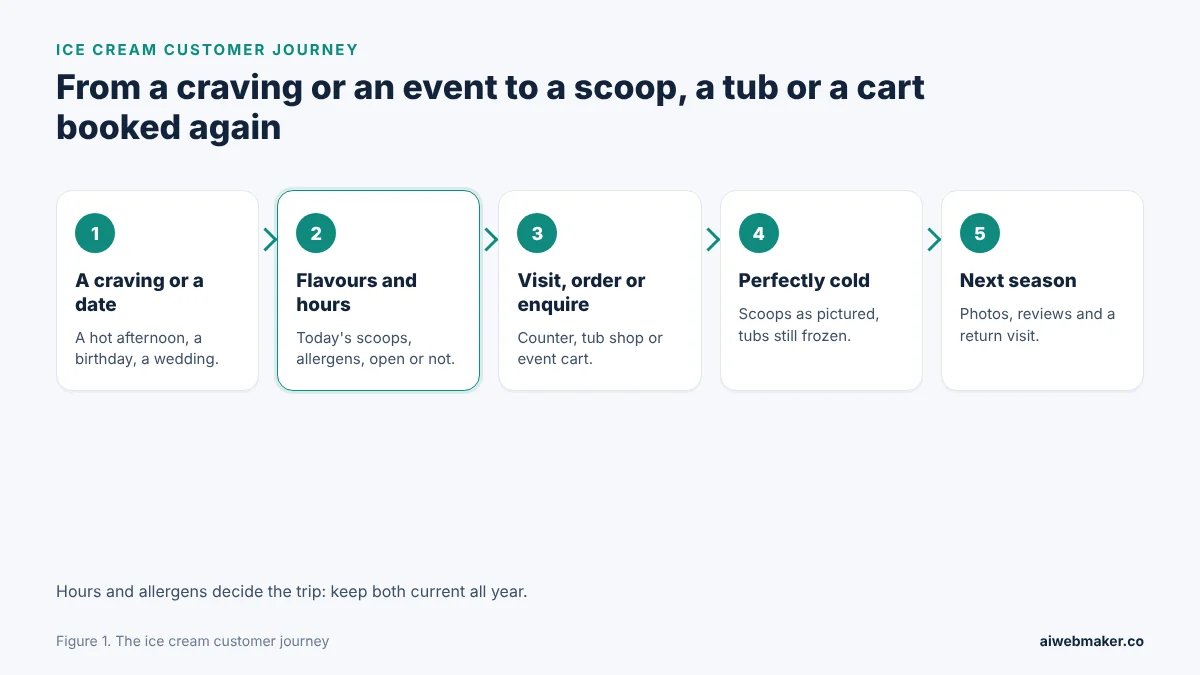
Five stages lead from a craving or an event idea to a customer who returns next season. The starting point might be a hot afternoon, a birthday or a wedding that needs a dessert with character. The visitor then checks flavours, hours and allergens, which decides whether they visit, order a tub or enquire about a cart. A visit, an order or an enquiry follows, and each must feel simple. The scoop, the tub or the cart has to match the photos and arrive in perfect condition. Photos, reviews and a return trip next summer complete the loop.
Which pages keep a parlour busy in every season?
An ice cream shop website needs pages that serve the summer queue and the winter freezer alike. Its home page should pair a photo of the counter with today's hours, then send visitors either toward the tub shop or toward events. A flavours page lists the signature and seasonal scoops with allergens. The shop sells tubs, packs and treats for collection or delivery. An events page explains carts and catering, while a story page covers how the ice cream is made and a visit page holds hours and directions.
| Page | What the visitor wants | What to include |
|---|---|---|
| Home | Is it open, and what is new? | Counter photo, today's hours, Shop and Events buttons |
| Flavours | Which scoops suit us? | Signature and seasonal flavours, allergens, dairy alternatives |
| Shop | Ice cream at home | Tubs, packs, sauces, prices, collection or delivery |
| Events and catering | A cart for our day | Occasions, how to enquire, notice needed |
| Our story | Why this ice cream | Milk, ingredients, small batches, the makers |
| Visit | When and where | Seasonal hours, map, parking, seating |
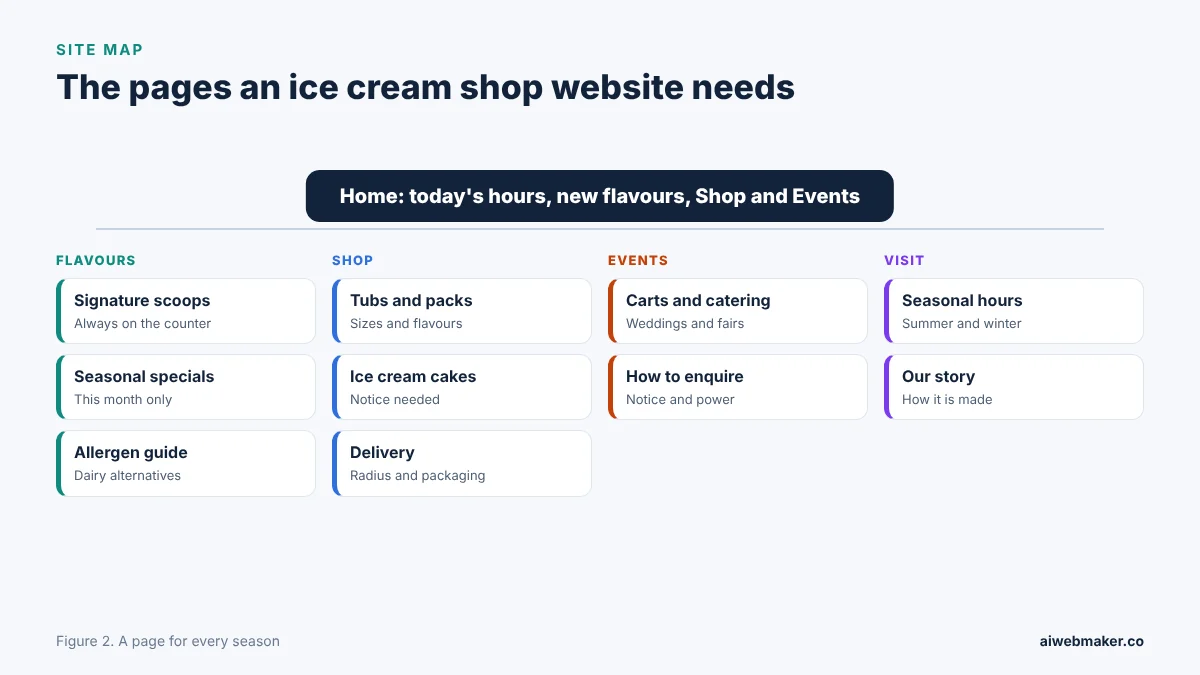
A creamery's site falls into four groups below the home page, each serving a different season or occasion. The flavour group holds signature scoops, seasonal specials and the allergen guide. Shop pages carry tubs, packs and treats for home freezers, with delivery and collection details. Event pages explain carts, catering and how far ahead to enquire, while visit pages hold hours, the map and the story of the makers. Our sample business, Frostbell Creamery, sells five products through its online shop and lists its signature flavours on a page of their own, while its story explains how and why it started and how its ice cream and treats are made. The ice cream shop website example selling tubs online is rounded off by events and contact pages, the latter with a map, and the whole build took 52 seconds.
Tubs, packs and treats in the online shop
An online shop gives an ice cream business income on cold days and reaches people who cannot reach the counter. Each listing should show the tub with the lid off, the size, the flavour and the price. Offering size and flavour as options lets a buyer settle on a large tub of pistachio in one place. With the online store builder for ice cream shops selling tubs and packs, buyers set their choices, collect tubs in a bag and reach a checkout that includes the delivery fee. A discount code can mark a winter offer or a new flavour, and a made to order ice cream cake can simply show an Enquire button, since its cost depends on the design. A shop that works all year turns a summer business into a steadier one.
| Product | Useful options | What the listing should state |
|---|---|---|
| Tub | Size and flavour | Servings, allergens, storage |
| Mixed pack | Choice of flavours | Number of tubs, delivery area |
| Ice cream cake | Size and flavour | Notice needed, Enquire for custom designs |
| Sauces and toppings | Flavour | Ingredients and shelf life |
| Party pack | Tubs, cones, sauces | Guests served, collection advice |
Frozen delivery: distance, packaging and timing
Delivering ice cream is a race against warmth, so the delivery page must be precise about distance and packaging. Insulated boxes with ice packs keep tubs frozen for a limited time, which is why many shops deliver only within a short radius. Some businesses use dry ice for longer journeys, which needs careful handling and a clear warning to the buyer. Delivery windows should be narrow, and the buyer should be home to put the tubs straight into a freezer. Home freezers are commonly set to around minus eighteen degrees Celsius, and the page can advise that tubs go in immediately. Clear delivery rules protect the product and the reviews at the same time.
| Delivery detail | What the page should state |
|---|---|
| Delivery radius | Towns or postcodes served |
| Packaging | Insulated box, ice packs, any dry ice warning |
| Delivery window | Narrow times and the need to be home |
| Collection | Hours and how to carry tubs home |
| On arrival | Freezer straight away, how long tubs keep |
Flavours, allergens and dairy alternatives
A flavour list is the page most visitors read, so it should be current, mouthwatering and clear about what each scoop contains. Milk is in almost every ice cream, eggs are common in custard bases, and nuts appear in pistachio, praline and many toppings. Cookie pieces, brownies and cones usually contain gluten, while some sorbets and vegan scoops contain soya or coconut. Shared scoops and serving wells make cross contact a genuine risk, which the page ought to admit plainly. Labelling duties for allergens are set nationally and differ, so the parlour applies the rules of its own country and encourages questions at the counter. Marking dairy alternatives and vegan flavours clearly brings in guests who might otherwise stay away.
| Style | What sets it apart | Allergen note |
|---|---|---|
| Ice cream | Cream and milk, often with egg, churned with air | Milk, often eggs |
| Gelato | More milk than cream, denser, served slightly warmer | Milk, sometimes eggs |
| Sorbet | Fruit and sugar, no dairy | Check for cross contact |
| Plant based | Oat, coconut, soya or nut bases | Soya, coconut or nuts |
| Frozen yogurt | Cultured milk, tangier taste | Milk |
Event carts and catering for weddings and fairs
Event catering is where an ice cream business finds its biggest days, and the events page should make enquiring simple. Organisers want to know whether the shop brings a cart, a van or a freezer counter, how many guests it can serve and for how long. Power needs matter, because freezers need a supply at the venue or a generator. How far ahead to enquire should be stated, since summer weekends are booked early. The shop and the organiser settle any deposit for the date between themselves, together with what happens if rain cancels an outdoor event. Photos of a cart at a real wedding help organisers picture the moment.
Seasonal hours and the winter plan
Seasonal hours cause more wasted journeys than any other detail, so the visit page must change when the season does. Summer evenings may run late while winter days shorten or close entirely on some weekdays. A short banner on the home page announcing new hours or a winter closure prevents disappointment. Winter is also the moment to promote tubs, ice cream cakes for birthdays and holiday flavours through the shop. Some parlours add hot drinks or warm desserts in the cold months, and the website should reflect that change. A clear winter plan keeps the business in customers' minds until the first warm day.
How the ice cream is made, and the words that carry weight
Customers pay more for ice cream with a story, so the story page should explain how it is made in plain detail. Small batches, the source of the milk and how flavours are developed all make the product feel special. Claims about ingredients should be accurate, because terms such as natural or local can be challenged if they are vague. The United States, for example, reserves the name ice cream for products meeting a minimum milkfat level, and other countries set their own definitions. A short, honest account of the method justifies a premium price. Craft described well becomes the reason customers choose one parlour over another.
What people search for when they want ice cream
People searching for ice cream type phrases such as ice cream near me, gelato in a named town, vegan ice cream or ice cream delivery. Organisers search for ice cream cart hire or wedding ice cream van, often months ahead. Headings on the flavours, shop and events pages that use those words help each page meet the right visitor. A map listing with seasonal hours, bright photos of scoops and the website address carries a large share of same day decisions. Reviews that praise flavours, generous scoops and friendly staff lift that listing further. Articles on hosting with ice cream, pairing desserts or making the most of a tub at home keep readers interested in winter.
The ice cream shop's yearly website budget
Year on year, a parlour's website spend is limited to hosting, a domain and roughly $0.65 for each drafted article. The yearly route at $119 is cheaper for a shop that sells tubs all year. A parlour that opens only in summer might choose $19 a month, which reaches $228 if paid every month of the year. Changing flavours, hours or prices costs nothing extra. The rows below show both routes, with the $189 tier as a benchmark.
| Item | Yearly | Monthly |
|---|---|---|
| Hosting the ice cream shop pages | $119 | $228 over twelve months |
| Domain | Depends on the ending | Depends on the ending |
| Higher plan, for comparison | $189 a year | Not needed |
| Twelve dessert and hosting articles at about $0.65 | About $7.80 | About $7.80 |
| Flavour, hours and price updates | No charge | No charge |
| Year before the domain | About $126.80 | About $235.80 |
The faults that send ice cream lovers to another parlour
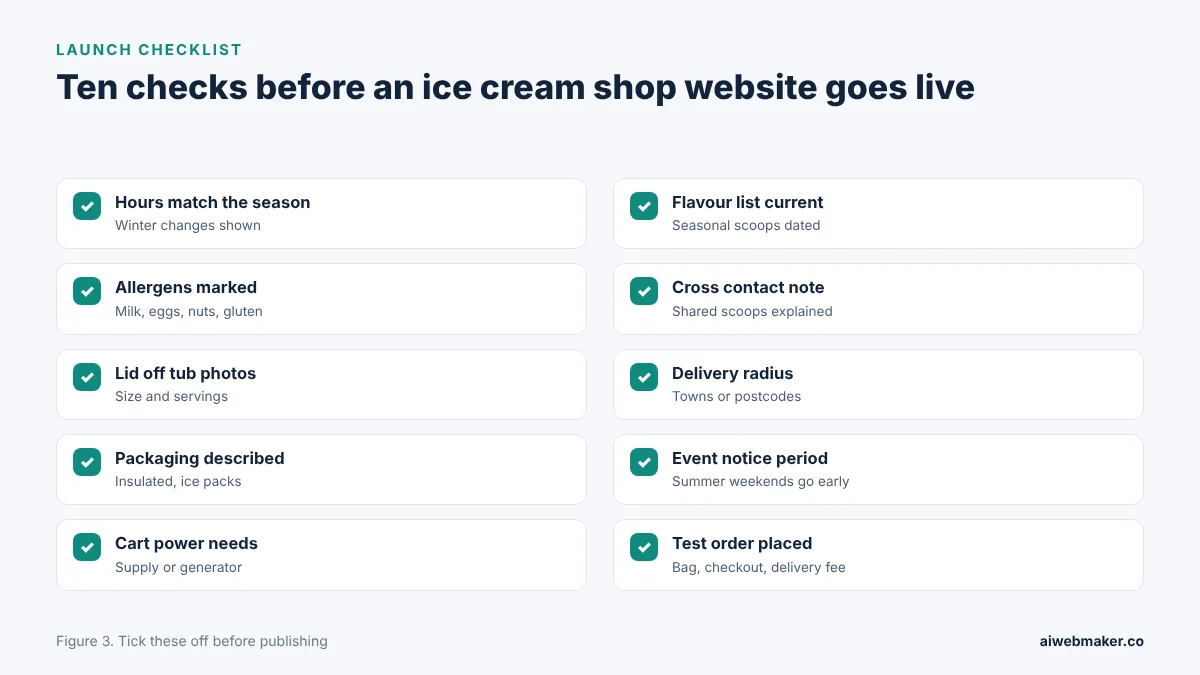
A visitor gives up on an ice cream site when the opening hours are still showing last summer. A flavour list without allergens loses parents and guests with dietary needs. A shop with no delivery radius leaves buyers unsure whether tubs will reach them frozen. Event pages without notice periods or power needs produce enquiries that cannot be met. Dark photos make bright, colourful scoops look dull. Each of those faults has a matching fix in the ten pictured below.
Frequently asked questions
How long does ice cream stay frozen on the way home?
Ice cream starts to soften within minutes in warm weather, so the journey home should be as short as possible. Insulated bags and ice packs extend that time, and many shops sell or provide them with tubs. Delivered tubs should go into a freezer as soon as they arrive. Ice cream that has melted and refrozen loses its texture and should be treated with caution. Clear advice at collection protects both the product and the customer's experience.
What is the difference between ice cream and gelato?
Gelato usually contains more milk and less cream than ice cream, and it is churned more slowly so less air is whipped in. That makes it denser, and it is typically served a little warmer, which brings flavours forward. Ice cream is often richer, with more fat, and many recipes use egg yolks. Legal definitions of both terms vary between countries. A short explanation on the flavours page helps visitors choose.
Can an ice cream cart work at a venue without power?
Some ice cream carts run on cold plates or ice and can serve for a few hours without power, while others need a supply for their freezers. Vans often carry their own power, although generators can be noisy near a ceremony. The events page should explain what the cart needs and how long it can serve. Venues should confirm their power options early. Clear technical details prevent melted plans on the day.
Do dairy alternatives suit guests with milk allergies?
Dairy alternatives are made without milk, but they may still be scooped from shared equipment, which creates a risk of cross contact. Guests with a serious milk allergy should ask staff how plant based flavours are stored and served. Some parlours keep separate scoops and serving wells for these flavours. The flavours page should describe the shop's practice honestly. Clear information lets guests with allergies make their own informed choice.
Will winter tub orders carry the creamery's year online?
A few weeks of winter tub orders, or a single summer wedding cart, usually bring in well over a creamery's $119 hosting year. Paying monthly, a handful of scoops on a warm afternoon covers the $19. Every tub sold after that is income the counter alone would never have earned in January. Accurate hours, honest allergen notes and a reliable tub shop persuade customers more than bright colours alone. Parlours that rewrite the flavour list each season keep regulars curious about what is new. A run of tub orders on a cold, grey week shows the website is earning through the quiet months.
Build your website in Minutes and get the AI Tools that work
Start Building Your Website →