Home Bakery Website Cost, Order Windows and the Limits of One Oven
A home bakery's order pages cost about fourteen sourdough loaves to host, which is $119 yearly or $19 on each monthly statement, before the domain. Then come the buyers, the pages, bake days and cut offs, pricing against one oven, collection, kitchen rules by region, allergens, cakes, search and finally the sums for the year.
- No coding required
- Live in minutes
- Blog, SEO and chatbot tools included
A kitchen table bakery spends $119 a year keeping its order pages online, or $19 a month while easing in, and the web address comes on top, priced by its ending. Its shop, the order dates table and the allergen notes can be drafted, rearranged and previewed before AI Web Maker bills a single cent. One busy cake weekend, or a few weeks of Friday sourdough, covers the whole twelve months. The harder problem is time, because one baker with one oven sells bake days rather than shelves. The site has to close orders on schedule, keep the family address private and tell careful buyers exactly what a domestic kitchen can and cannot promise. Covered in turn are the buyers, the sections, cut offs, oven pricing, collection, the kitchen's legal footing by region, allergens, cakes, search and finally the sums for the year.
This article is part of our complete guide: Food Business Website Builder.
Who orders from a kitchen table bakery, and what do they plan around?
Most buyers of a home baker plan around a single fact, which is the next bake day and how long they have to order for it. Weekly regulars want the same Friday loaf and hate finding it gone. Parents ordering a birthday cake care about the date, the number of slices and whether a child's allergy can be managed. None of them can walk into the kitchen to judge it, so they read the website for signs of care and legality instead. The baker who answers the date, the cut off and the kitchen question first wins the order before the doubts arrive.
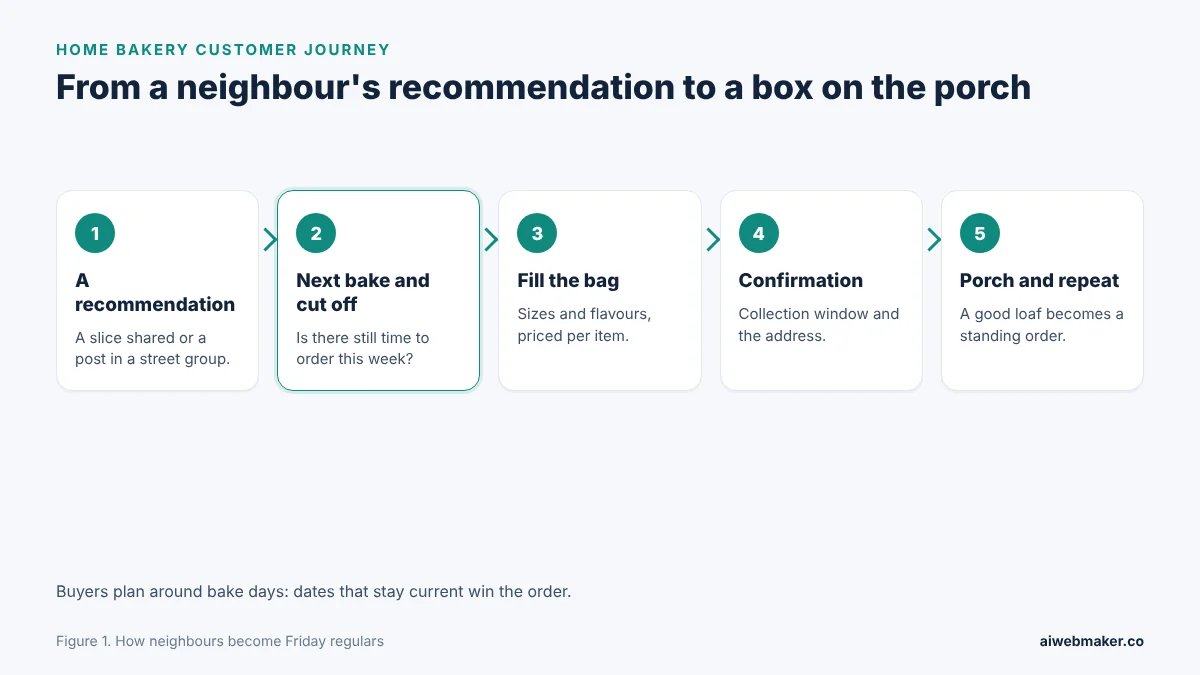
A recommendation starts this path, usually a neighbour handing over a slice or a post in a street group. The highlighted second step is the moment of truth: the visitor checks the next bake and the cut off, and decides whether there is still time this week. The confirmation then carries the collection window and the address, which the public pages deliberately leave out. Collection on the porch closes the loop, and a good loaf turns into a standing order. Every step after the second one depends on the baker publishing dates that never go stale.
The order dates table, the bag and the pages around them
A home baker's website is short, but each part answers a different worry, so none of them can be skipped. The order dates table removes the commonest message, which asks whether Friday is still possible. The shop turns that answer into a paid order, while the allergen table protects buyers who cannot take a risk. Celebration cakes need their own space because their notice, deposit and pricing work differently from weekly bread. A short set of questions catches cancelled bakes and holidays, keeping evening messages few.
| Page or section | Question it answers | Detail that matters |
|---|---|---|
| Order dates | When is the next bake? | Cut off day and hour, collection window |
| This week's bakes | What can be ordered now? | Options, price per item, sold out notes |
| Allergens | Is it safe for our family? | Contains and may contain, bake by bake |
| The kitchen | Is this allowed and clean? | Registration, training, who does the work |
| Celebration cakes | Can a cake be made for our date? | Sizes, servings, notice, deposit |
| Collection and delivery | Where and when do we collect? | Windows, delivery radius, fee at checkout |
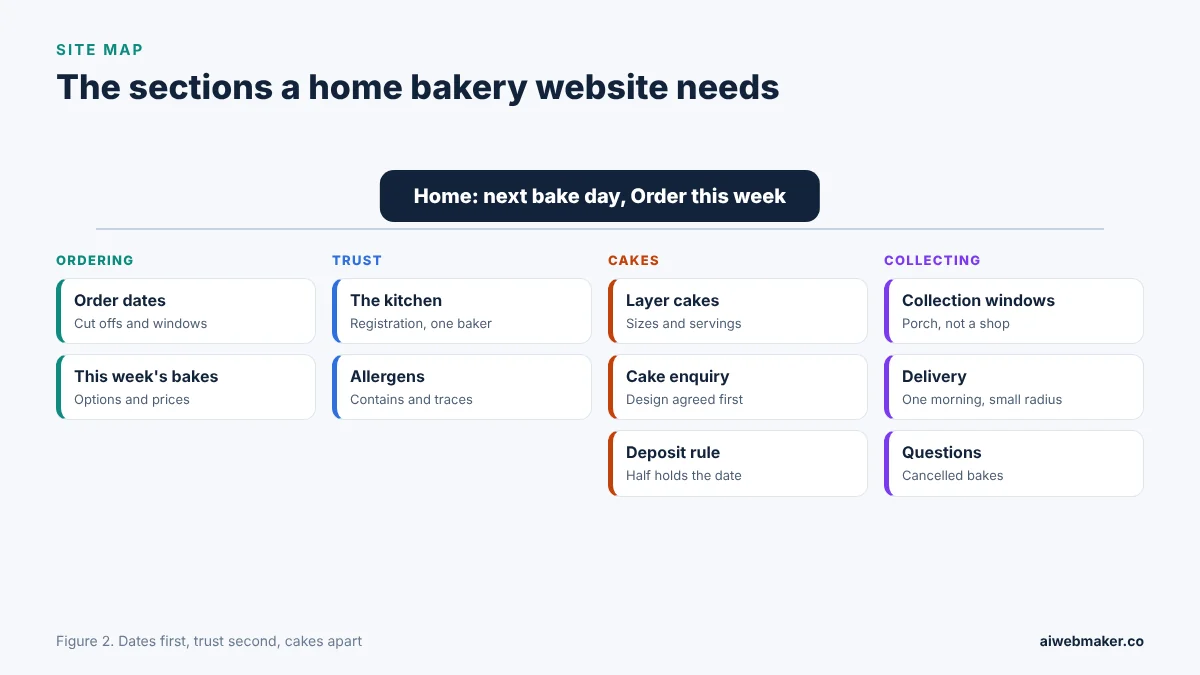
Four lanes run beneath the home page here: ordering, trust, cakes and collecting, in the order a careful buyer reads them. Crumb and Kettle Home Bakery, the invented kitchen behind the home bakery website example with order dates and an allergen table, follows that order on a single page. A chalkboard names the next bake, and a table follows with a Friday bread bake closing on Wednesday at 20:00, a Saturday sweet bake closing on Thursday and fourteen days of notice for celebration cakes. The shop lists country sourdough, seeded rye, cinnamon buns in a box of six, brown butter cookies in a box of eight and a lemon drizzle loaf, while the celebration cake carries no price and opens an enquiry instead. Below sit the registered kitchen, an allergen table with a column for traces, the six inch and eight inch layer cakes, the cupcake box and a short set of questions.
Bake days, cut offs and the sold out line
A cut off is the most useful sentence on a home baker's site, because it lets the baker buy flour for orders that exist rather than for hopes. Sourdough mixed on Thursday for a Friday bake needs the numbers by Wednesday evening, and the page should say so in plain hours. A limit per bake protects the oven and the baker's sleep, and closing a product when the limit is reached avoids awkward refunds. Same day orders should be refused openly near the bag, not quietly ignored in the inbox. Firm, visible rules feel generous to buyers once they understand that each loaf is made for a named person.
| Order rule | What it protects | What to state on the page |
|---|---|---|
| Cut off two days before the bake | Proving time and ingredients bought for real orders | Day and hour, in local time |
| Limit per bake | One oven's capacity | The number, and that the bake closes when full |
| Standing weekly orders | A steady base of income | How to pause or stop |
| Holiday weeks posted early | Regulars not caught out | Dates a month ahead |
| No same day orders | Promises the oven cannot keep | Said plainly beside the bag |
Pricing a loaf when the oven sets the ceiling
A home baker's income has a hard ceiling, set by what one domestic oven can bake in a day, so underpricing hurts more than it would in a shop. If the oven holds twenty four loaves across a bake day, the week's bread takings can never exceed twenty four times the price, however popular the loaf becomes. The price therefore has to cover ingredients, boxes and labels, oven energy and the hours from mixing to washing up, with something left for the baker. Celebration cakes earn the most per hour of oven time, which explains why many home bakers cap bread and protect cake weekends. A baker who prices from the ceiling down rarely needs a bigger oven to make the kitchen worthwhile.
| Cost line | What it includes | Often forgotten |
|---|---|---|
| Ingredients | Flour, butter, eggs, sugar, seeds, fruit | Price rises between seasons |
| Packaging | Boxes, bags, cake boards, labels | Printed allergen labels per box |
| Hours | Mixing, shaping, baking, washing, handover | Answering messages in the evening |
| Waste | Loaves that fail or are not collected | A clear policy for uncollected orders |
Porch collection, delivery radius and a private address
A home bakery has no counter to keep open, so the site should publish collection windows rather than shop hours. Crumb and Kettle uses a Friday afternoon window for bread and a Saturday morning one for sweet bakes, with the porch as the handover point. The full address arrives only with the order confirmation, which protects a family home from callers at odd hours. The online store builder for home bakers selling weekly bakes lets each bake carry choices, such as loaf size or cookie flavour, holds the chosen bakes together in one bag and includes the delivery fee in the checkout total, where a regulars' discount code also works. A celebration cake with no fixed price shows an Enquire button instead, so custom work never pretends to be a shelf item.
A domestic kitchen's legal footing, region by region
Selling food made at home is allowed in many places, but the paperwork differs so widely that no single rule can be stated for every baker. In the United States, many states have cottage food laws that let certain lower risk foods be made at home, sometimes with sales caps, labelling rules or a ban on fillings that need refrigeration. In the United Kingdom, a home kitchen that sells food is registered with the local council before trading and may then be inspected. Countries in the European Union apply general food hygiene rules, with registration handled nationally and details that vary between member states. The safest sentence on any baker's site states the kitchen's own status honestly and leaves the rest to the local food authority.
| Region, as examples | What home bakers often meet | Caveat |
|---|---|---|
| United States | State cottage food laws for lower risk foods | Foods, caps and labels differ by state |
| United Kingdom | Registration with the local council, then inspection | Hygiene training expected, details vary |
| European Union | General food hygiene rules | Registration set nationally |
| Elsewhere | A licence, permit or registration | Ask the local food authority before selling |
Allergens from a shared family kitchen
Almost no home kitchen is allergen controlled, and that admission belongs above the shop rather than in small print. Wheat, eggs, milk, soy, sesame and tree nuts often pass across the same worktop in a single day, so traces can reach any bake. A table with one column for what each bake contains and another for what it may carry as traces tells buyers far more than a vague warning. The official list of major allergens is not the same everywhere, since United States rules name nine while British and European Union rules name fourteen, so local labelling law should guide the wording. Honest allergen tables cost the odd sale but protect children, families and the baker's own name.
Celebration cakes: two a weekend and a deposit that buys butter
Celebration cakes deserve a hard weekly cap, because a single layer cake can take as many hours as a whole bread bake and cannot be rushed. Crumb and Kettle accepts two in any weekend, with a six inch layer cake from $55, an eight inch from $80 and a box of twelve cupcakes from $36. Each design is agreed by email before baking, with colours, piping and allergens confirmed in writing. A deposit of half the price holds the weekend, and a cake cancelled less than five days ahead keeps the deposit because the ingredients are already bought. Clear caps, servings and deposit terms turn cake enquiries into firm bookings rather than long negotiations.
Sourdough to order: the phrases neighbours type
People rarely search for a home baker by name, so the words on each page must match the bake and the place they type. Common phrases include sourdough to order, birthday cake for collection, cinnamon buns this weekend and cupcakes for an office, often followed by a neighbourhood. A map listing can show a service area rather than the street, which suits a kitchen that is also a family home. Reviews that mention a named loaf, the collection window or the way an allergy was handled count for more than general praise. Articles on keeping sourdough fresh, cutting a layer cake into even slices or choosing a size for a party answer questions that buyers ask before they order. Over a year, those plain pages bring the neighbours who become Friday regulars.
The yearly sums for a one oven bakery
Only two lines on a home baker's web bill are fixed, the hosting and the domain, and the extras stay tiny. Paying yearly gives the lowest total, while a baker testing demand may choose monthly billing for the first season. Twelve articles on storing and slicing bakes, written with AI credits, cost less than one sourdough loaf. Swapping bakes, moving dates or posting a holiday closure is never billed separately. Yearly and monthly figures sit in parallel columns below, beside one row for the $189 tier as a yardstick.
| Item | Yearly | Monthly |
|---|---|---|
| Hosting the home bakery shop and order pages | $119 | $228 over twelve months |
| Domain | Depends on the ending | Depends on the ending |
| Higher plan, for comparison | $189 a year | Not needed |
| Twelve baking and storage articles at about $0.65 | About $7.80 | About $7.80 |
| New bakes, order dates and holiday weeks | No charge | No charge |
| Year before the domain | About $126.80 | About $235.80 |
Reasons a buyer closes the tab before the cut off
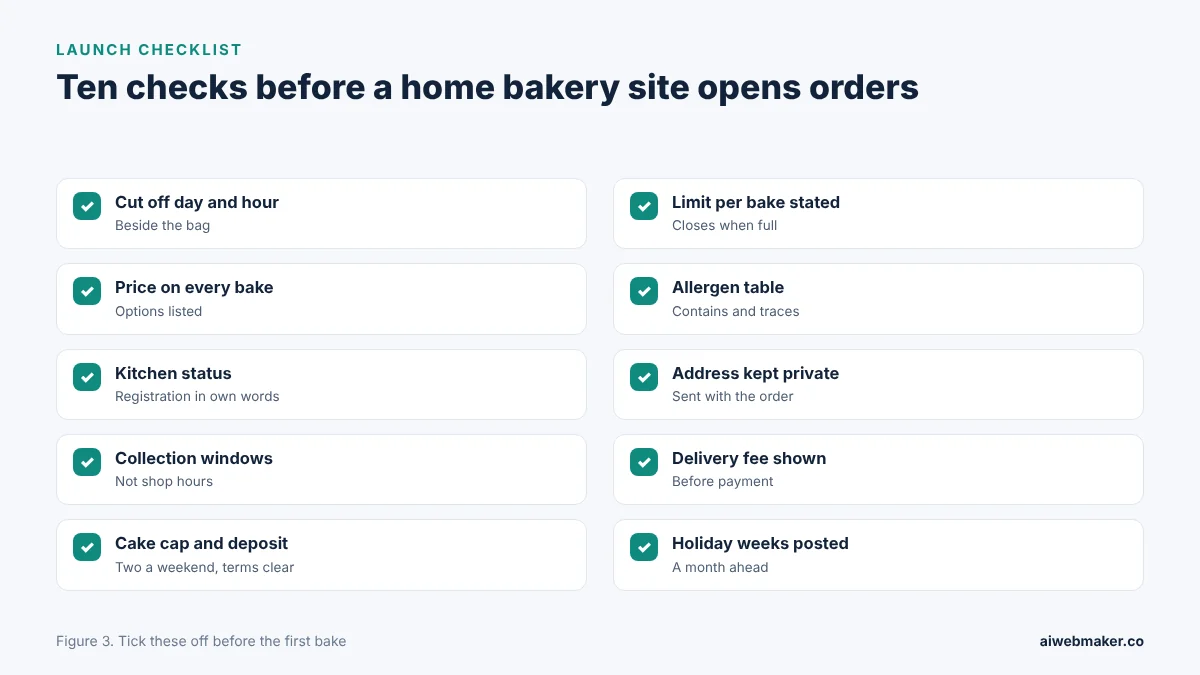
Buyers abandon a home baker's site when the order dates are out of date, because a stale table suggests the kitchen has quietly stopped baking. A shop without prices per item makes every order feel like a negotiation. Missing allergen details push careful parents to a bakery that lists them. No word on registration or hygiene leaves people wondering whether buying from a stranger's kitchen is wise. Ten fixes for those faults appear on the card that follows, each quick enough to make before Wednesday.
Frequently asked questions
Is registration needed before a kitchen table takes its first order?
That depends entirely on where the kitchen is, and the local food authority is the place to ask before the first sale. In some places registration must happen before trading, while in others a permit, a licence or a cottage food rule applies instead. Some regions also limit which bakes may be sold from home at all. The website should state the kitchen's actual status rather than borrow wording from another country. Settling it first spares the baker a fine and spares buyers any doubt.
How far ahead should orders close for a weekend bake?
Two days before the bake suits most bread, because sourdough needs a long rise and ingredients must be weighed for real orders. Sweet bakes and cookies can close a day later if they are mixed on the morning of baking. Celebration cakes need far longer, often one to two weeks, to agree the design and buy the decorations. Whatever the rule, the day and the hour should appear beside the bag and on the dates table. Buyers adapt quickly to a cut off that never moves.
Should the street address appear anywhere on the site?
Many home bakers leave it off the public pages and send it with each order confirmation instead. A neighbourhood or a part of town gives enough context for buyers to judge the distance. This keeps the family home private and stops people arriving outside the collection windows. The map listing can usually show a service area rather than the exact street. Privacy and convenience can sit together when the confirmation carries the details.
Can a home kitchen bake for a guest with a severe allergy?
Usually not safely, because a domestic kitchen shares worktops, bowls and air between every bake. A recipe can leave out an ingredient, but traces from earlier bakes may still reach the cake. The honest answer on the website is to explain the risk and suggest a bakery with a separate controlled area for that need. Parents generally respect a baker who says no clearly. Saying it early also prevents a disappointing conversation after the design has been agreed.
Fourteen loaves or one cake: the arithmetic of a kitchen table year
At the sample's prices, about fourteen large sourdough loaves, or an eight inch and a six inch layer cake from one weekend, match the $119 that hosts the kitchen's pages. Where the baker pays monthly, two loaves and a box of cookies settle each $19. Every regular who keeps a standing Friday order adds dozens of loaves across the year, and every cake booked through the site fills a protected weekend. Dates that stay current, prices on every bake and honest allergen tables bring those buyers back without a single advert. A Friday list that fills before Wednesday evening is the result to watch for.
Build your website in Minutes and get the AI Tools that work
Start Building Your Website →