Fishmonger Website Cost, Catch Labels and Fillets Ready for Collection
Every year a fishmonger spends $119 keeping its slab online, or pays $19 monthly, and buys a domain on top. Covered: the buyers, the sections, freshness, catch labels, filleting, collection orders, allergies and raw eating, search and annual costs.
- No coding required
- Live in minutes
- Blog, SEO and chatbot tools included
Every year a fishmonger spends $119 to keep its slab online through AI Web Maker, a sum that becomes $19 a month on the monthly plan, with the domain charged on top. Laying out the slab, the catch labels and the collection steps, and then checking every card in the preview, adds nothing to an AI Web Maker invoice. Two whole salmon ordered for parties pay for that hosting several times over. Fish itself is the harder problem, since the slab changes every morning with the boats and the weather while a website stays still until someone edits it. Shoppers want to know what landed today, where it was caught, how it will be prepared and whether it will reach their kitchen cold. The guide covers buyers, the page sections, freshness, catch labels, preparation, collection orders, allergies and raw eating, search and the yearly sums.
This article is part of our complete guide: Food Business Website Builder.
Weeknight cooks, party hosts and restaurant chefs at the slab
Fish buyers arrive at a fishmonger's website with very different plans, and each needs a fast answer. Weeknight cooks want two cod loins or a pair of mackerel, prepared so they can go straight into a pan. Party hosts want a whole salmon or a seafood platter for a set number of people on a set day. Careful shoppers ask where a fish was caught, whether it was farmed and whether it has been frozen before. Restaurant and café owners look for a reliable weekly supply at trade prices. A site that answers all four quickly turns a browse on the bus into an order for collection.
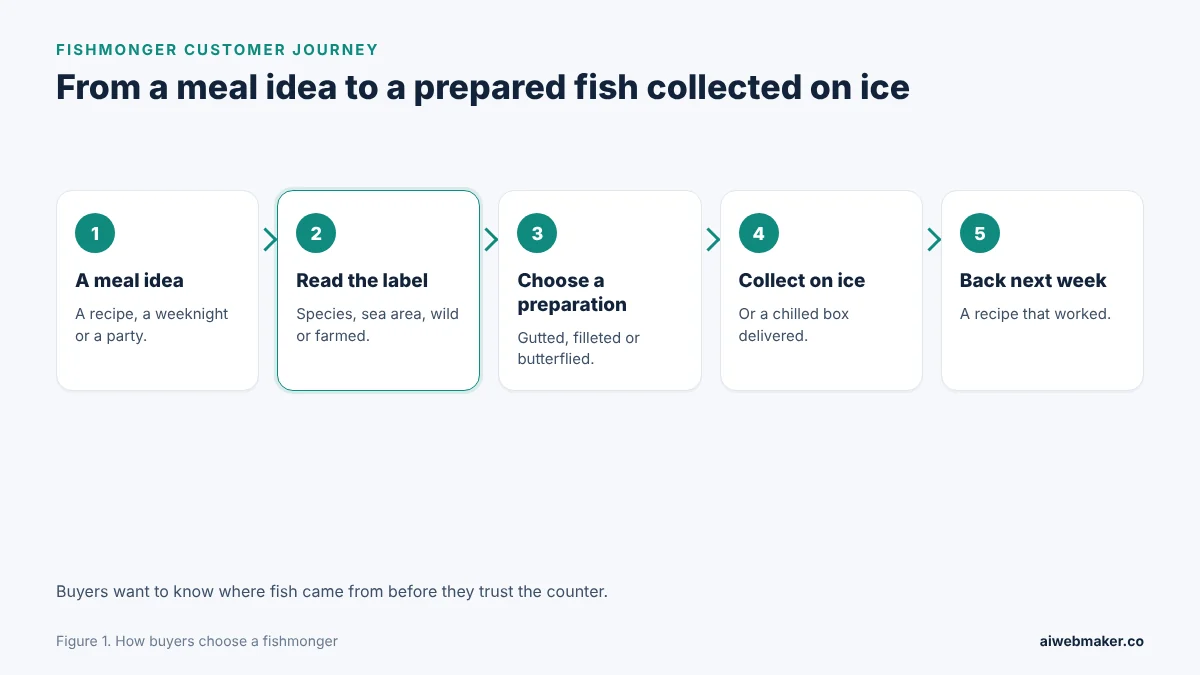
A dinner idea opens the five stages, and a return visit closes them. That idea often comes from a recipe seen online or a family celebration. The highlighted stage is reading the label, because buyers now expect to know the species, the sea area and whether a fish was wild or farmed. Choosing how it should be prepared follows, then collection from the counter or a chilled delivery. A fish that cooks well and a recipe that works decide whether the buyer comes back next week. Each stage is a reason to keep the website as current as the slab.
Slab, labels, recipes and orders: the sections a seafood counter shows
A fishmonger's site should mirror the counter itself, with the day's fish, the facts behind them and the service that prepares them. The opening view needs the counter's hours and the order cut off for tomorrow. A shop of fish and shellfish comes next, each card carrying its weight, its origin and its preparation options. A sourcing table explains where each species comes from and how it was caught or farmed. Recipe cards, collection steps and a route for whole fish and platters complete the page.
| Section | The buyer's question | What it should answer |
|---|---|---|
| Opening view | Is it fresh and when do you open? | Buying times, counter hours, order cut off |
| On the slab | What is on offer today? | Species, weight, origin, preparation choices |
| Sourcing table | Where was it caught? | Wild or farmed, sea area, method |
| Counter service | Will you prepare it? | Gutting, scaling, filleting, frames for stock |
| Recipes | How should it be cooked? | Short, tested recipes for this week's fish |
| Collection and delivery | Will it stay cold on the way home? | Times, ice, chilled boxes |
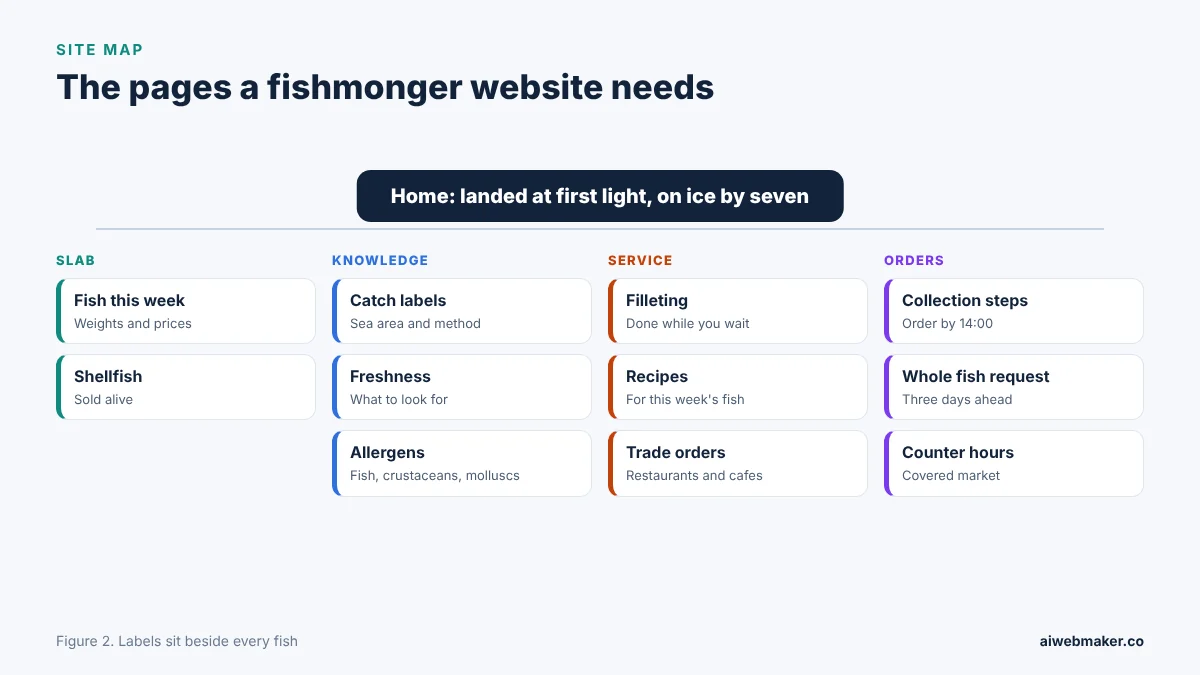
Followed from the slab outward, the fishmonger's site makes four groups: the slab, the knowledge, the service and the orders. Slab pages list fish and shellfish, while knowledge pages hold the sourcing table, freshness notes and allergen information. Our sample counter, Tidemark Fishmongers, offers cod loin in two portions, a whole sea bream, a pair of mackerel, rope grown mussels by the kilo, cooked prawns and a whole fish for a party. A table of where each species was caught, a counter section on filleting and three recipes follow, including whole bream with fennel and lemon, mussels in cider with herbs and grilled mackerel with a sharp salad. The fishmonger website example with catch labels and collection orders then explains collection in four steps before a gallery, reviews and a whole fish request. That order lets a buyer move from what landed to how it gets home without leaving the page.
Clear eyes, red gills and a sea smell: judging freshness honestly
Freshness is the first thing fish buyers worry about, and a fishmonger who teaches them how to judge it earns lasting trust. A fresh whole fish has bright, clear eyes, red or pink gills, firm flesh that springs back and a clean smell of the sea rather than a strong fishy odour. Live shellfish such as mussels should close when tapped, and any that stay open should be discarded before cooking. Fish that has been frozen before, such as many prawns, can be excellent but should be labelled as previously frozen and never frozen again at home. A counter that buys each morning should say so, and should admit when storms keep the boats in harbour. Teaching these signs openly shows confidence in what is on the slab.
| Sign to check | What fresh looks like | What to avoid |
|---|---|---|
| Eyes | Bright, clear, slightly domed | Cloudy or sunken |
| Gills | Red or pink, moist | Brown, grey or slimy |
| Flesh | Firm, springs back when pressed | Soft, leaves a dent |
| Smell | Clean, like the sea | Sour or strongly fishy |
| Live mussels and clams | Closed or close when tapped | Open shells that stay open |
| Previously frozen fish | Labelled clearly | Sold as fresh without a note |
Species, sea area and catch method on every label
Labels are the fishmonger's quiet proof of honesty, and a website that repeats them builds the same trust as the counter. Each fish should carry its species name, whether it was wild or farmed, the sea area or farming region, and the method used to catch or raise it. Requirements vary by country; in the European Union, for example, the label must show the species, the production method, the catch area, the category of fishing gear and whether the fish was defrosted. Elsewhere the minimum may be lighter, but many fishmongers choose to give the full picture anyway. When a supplier cannot confirm a detail, writing unconfirmed is far better than guessing. Shoppers who care about sustainability read these labels closely and reward counters that are candid.
| Label field | Example from a counter | Why buyers care |
|---|---|---|
| Species | Cod, sea bream, mackerel | Knowing exactly what they are buying |
| Wild or farmed | Wild, or farmed in sea pens | Taste, price and sustainability views |
| Sea area or region | North East Atlantic, inshore waters | Distance travelled and stock health |
| Method | Hand lines, pots, trawl, ropes | Bycatch and seabed impact |
| Previously frozen | Stated plainly | Whether it can be frozen at home |
Gutting, scaling, filleting and the frames kept for stock
Preparation is the service that sets a fishmonger apart from a supermarket fridge, and the website should describe it with pride. A whole fish can be gutted and scaled, filleted, skinned, pin boned or butterflied for the grill, often while the customer waits. Each preparation choice can appear on the product card, so online buyers receive the fish exactly as they want it. Heads and frames make excellent stock, and offering to bag them separately shows real kitchen knowledge. Mussels can be scrubbed and debearded, and prawns sold shell on or peeled. Explaining these options helps nervous cooks try whole fish for the first time.
Order by two for tomorrow: collection and chilled delivery
A clear order cut off is the backbone of online fish sales, because the counter buys at first light and needs to know what to buy. The page should state the time by which orders must arrive for the next day, when collections open and what happens if the boats do not bring a fish in. Using the online store builder for fishmongers taking collection orders, each fish can offer preparation as product options, such as skin on or skinless, and orders build up in a bag. For local delivery in a chilled box, checkout adds the fee for the buyer's address, and discount codes can reward regular customers. A whole fish for a party, priced by weight on the day, can show an Enquire button until the fish is weighed. Weights are estimates with fish, so a note on how heavier pieces are priced keeps trust intact.
Shellfish allergies, raw eating and the vulnerable
Fish, crustaceans such as prawns and crab, and molluscs such as mussels and squid are all major allergens in many countries, and a fishmonger handles all three on one counter. Cross contact between the three groups is possible, and the website should say so, asking shoppers with serious allergies to mention them at the counter first. Breaded or marinated products may also contain gluten, milk or mustard, so their labels need full details. Eating fish raw, for sushi or ceviche, needs particular care, because parasites can be present in some wild fish. Rules in the European Union, and official guidance in the United States, generally call for fish intended to be eaten raw to be deep frozen first, with some exceptions, and other countries set their own approach. Pregnant shoppers and people with weakened immunity should follow local health advice on raw and smoked fish, and a short line pointing them to it is enough.
What people type when hunting for mussels, bream or a whole salmon
Fish buyers search for a counter, a species or an occasion, such as fishmonger near me, fresh mussels, whole salmon to order, seafood platter or sustainable fish. Product cards and headings that name the species and the preparation help search engines match those phrases. The map listing should carry accurate counter hours, a photo of the slab and the market or street location. Reviews that mention clear labels, quick filleting and fish that stayed cold all the way home persuade new buyers. Articles on how to cook a whole fish, how to clean mussels or what is in season this month bring readers back every week. Generous cooking advice turns a fishmonger into the local authority on seafood.
Ice, slab and server: the counter's yearly web bill
A fishmonger's ongoing web costs are just hosting and a domain name, while a dozen cooking articles from AI credits cost about a pair of mackerel. Busy counters usually clear the $119 with one payment. Newer counters may split it into $19 monthly steps until the regulars find them. Changing the slab, the prices or the recipes adds nothing to the bill. Each route gets a column in the table, and the $189 line exists only to compare against.
| Item | Yearly | Monthly |
|---|---|---|
| Hosting the fishmonger pages | $119 | $228 over twelve months |
| Domain | Depends on the ending | Depends on the ending |
| Higher plan, for comparison | $189 a year | Not needed |
| Twelve seasonal fish articles at about $0.65 | About $7.80 | About $7.80 |
| Slab, price and recipe updates | No charge | No charge |
| Year before the domain | About $126.80 | About $235.80 |
Doubts that keep shoppers at the supermarket fish fridge
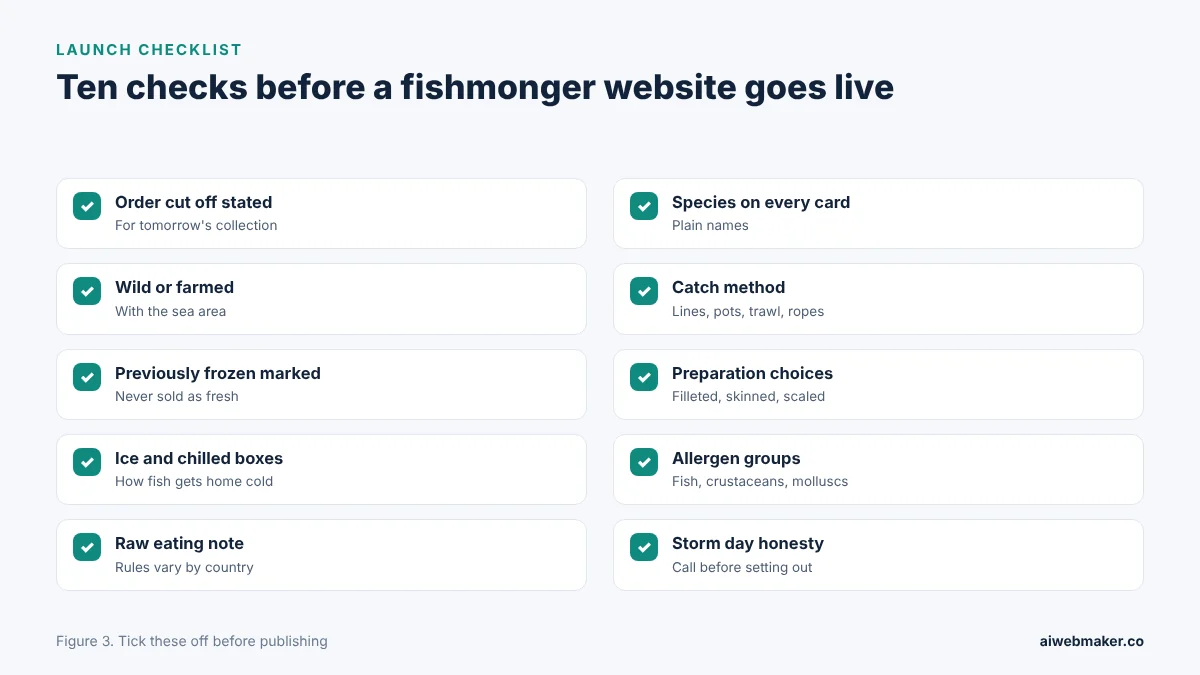
Shoppers stay with the supermarket fridge when a fishmonger's site gives no sign of what landed this week. Labels without the species, origin or method make careful buyers suspect the worst. Without a stated cut off time, nobody knows if tomorrow's dinner can be ordered today. Silence on how fish travels home raises fears of a warm parcel and a ruined meal. Missing allergen notes drive away families with shellfish allergies. A ten item checklist, pictured below this paragraph, turns each of those doubts into an answer.
Frequently asked questions
Does previously frozen fish taste worse?
Previously frozen fish can taste excellent, because fish frozen quickly at sea or at harvest often holds its quality better than fish kept chilled for many days. What matters is honest labelling and careful thawing. Fish that has been frozen once should not be frozen again at home, and the label should make that clear. Many prawns and some white fish reach counters this way. Buyers who understand the difference make better choices and trust the counter more.
How long can fresh fillets sit in a home fridge?
Fresh fillets are best cooked within a day or two of purchase, kept wrapped in the coldest part of the fridge. Whole fish keep slightly better than fillets, but neither improves with time. Live mussels should sit in a bowl under a damp cloth, never in water or a sealed bag. The website can print these tips on every order. Simple storage advice keeps meals safe and stops waste.
Why does the slab shrink on stormy mornings?
Day boats cannot fish safely in bad weather, so a counter that buys locally each morning has less to sell after a storm. Saying so on the website, or on a social post that morning, is better than filling the gap with fish of uncertain quality. Shoppers can be invited to call before setting out on a stormy day. Farmed fish and shellfish often fill part of the gap. Honesty about the weather shows that the counter buys with care.
Can a counter supply restaurants every week?
Many fishmongers supply restaurants and cafés with weekly orders agreed by phone or through an enquiry, with prices depending on volume and season. Chefs value reliability, clear labels and fish prepared to their specification. The website can describe the trade service briefly and invite kitchens to make contact. Delivery days and minimum orders, where they apply, should be stated. A few steady trade accounts can carry a counter through quiet weeks.
Fillets and mussel bags that repay the hosting
A single whole fish ordered for a party usually covers the full $119 hosting year for a fishmonger's pages. Paid monthly instead, each $19 is matched by a couple of cod loins and a bag of mussels. Every collection order that arrives before the cut off, and every new buyer who trusts the labels, is trade the pages helped to secure. Honest freshness notes, full catch labels and clear preparation choices persuade shoppers more than glossy photos of prawns. Counters that update the slab as the boats come in earn the loyalty of the whole town. Weekly orders that name a species and a preparation are the sign that buyers read every label.
Build your website in Minutes and get the AI Tools that work
Start Building Your Website →