Fish Farm Website Cost, Fingerling Orders and Honest Pond Advice
A fish farm's shop runs on yearly hosting of $119, or monthly hosting at $19, with the domain bought too. Covered: buyers, the pages, the fish shop, harvest days, fingerlings, species advice, new farmers and rules, search and the budget.
- No coding required
- Live in minutes
- Blog, SEO and chatbot tools included
A fish farm's web shop rests on hosting at $119 per year, or $19 per month if cash flow follows the harvests, with a domain purchased alongside. Product cards, the species comparison and the course pages can be drafted and checked in preview with no AI Web Maker charge. A single restaurant order of fresh tilapia, or one batch of fingerlings, pays for a full hosting year. The real difficulty is that fish are perishable, harvested on set mornings and sold live as fingerlings that must survive a journey, while new farmers arrive with hopes of income that no honest farm can promise. Buyers want freshness, preparation options and delivery details, and would be farmers want plain advice on water, feed, permits and risk. This guide covers the buyers, the page list, the fish shop, harvest days and live delivery, species advice, new farmers and the rules, search and the yearly sums.
This article is part of our complete guide: Food Business Website Builder.
Kitchens, market traders, households and new pond owners
Four main groups buy from a fish farm's website, and each needs different information. Households want fresh or smoked fish prepared the way they cook it, with clear weights and prices. Restaurants and market traders want regular quantities at consistent sizes, delivered on set mornings, which usually starts as an enquiry. Pond owners buy fingerlings and need to know sizes, batch numbers and how the fish travel. People planning their first pond look for advice, farm walks and courses, often long before they spend any money. Serving each group from a clear home page keeps the harvest sold and the course places filled.
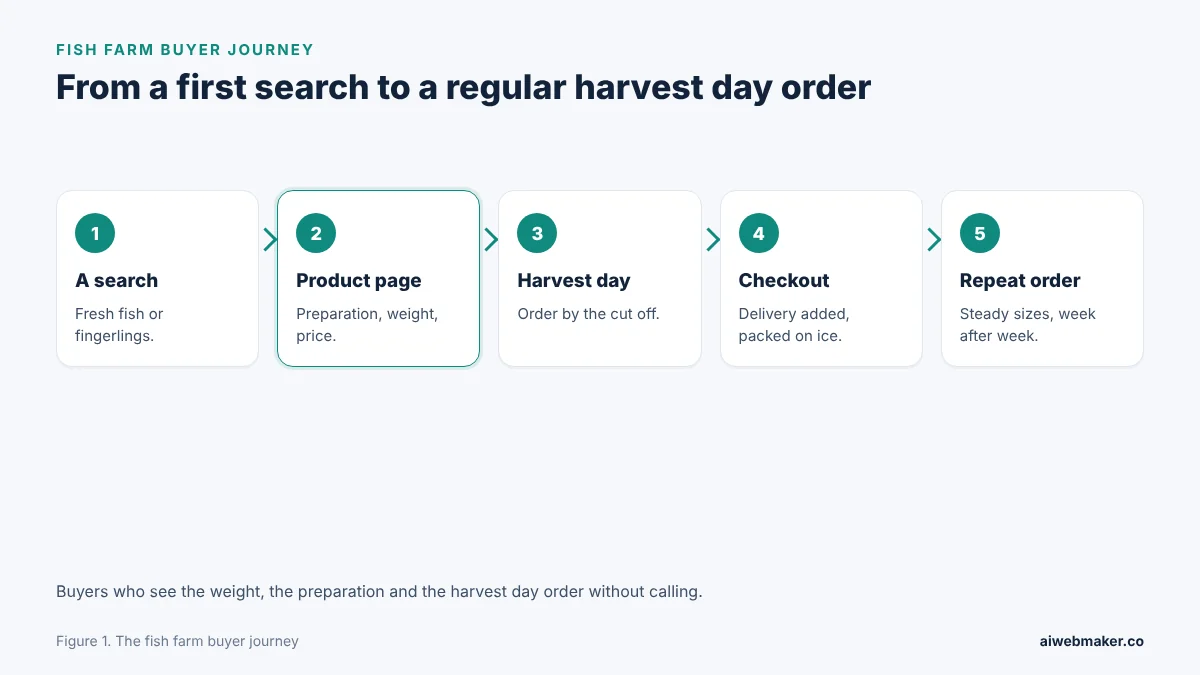
A first search for fresh fish or fingerlings opens the sequence, and a standing place on harvest day closes it. The coloured step is the product page, where preparation, weight and price decide whether a household or a kitchen orders. Checking the harvest days and order cut off comes next, because fish are netted to order. Checkout adds delivery, and fish arriving cold on ice, or fingerlings arriving lively in oxygen bags, decides the review. Repeat orders follow when the quality stays steady week after week. The site's job is to make each of these steps clear before the net goes into the water.
Fish, fingerlings, ponds and courses: the fish farm's page list
A fish farm's site needs a shop, a page on how the fish are raised and a section for people who want to farm fish themselves. Shop pages list table fish, smoked fish and fingerling batches with options and prices. A harvest and delivery page sets out netting days, order cut offs, ice packing and live fish transport. A ponds page explains water, feeding and daily checks, which reassures buyers about quality. Species comparisons, first pond steps, walks and courses serve new farmers, and a request form handles trade orders and visits. Set out like this, the site sells today's harvest while building tomorrow's customers.
| Page | Who reads it | What it should show |
|---|---|---|
| Fish shop | Households, cooks | Species, preparation, weight, price |
| Fingerlings | Pond owners | Size, batch numbers, transport, collection |
| Harvest and delivery | All buyers | Netting days, cut off, ice, distance served |
| The ponds | Curious buyers | Water source, daily checks, feeding |
| Tilapia or catfish | New farmers | Water, feed, growth time, breeding, selling |
| Walks and courses | New farmers | Length, group size, what is covered |
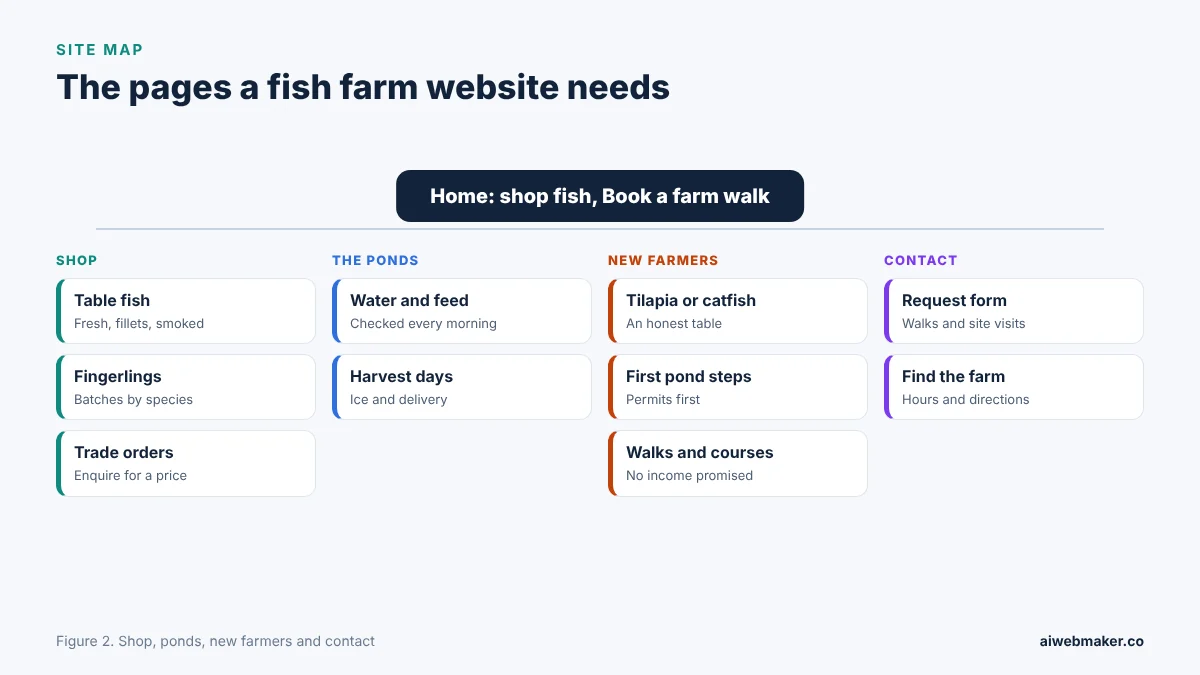
From a home page with shop and farm walk buttons, the pages spread into shop, the ponds, advice for new farmers and contact. Our sample, Clearwater Fish Farm, sells fresh tilapia whole, gutted and scaled or butterflied, tilapia fillets in three pack sizes, fresh catfish whole, gutted or in steaks, smoked catfish and fingerlings for stocking in batches, with an Enquire button for restaurant and market orders. A section on twelve spring fed ponds follows, then a table comparing tilapia with catfish and five steps for a first pond. Three offers serve new farmers, a Saturday farm walk, a pond site visit and a two day starter course, under a note that no pond's earnings can be promised. The fish farm website example with fingerling batches and honest pond advice rounds off with pictures of harvest morning, customer comments, common questions and one form for walks, site visits and trade supply. Any pond farm that sells and teaches can follow the same sequence.
Fresh, filleted, smoked or live: product options and the bag
Fish suit product options well, because the same fish leaves the farm in several forms. Fresh fish can be offered whole, gutted and scaled or butterflied, fillets by pack weight, catfish as steaks and smoked fish whole or in pieces. Fingerlings sell by species and batch size, with their length stated so pond owners know what arrives. The online store builder for fish farms selling table fish and fingerlings lets each product carry those options, keeps a buyer's selection in a bag and puts the delivery fee into the checkout total. Discount codes can reward a market trader's first order, while weekly supply for restaurants and stalls, priced case by case, shows an Enquire button where the figure would sit. A price per kilo for fresh fish, with a typical fish weight beside it, helps buyers estimate an order before they reach the checkout.
| Product | Options | What to state |
|---|---|---|
| Fresh tilapia | Whole, gutted and scaled, butterflied | Price per kilo, typical fish weight |
| Fillets | Pack weights | Skinned and boned, vacuum packed |
| Fresh catfish | Whole, gutted, steaks | Price per kilo, typical weight |
| Smoked fish | Whole or in pieces | Smoking method, keeping time |
| Fingerlings | Species and batch size | Length, transport, collection |
| Trade supply | Sizes and quantities | Enquire for a price |
Harvest mornings, ice and fingerlings in oxygen bags
Because table fish are netted to order, the delivery page should name the harvest mornings and the cut off for orders the day before. Packing on ice straight from the pond, and delivery or collection the same day, should be described plainly, with advice to keep fish in the fridge and cook it within a short time. Fingerlings need their own instructions, since live fish travel in sealed bags of water topped with oxygen and must be floated in the pond before release so the temperatures match. The distance the farm delivers live fish, and the option to collect from the hatchery, should be stated. Moving live fish may need permits or health certificates in some countries, so the page should ask buyers to check local rules. Clear handling advice protects both the fish and the farm's reputation.
Tilapia or catfish: comparing species without overpromising
New farmers usually ask which species to raise first, and a fair comparison ranks among the most valuable things a hatchery can put online. Water temperature, oxygen needs, feed, time to harvest, breeding behaviour and how each fish sells all differ between species. Every row should be phrased as a general pattern rather than a promise, because growth depends on local water, feed and care. Which species may be farmed at all is regulated in many countries, since some are treated as invasive outside their native range, so readers should check with their authority. Mentioning the farm's own experience, including seasons that went badly, makes the comparison more credible. An honest table helps new farmers choose and sends them back to the farm for stock.
| What to weigh | Tilapia | Catfish |
|---|---|---|
| Water | Warm and well oxygenated | Warm, copes with less oxygen |
| Feed | Plant based pellets, grazes the pond | Richer protein feed |
| Time to harvest | Several months to plate size | Several months to a larger size |
| Breeding | Breeds readily in ponds | Seldom breeds in ponds |
| Selling | Whole, fresh, fillets | Fresh, steaks, smoked |
First ponds, permits and the promise a fish farm should never make
People planning a first pond need practical steps more than encouragement, and the most helpful page sets them out in order. Checking that water lasts through the dry season, that the soil holds it and that the ground does not flood comes first. Permits for digging ponds, using water, discharging it and selling fish are set nationally or regionally, so the page should send readers to their local authority before any digging starts. Testing the water, stocking fewer fish than the pond could hold and recording feed and losses are the habits that separate careful farmers from disappointed ones. Above all, the page should say plainly that no one can promise a profit, because fish prices, feed costs and losses change from season to season. That honesty is what makes new farmers trust the farm's advice and buy its fingerlings.
Farm walks, site visits and a starter course
Walks and courses turn curious readers into confident customers, and each needs a clear card. A short farm walk around the ponds, hatchery and smoking kiln suits people at the beginning of their research. A site visit to the reader's own land, with a written note of what to fix before digging, suits those ready to act. A course over two days covering pond preparation, stocking, feeding, water testing, harvest and records suits people committed to starting. Biosecurity rules, such as boot dips at the gate and washing hands after touching fish or pond water, should be stated, along with keeping children beside an adult near deep water. Clear cards and rules fill places with the right people.
Fresh tilapia, fingerlings for sale, pond advice: how fish searches begin
Searches reaching a fish farm usually pair a product or a question with a district or town. Typical phrases are fresh tilapia near me, catfish for sale, smoked catfish, tilapia fingerlings for sale and how to start a fish pond. Product and advice pages that use those words in their titles match the searches closely. A map listing with shop hours, harvest days and photos of the ponds and hatchery helps buyers who prefer to collect. Reviews from kitchens about consistent sizes, and from new farmers about honest advice, carry real weight. Articles on pond preparation, water testing or cooking tilapia bring readers who later order, making the farm a reference point for fish farming in its region.
Ponds, harvests and the hosting ledger
A fish farm's website budget is hosting, a domain and a few articles drafted with credits. Farms selling every week usually choose yearly billing, which is cheaper across twelve months. A new farm testing online sales through its first harvests may start monthly. Price changes, new batch sizes and course dates can be added without charge. Underneath, one column prices the year in a single payment and the other in twelve, while the $189 tier gets a row for reference.
| Item | Yearly | Monthly |
|---|---|---|
| Hosting the fish farm shop and pages | $119 | $228 over twelve months |
| Domain | Depends on the ending | Depends on the ending |
| Higher plan, for comparison | $189 a year | Not needed |
| Twelve pond and harvest articles at about $0.65 | About $7.80 | About $7.80 |
| New batches, prices and course dates | No charge | No charge |
| Year before the domain | About $126.80 | About $235.80 |
When a kitchen or a pond owner gives up before the bag
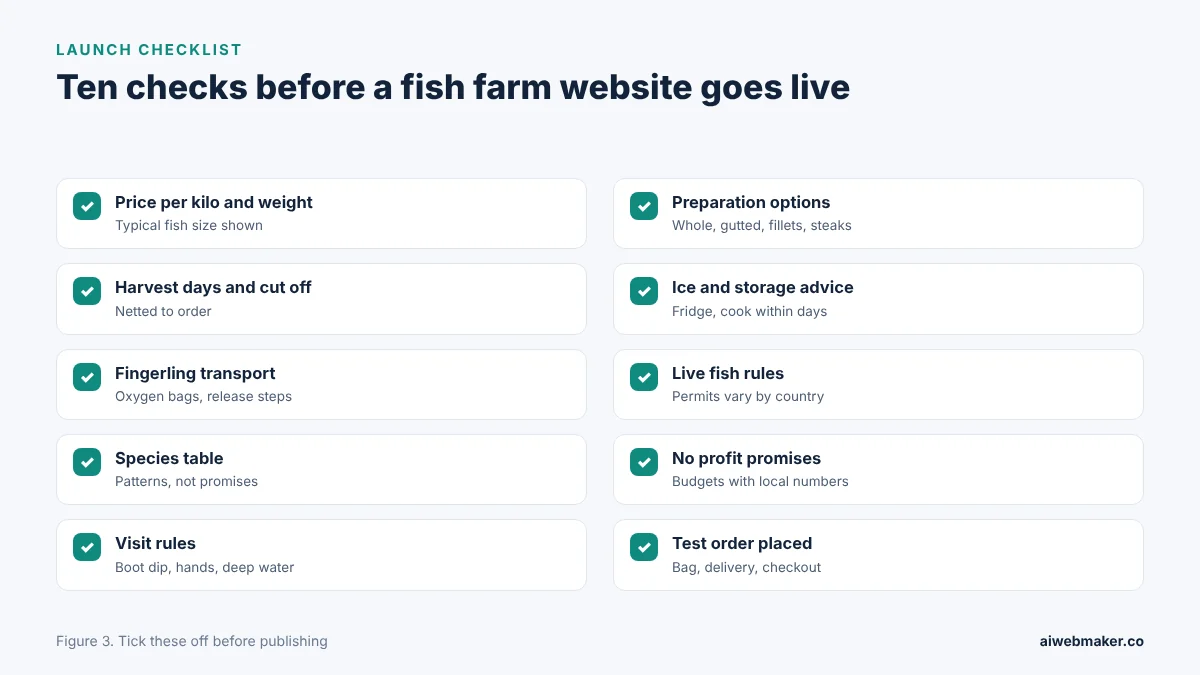
Buyers leave when prices appear without a weight or a typical fish size. No harvest days or cut off leave restaurants unsure whether an order can arrive for the weekend. Fingerling pages that skip transport and release instructions make pond owners fear losses. Advice pages promising easy profits put off careful readers and attract the wrong ones. Visit pages without biosecurity or child safety rules worry parents and serious farmers alike. Each fault gets its own tick box in the ten point list pictured next.
Frequently asked questions
How fresh is fish ordered from a farm?
Fish netted on a harvest morning, chilled on ice and delivered or collected the same day is about as fresh as fish can be. The page should state the harvest days and the order cut off so buyers know when their fish will be netted. Buyers should keep fish in the fridge and cook it within the time the farm advises. Food safety guidance for storing fish varies by country, so the farm should follow local advice in its wording. Clear freshness notes build trust with households and kitchens.
Will fingerlings survive the journey?
Fingerlings usually travel in sealed bags of water topped with oxygen, which keeps them comfortable for several hours. Floating the closed bag in the pond before release lets the water temperatures match. Delivery distance matters, so farms often limit live deliveries to a set radius and offer collection. The website should give the release steps in plain words. Following them gives the young fish the best start.
How many fingerlings should a new pond take?
The right number depends on the pond's size, how well the water stays oxygenated and whether air can be added. Starting with fewer fish than the maximum reduces losses while the farmer learns. A farm can suggest a starting number once it knows these details. The website should avoid quoting one figure for every pond. Careful stocking is the first habit of a well run pond.
Can a fish farm promise a profit to new farmers?
No honest farm can, because fish prices, feed costs, weather and losses change from season to season. Advice pages should help readers build their own budget with local numbers. Starting small and recording every cost and loss is the most useful habit to recommend. Testimonials should describe experiences, not earnings. Honesty here protects new farmers and the farm's reputation.
One crate of tilapia, twelve months online
A single fingerling batch, or a restaurant's crate of fresh tilapia, outruns the whole $119 hosting year. On the monthly route, a few kilos of fillets cover the $19. Every kitchen that orders weekly after reading the harvest days, and every new farmer who stocks a pond after a site visit, adds trade beyond the farm gate. Clear options, honest species advice and plain rules on live fish persuade buyers who cannot see the ponds. Farms that keep their batch sizes and course dates current online save repeated calls at the hatchery. Oxygen bags of fingerlings leaving for new ponds each week show the pages working.
Build your website in Minutes and get the AI Tools that work
Start Building Your Website →