Event Planning Website Cost, Packages and the Timeline Clients Trust
Event planners spend $119 yearly on AI Web Maker hosting, or pay $19 each month, and the domain sits on top. Inside: clients, pages, packages, fee models, the planning timeline, suppliers and insurance, the portfolio, search and the yearly budget.
- No coding required
- Live in minutes
- Blog, SEO and chatbot tools included
Event planners spend $119 a year on AI Web Maker hosting, or $19 a month if they would rather not pay upfront, and the domain sits on top. Package pages, the portfolio and the consultation request can be drafted and previewed at length before anything is charged. One day of coordination usually earns far more than that annual figure. Planners can test their package pages against the event planning company website sample, where Grand Occasion Events, a fictional firm on an AI Web Maker site, defines the scope before naming a price. The real challenge is trust, because clients are handing one of the most important days of their year to someone they found online. They also arrive confused about what a planner does, how fees work and how early they need to start. The ground covered here runs from clients and pages through packages, fee models, the planning timeline, suppliers and insurance, the portfolio, search and the annual spend.
This article is part of our complete guide: Food Business Website Builder.
Which clients hire an event planner, and what reassures each one?
Planning clients come from several worlds, and each needs a different kind of reassurance before booking a call. Couples planning a wedding want to feel understood, and they look for a style that matches theirs and a planner who stays calm. Corporate organisers running conferences, launches and team retreats care about logistics, budgets, invoicing and reliability. Families planning a milestone birthday or an anniversary want the day to feel personal without the stress of running it. Charities planning galas and fundraisers need someone who can stretch a budget and handle sponsors. Underneath, each client wants evidence of long experience and a steady temperament.
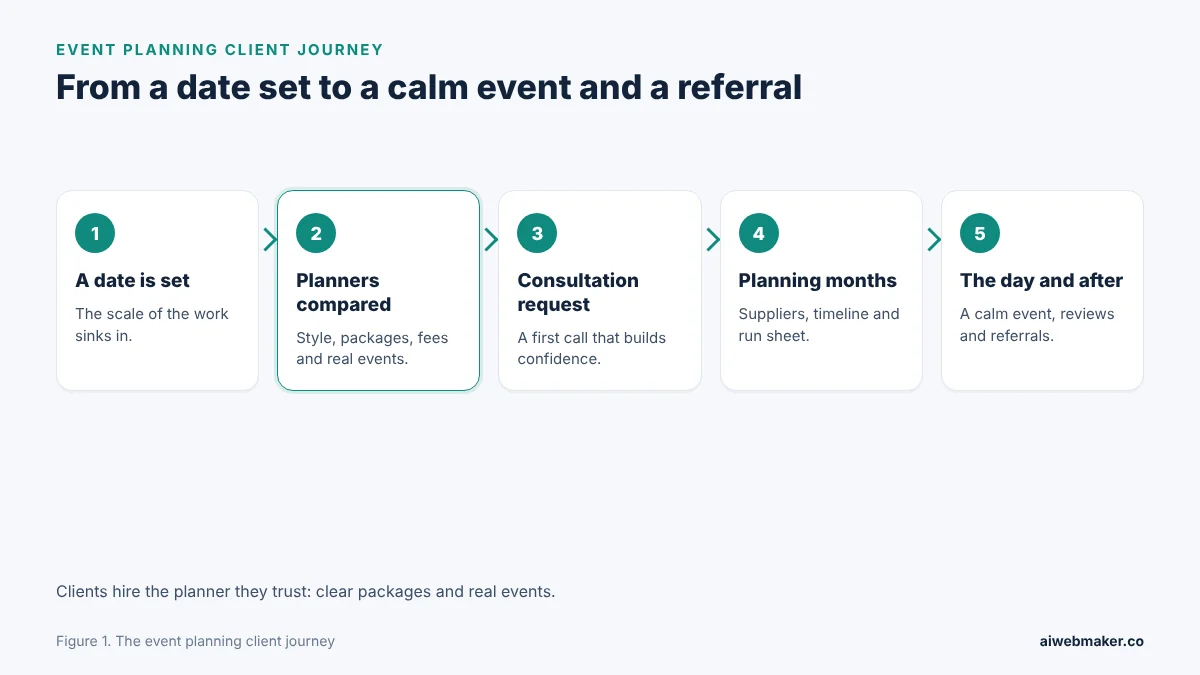
Five stages carry a client from a date on the calendar to a referral passed to a friend. The process begins when a date is set and the scale of the work sinks in. The client then compares planners by style, package and price, which is the stage where most decisions are made. A consultation request follows, and the first conversation either builds confidence or ends the search. The planning months and the event itself decide whether the promise holds. A calm day and a thank you message lead to reviews and the referrals most planners depend on.
Which pages let clients compare planning packages?
An event planning website needs pages that explain the work as clearly as it shows the results. One strong event photo on the home page sets the tone, joined by the kinds of events covered and a consultation button. A services page lays out each package, what it includes and how pricing works. A portfolio shows past events with captions, while a story page introduces the planner and the team. A planning guide or timeline page answers the common question of when to start, and a contact page closes the set.
| Page | What the client wants to know | What to include |
|---|---|---|
| Home | Is this planner right for us? | Signature event photo, event types, consultation button |
| Services and packages | What help can we buy? | Packages, inclusions, starting prices, fee model |
| Portfolio | What have they done before? | Events by style, guest count, captions |
| Planning timeline | When do we need to start? | Key tasks by month, booking advice |
| Our story | Who will be beside us on the day? | Planner, team, approach, experience |
| Contact | How do we begin? | Consultation request, reply times, areas served |
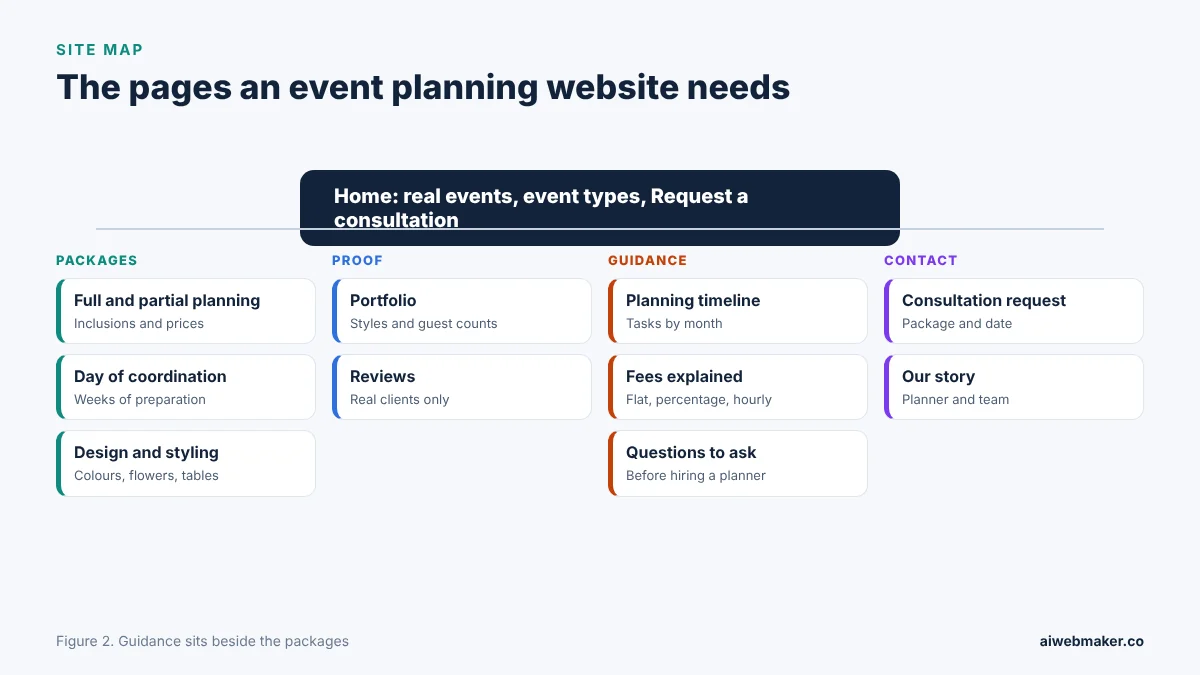
Four groups of pages sit beneath an event planner's home page, matching the order in which clients build confidence. Package pages explain full planning, partial planning, coordination and styling, each with its inclusions. Proof pages hold the portfolio and the reviews. Guidance pages cover the timeline, the fee model and the questions worth asking any planner. Our sample planner, Grand Occasion Events, takes requests for five services, namely full wedding planning, partial planning, day of coordination, event design and styling, and celebrations and private events, with a price shown for each package. The event planning website example with bookable planning packages includes services, portfolio, story and contact pages, which took AI Web Maker 56 seconds to generate.
Package by package: how much help each level of planning gives
Clients rarely know where one package ends and the next begins, so a comparison saves time on every call. Full planning starts early and covers the venue, the suppliers, the budget and the design. Partial planning suits clients who have booked the main suppliers and need help pulling everything together. Day of coordination is usually a misnamed service, because the coordinator takes over the details weeks before the event to build the run sheet. On the booking website builder for event planners offering consultation requests, a client picks a package and sends a request, and the planner can accept it, propose another time for the first call or say no if the date has gone to someone else. Retainers and payment schedules are agreed between planner and client directly, and none of the fee passes through AI Web Maker.
| Package | When it usually starts | What it covers | Best suited to |
|---|---|---|---|
| Full planning | A year or more ahead | Venue, suppliers, budget, design, the day | Busy clients, large or complex events |
| Partial planning | Several months ahead | Gaps in suppliers, design, logistics | Clients who booked the basics |
| Day of coordination | Weeks before the event | Run sheet, supplier timings, the day itself | Clients who planned everything themselves |
| Design and styling | Once the venue is set | Colours, flowers, tables, lighting | Clients who want a strong look |
| Private celebrations | Weeks to months ahead | Birthdays, anniversaries, parties | Smaller events with a personal feel |
How planners charge: flat fees, percentages and hourly rates
Fee models confuse clients more than any other part of event planning, so the services page should explain the one in use. Some planners charge a flat fee per package, which gives clients certainty from the first call. Others take an agreed share of the overall event spend, so the fee grows as the event does. Hourly rates suit consultations and small pieces of help. Planners should also state whether they accept commissions from suppliers, because clients deserve to know whose interests a recommendation serves. A clear fee model, written once, ends the awkward money conversation before it starts.
| Fee model | How it works | Point to explain |
|---|---|---|
| Flat fee | One price per package | What is included and what counts as extra |
| Percentage of budget | A share of the total event spend | Which costs the percentage applies to |
| Hourly rate | Time billed as used | Minimum hours and how time is tracked |
| Hybrid | A base fee plus a percentage | When each part is charged |
| Supplier commissions | Paid by suppliers to the planner | Whether they are accepted and disclosed |
The planning timeline clients want to see
A planning timeline shows clients what needs doing and when, which turns a vague worry into a set of manageable steps. Large weddings and conferences often begin a year or more ahead, when the venue and the main suppliers are booked. Invitations, design decisions and menus follow in the middle months. Final guest numbers, seating plans and the run sheet are settled in the last few weeks. Publishing a timeline also explains why popular dates and suppliers must be booked early. Clients who see the whole path feel the planner has walked it many times.
| Time before the event | Main tasks |
|---|---|
| Twelve months or more | Budget, guest estimate, venue, planner, key suppliers |
| Nine to six months | Catering, photography, music, invitations, design |
| Five to three months | Menus, flowers, transport, accommodation for guests |
| Two months to one month | Final suppliers confirmed, seating plan, run sheet draft |
| Final week | Numbers to suppliers, timings checked, emergency kit |
| On the day | Coordinator runs the schedule and handles surprises |
Suppliers, contracts and insurance
Clients want to know how a planner works with suppliers, because that shapes both quality and cost. Some planners book suppliers on the client's behalf, while others recommend trusted names and let clients sign each contract directly. The website should explain which approach is used and who is responsible if a supplier lets the event down. Many venues ask planners and suppliers for proof of public liability insurance, and requirements differ between countries. Events in public spaces, or events serving alcohol or playing music, can need permits or licences that also vary by country and city. A planner who explains these rules plainly looks like the professional clients hope to hire.
A portfolio built with permission
A strong portfolio shows the range of styles a planner has created, but every image should be used with permission. Couples and corporate clients should agree before their event appears online, and photographers usually expect a credit. Captions with the guest count, the setting and the style help clients judge whether the planner suits their own event. Corporate events may need to be described without naming the company, which still shows scale and logistics. Only real clients' words belong in the reviews, so example text has to go before launch. A portfolio built this way earns trust because every image and every word is genuine.
What clients search when they need a planner
Typical queries read wedding planner near me, corporate event planner, day of coordinator or party planner in a named city. Couples often search by style, such as a garden wedding planner or a destination wedding planner. Headings on each package page that use those words help the right page meet the right client. A map listing with the planner's area, real event photos and the website address supports clients who search locally. Reviews that describe a calm planner and a smooth day are worth more than any slogan. Articles on planning timelines, questions to ask a venue or how to set an event budget attract clients months before they book.
The yearly cost of an event planner's website
Every year an event planner's site carries two fixed costs, hosting and a domain, plus small credit charges for any drafted articles. For a planner with a steady diary, the $119 yearly route is the cheaper one. A newly launched planner might pick $19 monthly, totalling $228 over twelve payments. Editing packages, adding portfolio events or changing prices is never billed. The table puts both routes beside the $189 tier, which appears for reference only.
| Item | Yearly | Monthly |
|---|---|---|
| Hosting the event planning pages | $119 | $228 over twelve months |
| Domain | Depends on the ending | Depends on the ending |
| Higher plan, for comparison | $189 a year | Not needed |
| Twelve planning guide articles at about $0.65 | About $7.80 | About $7.80 |
| Package, price and portfolio updates | No charge | No charge |
| Year before the domain | About $126.80 | About $235.80 |
What makes a planning client close the tab
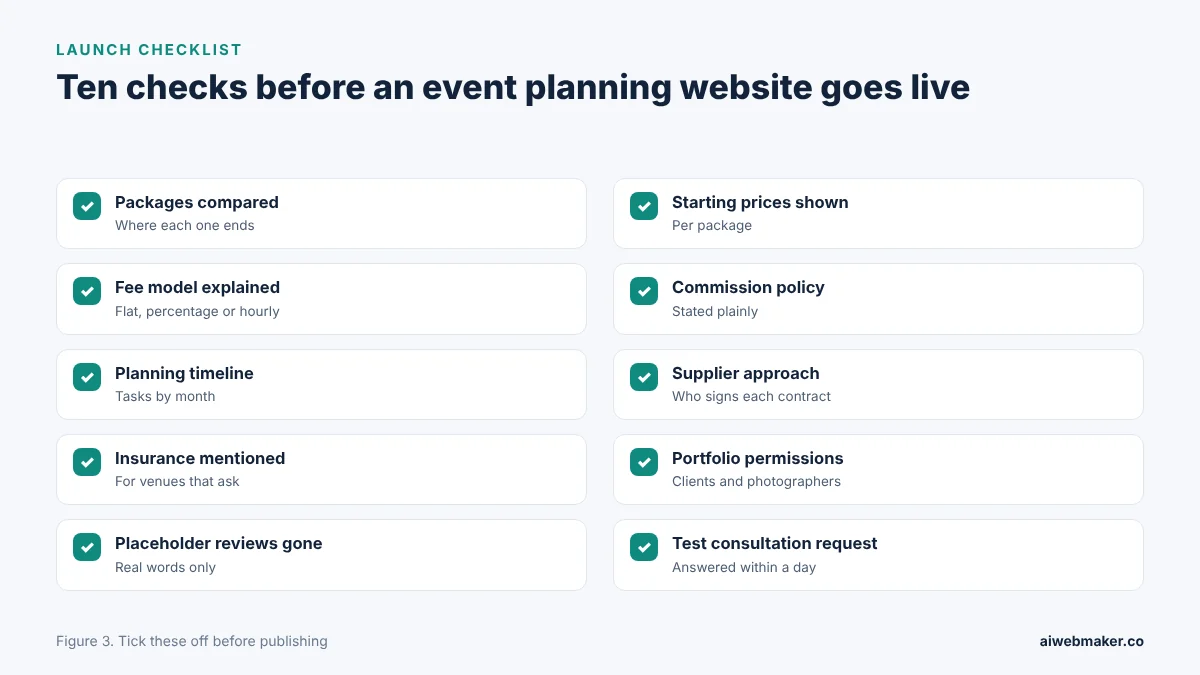
Planning clients close the tab when the packages are vague and nothing explains where one ends and the next begins. A site with no prices, no fee model and no hint of a budget range leaves them guessing. Stock photos in place of real events suggest the planner has little to show. No timeline makes clients unsure whether they are already too late. Missing details on suppliers and insurance worry corporate organisers in particular. Ten fixes for those doubts appear in the image below.
Frequently asked questions
When should a couple book a wedding planner?
For a full wedding, many couples bring a planner in twelve months or more before the date, earlier still for sought after venues. Partial planning tends to begin some months out, after the main suppliers have signed. Day of coordination is usually booked several weeks ahead so the coordinator can prepare the run sheet. Peak seasons fill quickly, so early contact is wise. The planning timeline page can show couples exactly where they stand.
Is day of coordination really only one day?
Day of coordination almost always involves work in the weeks before the event, despite its name. The coordinator meets the client, reviews the supplier contracts and builds a detailed run sheet. Suppliers receive their timings in advance, and a final walk through of the venue often follows. On the day itself the coordinator runs the schedule and solves problems quietly. Explaining this on the package page helps clients see the value in the fee.
Can one planner handle weddings and corporate events?
One planner can handle weddings and corporate events, as long as the website explains each service in its own section. Couples look for style and personal attention, while corporate clients look for logistics, budgets and invoicing. Separate portfolio sections help each audience find relevant examples. The consultation request can ask which kind of event is being planned. Serving both markets keeps the diary fuller across the seasons.
Do event planners take commission from suppliers?
Some event planners accept commissions from suppliers and others refuse them, so the website should say which applies. Clients deserve to know whether a recommendation is shaped by a payment. Planners who accept commissions can disclose them clearly or pass them back to the client. Transparent arrangements protect the planner's reputation and the client's trust. A short line on the services page settles the question before it is asked.
Does one coordinated wedding cover the planner's year online?
One coordinated wedding typically earns many times an event planner's $119 hosting year. Planners paying monthly usually clear the $19 with a single paid consultation. Each package booked afterwards lands on top of hosting that is already covered. Clear packages, an honest fee model and a portfolio of genuine events persuade clients more than polished promises. Planners who add each new event to the portfolio give future clients more reasons to call. A diary filling up a year in advance is the strongest signal that the website is working.
Build your website in Minutes and get the AI Tools that work
Start Building Your Website →