Donut Shop Website Cost, Boxes by Tomorrow and Sugar Shown per Ring
Twelve months of donut shop hosting come to $119, or a run of $19 monthly payments, with the domain extra. Covered: customers, the page, fryer timing, sugar per donut, boxes for tomorrow, offices and towers, allergens, search and the yearly budget.
- No coding required
- Live in minutes
- Blog, SEO and chatbot tools included
Twelve months of donut shop hosting on AI Web Maker come to $119, or a run of $19 monthly payments, with the domain bill depending on the letters after the dot. Writing up the trays, the box sizes and the tower enquiry, and paging through each screen in the preview, leaves the shop's account untouched. A single office order of three dozen covers that hosting in one morning. The real difficulty for a donut shop is time, because the best donuts are fried before dawn and the trays are often empty by noon. Customers need to know what is fresh, when it sells out, how to order a box for tomorrow and how far ahead a tower must be booked. These pages cover the customers, the page, fryer timing, sugar per donut, boxes for tomorrow, offices and towers, allergens and nuts, search and the yearly figures.
This article is part of our complete guide: Food Business Website Builder.
Commuters, office managers and birthday planners at the hatch
Four kinds of customer keep a donut shop busy, and each one opens the website looking for something different. Commuters want the hatch's opening time and whether it is on their way to the train. Office managers want boxes of twelve delivered before a nine o'clock meeting, labelled so colleagues can see what each donut contains. Birthday planners want glazes in particular colours, donut holes for small guests and a price per dozen. Couples planning a wedding brunch look for a tower and the notice it needs. A page that serves all four groups quickly turns a sweet craving into a planned order.
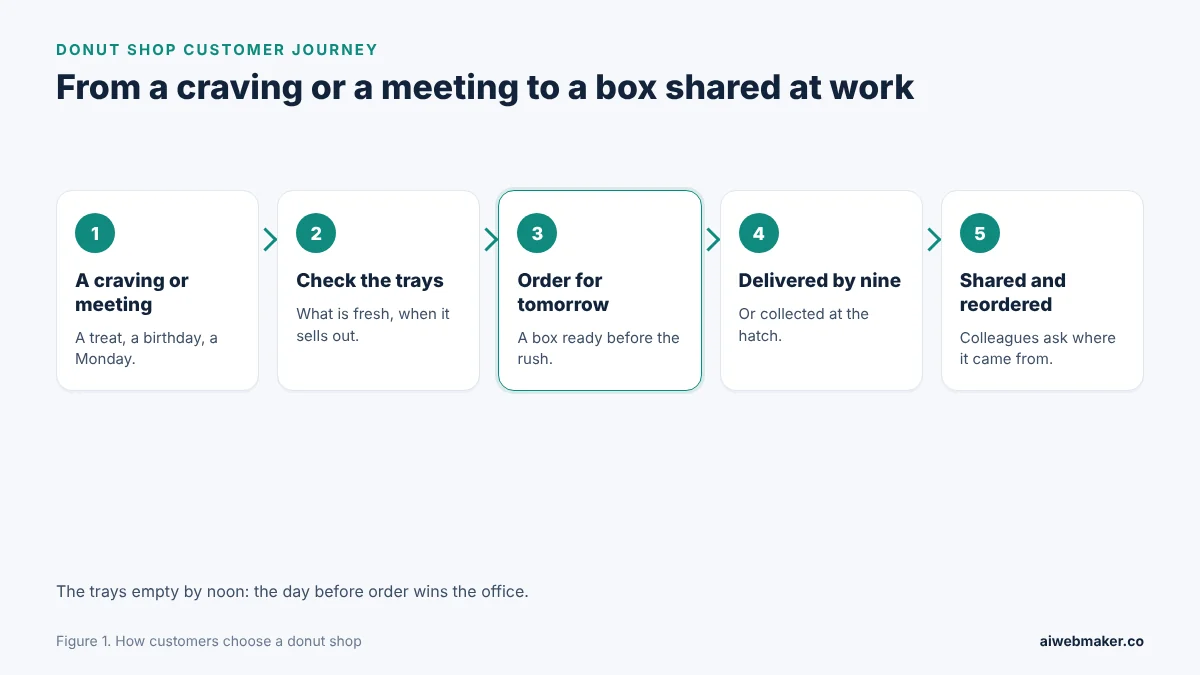
On the left of the picture sits a craving or a meeting in the diary, and on the right sits an empty box shared at work. Checking what is fresh and when it sells out comes first, especially on a Saturday. The highlighted step is ordering a box for tomorrow, because a box ordered the day before is the only sure way to beat the morning rush. Delivery or collection follows, ideally before the first coffee of the day. When colleagues reach for a custard filled donut and ask where it came from, the next order is already half placed. A website that makes the day before order effortless wins most of this trade.
Trays, boxes, sugar figures and towers: one scrolling page
A donut shop's site can live on one scrolling page, as long as each section answers a single question. The opening view should give the hatch time and the daily frying rhythm. A shop of boxes for the next morning comes next, with mixes and glazes to choose. A table of the day's flavours with price, sugar and allergens follows, then a section on dough and frying. Office, party and tower orders, an allergen panel and the hatch's hours complete the page.
| Section | The customer's question | What it should answer |
|---|---|---|
| Opening view | When are they fresh? | Frying times, hatch opening, sell out warning |
| Boxes for tomorrow | Can a box be ready by morning? | Box sizes, mixes, glazes, order cut off |
| Today's trays | What flavours are there? | Price each, sugar estimate, allergens |
| Dough and fryer | Why are they good? | Overnight proving, small batches, oil changes |
| Offices and towers | Can you handle a big order? | Notice, delivery times, price per dozen |
| Allergens | Is it safe for my group? | Every allergen, shared fryer, children's note |
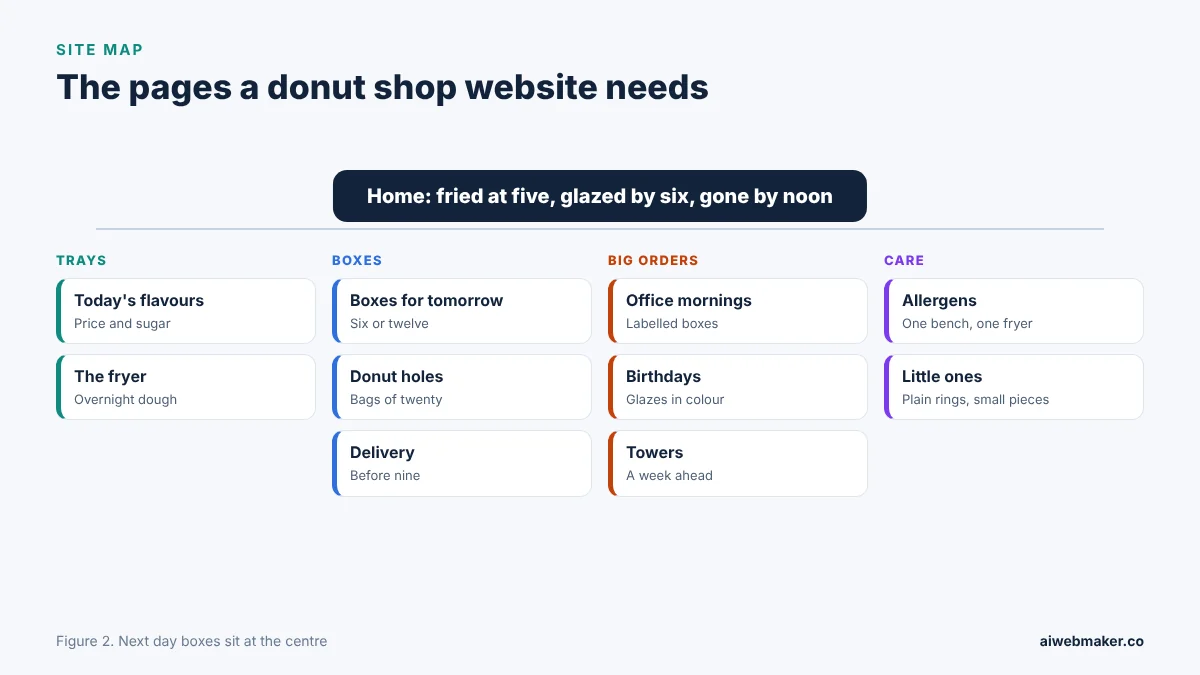
Divided by how people buy, the donut shop's site forms four groups: the trays, the boxes, the big orders and the care notes. Tray pages list each flavour with its price and sugar figure, and box pages handle orders for the next morning. Our sample shop, Glaze and Ring Donuts, sells the mixed dozen, a half dozen mixed, classic glazed in a box of six, filled donuts in a box of four, a bag of twenty donut holes and a celebration tower. A table of eight flavours with sugar estimates follows, then a section on overnight dough, office mornings, birthdays and parties, weddings and towers, an allergen panel, a gallery and reviews. The donut shop website example with sugar figures and office boxes closes with an enquiry for offices and celebrations and the hatch's hours. Customers scrolling that page learn what to order and when before the fryer is even on.
Dough proved overnight and batches fried every hour
The quality of a donut is decided long before it reaches the glaze, and customers enjoy learning why. Yeast raised dough mixed in the evening and proved slowly in the cold develops a lighter ring with a better chew than dough rushed in the morning. Cake donuts, made from a batter rather than a yeast dough, are denser and quicker to make, and a shop that sells both should explain the difference. Frying in small batches every hour, rather than one huge batch at dawn, means a donut bought mid morning is still fresh. Fresh oil, changed regularly, keeps flavours clean. Telling this story in a few lines turns a cheap treat into something worth crossing town for.
| Style | How it is made | What customers notice |
|---|---|---|
| Yeast raised ring | Dough proved, cut, fried, glazed | Light, airy, slightly chewy |
| Filled donut | Round yeast dough, fried, then filled | Jam, custard or curd to the middle |
| Cake donut | Batter dropped or piped into oil | Denser, crumbly, holds toppings |
| Donut holes | Small rounds of dough | Bite sized, good for sharing and children |
A sugar figure beside every ring and filled flavour
Donuts are a treat, and nobody expects them to be healthy, but many customers still like to know how sweet each one is. A table that shows an estimated sugar figure for each donut, worked out from the shop's own recipes, lets parents choose a lighter ring for a child and save the lemon curd for themselves. Glaze poured by hand varies a little from donut to donut, so the figures should be described as estimates. The same table can list allergens and the price of a single donut. Very few shops publish this, so it becomes a reason to choose one bakery over another. Plain numbers also show respect for customers who are managing their sugar for health reasons.
| Donut in the sample | Each | Sugar, about | Contains |
|---|---|---|---|
| Classic glazed ring | $2.80 | 12 g | Gluten, milk, egg |
| Cinnamon sugar ring | $2.80 | 11 g | Gluten, milk, egg |
| Chocolate glazed ring | $3.00 | 15 g | Gluten, milk, egg, soy |
| Maple and pecan ring | $3.40 | 16 g | Gluten, milk, egg, pecan |
| Raspberry jam filled | $3.20 | 18 g | Gluten, milk, egg |
| Lemon curd filled | $3.40 | 19 g | Gluten, milk, egg |
Boxes of six and twelve ordered by three for tomorrow
A clear cut off for next day orders is the heart of a donut shop's online trade, because the baker needs to know how much dough to mix that evening. The page needs the latest hour for next day orders, the time boxes are ready and whether delivery runs before the working day starts. Through the online store builder for donut shops selling boxes for the next morning, each box can carry a mix, a glaze or a filling as a product option, with the boxes waiting together in a bag. The delivery fee for the address appears when checkout totals the order, and a discount code can thank an office that orders every Friday. A celebration tower, priced to the number of donuts and colours, can show an Enquire button rather than a fixed sum. A box waiting behind the counter on a busy Saturday is the best argument for ordering ahead.
Office mornings, birthday colours and stacked towers
Large orders bring in the most money for the least selling, and they need their own section with notice periods stated plainly. Office mornings work best when boxes arrive before nine, labelled by flavour, with napkins and a card listing what each donut contains. Birthday orders often ask for glazes in particular colours and donut holes cut small for younger guests. Wedding and party towers of forty to a hundred donuts need a week's notice, a stand and someone to set it up at the venue. An enquiry that captures the date, headcount, flavours or colours and any allergies in the group lets the baker price it quickly. Once a price is agreed, the customer settles it with the shop directly.
One fryer, nut toppings and the warning for little ones
Donut shops usually make everything on one bench and fry it in one fryer, so the allergen section must be honest about cross contact. Wheat flour, milk and egg are in most doughs, soy may appear in chocolate glazes, and nut toppings such as pecan or pistachio bring further risks. A shop that cannot make a donut safe for people with these allergies should say so rather than offering a version that might not be. Nut pieces and whole donuts can be a choking risk for young children, so suggesting a plain ring cut into small pieces is sensible. Allergen labelling rules differ between countries, and the shop should follow the requirements where it trades. Customers with severe allergies should be invited to ask before ordering.
Searches like glazed rings near me and a dozen delivered to the office
Searches mix the treat, the occasion and the place: donut shop near me, fresh donuts open early, office donut delivery, wedding donut tower or custard filled donuts. Headings and product names that repeat those phrases let search engines match them. An accurate map listing with the hatch's early opening time, a photo of a fresh tray and the street address catches commuters. Reviews mentioning boxes that arrived on time, soft dough and honest sugar figures persuade office managers. Short articles on how donuts are made, how to keep them or how to plan a donut tower bring readers who later order. Cheerful, practical writing keeps the shop in mind for the next celebration.
Dozens against dollars: the fryer's yearly web bill
A donut shop's web bill repeats just two items, the hosting fee and the domain renewal, while twelve dough articles paid for in AI credits come to under three rings. Busy shops tend to settle the year with a single $119. A shop in its first season may like the $19 monthly route better. New flavours, price changes and tower photos add nothing at all. Both payment routes appear in the columns below, with the costlier $189 plan included for contrast alone.
| Item | Yearly | Monthly |
|---|---|---|
| Hosting the donut shop pages | $119 | $228 over twelve months |
| Domain | Depends on the ending | Depends on the ending |
| Higher plan, for comparison | $189 a year | Not needed |
| Twelve dough and tower articles at about $0.65 | About $7.80 | About $7.80 |
| Flavour, box and price updates | No charge | No charge |
| Year before the domain | About $126.80 | About $235.80 |
Why the morning crowd buys from the petrol station instead
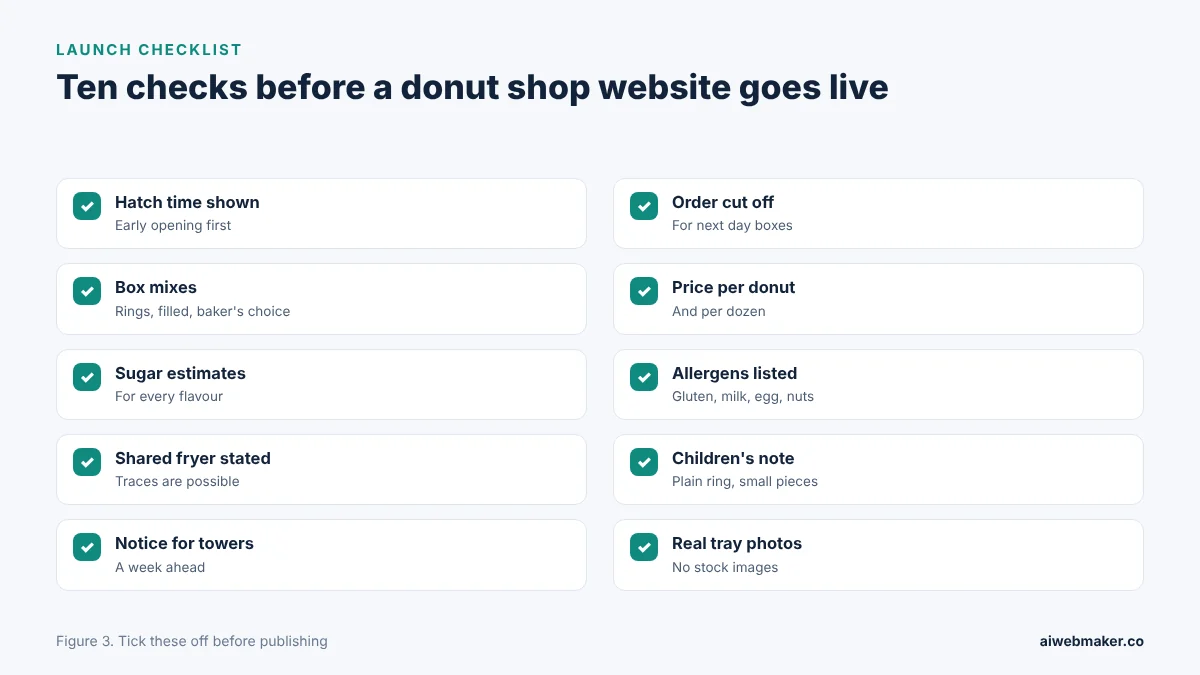
The morning crowd settles for a petrol station donut when the bakery's site hides its hatch time or shows yesterday's flavours. No next day ordering means a busy office manager has to queue at dawn or go elsewhere. Large orders without notice periods or prices push planners to a supermarket platter. Silence on allergens and nut toppings loses any group with a careful eater. Photos that look nothing like the real trays make customers wary. A ten line checklist, drawn in the picture beneath, puts these problems right.
Frequently asked questions
When does a fried ring go stale?
A fried donut is at its best on the day it is made, ideally within a few hours. Glazed rings can be warmed for a few seconds to soften them the next day, while filled donuts with custard or curd should be kept chilled and eaten by the next morning. The website can print simple keeping advice on every box. Customers who know this plan their orders around the day of eating. Fresh donuts eaten on time are the shop's best advertisement.
Can the fryer turn out a donut without gluten or egg?
Most donut shops cannot make a donut safe for people avoiding gluten, milk or egg, because the dough uses wheat flour and everything shares one fryer. A shop that does offer such a donut needs a separate process, and it should explain exactly how traces are kept out. Otherwise, honesty is the safest answer. The website should state clearly what the shop can and cannot provide. Customers with allergies value a truthful answer more than a hopeful one.
Is the mix inside a box up to the buyer?
Many shops let customers choose a mix when adding a box to the bag, such as the baker's choice, rings only or filled only. A box made exactly to a list of flavours may need an enquiry or a phone call. The website should explain both routes so nobody is surprised. Popular flavours can sell out, so a note about substitutions helps. Clear choices make ordering quick for busy people.
What happens to unsold trays at closing?
Shops handle leftovers in different ways, and saying what happens to them builds goodwill. Some donate unsold donuts to a local shelter or charity the same day, as the sample shop does. Others sell them at a lower price near closing time. Frying in small batches through the morning reduces how many are left. Customers appreciate a shop that wastes little and gives back to its neighbourhood.
Dozens that settle the hosting for twelve months
A single office order of a few dozen donuts outweighs the $119 that keeps a donut shop's pages hosted for a year. For shops paying monthly, a mixed dozen on a Saturday covers each $19 with something left over. Every box ordered the evening before, and every tower booked for a wedding brunch, is trade the site helped to secure. Honest sugar figures, clear cut off times and careful allergen notes persuade customers more than glossy photos of sprinkles. Shops that keep their trays and hours current become part of the town's morning routine. Standing Friday orders for the office are the surest proof that people read the box page.
Build your website in Minutes and get the AI Tools that work
Start Building Your Website →