Deli Website Cost, Sliced to Order Counters and Office Platters
Hosting a delicatessen's counter costs $119 per year, or comes in $19 monthly instalments, while its domain is priced by the ending. Inside: who orders, the page sections, slicing, labels, the hatch, platters, hampers, search and the yearly sums.
- No coding required
- Live in minutes
- Blog, SEO and chatbot tools included
Hosting a delicatessen's counter online costs $119 per year with AI Web Maker, or comes in $19 monthly instalments, while its domain is priced by the ending it picks. Putting the cured meats, the sandwich board and the platter menu together, and then tapping through each screen in the preview, never triggers an AI Web Maker charge. One antipasti board for an office meeting brings in more than a year of hosting. A deli's real puzzle is that it sells three things at once: a counter priced by weight, a lunch hatch that lives on speed, and catering that depends on notice and careful labelling. Each part attracts a different customer, and all of them want allergens, prices and timings before they commit. Below come the customers, the page sections, slicing and pricing, dated dishes and labels, the hatch, platters, hampers, search and the yearly figures.
This article is part of our complete guide: Food Business Website Builder.
Office lunches, Friday suppers and gift crates: the people behind deli orders
A deli serves more kinds of customer than almost any food shop, and each reaches the website with a narrow, practical question. Office workers check what time the sandwich hatch opens, what the fillings are and whether there is a vegan option today. Home cooks want to know which cured meats are on the slicer and whether the lasagne for two will be ready on Friday. Office managers and party hosts need a platter for a fixed number of people, with allergens labelled and a time agreed. Gift buyers look for a hamper that can be posted or collected. A site that answers each of these within a scroll keeps all four groups coming back.
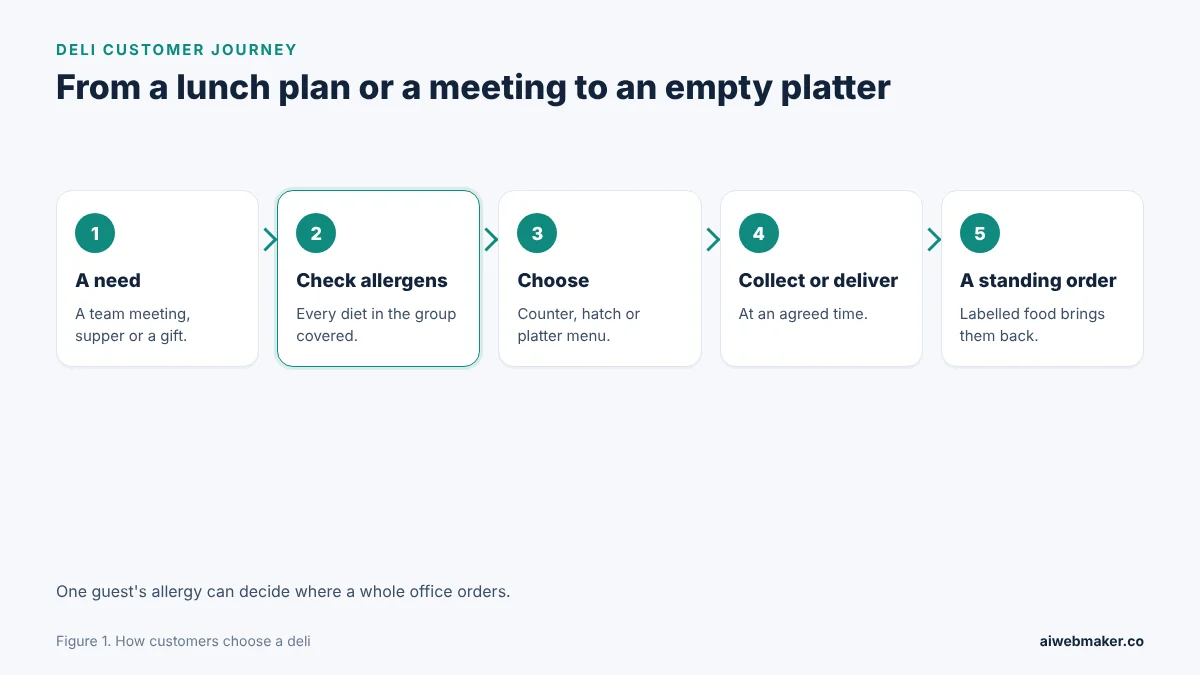
Five stages carry a deli customer from a need to an empty board and a repeat order. A trigger comes first, such as a team meeting, a Friday supper or a birthday gift. The highlighted stage is checking allergens and diets, because a single guest who avoids gluten or sesame can decide where an office orders. Choosing from the counter, the hatch or the platter menu follows, then collection or delivery at an agreed time. The food itself, labelled item by item, decides whether the order becomes a weekly habit. Pages that support each stage turn a one off lunch into a standing arrangement.
Hatch, counter, kitchen and platters as sections of one page
A delicatessen's site needs sections that match the way the shop actually trades, from the early hatch to the party platter. The opening view should name the counter, the hatch hours and the smallest slice order. A shop of counter goods comes next, then a sandwich board with fillings, allergens and prices. A kitchen section explains sourcing, slicing and dating, and a catering section sets out platters with guests served and notice needed. A route for platter enquiries and the counter's hours close the page.
| Section | The customer's question | What it should answer |
|---|---|---|
| Opening view | What does this deli do? | Slicing to order, hatch hours, platters |
| Counter shop | What is ready to collect? | Meats, cheeses, bread and dishes with prices |
| Sandwich board | What is at the hatch today? | Fillings, allergens, prices, opening time |
| Kitchen and sourcing | Is it made here and when? | Producers, slicing, dates on every dish |
| Catering platters | Can you feed my team? | Guests served, contents, notice, diets |
| Questions and hours | Allergies, keeping, posting | Plain answers and counter times |
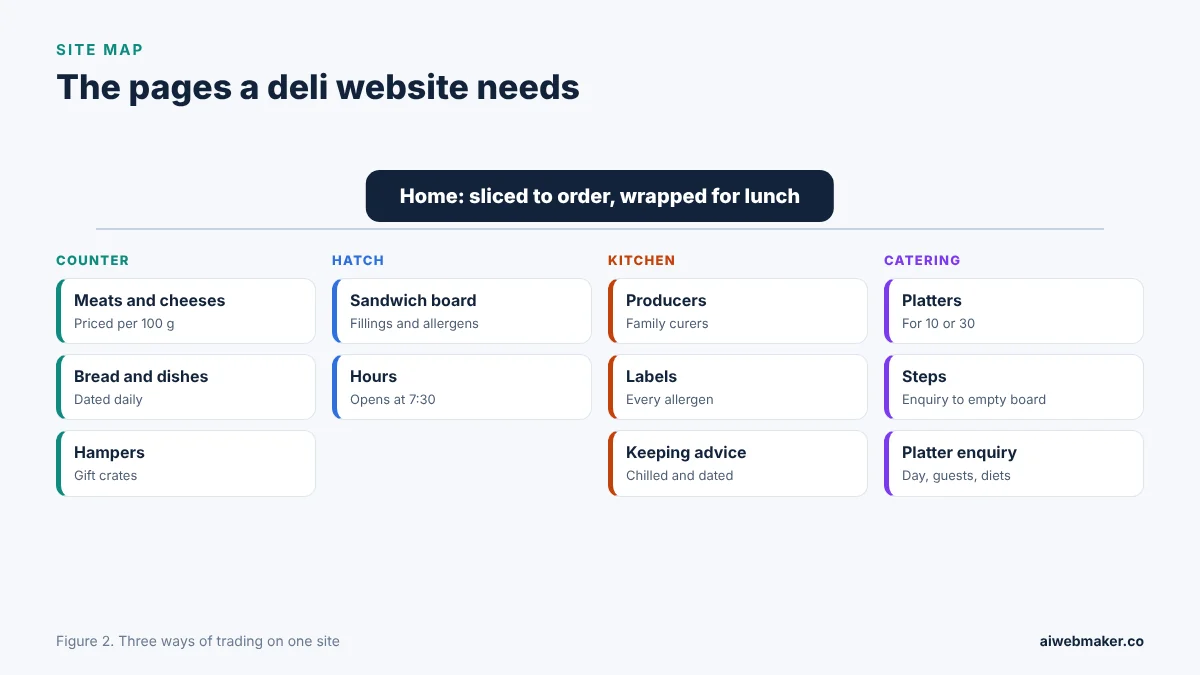
Organised around the ways people buy, the deli's site separates into the counter, the hatch, the kitchen story and catering. Counter pages carry meats, cheeses, breads, prepared dishes and hampers, each priced and labelled. Hatch pages hold the sandwich board, and kitchen pages explain sourcing and dating, while catering pages present platters and the steps from enquiry to an empty board. Our sample shop, Larder Lane Delicatessen, lists air dried ham, fennel salami, marinated olives, a sourdough loaf, lasagne for two, a squash and chickpea salad, a deli hamper and a whole leg of ham. A sandwich table, a kitchen section, three catering tiers and four steps follow, then a gallery, reviews and a platter enquiry. The deli website example with a sandwich hatch and catering platters shows how three ways of trading fit on one scrolling page.
Slicing to order and pricing by the hundred grams
Cured meats dry out within hours of cutting, which is why a good deli slices to order and why the website should say so. Every counter item needs a price tied to a weight, such as per 100 g for ham and salami or per 200 g for olives. Slice thickness matters more than many shops realise, since paper thin ham suits a board while thick slices suit cooking. Products sold as a unit, such as a loaf or a dish for two, should be priced as a unit. The smallest slice order deserves a mention, because it reassures someone who only wants enough for one sandwich. Clear weights and options on every card stop the counter from fielding the same questions all day.
| Counter item | Priced by | Option worth offering |
|---|---|---|
| Air dried ham | 100 g | Paper thin, thin, thick for cooking |
| Salami | 100 g | Thin, thick or a whole piece |
| Olives and antipasti | 200 g | Mixed, green or black |
| Bread | The loaf | White, wholemeal, rye |
| Prepared dishes | The dish | Meat or vegetable version |
| Salads | 300 g or 600 g | Size |
Dated dishes, chilled shelves and allergen labels on everything
Prepared food is where a deli's care shows most clearly, so the website should explain how dishes are made, chilled and dated. A kitchen that cooks salads, lasagne and soup each morning can label each item with the day it was made and a use by date. Food safety and labelling rules differ between countries, and owners should follow the requirements of their local authority. In the United Kingdom, for example, food packed on the premises before a customer orders it must carry a full ingredients list with allergens emphasised. Even where the law is lighter, listing every allergen in plain words on each card and label is the safer course. A deli that labels this carefully earns the trust of the customers with the strictest needs.
Shared counters create a further issue, because meat, cheese and bread meet on one surface and one slicer often handles every cured meat. The website should say honestly that traces are possible and invite anyone with a severe allergy to speak to the staff before anything is made. Cured meats and soft cheeses raise questions during pregnancy, and guidance differs between countries, so the right answer is to point customers to their own midwife or doctor for advice. A deli can then offer cooked fillings or pasteurised cheeses without giving advice it is not qualified to give. Careful wording of this kind protects customers and the business together.
The sandwich hatch at half past seven
A lunch hatch lives on speed, so its section of the site should read like a board on the wall rather than an essay. Each sandwich needs its name, its fillings, its allergens and its price in one line. Opening times matter more here than anywhere else, because a commuter who arrives before the hatch opens rarely comes back. A note that the hatch runs until the bread runs out is honest and creates gentle urgency. At least one vegetarian and one vegan option each day, clearly marked, widens the queue. Soup of the day and a thick slice of bread suit colder months and deserve a seasonal line.
Platters, grazing tables and the notice they need
Catering platters are usually a deli's most valuable orders, and each sells best with its guests, contents and notice stated. An office manager wants a sandwich platter for ten with one side kept vegetarian. A party host wants an antipasti board for a starter or a grazing table laid out at the venue. Every platter should arrive with a label for each item and its allergens, so guests can choose without asking. The enquiry route should gather the day, the time, the number eating and any diets or allergies to plan around. Payment for catering is agreed directly between the deli and the customer.
| Platter | Feeds | Contents | Notice |
|---|---|---|---|
| Sandwich platter | 10 for lunch | Twenty halves, one side vegetarian | 24 hours |
| Antipasti board | 10 as a starter | Meats, two cheeses, olives, breads | 24 hours |
| Grazing table | 30 at a party | Meats, cheeses, salads, breads, fruit | Five days |
| Whole leg of ham | A party | Leg on a carving stand, carving tips | By enquiry |
Hampers by post and an online counter for collection
An online counter lets regulars order meats, bread and dishes ahead and pick them up without queuing, while hampers reach people further away. With the online store builder for delis selling by the slice and the hamper, each product can offer slice thickness, loaf type or size as product options, and items wait together in a bag. Checkout adds the delivery fee for the shopper's address, and a code from the deli's monthly letter can be typed in for a discount. A whole leg of ham or a very large order, priced case by case, can carry an Enquire button so the deli can talk it through. Posting meat and dairy across borders is often restricted, and rules vary by country, so international hampers should only be accepted after the destination's rules are checked. A tidy online counter turns the deli's regulars into customers who order before they arrive.
Searches like deli near me open now and antipasti platter delivery
Deli customers search for the shop, the lunch or the occasion: deli near me, sandwich shop open now, antipasti platter, office lunch catering or a gift hamper. Using those exact words in the counter, hatch and catering headings helps each search land on its answer. A map listing with accurate hatch hours, a photo of the counter and the street address captures much of the lunchtime traffic. Reviews that mention thin sliced ham, quick service or a platter that arrived labelled persuade new office managers. Articles on building an antipasti board, storing cured meats or the producers behind the salami bring readers who later become regulars. Practical, generous writing gives a neighbourhood deli a reputation beyond its own street.
The delicatessen ledger: what the pages cost to keep live
Two items recur for a deli online, hosting and a domain, while a dozen articles about cured meats and boards come to under eight dollars of AI credits. A deli with steady trade will usually choose the single $119 payment. A new counter may prefer the $19 monthly route through its first seasons. Adding dishes, changing prices or updating the sandwich board costs nothing. The rows below place both routes next to each other, with the dearer $189 plan shown purely as a yardstick.
| Item | Yearly | Monthly |
|---|---|---|
| Hosting the deli pages | $119 | $228 over twelve months |
| Domain | Depends on the ending | Depends on the ending |
| Higher plan, for comparison | $189 a year | Not needed |
| Twelve counter and catering articles at about $0.65 | About $7.80 | About $7.80 |
| Sandwich, dish and price updates | No charge | No charge |
| Year before the domain | About $126.80 | About $235.80 |
Why lunch seekers walk past to the chain sandwich bar
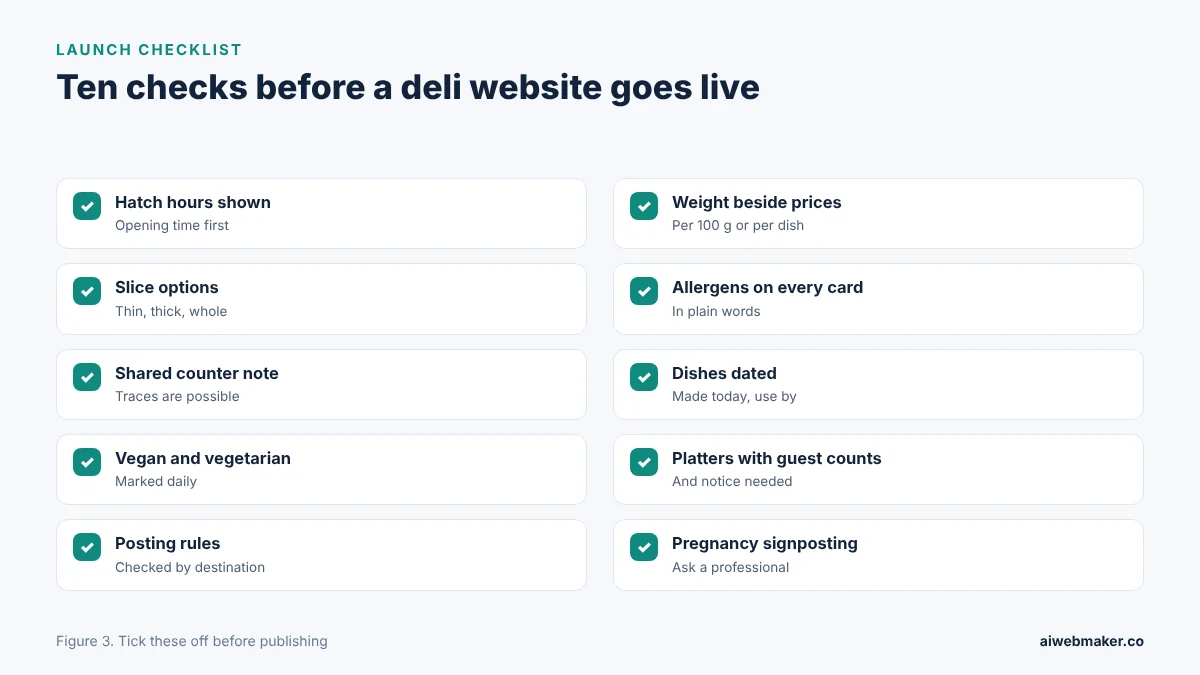
Lunch seekers choose a chain sandwich bar when the deli's site hides its hatch hours or shows a menu without prices. Missing allergen information sends anyone with a dietary need straight to a shop that lists it. Platters described without guest numbers or notice leave office managers unsure whether to call. Photos of a dim counter with no labels make the food look older than it is. A site that never mentions vegan or vegetarian options loses the group order that hinged on one guest. Ten fixes for these problems sit in the next picture, one per line.
Frequently asked questions
How long does sliced cured meat keep?
Sliced cured meat is best eaten within a few days, kept wrapped and chilled, because cut surfaces dry out and lose flavour quickly. Whole pieces of salami or ham keep much longer before they are cut. Prepared dishes should carry a use by date on their labels, set by the kitchen under local food safety rules. The website can give simple keeping advice beside each counter item. Customers who know how long food lasts waste less and order more confidently.
Can a deli label one sandwich safe for a severe allergy?
A deli with a shared counter and slicer usually cannot promise that any sandwich is safe for a severe allergy, and it should say so honestly. It can list every allergen in the recipe and explain how food is prepared. Customers with severe allergies should speak to the staff before ordering, and the site should invite them to do so. Some delis prepare a separate item on a cleaned surface for a known guest, but only where they are confident of the process. Honesty here protects customers far better than reassuring words.
Should cured meats carry a note for pregnant customers?
A short note pointing pregnant customers to their midwife or doctor is sensible, because guidance on cured meats and soft cheeses differs between countries. The deli should not give its own medical advice. Offering cooked fillings or pasteurised cheeses as alternatives is a helpful touch. Labels that state whether a cheese is pasteurised make choices easier. Careful signposting shows respect for customers without overstepping.
What lead time suits a grazing table for thirty?
A grazing table usually needs several days of notice, because meats, cheeses and breads are ordered and prepared for that specific event. Simple sandwich platters and antipasti boards often need only a day. December and early summer fill quickly, so organisers should ask well ahead. The website should state the notice for each platter so nobody is disappointed. Clear lead times help the kitchen plan and keep standards high.
Platters and loaves that cover twelve months online
One sandwich platter for an office outearns the $119 that keeps a deli's pages hosted for a year. Under monthly billing, the $19 is repaid by two sandwiches and a loaf before the morning rush ends. Every platter ordered for a meeting and every hamper posted to a family member is trade the site helped to bring in. Honest labels, clear hatch hours and prices tied to weights persuade customers more than polished slogans. Delis that keep the sandwich board and counter list current become part of the neighbourhood's daily routine. A standing Friday order for lasagne is the kind of loyalty that tells an owner the pages are read.
Build your website in Minutes and get the AI Tools that work
Start Building Your Website →