Coffee Roaster Website Cost, From Roast Date to Wholesale Sack
For a roastery, hosting the shop and wholesale pages costs $119 annually, or $19 a month if preferred, plus a domain. Covered: who buys, the pages, roast dates, product pages, the shop, wholesale, sourcing claims, search and the budget.
- No coding required
- Live in minutes
- Blog, SEO and chatbot tools included
Running a roastery's shop and wholesale pages online takes $119 of hosting a year, or $19 a month, before the domain. Product cards, the roast date table and the wholesale page can all be assembled and previewed with no invoice from AI Web Maker. A single 5 kg wholesale order at the sample's cafe rate of $28 a kilo comes to $140, which already beats twelve months of hosting. The difficulty is freshness and trust, because buyers cannot smell the beans and must take the roaster's word for when they were roasted and how they will taste. Trade buyers add their own questions about price per kilo, delivery days and support. Who buys, the pages, roast dates, product pages, the shop, wholesale accounts, sourcing claims, search and the yearly sums are each covered below.
This article is part of our complete guide: Food Business Website Builder.
Home brewers, gift buyers and cafes: who orders from a roastery
People buying from a roaster online usually tasted the coffee somewhere first, in a cafe that pours it or at a friend's kitchen table. Home espresso owners want a reliable house blend in larger bags, while filter fans want to explore single origins one at a time. Gift buyers look for a tasting set, and households that drink decaf in the evening look for one that tastes like coffee. Cafes, restaurants and offices form a separate group with different questions about price per kilo and delivery. Every buyer checks freshness, origin and grind options before anything goes in the basket.
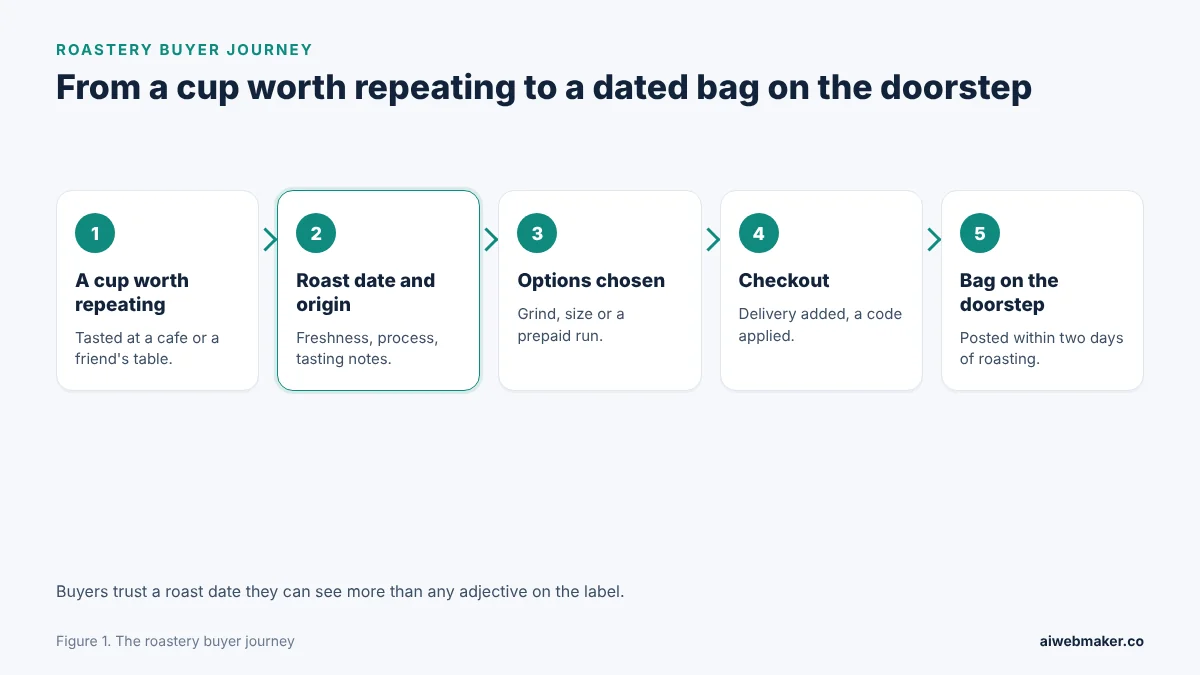
The second step settles most orders, because a buyer who cannot see a roast date or an origin rarely gets as far as the basket. Freshness facts, process and tasting notes give the buyer the confidence a roastery visit would. Options for grind and size then let the buyer match the coffee to the brewer at home. Checkout, with the delivery fee added and a discount code applied, should hold no surprises. A dated bag that arrives within days of roasting is what turns a first order into a habit.
Pages a roastery needs for home brewers and trade buyers
A roastery website serves two audiences at once, so its pages should keep home brewers and trade buyers on separate paths. The home page should state the roast days and posting times and send visitors straight to the shop. Shop pages carry each coffee with its origin, roast level and grind options, while a roast date page explains when each coffee tastes best. Sourcing and brewing pages support the shop with facts and practical help. A wholesale page, written for cafes and offices, completes the set with its own tone and its own enquiry route.
| Page | Buyer's question | What it should show |
|---|---|---|
| Home | Is this coffee fresh? | Roast days, posting times, a link to the shop |
| Shop | Which coffee, which grind? | Products with origin, roast level and grind options |
| Roast dates | When will it taste best? | Rest days and best window for each coffee |
| Sourcing | Where does it come from? | Country, region, process, importer details |
| Wholesale | Can a cafe be supplied? | Price per kilo by volume, sample bags, delivery days |
| Brewing help | Which grind suits a brewer? | Grind by method, storage advice |
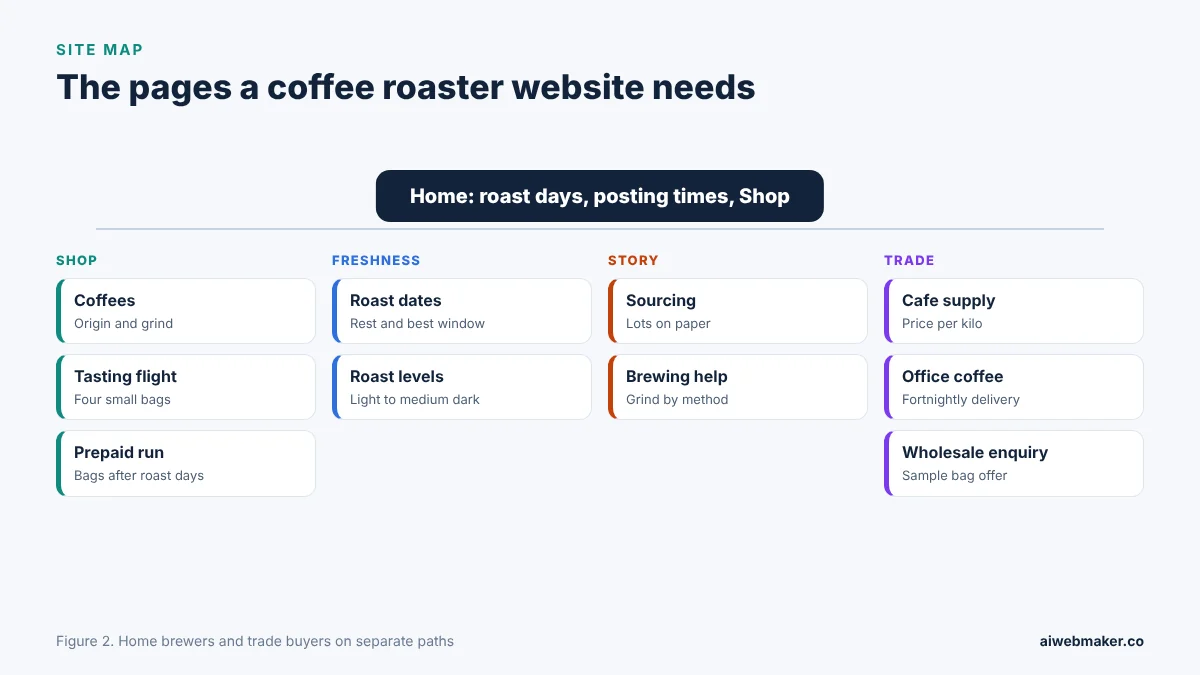
Two audiences share this plan, home brewers and trade buyers, and the branches keep them from tripping over each other. Shop pages hold the coffees, the tasting flight and the prepaid run, freshness pages hold roast dates and roast levels, story pages hold sourcing and brewing help, and trade pages hold cafe and office supply. Our sample, Ember Hill Coffee Roasters, sells Ember House Espresso at $14, Ethiopia washed at $16, Colombia natural at $15 and Decaf Colombia at $15, each a 250 g bag with grind options. It also offers a tasting flight of four 100 g bags at $24, a prepaid run from $42, a 1 kg espresso bag at $46, and wholesale 5 kg sacks, cafe supply and office coffee for trade buyers. The coffee roaster website example with roast dates on every bag is a sample written by hand, and no beans have ever left its drum. Its roast date table is the feature a real roaster can adopt first.
Roast dates, rest windows and the posting rhythm
Freshly roasted coffee needs a few days to rest before it tastes its best, then slowly fades, and roasters who explain this sell with more confidence. A roast date stamped on every bag tells a buyer more than a distant best before date. Under European Union and British labelling law, for instance, packed coffee normally carries a best before date too, so both dates may share the bag. A table giving each coffee's rest period and best window, counted from the roast date, turns freshness into something a buyer can plan around. Roast days and posting days belong on the same page, so buyers know when an order placed on a Sunday will leave. Clear dates answer the first doubt of anyone buying coffee they cannot smell.
| Coffee | Roasted | Best from | Best within |
|---|---|---|---|
| Ember House Espresso | Tuesday | Day 7 | 6 weeks |
| Ethiopia, washed | Thursday | Day 4 | 5 weeks |
| Colombia, natural | Tuesday | Day 5 | 5 weeks |
| Decaf Colombia | Thursday | Day 5 | 5 weeks |
| Tasting flight | Tuesday | Day 5 | 4 weeks |
Product pages: origin, process, roast level and grind
A roaster's product page has to replace the smell of the roastery with facts, so each coffee needs its origin, process, roast level and tasting notes in plain words. Country and region, a process such as washed or natural, and the roast level shape the cup more than any adjective. Tasting notes should be explained as descriptions of flavour, since some buyers worry that words like hazelnut mean something was added. Offering whole bean alongside espresso, filter and cafetière grinds looks after buyers with and without a grinder. Bag sizes from a small tasting bag to a full kilo suit different households and small offices. Product pages written this way let a buyer choose with the same confidence as at the roastery door.
| Shop line | Options to offer | Who it suits |
|---|---|---|
| Single origin, 250 g | Whole bean, espresso, filter, cafetière | Home brewers exploring origins |
| House espresso, 1 kg | Whole bean or espresso grind | Heavy home use and small office machines |
| Tasting flight | A grind for the buyer's brewer | First orders and gifts |
| Decaf | The same grind choices | Evening drinkers and decaf households |
| Prepaid run | Number of bags and their spacing | Regulars who would rather not reorder |
| Wholesale sacks | No listed price, an Enquire button | Cafes and offices |
Selling dated bags through the online shop
Selling beans online works best when the shop mirrors the way people buy coffee, one coffee, one grind and one size at a time. The online store builder for coffee roasters selling dated bags and wholesale sacks gives each coffee its options, such as grind and bag size, gathers the chosen bags in a shopping bag, then totals the order with its delivery fee at checkout. Discount codes, for example from a roast day letter, take money off an order, and a product with no listed price, such as wholesale sacks, shows an Enquire button instead. A prepaid run can be sold as a single product whose options set the number of bags, bought once through the checkout, with the roaster sending a bag after each roast day. Seeing the delivery fee before paying, rather than discovering it later, removes a common reason to abandon a first order. Each of these pieces makes buying fresh beans nearly as easy as tasting them.
Wholesale accounts for cafes, restaurants and offices
Wholesale accounts can matter as much to a roaster as retail sales, and they need a page with a different tone. Cafes, restaurants and offices want to know the price per kilo at their volume, how often deliveries come and what support arrives with the first order. Help dialling in the espresso on the first morning, a sample bag before commitment and barista training sessions are typical draws, and the sample prices cafe supply from $28 a kilo and office coffee from $32. Terms such as payment days and minimum orders should be agreed in writing and settled between roaster and account directly. An enquiry route for wholesale, rather than a fixed basket price, suits volumes that vary from one cafe to the next. A clear wholesale page can turn a curious cafe owner into a weekly delivery.
Sourcing claims, labels and decaf: what a roaster can print
Sourcing stories sell coffee, but they also invite scrutiny, so the website should print only what the roaster can document. Country, region, altitude, process and the importer who supplied the lot are facts most roasters can show on paper. Calling a coffee organic is regulated in many markets, Europe and America among them, so the word belongs only on certified lots. Claims about direct trade, prices paid to growers or partnerships deserve the same caution. Decaf deserves a note on how it was decaffeinated, and the website should make no health claims, telling buyers who must avoid caffeine to ask a doctor rather than trust a label. Rules on sending food across borders also differ, so posting abroad should be checked address by address.
Searches for fresh beans and a wholesale supplier
Coffee buyers search for freshness, origin and format far more than for a roastery's name. Home brewers type phrases such as fresh roasted coffee beans, single origin coffee, espresso beans 1 kg or decaf coffee beans, while trade buyers type wholesale coffee supplier or office coffee beans. Putting each phrase in the heading of the matching page lets the wholesale page meet the cafe owner who typed wholesale. A map listing for the roastery, with collection hours and photos of the drum, helps nearby buyers who would rather collect. Reviews that mention roast dates, freshness on arrival or help with dialling in persuade both audiences. Articles on rest days, grinding for each brewer or a new origin's story give buyers a reason to return between orders.
What hosting costs a roastery across a year
Beside one wholesale order, the cost of hosting the shop is hardly worth a line in the roastery's books. A roaster with steady sales keeps it lowest at $119 billed once, and a new roastery testing demand might choose $19 a month instead. Twelve articles on origins, rest days and brewing come to roughly $7.80 when drafted with credits. New coffees, revised prices and fresh discount codes are added without any charge. Both payment routes follow, the $189 tier listed underneath them as a yardstick only.
| Item | Yearly | Monthly |
|---|---|---|
| Hosting the shop, roast date and wholesale pages | $119 | $228 over twelve months |
| Domain | Depends on the ending | Depends on the ending |
| Higher plan, for comparison | $189 a year | Not needed |
| Twelve origin and brewing articles at about $0.65 | About $7.80 | About $7.80 |
| New coffees, prices and codes | No charge | No charge |
| Year before the domain | About $126.80 | About $235.80 |
Gaps that send coffee buyers to another roaster
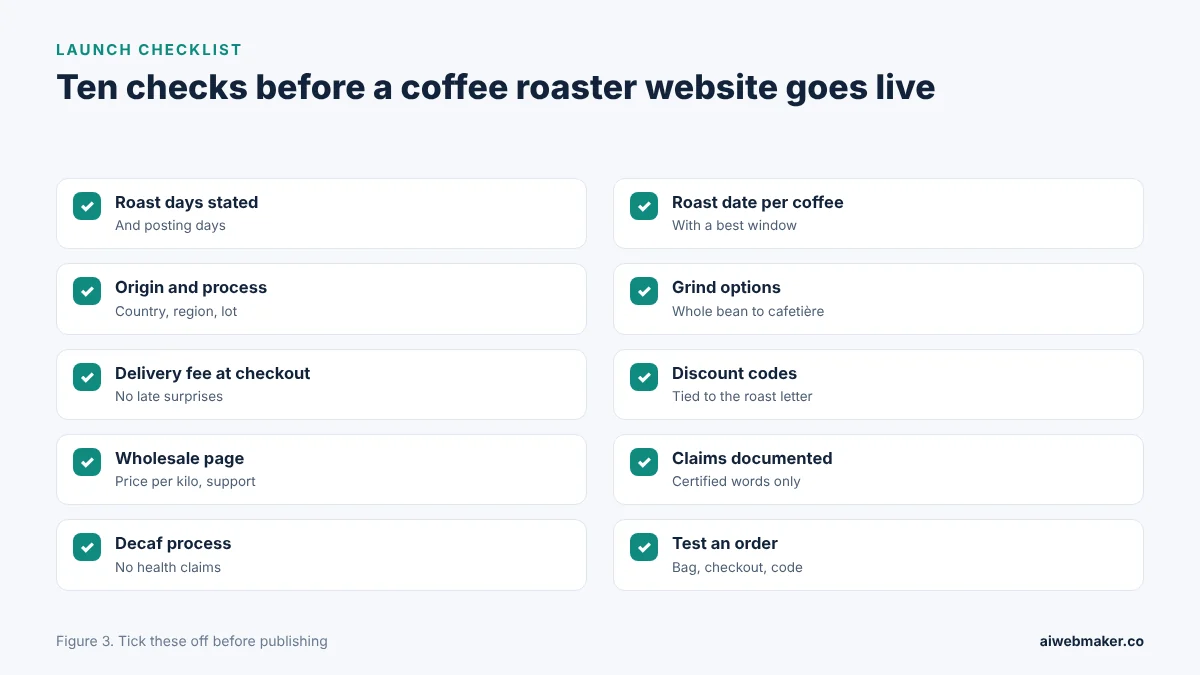
Buyers leave a roaster's site quickly when no roast date appears anywhere near the price. A bag with no grind options sends buyers without a grinder elsewhere. Postage revealed at the very last click makes a first order feel like a trap. Vague origins, or claims about farms and certifications with nothing to back them, raise doubts among the buyers who care most. A wholesale offer hidden behind a generic contact form loses cafes that wanted a price per kilo. The ten roastery checks drawn here close those gaps before a buyer finds them.
Frequently asked questions
Why print a roast date as well as a best before date?
A roast date tells buyers when the coffee left the drum, which matters far more to flavour than a distant best before date. Beans past their best window are not spoiled, they simply taste less lively. Many places require a best before date on packed food, so roasters often print both. A short explanation on the shop page clears up any confusion. Buyers who understand the dates plan their orders around the rest window.
Which grind should a buyer choose?
Whole bean keeps longest and suits anyone with a grinder at home. Otherwise the grind should match the brewer, with fine for espresso machines, medium for filter and pour over, and coarse for a cafetière. Grinding on the morning of posting, as the sample does, keeps ground coffee as fresh as possible. A short grind guide beside the product options reduces wrong orders. Clear advice here saves both the buyer's morning and the roaster's returns.
Can a roaster post beans abroad?
Posting within the roaster's own country is usually straightforward, but sending food across borders follows rules that differ by destination. Some countries limit or inspect food imports, and delivery costs and times rise sharply. A roaster should say on the website whether it posts abroad and that it checks each foreign address before taking the order. Buyers abroad can then ask before they fill a bag. Honest wording avoids parcels stuck at customs and disappointed customers.
Do tasting notes mean flavourings were added?
Tasting notes describe flavour rather than ingredients, a point worth one plain sentence on every product page. Words like hazelnut, berries or caramel come from the bean, its process and the roast. Roasters that handle only coffee can say that no nuts, milk or flavourings pass through the roastery, where that is true. Allergen rules differ by country, so buyers with a concern should be invited to ask. A single clear sentence prevents both confusion and complaints.
How many bags of beans pay for the roastery's year online?
Nine bags of house espresso at $14 out earn the twelve month hosting fee. A single wholesale sack for a cafe covers it on one delivery. What sells those bags is visible freshness, honest origins and a checkout that holds no surprises. Wholesale pages that state a price per kilo and the support on offer then add steady weekly orders. Roasters who update roast dates, coffees and codes give buyers a reason to come back after every roast day. Counted in bags of beans, the year online is paid for before the first week is out.
Build your website in Minutes and get the AI Tools that work
Start Building Your Website →