Cheese Shop Website Cost, Cuts by Weight and Raw Milk Labelled Plainly
A cheesemonger's hosting costs $119 across twelve months, or $19 per instalment when paid monthly, plus a domain. Covered: buyers, the sections a counter needs, cuts and labels, raw milk care, tasting notes, chilled posting, boards, search and the yearly budget.
- No coding required
- Live in minutes
- Blog, SEO and chatbot tools included
Twelve months of hosting for a cheesemonger cost $119 on AI Web Maker, or $19 at a time on monthly billing, with the web address charged by whichever ending suits it. Writing tasting notes, pricing the cuts and testing every card in the preview runs up no AI Web Maker bill at all. A single board for a party, or a few hampers in December, covers that hosting with room to spare. The harder part is translating a counter built on tasting into pages that cannot offer a sliver on the end of a knife. Shoppers need to know how a cheese tastes, what milk it comes from, whether it was pasteurised and how it will survive the journey home or through the post. These pages cover the buyers, the sections a counter needs, cuts and labels, raw milk care, tasting notes, chilled posting, event boards, search and the yearly sums.
This article is part of our complete guide: Food Business Website Builder.
Gift hunters, party hosts and Saturday regulars at the counter
Several kinds of shopper look up a cheese shop online, and each one carries a separate question to the screen. Regulars check which wheels are on the counter this week and whether the washed rind they loved last month is back. Gift buyers hunt for a hamper that can travel to a parent in another town and arrive in good condition. Party hosts and couples planning weddings want a board or a tower for a set number of guests on a fixed date. Some shoppers arrive with a careful question about pregnancy, allergies or vegetarian rennet before they buy anything. Each of them should find the answer in a line or two, without phoning during the Saturday rush.
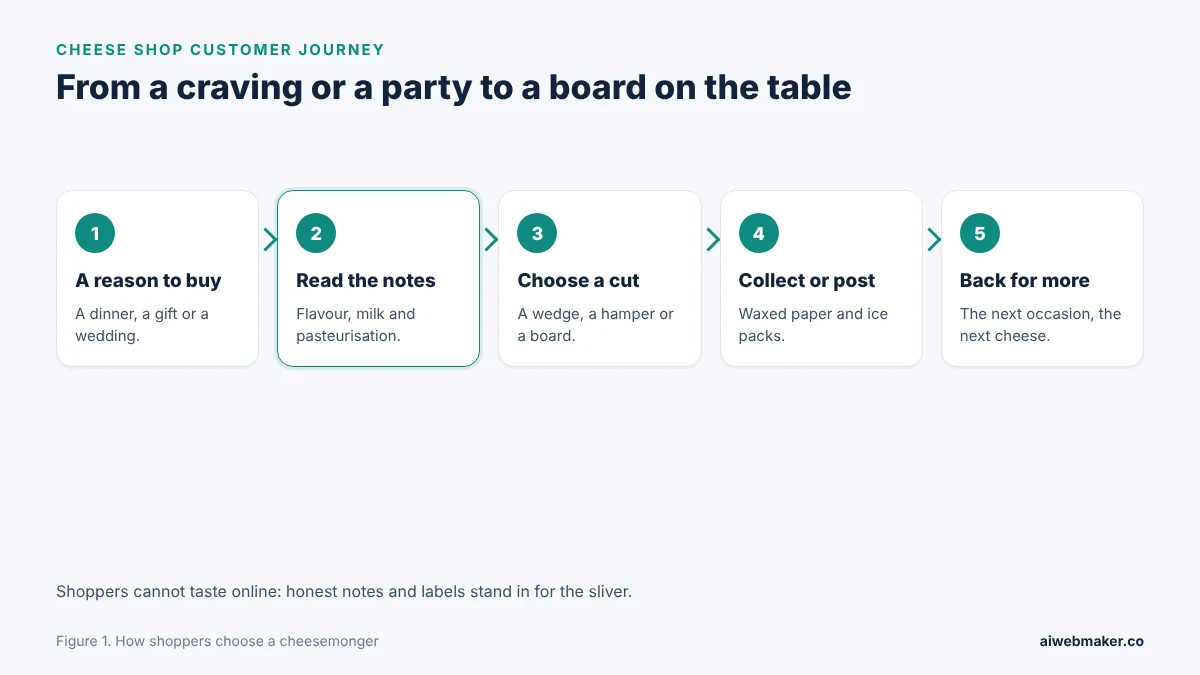
Five stages lead a shopper from a craving or an upcoming party to cheese on a plate and a return visit. A reason to buy comes first, whether a dinner, a gift or a wedding. The highlighted stage is reading the tasting notes and labels, because shoppers who cannot taste first rely on words about flavour, milk and pasteurisation. Choosing a cut or a board follows, then a decision between collection, delivery or a venue drop. The cheese itself decides whether the shopper comes back for the next occasion. A site that writes well about flavour helps every stage, since good words stand in for the sliver offered at the counter.
Counter, cool room and boards: the sections a cheesemonger's site carries
A cheesemonger's site needs sections that mirror the counter, the cool room and the party orders, each with one clear job. The opening view should say how cheese is cut and wrapped, with the smallest cut stated. A shop of current cheeses with cuts to choose comes next, followed by tasting notes in a table. A raw milk section, an events section for boards and towers, and a practical section on storage and delivery complete the set. Questions about rennet, allergens and pregnancy deserve plain answers near the end.
| Section | The shopper's question | What it should answer |
|---|---|---|
| Opening view | How does buying here work? | Cut to order, smallest cut, wrapping |
| Shop | What is on the counter now? | Each cheese, milk, cut sizes, price per cut |
| Tasting notes | What will it taste like? | Flavour, texture and pairings |
| Raw milk labels | Was it pasteurised? | A clear label on every cheese, with careful advice |
| Boards and towers | Can you feed my party? | Guest numbers, contents, notice needed |
| Delivery and storage | Will it survive the trip? | Wrapping, ice packs, fridge advice |
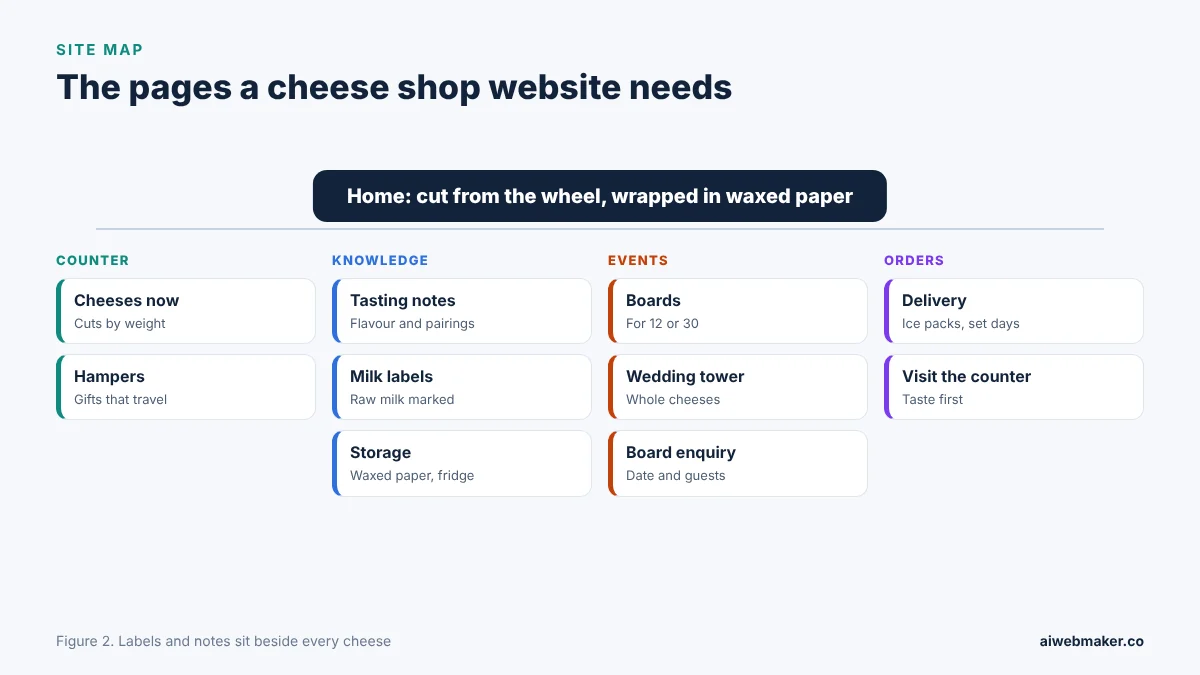
Grouped as a shopper moves through it, the cheese site falls into the counter, the knowledge, the events and the orders. Counter pages hold the cheeses, the cuts and the hampers, and knowledge pages carry tasting notes, milk labels and storage advice. Our sample counter, The Rind Cheesemongers, opens with the promise that every cheese is cut from the wheel and wrapped in waxed paper, then lists a clothbound hard cheese, a soft white rind, a washed rind, a blue veined cheese, an ash coated goat's cheese, an aged sheep's milk cheese, a cheese hamper and a wedding cheese tower. A tasting notes table, a section labelling unpasteurised cheese, and boards for 12 and for 30 follow, ahead of a cool room gallery, reviews and an enquiry route for boards. The cheese shop website example with raw milk labels and event boards shows how a counter built on tasting can still read well on a phone.
Cut to order, priced by weight and labelled by milk
Cheese is sold by weight, so every price on the site should name the cut it belongs to and the smallest amount the counter will cut. A price for 200 g of a hard cheese means nothing without that weight beside it, and a whole soft cheese is better priced as a unit. Each card should say which milk was used, whether it was pasteurised and how long the cheese was aged. Allergen information follows naturally, since every cheese contains milk and hampers often add gluten from crackers and nuts from pairings. Rules on how allergens must be shown on loose foods vary between countries, so the shop should confirm what applies locally. Clear labels on every card answer half the questions the counter usually fields.
| Cheese family | What to tell the buyer | Helpful extra |
|---|---|---|
| Fresh and goat's cheeses | Milk, age in days or weeks, texture | Best eaten soon |
| Soft bloomy rind | Pasteurised or not, ripeness | Whole cheese or a cut |
| Washed rind | Strength of aroma, rind treatment | A note for the cautious |
| Blue veined | Strength, creaminess, milk | Pairings with fruit and honey |
| Clothbound and hard | Age in months, texture | Keeps longest once cut |
| Sheep's milk | Age, nuttiness, firmness | Often chosen by those avoiding cow's milk |
Raw milk, rennet and pregnancy questions handled with care
Raw milk cheeses are a source of pride for many cheesemongers, and they deserve labelling that is plain rather than buried. Unpasteurised cheese is made from milk that has not been heated to kill bacteria first, and every label should say so in the shop, on the website and on the wrapping. Rules on selling raw milk cheese differ widely; in the United States, for example, it generally has to be aged for at least sixty days before sale, while other countries take other approaches. Guidance on soft, blue and raw milk cheeses during pregnancy, or for people with weakened immunity, also differs between countries and between individuals. A careful shop does not advise on medical questions and instead points shoppers to a midwife, doctor or other health professional, while offering pasteurised options. Handling these questions calmly protects customers and keeps the counter's reputation intact.
Rennet is the other question that comes up often, because some cheeses are made with animal rennet and others with microbial or vegetable alternatives. Vegetarians want a clear label rather than a guess, and the website can mark each cheese accordingly. A filter or a short list of vegetarian cheeses saves repeated questions at the counter. Shared boards and wires mean traces of one cheese can reach another, which matters to people avoiding particular milks. Honest notes like these show the shop knows its cheese beyond the flavour.
Tasting notes, ageing rooms and the cheese of the month
Tasting notes are the closest a website gets to offering a sliver, so they deserve the same care as the cheeses themselves. Good notes name the milk, the texture and two or three flavours in everyday words, such as brown butter, mushroom or a sharp blue bite. Pairings help shoppers picture a plate, whether crisp apples, rye bread, honey or a dark ale. A photo of wheels being turned in a cool room shows that cheese in this shop is cared for between the farm and the counter. A monthly feature on one cheese and the farm that makes it gives regulars a reason to read and a reason to visit. Shoppers who learn a little each month become the customers who trust the counter's recommendations.
Posting cut cheese with ice packs, and the store builder that sells it
Sending cheese by post is where online sales succeed or fail, because a soft cheese left in a warm sorting office reaches its buyer in poor shape. Cut cheese should travel wrapped in waxed or cheese paper, inside an insulated box with ice packs, on delivery days that avoid sitting over a weekend. The website should explain the packing, the days orders are sent and what happens in hot weather. Through the online store builder for cheesemongers selling cuts and hampers, each cheese can offer its cuts as product options, chosen wedges sit together in a bag, and checkout prices delivery to the address given before payment. Discount codes suit a cheese of the month or a loyal customer, and a wedding tower, priced only after a conversation, can wear an Enquire button where a figure would sit. International orders need extra care, since rules on sending cheese, raw milk cheese above all, vary by destination.
Boards for twelve, boards for thirty and wedding towers
Event boards are often the most valuable orders a cheese shop takes, and they sell best when every board states its guests, contents and notice period. Hosts want to know how many people a board serves, which cheeses and extras it includes and how far ahead to order. Boards built on the morning of the event taste better, and saying so explains the notice needed. A wedding tower of whole cheeses stacked like a cake needs a longer lead time, a tasting conversation and agreement on fruit or flowers that are safe near food. A good enquiry route collects the event date, guest numbers, the way the order reaches the venue and any allergies or cheeses to leave out. Payment for these orders is settled directly between the shop and the host.
| Order | Serves | Contents | Notice |
|---|---|---|---|
| Board for 12 | 12 as a late supper | Four cheeses, crackers, chutney, fruit | Two days |
| Board for 30 | 30 at a party | Six cheeses, breads, chutneys, honeycomb | Three days |
| Wedding cheese tower | 60 to 120 guests | Three to five whole cheeses, dressed | At least a month |
| Cheese hamper | A gift | Three cheeses, crackers, chutney, walnuts | Packed the same day |
Phrases like cheesemonger near me, cheese hamper and wedding tower
Cheese buyers search by counter, gift or occasion: cheesemonger near me, cheese hamper delivery, cheese board for a party, wedding cheese tower or a named style. Product cards and section headings that use those words give search engines something solid to match. On the map listing, current hours, a bright photo of the counter and a correct street address matter most. Reviews that mention tasting before buying, careful labels or a board that arrived on time persuade first time shoppers. Articles on storing cheese, building a board or the farm behind a cheese of the month draw in curious readers well before Christmas. Writing that shares the cheesemonger's knowledge makes the shop the place locals mention first.
A cheesemonger's yearly hosting sums
Only hosting and a domain recur on a cheese counter's website bill, and a dozen tasting articles bought with AI credits cost less than a single wedge. Paying once a year at $119 suits an established counter. A new shop can spread the bill at $19 a month while it builds a following. Changing cheeses, prices or board menus costs nothing. The table splits the two routes into columns and lists the $189 plan purely as a yardstick.
| Item | Yearly | Monthly |
|---|---|---|
| Hosting the cheese shop pages | $119 | $228 over twelve months |
| Domain | Depends on the ending | Depends on the ending |
| Higher plan, for comparison | $189 a year | Not needed |
| Twelve tasting and storage articles at about $0.65 | About $7.80 | About $7.80 |
| Cheese, price and board updates | No charge | No charge |
| Year before the domain | About $126.80 | About $235.80 |
What sends a cheese lover to the supermarket counter instead
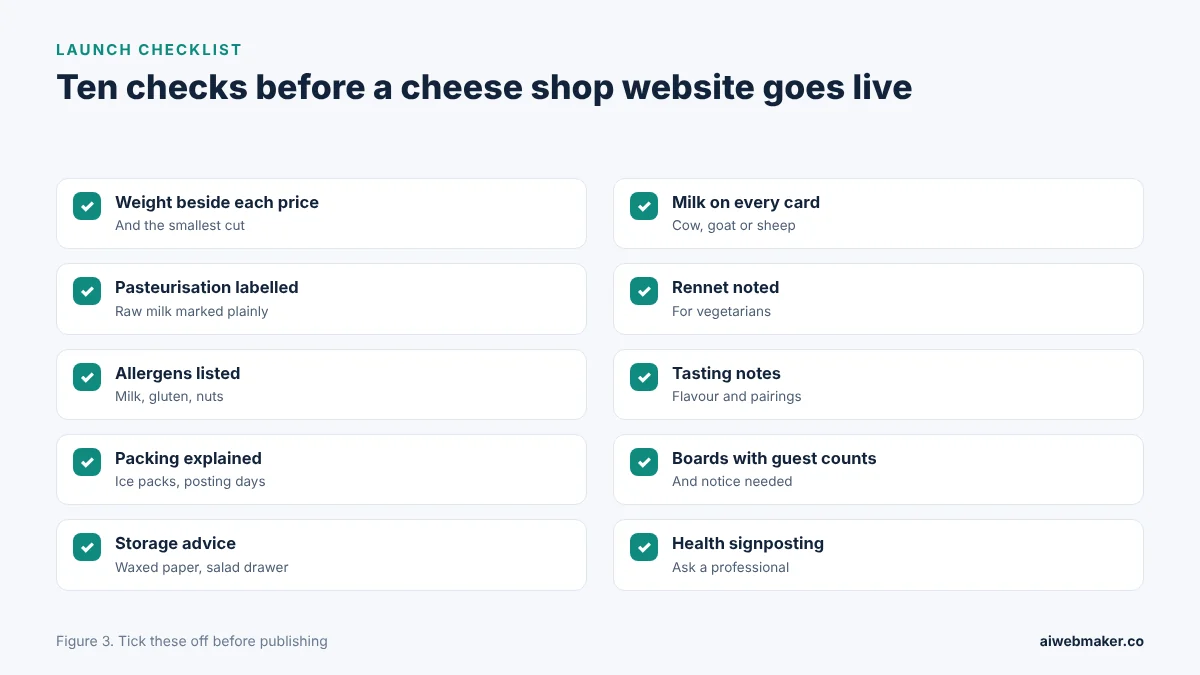
Cheese lovers give up on a specialist site when prices appear without the weight they buy. Missing pasteurisation labels drive away anyone who needs to be careful, and they are often the most loyal customers. Bare names with no tasting notes leave shoppers unable to choose between six unfamiliar cheeses. No word on how cheese is packed for posting makes gift buyers fear a sweating parcel. Boards without guest numbers or notice periods push party hosts to call someone else. The picture after this paragraph sets out ten checks that close those gaps for good.
Frequently asked questions
How should a cut wedge be kept once it is home?
A cut wedge keeps best wrapped in waxed or cheese paper in the salad drawer of the fridge, where it can breathe without drying out. Cling film traps moisture and can make the surface sweat. Taking cheese out about an hour before eating lets its flavour open up. Hard cheeses keep for a couple of weeks once cut, while soft ones are best eaten within a few days. A short storage note on every order helps the cheese taste as the shop intended.
Can soft and blue cheeses travel by post in summer?
Soft and blue cheeses can travel in summer if they are packed in an insulated box with ice packs and sent on a day that avoids weekend delays. Hot spells raise the risk, so some shops pause posting soft cheese during heatwaves. The website should explain the shop's own policy and the days orders leave. Buyers should be told to unpack and refrigerate the cheese on arrival. Clear rules prevent disappointing parcels and awkward refunds.
Do vegetarians need to check the rennet?
Vegetarians often check the rennet, because traditional rennet comes from animals while many cheeses now use microbial or vegetable alternatives. Some famous traditional cheeses must use animal rennet under the rules that protect their names. A clear label on every cheese saves shoppers from asking each time. The counter should also know which cheeses are suitable and say so confidently. Honest labelling turns a nervous question into an easy purchase.
Why does a cheesemonger offer a taste before cutting?
Tasting before cutting lets shoppers choose with confidence, because cheese varies between batches and with age. A sliver of two or three options often leads to a better match than any description. The website can invite visitors to taste at the counter and explain that it is part of the service. Online buyers rely on tasting notes instead, so those notes should be written with the same care. Shops that taste with customers build the deepest loyalty.
Wedges and hampers that pay for the year
A single party board usually outearns the $119 that hosts a cheese shop's pages for a whole year. On the $19 monthly route, a couple of wedges sold on a quiet Tuesday settle each bill. Every hamper posted to a distant parent and every wedding tower booked is trade the site helped to win. Honest labels, warm tasting notes and careful packing persuade shoppers more than any photograph of a laden board. Counters that keep their cheeses and prices current turn curious browsers into weekly regulars. Enquiries that already name a cheese from the tasting notes prove the words are doing the work of the sliver.
Build your website in Minutes and get the AI Tools that work
Start Building Your Website →