Charcuterie Website Cost and Boards Sized to the Guest List
Charcuterie makers pay AI Web Maker $119 to host a year of boards online, or $19 monthly, plus the domain. Topics: the people ordering, the pages, sizes and occasions, the chilled journey, labels, grazing tables, kitchen rules, search and the annual sums.
- No coding required
- Live in minutes
- Blog, SEO and chatbot tools included
Charcuterie makers pay AI Web Maker $119 to host a full year of their board shop, or $19 monthly if they would sooner spread it, and the domain is chosen separately. Writing the board descriptions, photographing each spread and trying the checkout in the preview are not billed at all. If you want a finished reference first, the charcuterie business website design in AI Web Maker's samples belongs to an imaginary board maker and sizes every board by guest count. A single grazing table for a wedding or an office party typically outweighs the yearly hosting several times. The real test is that the product is beautiful, perishable and tied to a date, so a board that is too small, too late or too warm spoils the occasion. Customers also need confidence that every guest can eat something, from the vegetarian to the friend who avoids nuts. Covered below are customers, pages, sizes by guest count, the chilled journey, labels, grazing tables, kitchen rules, search and what a year of hosting adds up to.
This article is part of our complete guide: Food Business Website Builder.
Who orders a board, and for what kind of gathering?
Board customers are almost always planning for other people, which makes them careful about size, timing and dietary needs. Hosts of dinner parties want a board that arrives ready to set down with drinks. Couples planning a picnic or a date night look for something small, pretty and easy to carry. Office managers order platters for meetings and need a delivery time they can rely on. Wedding couples and event planners compare grazing tables for a hundred guests or more. Gift buyers want a box that travels well and looks generous when opened.
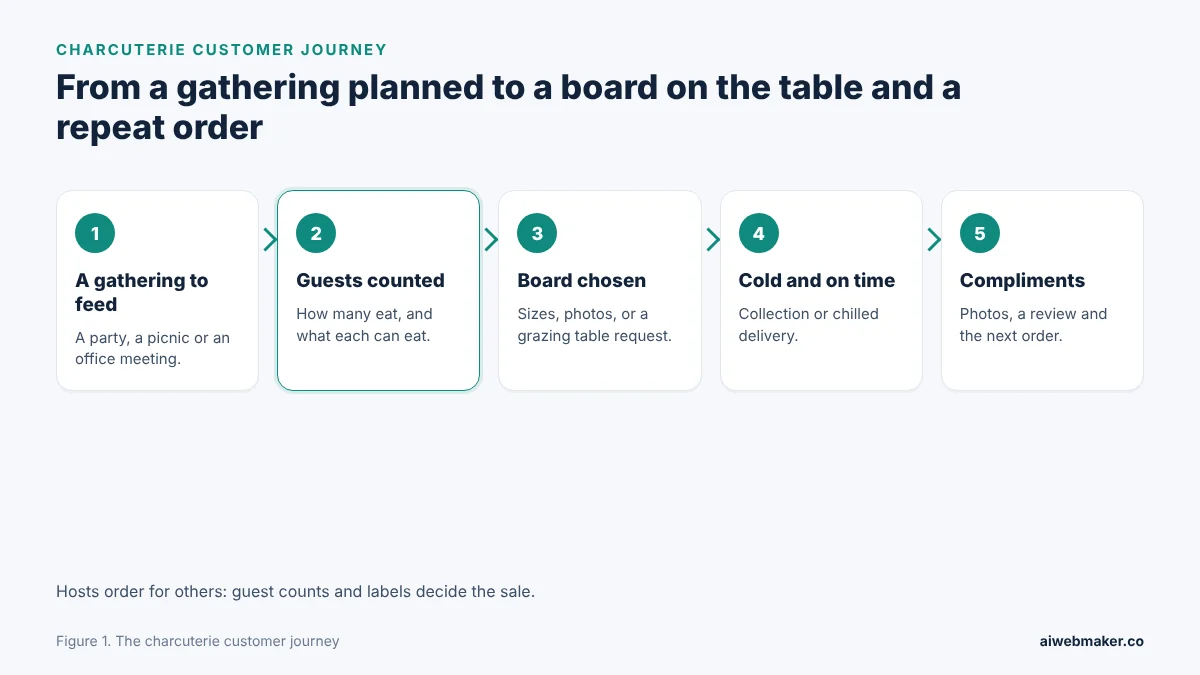
Each order travels through five stages, starting with a gathering that someone has agreed to feed. The host then works out how many guests will eat and what they can eat, which is the stage where most orders are won or lost. Choosing the board or requesting a grazing table follows, guided by sizes and photos. Collection or delivery has to keep the food cold and arrive on time. A board that looks as good on the table as it did online earns photos, compliments and the next order.
Which pages does a board and grazing business need?
A charcuterie website needs pages that move a host from guest count to a confident order with as few questions as possible. The home page shows a signature board, the main occasions and buttons for the shop and for events. The shop lists boards and boxes with sizes, prices and what each contains. A sizes and dietary page helps hosts choose and flags what suits each guest. An ordering guide explains timing, collection and delivery, while an events page covers grazing tables and larger spreads.
| Page | What the host needs | What to include |
|---|---|---|
| Home | A sense of quality and occasion | Signature board, occasions, Shop and Events buttons |
| Shop | A board for a date | Sizes, contents, prices, collection or delivery |
| Sizes and dietary needs | The right amount for every guest | Guest counts, vegetarian options, allergen labels |
| Ordering guide | Confidence in timing | Order cut off, collection windows, delivery area |
| Events and grazing | A spread for a crowd | Setup, guest numbers, venue needs, enquiry route |
| About | Who makes the boards | Sourcing, preparation, kitchen practice |
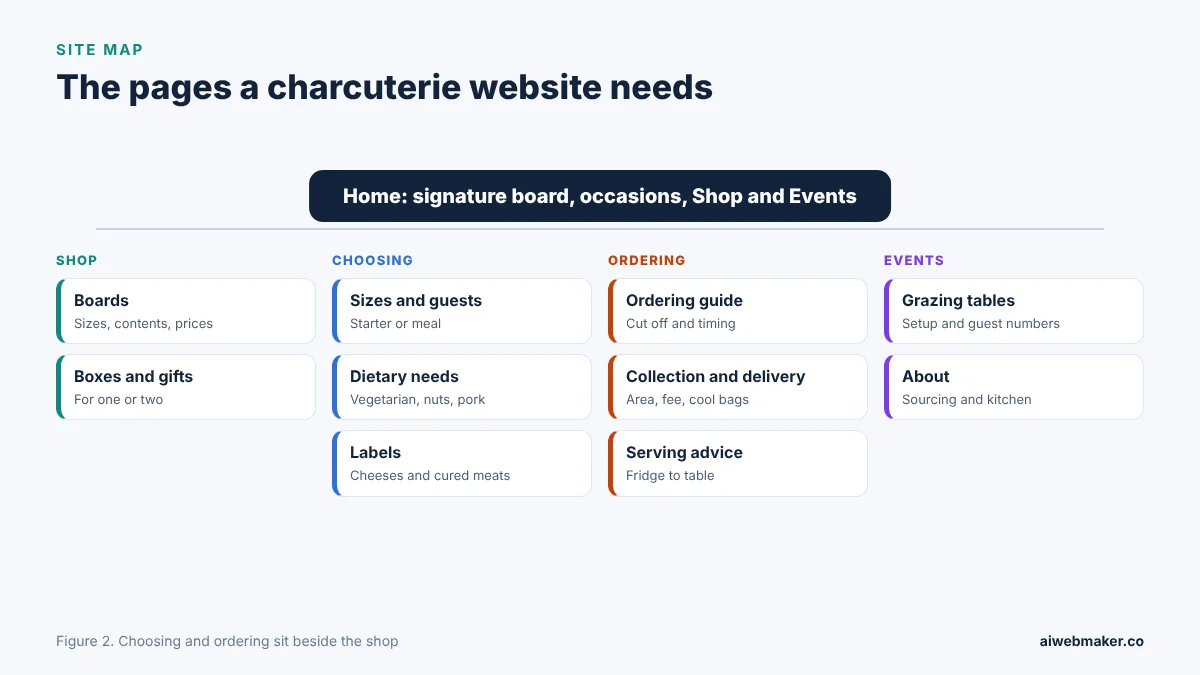
Four branches sit beneath the home page of a board business, each easing a different worry. The shop branch holds the boards, boxes and gift options. Choosing pages cover sizes, guest counts and dietary needs, so hosts order the right amount for the right people. Ordering pages explain the path from request to finished board, with collection, delivery and timing. Our sample business, Graze and Gather Boards, sells five boards online and explains sizes and dietary needs with help finding the right board for an occasion, while its ordering guide covers what to have ready, collection and delivery, and custom and event orders. The charcuterie website example with boards to order by size took AI Web Maker 44 seconds to build, shop and four companion pages included.
Selling boards by size, guest count and occasion
Hosts think in guests, not grams, so every board should say roughly how many people it serves and whether it is a starter or a meal. A board served with drinks before dinner can stretch further than one that replaces lunch. Photos should show the board from above and at an angle, with a hand or a glass for scale. On the online store builder for charcuterie boards and grazing boxes, hosts pick a size, drop each board into a bag and find the delivery charge totalled at checkout. A discount code suits a launch or a returning corporate client, and grazing tables without a set price can carry an Enquire button. Clear sizing protects the reputation, because a board that runs out halfway through a party is remembered longer than its flavour.
| Format | Typical use | What to state |
|---|---|---|
| Box for one or two | Picnics, gifts, date nights | Contents, how long it keeps chilled |
| Small board | Drinks before dinner | Guests served as a starter |
| Large board | Parties at home | Guests served as a starter or a light meal |
| Platter set | Office meetings | Delivery window, plates and napkins included |
| Grazing table | Weddings, launches, large events | Price per guest on request, setup time |
| Dietary board | Mixed groups | What is left out and how it is kept apart |
The chilled journey from kitchen to table
Cured meats, soft cheeses and dips are chilled foods, so the journey from the kitchen to the table matters as much as the arrangement. The ordering guide should state the order cut off, the collection window and the delivery area with its fee. Boards should travel in cool bags or chilled vehicles, and the guide should tell hosts to refrigerate them on arrival if the party is hours away. Food safety guidance in many countries limits how long chilled food should sit at room temperature, and the limit shortens in hot weather. A clear note on when to take the board out of the fridge and when to clear it away protects guests and the business. Rules differ between countries, so the advice should follow the food authority where the business operates.
| Logistics detail | What the ordering guide should state |
|---|---|
| Order cut off | The latest time for next day boards |
| Collection window | Hours and the address for pickup |
| Delivery area and fee | Towns covered and the charge shown at checkout |
| Packaging | Cool bags, wraps and what can be recycled |
| Before serving | When to take the board out of the fridge |
| Time on the table | How long it should sit out, shorter in heat |
Labels for cheeses, cured meats and accompaniments
Labelling every component builds trust with hosts who must answer their guests' questions. Cheeses can be marked as soft or hard, pasteurised or not, and made with animal or vegetarian rennet, because many traditional cheeses use animal rennet. Cured meats should name the animal, since some guests avoid pork or beef for faith or personal reasons. Crackers often contain gluten, and nuts, mustard, sesame and sulphites hide in accompaniments and dried fruit. Health services in many countries advise pregnant guests to take care with certain soft cheeses and uncooked cured meats, so clear labels let them follow their own medical advice. Allergen labelling law varies by country, so the business should follow its local rules and invite questions before ordering.
Grazing tables and event orders
Grazing tables are where a board business finds its largest orders, and they need a page that answers an organiser's practical questions. The organiser wants to know how much table length is needed, how long setup takes and whether the maker stays to refresh the spread. Venue access matters, from stairs and lifts to the time the room opens. Equipment such as stands, boards and linens may be collected after the event, and the page should say when. Any deposit to hold the date is arranged between the maker and the organiser, along with the cancellation terms. Photos of past tables with the guest count in the caption help organisers picture their own.
Kitchen registration and the rules behind a board business
Many board businesses begin at home, but the rules for selling chilled food are stricter than for cakes or biscuits. In many places, home kitchen exemptions exclude meat and cheese, so a registered or inspected kitchen is often required. Food business registration, hygiene training and inspections vary between countries and regions, and some councils or states publish hygiene ratings. Insurance for events and product liability is worth explaining to corporate clients who ask. A short note on the about page stating that the kitchen is registered where required reassures careful buyers. Getting the legal footing right first protects the business as it grows.
What hosts search before they order a board
Hosts looking for a board type phrases such as charcuterie board delivery, grazing table for a wedding, cheese board near me or picnic box in a named town. Corporate buyers search for office platters or meeting catering, often during working hours. Headings on the shop and events pages that use the same words help each page meet its audience. A map listing with collection hours, photos of finished boards and the website address helps people who order on the day. Reviews that mention generous boards, punctual delivery and happy guests carry real weight. Articles on building a cheese board at home, wine pairings for cured meats or planning food for a garden party bring readers who later order for a bigger event.
A board maker's website budget for the year
A board business needs only two recurring items online, its hosting and its domain, and any drafted article adds roughly $0.65. A maker with steady orders keeps costs lowest by paying $119 for the year. A maker still testing demand can choose $19 monthly instead, or $228 once the year is out. New boards, price changes and fresh photos are never billed. Both routes are broken down below, and the $189 tier appears for comparison alone.
| Item | Yearly | Monthly |
|---|---|---|
| Hosting the charcuterie pages | $119 | $228 over twelve months |
| Domain | Depends on the ending | Depends on the ending |
| Higher plan, for comparison | $189 a year | Not needed |
| Twelve hosting and pairing articles at about $0.65 | About $7.80 | About $7.80 |
| New boards, prices and photos | No charge | No charge |
| Year before the domain | About $126.80 | About $235.80 |
Why hosts abandon a board shop halfway
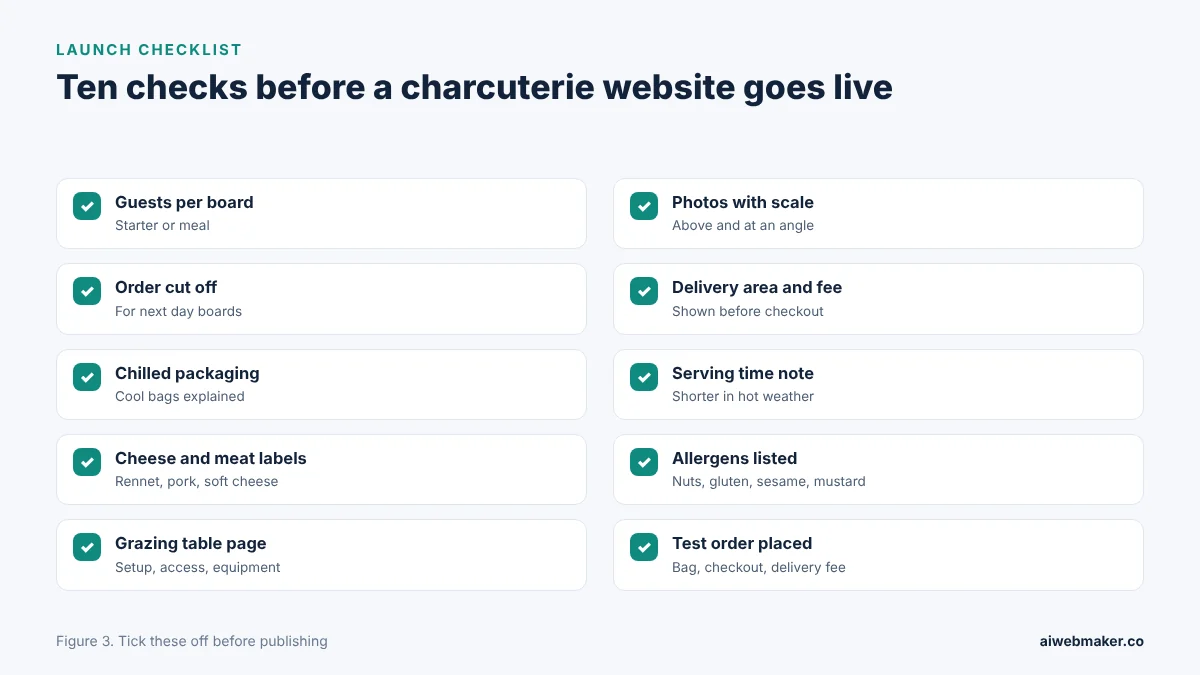
Hosts abandon a board shop when no board says how many guests it feeds. A missing order cut off leaves them unsure whether tomorrow's party is still possible. Silence on delivery areas or fees makes the checkout feel risky. Boards without labels for nuts, pork or soft cheese lose hosts with mixed guest lists. Photos taken in poor light make expensive food look ordinary. Each of these problems has a fix among the ten points pictured here.
Frequently asked questions
How long can a board sit out at a party?
A board should sit out only for a limited time, because cured meats, soft cheeses and dips are chilled foods. Food safety guidance in many countries sets a limit of a few hours at room temperature, and less in hot weather. The safest approach is to keep part of the spread in the fridge and refresh the board during the party. Leftovers that have been out for a long time are best thrown away. A short note with every order helps hosts serve the board safely.
Can a board be made for guests who avoid meat or dairy?
Most board makers can prepare vegetarian boards and many can make boards without dairy or nuts. The page should explain how these boards are prepared and whether cross contact with other ingredients is possible. Vegetarian guests may also need cheeses made with vegetarian rennet, which should be labelled. Hosts with several dietary needs may prefer a mix of boards rather than one compromise. Honest labels let every guest eat with confidence.
How far ahead should a grazing table be ordered?
A grazing table should be requested weeks ahead for weddings and busy seasons, and as early as possible for large events. Standard boards usually need a day or two, while large spreads need time to source cheeses and meats. Holiday periods fill quickly, and the page should say when to order for them. Short notice requests can sometimes be met with a simpler spread. Clear lead times protect both the quality and the host's plans.
What happens to the boards and stands after an event?
Equipment used for grazing tables, such as wooden boards, stands and linens, is often collected after the event. The events page should state when collection happens and whether the organiser needs to be present. Disposable or compostable platters avoid collection altogether and suit drop off orders. Any charge for lost or damaged equipment should be agreed in writing beforehand. Clear arrangements prevent awkward calls the next day.
Will a single grazing table pay for the year online?
A single grazing table for a modest party normally outearns a charcuterie site's $119 year of hosting. Makers on monthly billing can recover the $19 from one small board. Each box, platter and event that follows is income on top of hosting already covered. Clear sizes, honest labels and a careful chilled journey persuade hosts more than any styled photo. Board makers who caption each spread with its guest count help hosts order with confidence. A weekend diary of boards going out to parties is the clearest proof the shop is doing its job.
Build your website in Minutes and get the AI Tools that work
Start Building Your Website →