Axe Throwing Venue Website Cost: Lanes, House Rules and Leagues
Hosting an axe throwing venue's site comes to $119 for the year or $19 in any month, with a domain on top. Covered here: how organisers choose, sessions, coaching, house rules, parties and leagues, lane requests, search and the yearly sums.
- No coding required
- Live in minutes
- Blog, SEO and chatbot tools included
Whatever the number of cages, an axe throwing venue settles its hosting with a $119 yearly bill or a $19 monthly one, plus a domain. No invoice arrives while the session cards, house rules and lane request are drafted and rehearsed in the preview. A dozen colleagues on one group session clear that bill with plenty to spare. Persuading a nervous group, most of whom have never lifted an axe, that the evening is safe, coached and properly run is far tougher. Organisers also need the age rule, the drinks rule and the price per thrower before they can forward the link to anyone. Below come the organiser's path, the pages worth building, sessions, coaching, house rules, parties and leagues, lane requests, search, the yearly arithmetic and the omissions that cost bookings.
This article is part of our complete guide: Food Business Website Builder.
Who books a lane, and what do group organisers weigh first?
Most axe throwing bookings come from one organiser acting for a group, so the website has to satisfy that person and then everyone they forward it to. A colleague planning a team social weighs the price per head, the length of the session and whether there is food afterwards. Someone arranging a birthday wants a private lane, a format with a winner and a table for the group once the throwing ends. Couples booking a first visit care most about whether beginners will manage. Regular throwers look for league nights, scoring and a ranking table that gives them a reason to return every week. Answering the safety, age and drinks questions on the first screen is what turns a browsing organiser into a lane request.
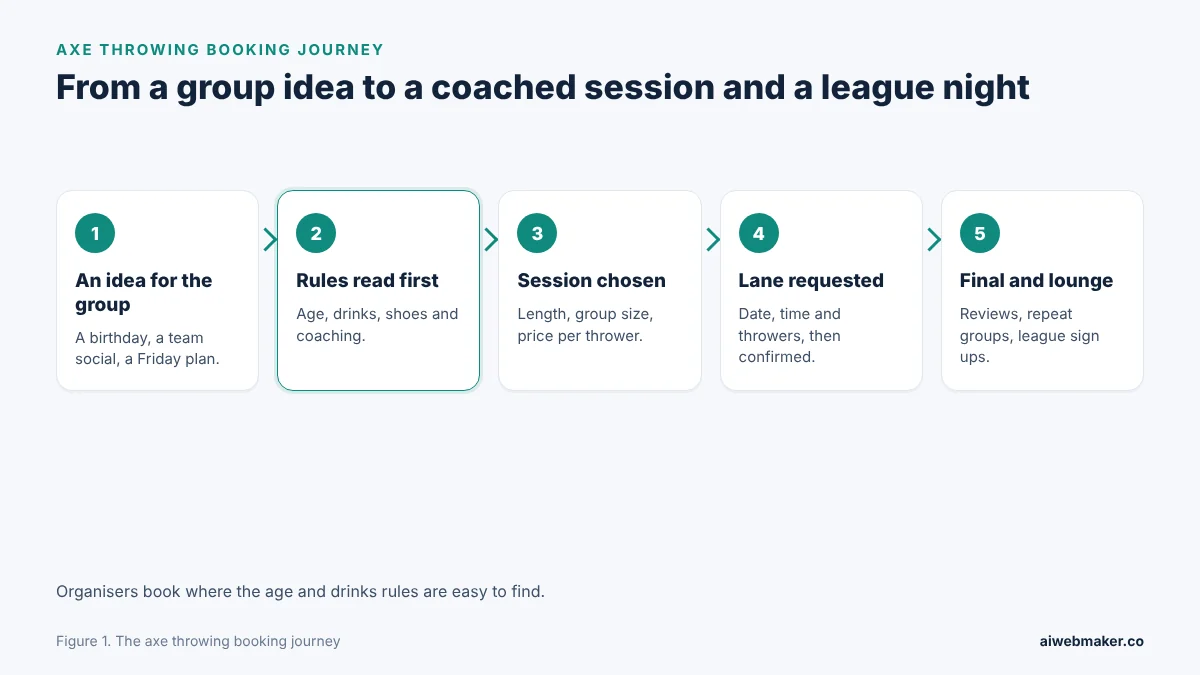
Five stages run from the moment someone suggests axe throwing to the moment a first timer signs up for the league. The highlighted stage is reading the rules, because organisers who cannot find the age limit or the drinks policy rarely risk booking for a whole group. Choosing a session follows, usually by comparing price, length and group size side by side. The lane request then fixes the date, the start time and the number of throwers, and the venue confirms it. After the final, a good coach and a table in the lounge turn a one off evening into reviews, repeat groups and new league players. Every page of an axe venue's site ought to nudge the organiser one step nearer the lane.
Session, safety and rules pages an axe throwing site should carry
An axe throwing venue needs fewer pages than most hospitality businesses, but each one carries a decision that a group cannot make without it. The sessions page sets out formats, lengths, group sizes and the price per thrower, with coaching and axes clearly included. A safety page explains the briefing, the coach at the lane and how axes are retrieved. The house rules page states the age limit, the alcohol policy, footwear and any health cautions in plain sentences. Parties and leagues deserve their own space because different people book them for different reasons. A lane request page and a visit page with directions and opening hours complete the set.
| Page | Question it settles | What belongs on it |
|---|---|---|
| Sessions | Which format suits the group | Length, group size, price per thrower, what is included |
| Coaching and safety | Whether beginners will be safe | Briefing, a coach at every lane, the retrieval routine |
| House rules | Who can throw, and when drinks are served | Age limit, alcohol policy, shoes, health cautions |
| Parties and socials | Whether a celebration fits | Private lanes, brackets, lounge tables |
| League | What regulars commit to | Weeks, night, scoring, entry rule |
| Lane request | How to secure a date | Session, date, start time, throwers, ages |
| Visit | How to get there | Address, hours, transport, parking |
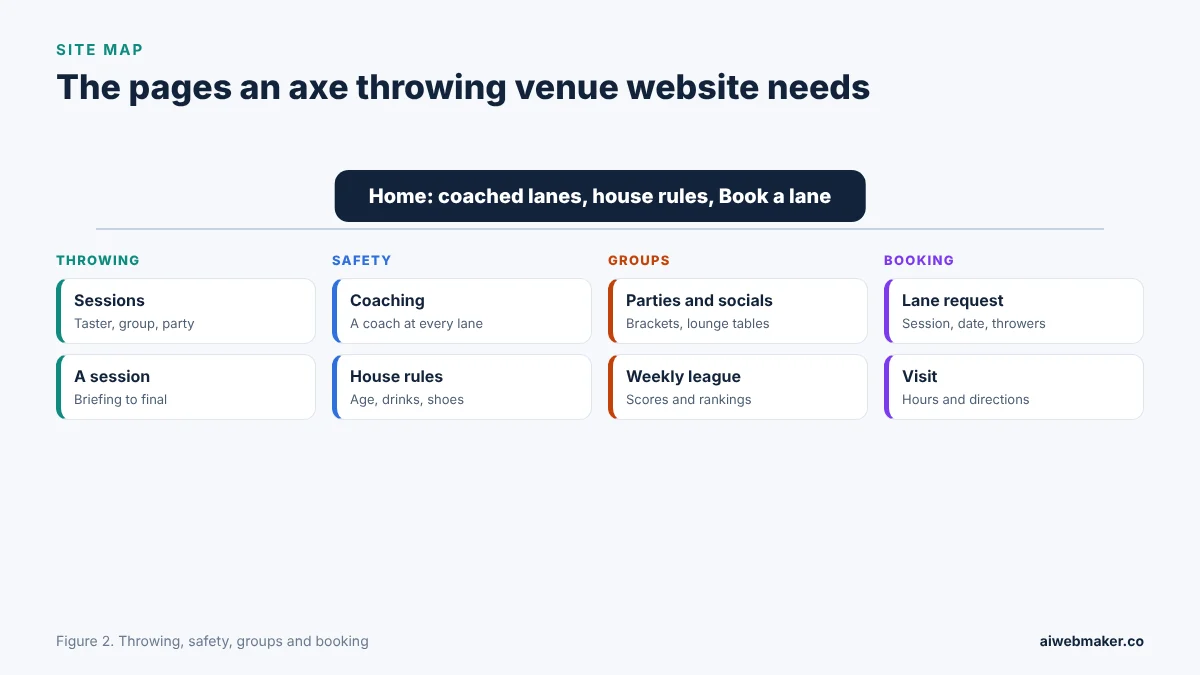
Four branches leave the home page in this plan: throwing, safety, groups and booking, arranged in the order an organiser's questions tend to arrive. Throwing holds the sessions and the outline of an evening, safety holds the briefing and the house rules, groups hold parties and the league, and booking holds the lane request and directions. Our sample venue, Timberline Axe Throwing, fits all of this onto a single page that opens with three sessions: a taster hour, a group session and a private party. Further down it offers birthday throws, team socials, a weekly league and the lounge, then a table of house rules covering age, alcohol, shoes, health and the line. The axe throwing venue website example with house rules and a lane request form finishes with a request that asks for the session, the date, the start time and the number of throwers. A real venue can borrow that sequence and swap in its own lanes, prices and rules.
Taster hours, group sessions and private parties, priced per thrower
Most axe throwing venues price by the thrower and by the length of the session, because each lane holds a fixed number of people taking turns. A taster of about an hour suits first visits and small groups, with time to learn a two handed and a one handed throw before a few scored rounds. Longer group sessions add games and a final, which keeps a larger party engaged after the novelty of the first bullseye fades. Private parties usually reserve whole lanes, a dedicated coach and a tournament bracket, often with a table held for afterwards. Some venues charge per lane per hour instead, which suits couples and regulars but makes group totals harder to estimate. Whichever model a venue chooses, the page should show what one thrower pays, what is included and how many people share a lane.
| Pricing model | Suits | Watch out for |
|---|---|---|
| Per thrower, per session | Groups splitting the cost | State the minimum group size |
| Per lane, per hour | Couples, friends, regulars | Show how many throwers a lane holds |
| Party package | Birthdays and team socials | List exactly what the package includes |
| League fee for a season | Returning throwers | Say how many weeks and which night |
The safety briefing, the coach and the cage
Safety is the first thing a hesitant thrower reads about, and vague reassurance does less than a plain account of how the lanes are run. A good page explains that every session opens with a briefing on grip, stance, throwing and retrieving, and that nobody throws until it is finished. It should say that only one person stands in a lane at a time, that others wait behind a marked line and that a coach decides when axes are collected. Cages or solid walls between lanes, and boards replaced as they wear, show care for equipment. Many venues also check and sharpen their axes between sessions, since a well kept edge sticks more reliably and bounces less. Writing these routines down lets an organiser forward the page to the most anxious person in the group with confidence.
House rules on age, alcohol and health, stated plainly
House rules work best as a short table near the booking route, because groups plan the whole evening around them. Minimum ages differ between venues, and laws on age and on serving alcohol at throwing venues vary by country and often by city, so each venue should present its rules as its own. Alcohol is the rule organisers ask about most, and venues that keep drinks away from the lanes should say so without apology. Footwear and clothing rules, such as closed toe shoes and no loose scarves, prevent arguments at the door. A note asking anyone who is pregnant or has a shoulder, back or heart condition to check with a doctor before booking is sensible and kind. Clear rules published in advance protect the coach, the venue and the group at once.
| Rule | Why throwers need it | How to word it |
|---|---|---|
| Minimum age | Families and teenagers ask first | The age, and who must accompany under 18s |
| Alcohol | Groups plan drinks around the session | When the bar serves, and the sober to throw rule |
| Footwear | Open shoes are a real hazard | Closed toe shoes only, with no exceptions |
| Clothing and jewellery | Loose items catch on the swing | No scarves or long dangling jewellery |
| Health | Shoulders, backs and pregnancy | Check with a doctor before booking |
| Waivers or declarations | Many venues ask throwers to sign one | What is signed, and that rules vary by country |
Birthday throws, team socials and a weekly league
Groups and leagues are where an axe throwing venue fills its quieter nights, so each format deserves its own description rather than a line in a price list. A birthday section can explain the private lane, the bracket and the small tradition of letting the birthday thrower go first in the final. Team socials appeal to office organisers when the page mentions the length, the coached games and the food or sharing boards afterwards. A weekly league needs the night, the number of weeks, how matches are scored and whether a ranking table is kept. Many venues ask new league players to complete a coached session first, and stating that entry rule saves awkward emails. Well described group formats turn one good evening into bookings that repeat every season.
How a lane request reaches the venue and gets confirmed
A lane request should take an organiser about a minute and leave no doubt about what happens next. The sample's request asks for the session, the date, a start time, the number of throwers and whether anyone aged 14 to 17 is coming. Through the booking website builder for axe throwing lanes and group sessions, an organiser submits those details and the lanes team decides. Staff can confirm the lane, move the group to another evening or turn the request down when every cage is taken. Deposits, if the venue takes them, are settled between the organiser and the venue, with nothing skimmed by AI Web Maker. That arrangement leaves both the diary and the money in the hands of the people running the lanes.
What groups type when searching for axe throwing
Groups planning a night out type phrases such as axe throwing near me, axe throwing party, team building ideas or minimum age for axe throwing. A page heading that matches each of those intents, written with the district the venue serves, gives a search engine a clear reason to show it. The venue's map listing should carry the same opening hours as the website, real photos of the lanes and a link to the sessions page. Reviews that mention a coach by name, the safety briefing or a birthday bracket persuade other organisers more than generic praise. An article on what to wear for axe throwing, or on how a league season is scored, answers what groups wonder about before they commit. Over a year, that steady writing makes the venue the name locals think of for a night out.
Hosting, domain and articles: an axe throwing venue's yearly sums
An axe throwing venue's running costs for the site are hosting and a domain, plus about 65 cents for each article drafted with credits. Paying yearly keeps the hosting at $119, while monthly billing at $19 adds up to $228 over twelve months. Domain prices depend on the ending chosen, and around 400 endings are available. A $189 tier sits in the table only so the two figures can be compared. Changing session prices, adding league dates or rewording the house rules carries no extra fee.
| Item | Yearly | Monthly |
|---|---|---|
| Hosting the axe throwing pages | $119 | $228 over twelve months |
| Domain | Depends on the ending | Depends on the ending |
| Higher plan, for comparison | $189 a year | Not needed |
| Twelve throwing and league articles at about $0.65 | About $7.80 | About $7.80 |
| Session, rule and league updates | No charge | No charge |
| Year before the domain | About $126.80 | About $235.80 |
Gaps that send an organiser to another set of lanes
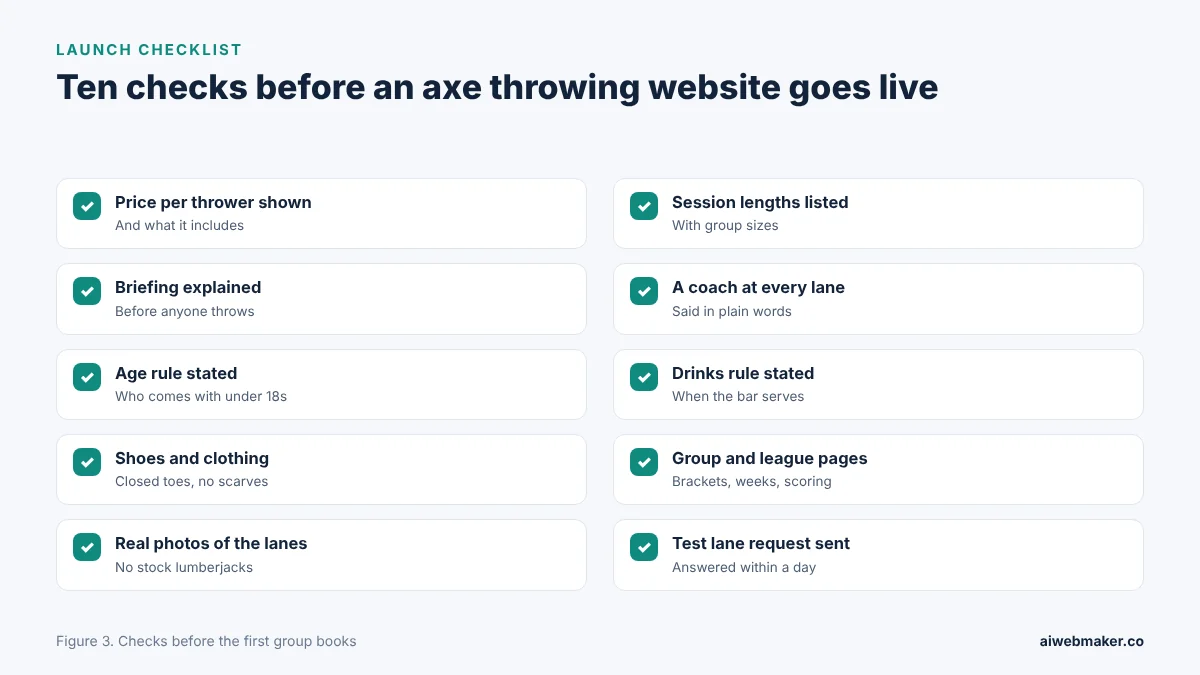
Organisers abandon an axe throwing website quickly when the age limit or the drinks rule is missing, because they cannot promise their group anything. Prices shown without a clear statement of what is included make the evening look dearer than it is. Stock photos of lumberjacks instead of the real lanes suggest the venue has little to show. A request page that says nothing about confirmation leaves people unsure whether they have booked at all. Silence about coaching makes first timers fear standing alone with an axe. Ten fixes for exactly these gaps are pictured next, one per tile.
Frequently asked questions
Where should the minimum throwing age appear?
The minimum age belongs beside the sessions and the request route, because parents and organisers of mixed groups ask about it before anything else. The page should give the age, say who must accompany younger throwers and mention any identification checked at the door. Age rules for axe throwing differ between countries and cities, so the wording should present the venue's own policy rather than a universal law. A clear age rule near the request route stops groups arriving with someone who cannot throw. That single line saves both disappointment and refunds.
Can a group drink beside the lanes?
Whether a group can drink depends on the venue's policy and on local licensing, which varies widely between countries and cities. Many venues keep alcohol away from the lanes entirely and serve drinks only once the throwing has finished. Others, where the law allows it, serve at the lane under strict limits. Whatever the rule, the website should state it plainly, along with what happens to a thrower who appears drunk. Organisers plan the evening around this answer, so it belongs close to the booking route.
How long should a first axe throwing session last?
A first session of about an hour suits most beginners, leaving time for a briefing, two basic throws and a few scored rounds. Larger groups often prefer ninety minutes, which allows games and a final without rushing anyone. Two hours suits private parties with a tournament bracket and many throwers taking turns. The website should list each length beside the group size it suits. Clear options help an organiser choose in one reading.
What should a league season page tell regular throwers?
A league page should tell regular throwers the night, the number of weeks, the fee for the season and how scores and rankings are kept. It should also state any entry rule, such as completing a coached session first. Photos of league nights and a short note on how the final is decided give the format character. Regulars return every week, so a league is often the most valuable booking a venue takes. A clear page makes joining feel like an easy next step after a first visit.
One team social, twelve months of lanes online
A handful of colleagues on one coached session typically out earns the $119 that keeps the lanes online for twelve months. At the sample venue's prices, one thrower on a taster hour more than covers a month on the $19 plan. Each birthday bracket, team social and league season beyond that point is trade the pages helped win. Clear rules, honest coaching notes and a quick lane request reassure nervous groups better than any slogan about adrenaline. Venues that keep session prices and league dates current find organisers coming back with new groups. A Friday with every cage booked out is the result those pages exist to deliver.
Build your website in Minutes and get the AI Tools that work
Start Building Your Website →