Tutoring Website Cost and the Questions Parents Ask Before Lesson One
Tutors settle a $119 hosting bill once a year, or split it into $19 monthly payments, and register a domain as well. What follows: parents' choices, subjects and levels, formats, safeguarding, lesson requests, progress reports, search and the yearly budget.
- No coding required
- Live in minutes
- Blog, SEO and chatbot tools included
Tutors who publish with AI Web Maker settle a hosting bill of $119 once a year, or split it into payments of $19 a month, and they also register a domain. Every subject and level page can be drafted, read over and corrected in the preview, which AI Web Maker does not bill. Planning them is easier after reading the tutoring website example, where an invented tutoring business set up with AI Web Maker lists its subjects by year level. A few weeks of lessons for one family typically cover the whole year. The real challenge is that parents are trusting a stranger with their child's learning, and often with time alone with their child. They need to see the right subject and level, proof of safeguarding, a clear way to start and evidence that progress will be visible. Covered next are how parents choose, subjects and curricula, lesson formats, safeguarding, lesson requests and terms, progress reports, search and the yearly budget.
This article is part of our complete guide: Fitness Website Builder.
What sends a parent looking for a tutor, and how do they compare options?
Parents usually start looking after a specific trigger, and the website has to recognise that trigger within seconds. A disappointing school report, a teacher's comment or a child in tears over homework sends many families searching. Exam years, entrance tests and a move to a new country with a different curriculum bring another wave. Some students search for themselves in their final school years, and adult learners look for language or maths support for work. Parents then compare tutors on subject and level, curriculum knowledge, qualifications, checks, format, timing after school and price per hour. Reviews from other parents often settle the choice between two tutors who look equally qualified.
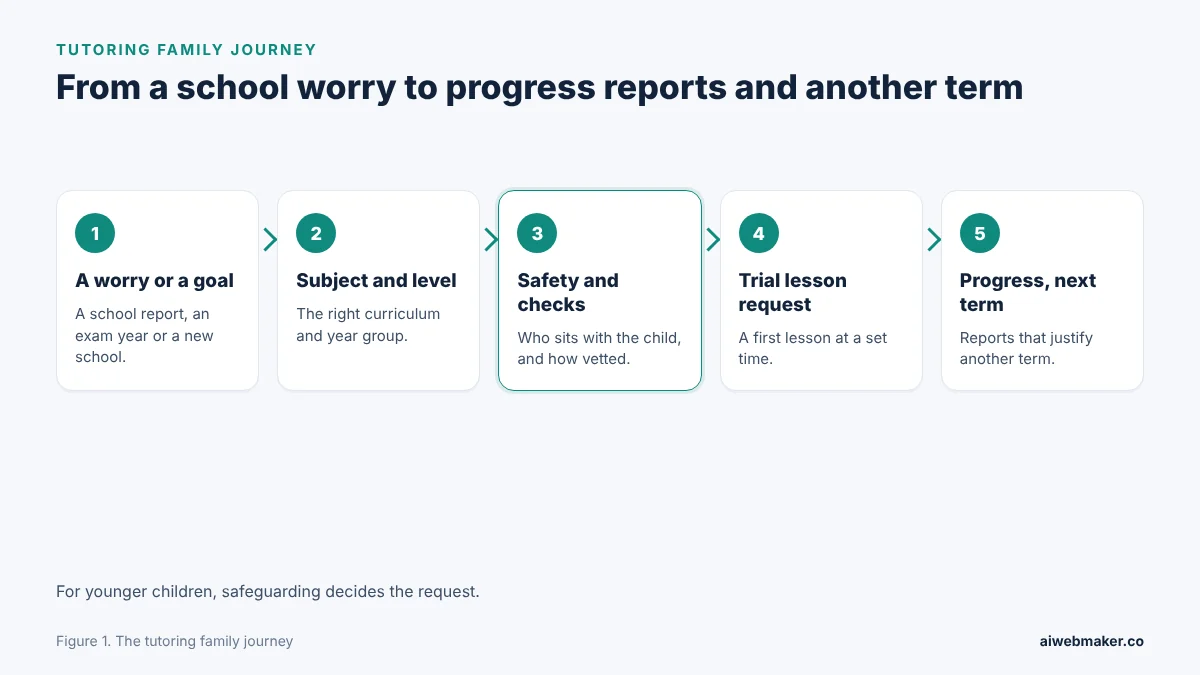
Parents move through five stages before a tutor becomes part of the family's week, and the third stage carries the most weight for younger children. A worry or a goal starts the search, and the subject and level match decides whether the tutor is even considered. Safety and tutor checks come next, because parents of primary age children want to know who will sit beside their child and how that person was vetted. A trial lesson request turns the shortlist into a single choice. Progress reports then decide whether the family books another term, which is where most of a tutor's income is really earned. Tutors who answer each stage openly win families who stay for years.
Subjects, tutors, safeguarding and terms: the pages a tutoring site needs
A tutoring site needs a page for every question a careful parent would ask on the phone, and the safeguarding page is the one most tutors forget. The subjects page names each subject with its levels and curricula. Tutor profiles show who teaches what, and the safeguarding page explains checks and lesson rules. A lessons and terms page sets out length, price, packages and cancellations. A progress page and a contact page with areas served complete the route.
| Page | What the parent asks | What to include |
|---|---|---|
| Home | Can they help with this problem? | Subjects, levels, formats, areas served, request button |
| Subjects | Is our subject and level covered? | Subjects, year levels, curricula and exams |
| Tutors | Who will teach our child? | Qualifications, subjects, experience, checks |
| Safeguarding | Is our child safe? | Background checks, lesson rules, contact policy |
| Lessons and terms | How do lessons and payments work? | Length, price, packages, cancellation, holidays |
| Progress | How will we know it helps? | Lesson notes, termly reports, parent meetings |
| Contact | Where and when are lessons held? | Areas, centre address, online option, hours |
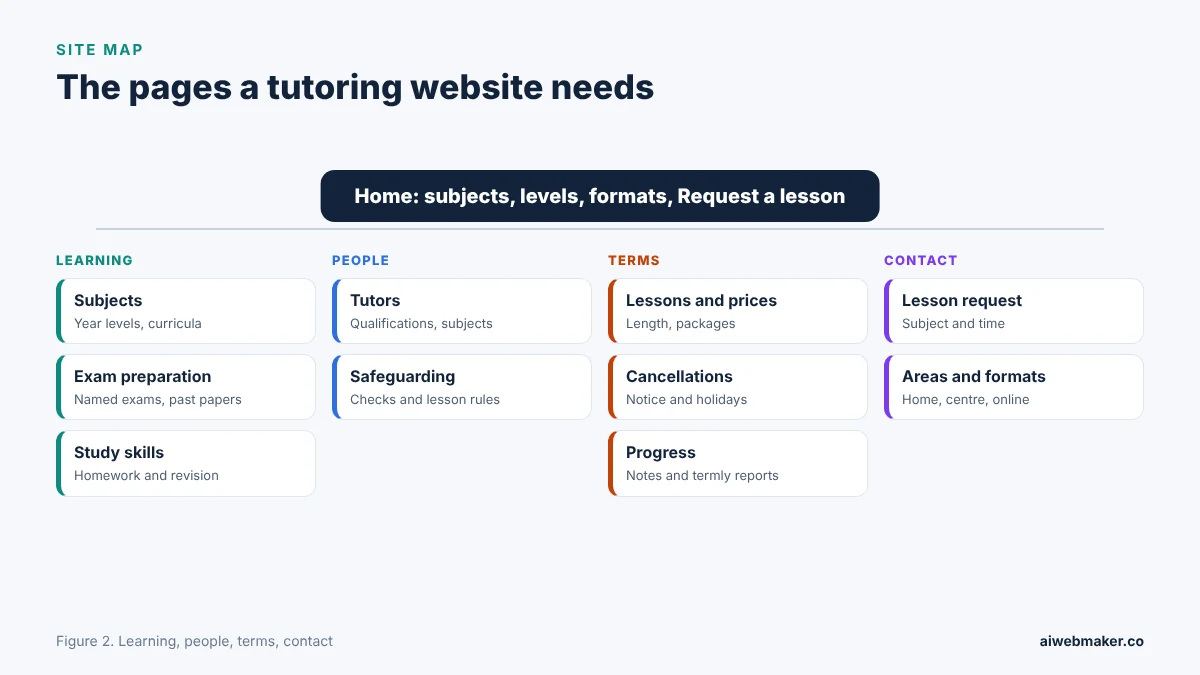
The tutoring site map groups its pages into four families that mirror a parent's worries in order. Learning pages hold the subjects, the levels and the exam preparation. People pages hold the tutor profiles and the safeguarding policy. Terms pages cover lesson length, pricing, cancellations and progress reporting, while the contact group carries the lesson request and areas served. Brightpath Tutoring, the sample business, offers five bookable services covering maths, English and writing, sciences, homework and study skills, and exam preparation, with exam preparation priced above the subject lessons and study skills priced below them; the tutoring website example where parents book lessons by subject was generated in 42 seconds. Its subjects page has a section on subjects and year levels followed by a description of a typical session, and its tutor page explains how progress is tracked and shared beside the tutor profiles.
Year levels, curricula and exam boards: how should subjects be listed?
Subjects should be listed with the year levels, curricula and exams they cover, because maths for a seven year old and maths for a final year student are different services. Parents search with the language of their school system, so naming the programme or exam board matters. A tutor working with international families can list each curriculum taught, such as a national curriculum alongside the International Baccalaureate. Each subject line can also state the typical goal, from building confidence to reaching a target grade. Precise listings prevent mismatched requests and help search engines connect the page with the right families. A parent who sees their child's exact level named feels understood before the first lesson.
| Subject | Levels to name | Curriculum detail | Typical goal |
|---|---|---|---|
| Maths | Primary to final school year | National curriculum or international programme | Confidence, then exam grades |
| English and writing | Reading, essays, literature | Set texts and exam board | Clear essay structure |
| Sciences | Biology, chemistry, physics | Separate or combined science | Understanding before memorising |
| Languages | Beginner to advanced | School exams or adult levels | Speaking confidence |
| Homework and study skills | Any school age | Organisation and revision methods | Independent work habits |
| Exam preparation | Entrance, school leaving, university entry | Named exams, for example GCSE in England or the SAT in the United States | Past papers and timing |
Home visits, a tutoring centre or online lessons: which format suits which family?
Each lesson format suits a different family, and stating the options clearly widens the audience without confusing anyone. Home visits suit younger children who learn best in familiar surroundings, though travel limits how many families a tutor can reach. A tutoring centre offers a calm, supervised space and resources, and it suits parents who want a clear separation between school work and home. Online lessons reach families anywhere and suit older students comfortable with screens. Small group sessions lower the price and suit exam revision, while one to one lessons give the closest attention. Families choose faster when each format's strengths and limits are written down plainly.
| Format | Strengths | Points to consider | What the page should state |
|---|---|---|---|
| Home visits | Familiar setting, no travel for the family | Limited area, tutor travel time | Areas covered and whether an adult must be home |
| Tutoring centre | Supervised space, resources, routine | Families must travel | Address, parking, waiting area |
| Online one to one | Reaches anywhere, flexible hours | Needs a quiet room and a working device | Video tool, materials, camera rules |
| Small group | Lower price, shared motivation | Less individual attention | Group size and how levels are matched |
What safeguarding information do parents expect from a tutor?
Parents expect a tutor to explain background checks, lesson rules and how concerns are handled, and a dedicated page answers this better than a line in the footer. Many countries run formal checks for adults working with children, but the names, rules and requirements differ, so tutors should state what applies where they work. Home visit rules often include an adult staying in the house, while online lessons can be held in a shared room with cameras on. Contact policies matter too, such as messaging parents rather than young students and never connecting on personal social media. Privacy laws in many countries give children's records extra protection, which is why the page should explain how notes and contact details are stored. Centres can name the person responsible for safeguarding, and any family with a concern should know exactly whom to contact.
How should trial lessons, packages and cancellations be set up?
A trial lesson works best as a simple request in which the parent picks the subject service and a time, then sends it to the tutor. The tutor then says yes, suggests another hour, or turns it down if the level lies beyond their expertise. With the booking website builder for tutors and tutoring centres, each subject becomes a lesson families can request. Families pay lesson fees and termly packages straight to the tutor, in whatever way the tutor arranges, with no commission to the platform. Cancellation notice, school holidays and busy exam weeks should be explained beside the lessons. Clear terms keep a tutoring relationship focused on learning rather than on awkward money conversations.
Which progress reports keep families booking another term?
Progress reports keep families booking because parents pay for months before school marks change, and they need evidence along the way. A short note after each lesson can name the topic covered, the homework set and one thing to practise. A fuller report each term can describe strengths, gaps and next targets in plain language. Practice paper scores, with timing and patterns of error, help exam students see their own improvement. Tutors should be honest when progress is slow and suggest what might help, including a conversation with the school. Consistent, candid reporting is the strongest reason a family renews.
| Update | When it arrives | What it contains |
|---|---|---|
| Lesson note | After each lesson | Topics covered, homework, one thing to practise |
| Monthly summary | Each month | Progress against goals, attendance |
| Termly report | End of each term | Strengths, gaps, next targets, exam readiness |
| Practice paper review | After each mock or past paper | Score, timing, patterns of error |
| Parent meeting | Once or twice a year | Goals, options and next steps |
What do parents type when hunting for help in a particular subject?
Parents type the subject and level first, with phrases such as maths tutor near me, online chemistry tutor, English tutor for year six or entrance exam tutor. A page or heading for each subject and level, using those words, matches the search far better than a general list. Tutoring centres gain from a map listing that shows the learning space, gives accurate hours and links to the subjects page, while home tutors can list the areas they visit. Reviews from parents carry great weight, though children should never be named without permission. Articles on revision timetables, reading with younger children or preparing for a named exam reach parents months before the busiest season. Helpful writing like this makes the business look experienced before any parent calls.
What share of a tutoring budget does the website take?
Set against teaching materials, room hire and travel, the website takes a very small share of a tutoring budget. Tutors with full timetables keep the cost lowest on the yearly route. Someone starting out may choose monthly billing through the first school year. A monthly article on revision or reading, drafted with credits, adds under eight dollars across the year. Every figure is laid out below, with the $189 tier as a reference only.
| Item | Yearly | Monthly |
|---|---|---|
| Hosting the tutoring pages | $119 | $228 over twelve months |
| Domain | Depends on the ending | Depends on the ending |
| Higher plan, for comparison | $189 a year | Not needed |
| Twelve revision and study articles at about $0.65 | About $7.80 | About $7.80 |
| Subject, level and term updates | No charge | No charge |
| Year before the domain | About $126.80 | About $235.80 |
Which omissions make a careful parent choose another tutor?
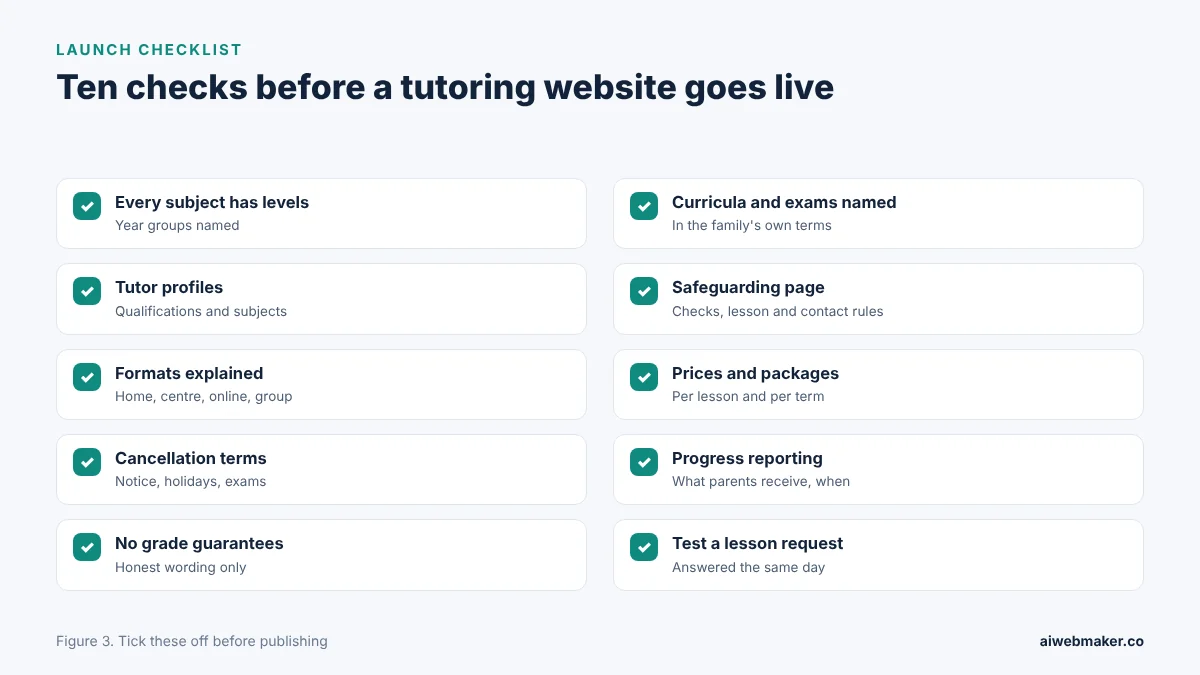
Careful parents move on when the website leaves a safety or suitability question unanswered. A subjects page without year levels or curricula leaves them guessing whether the tutor knows their system. No mention of background checks or lesson rules worries any parent of a young child. Vague prices and no word on cancellations suggest surprises later. A site that never explains how progress is shared gives no reason to expect results. Each of these gaps has a fix among the ten checks pictured here.
Frequently asked questions
Can a tutor guarantee better grades?
No honest tutor can guarantee a grade, because results depend on the student's effort, school teaching, health and many other factors. The website can describe the tutor's approach, typical lesson structure and how progress is measured instead. Specific promises, such as a set grade improvement within a term, mislead parents and can breach consumer rules in many countries. Real reviews describing a student's growing confidence or improved marks are more credible than any guarantee. Parents trust tutors who speak honestly about what tutoring can and cannot do.
Should a parent stay nearby during lessons?
For younger children, many tutors ask that a parent or another adult stays in the home during visits, and stating this policy reassures families. Online lessons for children are often held in a shared room rather than a closed bedroom. Older teenagers may work more independently, though the same contact rules still apply. Centres usually have a waiting area or a clear collection process. Clear expectations protect both the child and the tutor.
How long should a tutoring lesson last?
Lesson length usually depends on the student's age, attention span and goals, so the website should explain the options. Younger children often work best in shorter lessons, while older students preparing for exams may manage an hour or more. Some tutors offer longer sessions for practice papers under timed conditions. Each length can be listed as its own service with its own price. Sensible lengths keep students focused and make every lesson count.
How early before an exam should tutoring start?
For major exams, starting several months ahead gives time to fill gaps rather than simply revise. Short, intensive revision blocks can still help in the final weeks, especially with exam technique and timing. Entrance tests often reward steady preparation across a school year. The website can explain how the tutor plans each route and what parents should expect. Early planning reduces stress for students and families alike.
How many weeks of lessons cover the tutoring website's year?
A few weeks of lessons for one family usually outweigh a tutoring website's entire hosting bill of $119. On monthly billing, a single lesson more than covers the $19. Families who stay for several terms, and recommend the tutor to friends at the school gate, are worth many years of hosting. Clear subjects and levels, open safeguarding and honest progress reports give careful parents the confidence to send that first request. Tutors who keep their pages current before each exam season meet families exactly when the need is greatest. A timetable filled by families returning term after term is the result that matters.
Build your website in Minutes and get the AI Tools that work
Start Building Your Website →