Test Prep Website Cost, From Diagnostic Sessions to Mock Exam Days
Exam tutors pay $119 to host a test prep website for a year, or $19 instalments monthly, with the domain bought apart. Covered here: how families choose, the tests page, pricing, mock papers, honest claims, assessment requests, search and annual costs.
- No coding required
- Live in minutes
- Blog, SEO and chatbot tools included
Exam tutors pay $119 to keep a test prep website live for a whole exam cycle, or $19 instalments when income dips between seasons, and the domain sits outside that price. Drafting the course pages, the mock paper pages and a sample report, then polishing each one on screen before launch, is something AI Web Maker leaves off the bill entirely. A single student signing up for a course pays for that year several times over. The harder task is persuading anxious parents and students that a tutor will raise their readiness honestly, in a market crowded with score guarantees and claims of inside knowledge. Families want to see which tests are covered, how practice is structured and what feedback will look like before they book anything. Below, the guide works through how families choose, the tests page, pricing, mock papers, honest claims, assessment requests, search and the annual hosting sums.
This article is part of our complete guide: Fitness Website Builder.
Who books test preparation, and what tips them toward one tutor?
Test prep is usually booked by parents of younger students sitting school entrance exams, and by teenagers or their families facing college and university admissions tests. Adults preparing for graduate or professional admissions tests form a third group, often paying for themselves and booking around work. Each group starts with a deadline, because the test date and the application deadline fix how many weeks of practice remain. Families then compare tutors on the tests they know, the format of the teaching and the feedback they give. Price matters, yet most parents weigh it against the risk of a wasted term. The tutor who explains the route from first assessment to test day most clearly usually wins the booking.
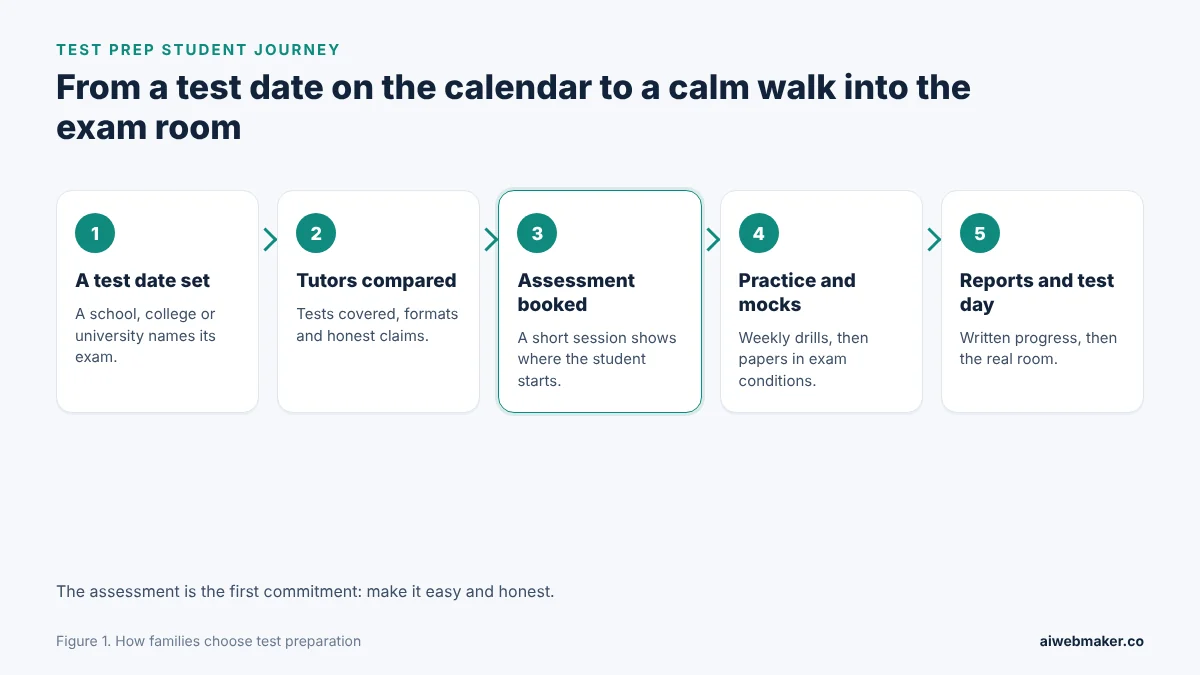
Five steps link a test date on the calendar to a student who walks calmly into the exam room. The highlighted step is the assessment, because it is the first commitment a family makes and the point where a website either earns trust or loses it. Before that step, families compare tests covered and formats; after it, weekly practice and mock papers do the work. Written reports keep parents involved between classes, which matters most when the student is young. A clear page for each step lowers the anxiety that often stops families from booking at all. Mapping the website to this sequence makes the tutor's method visible before the first lesson.
What does a test prep site need, from diagnostic to mock paper?
A test prep website needs pages that mirror the method, so that a parent can see exactly what happens between the first session and the exam. The home page should name the kinds of test prepared for and offer a clear way to book an assessment. A tests page explains formats and skills, while a courses page compares group courses, one to one tutoring and mock papers. A mock test page describes conditions and marking, and a reports page shows what parents receive. A booking page then turns interest into a confirmed assessment or course place.
| Page | Who reads it closely | What it should state |
|---|---|---|
| Home | Parents and older students | Tests covered, formats, a button to book an assessment |
| Tests covered | Families checking fit | Kinds of test, typical ages, skills practised |
| Courses and tutoring | Families comparing cost | Group size, lesson length, number of weeks, price |
| Mock tests | Students near the date | Conditions, timing, marking turnaround, feedback |
| Progress reports | Parents | How often, who writes them, what they cover |
| Booking request | Everyone ready to commit | What to book, the test ahead, preferred day and time |
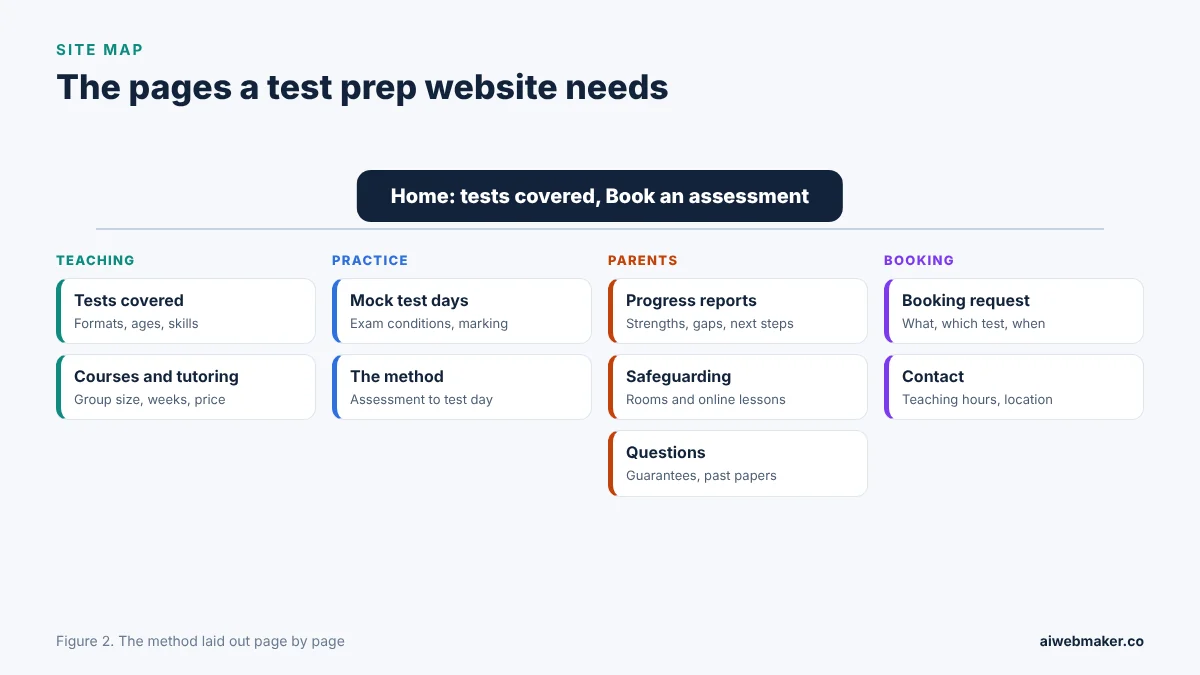
Under the home page sit four branches, covering what is taught, how practice happens, what parents see and how to book. The teaching branch holds the tests covered and the course options, and the practice branch holds mock papers and the five step method. Reports sit apart because parents look for them separately, and the booking branch carries the request and contact details. Mark Ahead Test Prep, the invented business behind our test prep website example with mock test days and written progress reports, follows the same plan. It offers a small group course, one to one tutoring and a mock test day, and it lists school entrance exams, senior school admissions tests, college and university admissions tests and scholarship papers. Its reports cover where the student is now, timing and habits, and what to practise next, and its booking form asks what to book, which test lies ahead and a preferred day and time.
Which exams and formats should the tests page name?
The tests page should name the kinds of exam a tutor prepares for, the ages at which they are usually taken and the skills each one rewards. Entrance exams for younger students often test reading, writing, maths and reasoning puzzles, for example selective school tests in some countries. Admissions tests for colleges and universities vary widely, from the SAT or ACT used by many colleges in the United States to subject aptitude tests set by individual universities elsewhere. Graduate admissions tests and language proficiency tests have their own published formats and scoring scales. Because formats change, the page should say that teaching follows the format each test owner currently publishes. Precise, current descriptions show families that the tutor actually knows the paper their child will sit.
| Kind of test | Usually taken | Skills worth practising | What the page should add |
|---|---|---|---|
| School entrance exams | Late primary years | Comprehension, short writing, maths, reasoning | Which schools or regions set this kind of test |
| Senior school admissions | Early teens | Verbal and numerical reasoning, extended writing | Whether interview practice is offered |
| College admissions tests | Late teens | Reading, maths, essay planning, pacing | Which test formats are taught |
| Subject aptitude tests | Late teens | Critical thinking, problem solving | Courses or universities that use them |
| Graduate admissions tests | Adults | Quantitative reasoning, analytical writing | Evening and weekend options |
| Language proficiency tests | Teens and adults | Listening, reading, writing, speaking | Which score bands are targeted |
How should courses, tutoring and mock papers be priced?
Test prep is usually priced three ways: a fixed course fee, an hourly tutoring rate and a single fee for each mock paper. Group courses suit students who need steady, structured practice and benefit from working alongside others. One to one tutoring targets particular gaps, often after an assessment shows where marks are being lost. Mock papers can be sold on their own, which brings in students taught elsewhere who simply want exam conditions. An assessment fee that comes off the course price if the student joins is a fair way to cover the tutor's time without putting families off. Refund, cancellation and missed class rules should be written beside the prices, not after the booking.
| Format | How it is usually charged | What families need to see |
|---|---|---|
| Assessment | A single session fee | Length, what is tested, whether it is credited later |
| Group course | One fee per course | Group size, weeks, lesson length, mocks included |
| One to one tutoring | An hourly rate | Lesson length, in person or online, notes after lessons |
| Mock paper | A fee per paper | Date, length, marking time, feedback session |
| Interview practice | Added to tutoring hours | Where interviews are part of admission |
What makes a mock test worth a Saturday morning?
A mock test is only worth sitting if the conditions feel like the real exam room, so the page should describe them in detail. Students should sit in rows in a quiet room, with timed sections, a visible clock and an invigilator who follows the same rules on phones and water bottles that most test centres apply. Marked papers should come back quickly, ideally within a few working days, while the questions are still fresh. A feedback session that covers pacing as well as wrong answers often reveals the easiest marks to gain. Progress reports then turn a series of mock scores into advice parents can follow, naming strengths, gaps and three things to practise next. Reports that describe habits and work, rather than predicting a result, keep everyone focused on what can still change.
Why should a test prep tutor refuse to promise scores?
A test prep tutor should refuse to promise scores or places because results depend on the student, the paper and the competition, none of which a tutor controls. Advertising rules in many countries treat guaranteed outcomes as misleading, and parents increasingly see such claims as a warning sign. Claims of inside knowledge are worse, because test owners keep live papers secure and sharing their questions can break test rules and copyright. Practice material should come from papers the tutor writes in the published format, together with official samples that test owners release for practice. Students who need extra time or other access arrangements should be pointed to the test owner or their school, since only those bodies can approve them. Honest boundaries like these make a tutor more credible, not less.
How can assessment and course requests be taken online?
An assessment or course request should take a parent under two minutes to complete. It can offer choices for what to book, the test ahead, in person or online lessons and a preferred day and time. A box for the test date and the hardest subjects gives the tutor what they need to plan the first session. Through the booking website builder for test prep tutors and mock test days, the family sends that request, and the tutor then confirms the time, moves it to a nearby slot or declines it when a group is full. Money for courses and mock papers passes directly from the family to the tutor on terms the tutor sets, and AI Web Maker keeps no cut of it. A note that nothing is booked until the tutor confirms prevents misunderstandings. A calm, simple request page suits families who are already anxious about the exam.
Which exam names do families type into a search bar?
Families searching for help usually type the name of the test, such as entrance exam tutor, SAT prep course or admissions test practice. Many add their town or the word online, and some add the name of the school they are aiming for. Each kind of test on the tests page should carry its own heading using the name families recognise. Parents comparing centres nearby often meet the map entry first, so it should show teaching hours and classroom photos and point to the request page. Reviews that mention clear feedback, patient tutors and well run mock days persuade more than reviews that only mention results. Articles on pacing, reading a mark scheme or planning the last six weeks before a test draw students long before they book. A tutor who publishes careful exam advice becomes the name students pass to their friends.
How does a tutor's hosting bill add up across an exam year?
The bill for a test prep site has two recurring parts, hosting and the domain, and a monthly exam strategy article costs well under a dollar in AI credits. Tutors whose timetables are already full spend less overall on annual billing. Those who are just starting may prefer twelve smaller payments while they build a client list. New courses, test dates and price changes can be added at no cost. The $189 option is listed only so the two tiers can be compared.
| Item | Yearly | Monthly |
|---|---|---|
| Hosting the test prep pages | $119 | $228 over twelve months |
| Domain | Depends on the ending | Depends on the ending |
| Higher plan, for comparison | $189 a year | Not needed |
| Twelve exam strategy articles at about $0.65 | About $7.80 | About $7.80 |
| New courses, dates and prices | No charge | No charge |
| Year before the domain | About $126.80 | About $235.80 |
Which claims make an exam family distrust a tutor on sight?
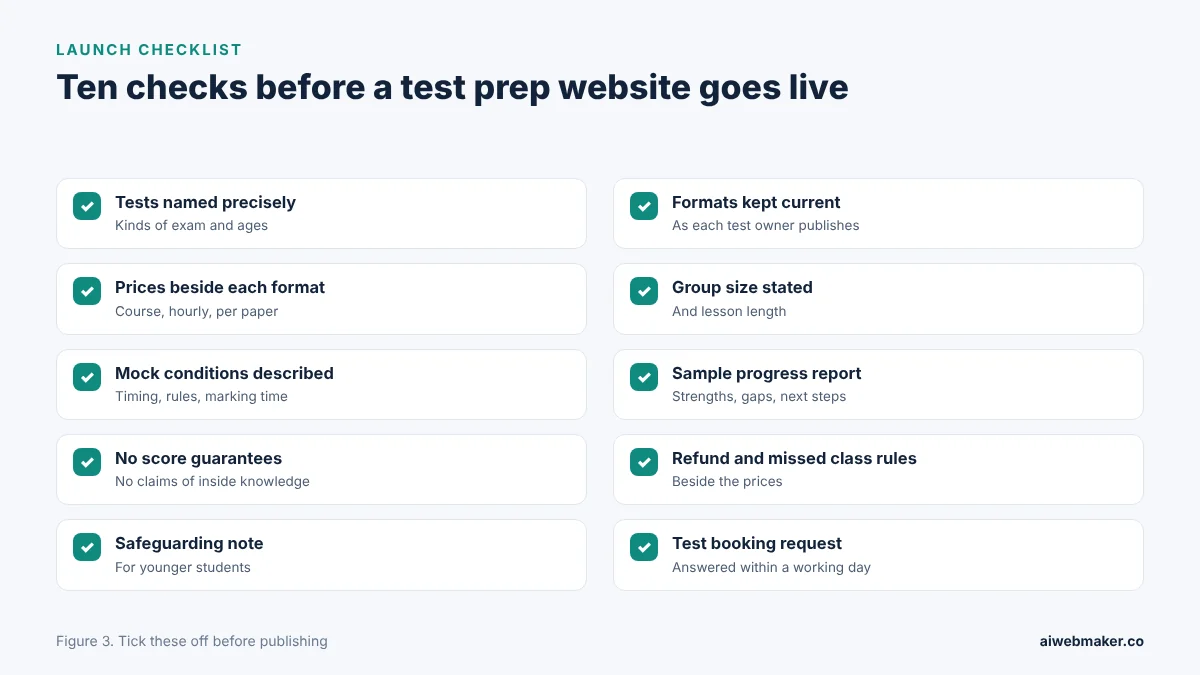
Anxious parents close a tutor's page when it promises guaranteed scores, because they have learned to distrust anyone who claims to control an exam. Vague lists of subjects with no test names suggest the tutor does not know the paper. Missing prices, refund rules or group sizes make the cost feel open ended. A booking route that demands payment before any assessment puts cautious families off. Silence about safeguarding for younger students raises questions that a parent will not ask aloud. The ten launch checks pictured next close every one of these gaps for a tutor.
Frequently asked questions
Can practice papers come from real past exams?
Practice papers can include past or sample papers only where the test owner publishes them for practice or permits their use. Many test owners release official samples, while others keep past papers private and protect them by copyright. Tutors can write their own papers in the published format, which keeps practice legal and lets them target particular skills. The website should state where practice material comes from in plain words. Clear sourcing reassures parents and protects the tutor.
When should a student start preparing for an admissions test?
Most students benefit from one or two terms of steady practice before an admissions test, though some start a year ahead and a few need only a short refresh. The right start date depends on the test, the student's starting point and how much time they have each week. An assessment gives the tutor the evidence to suggest a sensible timetable. Last minute cramming rarely helps and often adds stress. Honest advice on timing builds trust with families.
Is online test prep as useful as lessons in a classroom?
Online lessons by video work well for one to one tutoring, especially when the tutor shares a screen and marks work in real time. Group courses can also run online, though some students concentrate better in a room. Mock papers are best sat in person, because the point is to recreate exam conditions as closely as possible. Many tutors offer both, letting families choose by distance and preference. The website should say clearly which formats are offered for each service.
How should younger students be safeguarded during tutoring?
Tutors working with children should follow the safeguarding and background check rules that apply where they teach, which differ between countries. Lessons in a room can keep doors open or take place in shared spaces, and parents can be welcome to wait nearby. For video lessons, a shared family room with a parent nearby is a sensible default, and any recording needs consent first. The website should state these arrangements plainly, along with who to contact with a concern. Clear safeguarding notes make parents comfortable booking a first session.
How many course places pay for a test prep site's year?
One student joining a group course covers the $119 yearly hosting several times over. Paying monthly, a tutor recovers the $19 from part of a single hourly lesson. Every mock paper booked by a student taught elsewhere adds income that the website alone brought in. Named tests, clear prices, real exam conditions and honest claims persuade careful families better than any promise of a top score. Tutors who keep test dates and courses current find that each exam season fills sooner than the last. Groups that fill weeks ahead of the test date tell a tutor the site is earning its place.
Build your website in Minutes and get the AI Tools that work
Start Building Your Website →