Tennis Coach Website Cost and a Lesson Timetable Players Can Book
Tennis coaches pay $119 for twelve months of hosting, or $19 in each month, plus a domain. This guide covers lesson formats, levels and junior stages, how players request lessons, courts and rain rules, packages and terms, the coach's profile, safeguarding, camps and the first year budget.
- No coding required
- Live in minutes
- Blog, SEO and chatbot tools included
Tennis coaches pay $119 for twelve months of hosting, or $19 in each month when a coach is billed monthly, and pick a domain on top. Building the coaching site on AI Web Maker and checking it in the preview cost the coach nothing. As a model, the tennis coach website example shows an invented coach whose lessons can be booked online, all built with AI Web Maker. A few private lessons cover that bill, but a coaching website has to do more than exist. Adult beginners, returning players, competitive juniors and their parents all search for coaching, and each wants something different. Beginners want reassurance that they will not be embarrassed, parents want safe and encouraging coaching, and club players want technical help to win more matches. What follows shows how lessons, timetables and requests can be arranged so every one of these players finds a suitable first session.
Who looks for a tennis coach, and what do they want?
Four groups look for a tennis coach, and the website should welcome each of them in the first screen. Adult beginners, often inspired by a summer of watching tennis, want a patient coach and a relaxed group. Returning players who have not picked up a racket for years want to rebuild technique without starting from zero. Competitive juniors and their parents look for structured progress, match play and a coach with experience of tournaments. Club players want specific help, such as a stronger second serve or better doubles positioning. Each group needs a different format, so the lesson menu is the heart of a coaching site.
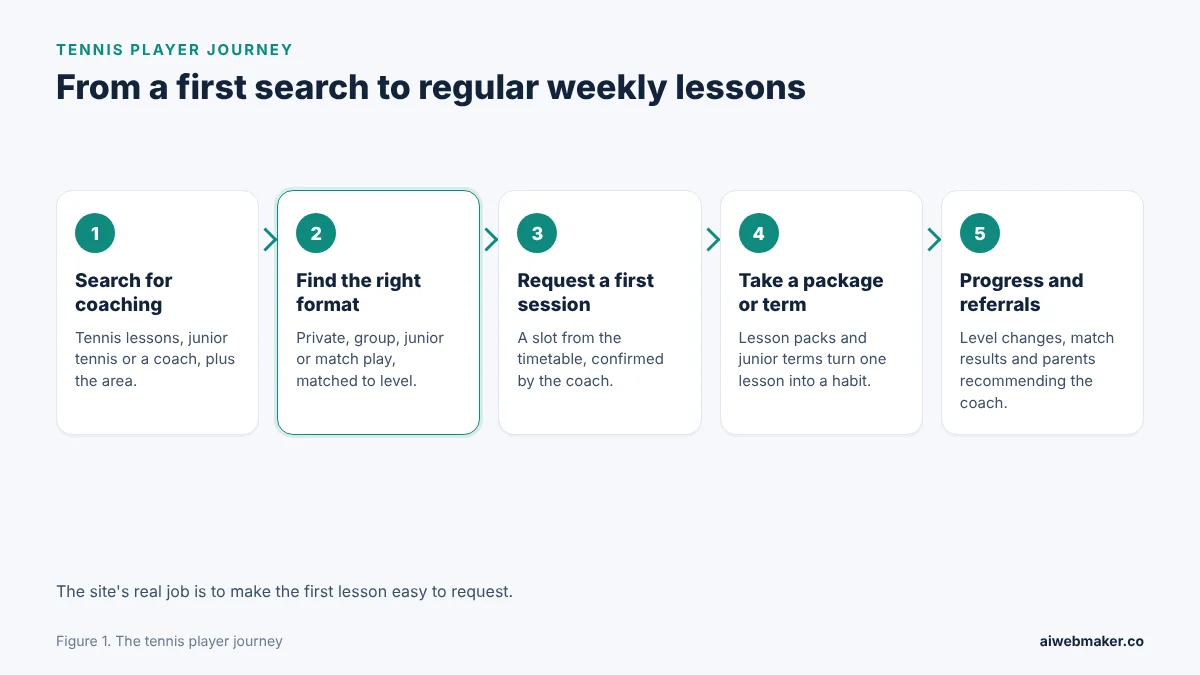
The journey above shows how a trial session becomes a long relationship. Most players decide after their first lesson whether the coach suits them, so the website's real goal is to make that first lesson easy to request. After that, packages and term timetables turn single lessons into a weekly habit. Progress updates and match results keep players motivated. Parents who see their children improving recommend the coach to other families. Every step of that journey can be supported by a clear page.
Which lesson formats should a coaching website offer?
Offer a short menu of lesson formats, each with length, group size, price and the players it suits, since players choose by format first. Private lessons suit players who want fast, focused improvement. Semi private lessons with two players halve the cost and suit friends or doubles partners. Small group sessions build skills in a social setting, while junior classes are organised by age and ability. Match play and drill sessions suit club players who want competitive practice. Listing formats in a table makes comparison easy on a phone.
| Format | Group size | Who it suits | What the line should state |
|---|---|---|---|
| Private lesson | One player | Fast progress, specific goals | Length, price, video analysis if offered |
| Semi private | Two players | Friends, doubles partners | Price per player, shared focus |
| Adult group | Four to six players | Beginners and improvers | Level, day, time, term length |
| Junior class | Small groups by age | Children learning the game | Age band, ball stage, term dates |
| Squad training | Selected juniors | Competitive players | Selection, sessions per week, match play |
| Match play and drills | Small groups | Club players | Level required, format, intensity |
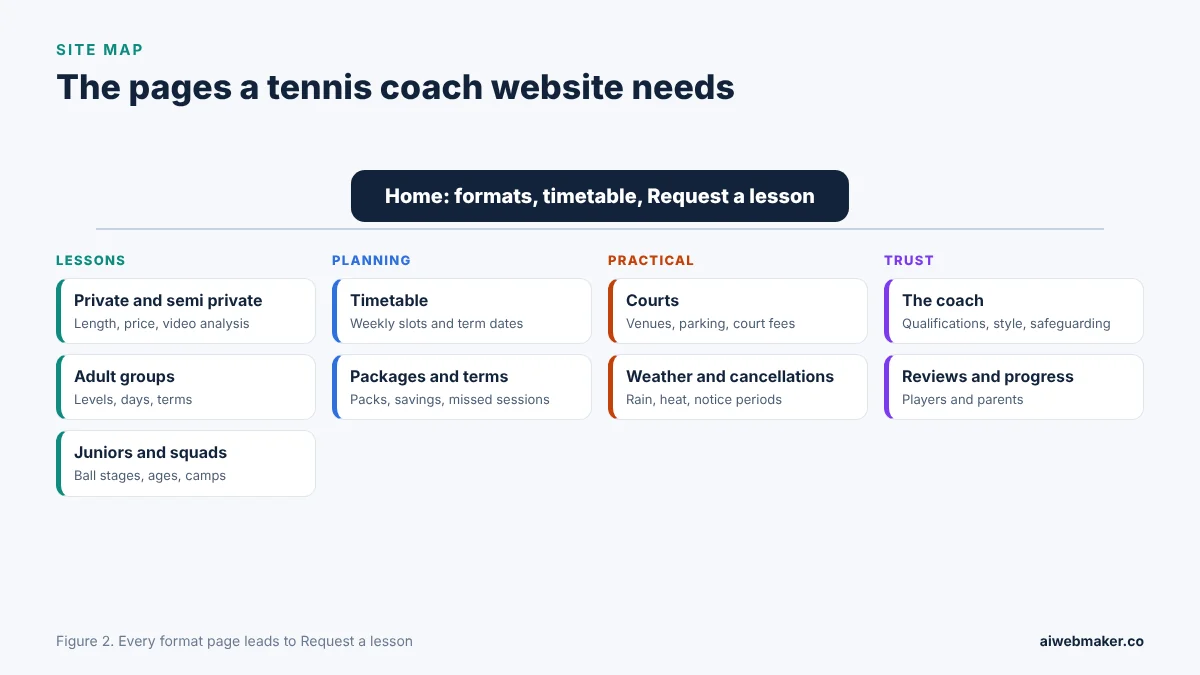
Tennis coaching sites need fewer pages than many trades, but those pages must be grouped so players find their format quickly. Lesson pages separate private and semi private coaching, adult groups, and junior programmes with squads. Planning pages show the weekly timetable along with packages and terms. Practical pages describe the courts used and the rules for rain, heat and cancellations. Trust pages introduce the coach and share reviews and progress stories. Placing the request button on each format page turns a moment of interest into a slot on the timetable.
How should levels and junior stages be explained?
Levels should be explained in plain terms so players can place themselves without fear of being in the wrong group. Adult levels can be described by what a player can already do, such as rallying from the baseline, serving consistently or playing full matches. Junior classes in many countries follow progressions with slower balls and smaller courts for younger children, as described in the International Tennis Federation's Tennis Play and Stay programme. Explaining the coloured ball stages on the website helps parents understand why their child plays on a smaller court at first. A short note on how players move up a level, such as an assessment at the end of each term, keeps progress transparent. Clear levels reduce mismatched groups and unhappy players.
| Level or stage | What players can usually do | Typical next step |
|---|---|---|
| Red ball stage | Young children rallying on a small court | Orange ball on a larger court |
| Orange ball stage | Rallies, serves and simple scoring | Green ball, then full court |
| Green ball stage | Full court rallies with a softer ball | Yellow ball and match play |
| Adult beginner | Learning grips, forehand and backhand | Improver group |
| Adult improver | Rallying and serving with some consistency | Match play sessions |
| Club player | Playing full matches | Targeted private lessons and drills |
How do players request a lesson online?
A player requests a lesson by choosing the format, picking a time from the coach's timetable and sending the request. The coach then accepts it, suggests another slot or turns it down, which keeps court bookings and rain delays under the coach's control. Each session type is shown as a line players can request by the booking website builder that tennis and racket sport coaches use. Parents can request a trial class for a child before committing to a term. Lesson and package payments go straight to the coach, who keeps every dollar of each booking. Quick confirmations matter, because players often decide between two coaches on the same day.
Timetables work best when they are honest about availability. A coach who lists every possible hour and then declines most requests frustrates players. Showing the regular weekly slots, with term dates for groups and junior classes, sets the right expectations. Private lesson slots can be released a few weeks ahead. Notes on how far in advance to book during busy seasons help players plan. A realistic timetable builds trust from the first click.
How should courts and weather rules be described?
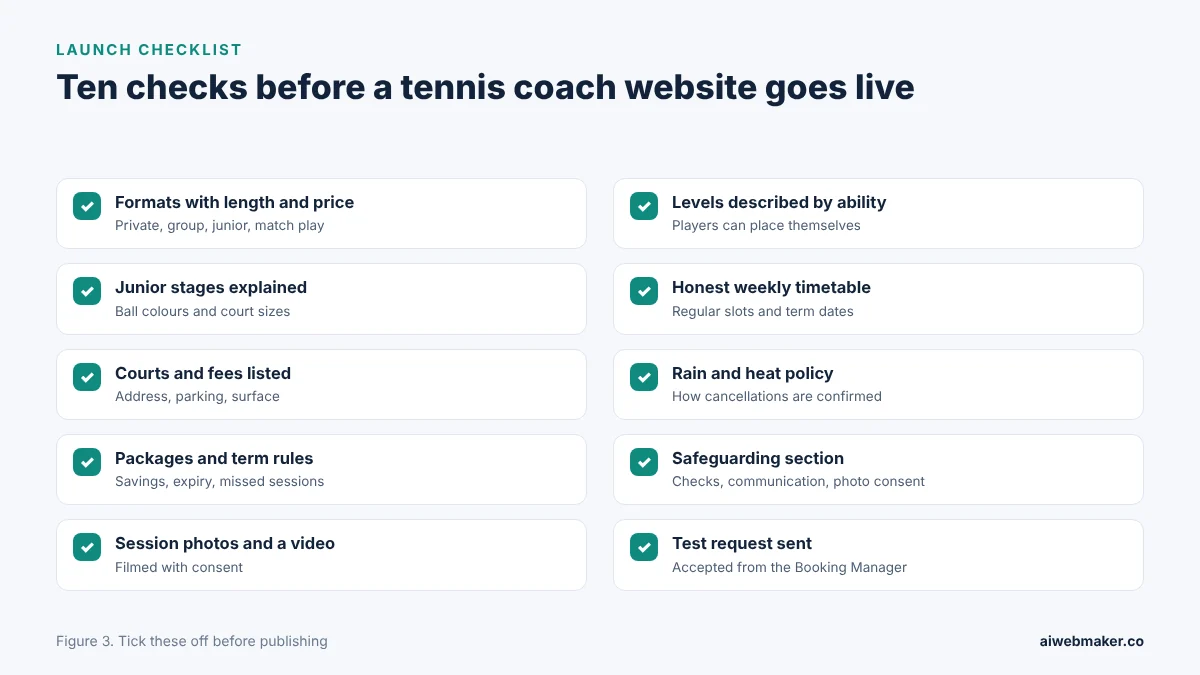
Courts and weather rules should be described clearly, because players need to know where to go and what happens when it rains. Each venue the coach uses deserves a short section with the address, parking, court surface and whether court fees are included in the lesson price. Indoor courts, if available, can be mentioned as the wet weather option. A simple rain policy explains whether sessions move indoors, change date or are credited to a future lesson. Heat policies matter in warm climates, with notes on early or evening sessions in summer. Clear rules prevent confused messages on wet mornings.
| Situation | What the policy page should say |
|---|---|
| Light rain | Whether play continues, moves indoors or is postponed |
| Heavy rain or storms | How and when the coach confirms a cancellation |
| Extreme heat | Session times moved or shortened, water breaks |
| Court unavailable | Alternative venue or a credit for the session |
| Player cancels late | The notice period and whether the session is charged |
| Coach cancels | How the session is rescheduled or credited |
How should packages and terms be presented?
Packages and terms should be presented with what is included, the saving against single lessons and the rules for using them, because players compare value as well as price. A pack of five or ten private lessons can carry a modest saving and an expiry date. Junior terms can be shown as a set number of weekly classes with a total fee. Holiday camps, often popular with parents, can be listed with dates, hours and age groups. Terms on missed sessions, transfers and refunds should be stated simply. Clear packages encourage commitment, and committed players improve faster.
What should the coach's profile page say?
The coach's profile page should describe coaching qualifications, playing background, years of coaching and the kinds of players the coach enjoys working with. Parents look for evidence of safe, positive coaching, while adults look for someone patient and clear. A short paragraph on coaching philosophy, such as building technique through game situations, helps players recognise a fit. A video of a lesson in progress shows the coaching style better than words. Results of former students can be mentioned with their permission, without overstating the coach's role. A warm, honest profile is often the reason a player books.
Safeguarding deserves a clear section when the coach works with juniors. The profile can mention the background checks and safeguarding training the coach holds, in line with the rules of the country and any national tennis body. A short policy on communication with juniors, such as copying parents into messages, reassures families. Photo consent should be explained before any images of children appear online. Parents choose coaches they feel they can trust completely. Being open about safeguarding is part of earning that trust.
How do players searching for lessons find a coach?
Phrases like tennis lessons, junior tennis or adult beginner tennis, plus an area, are what players type, so titles and headings should use them. Giving every lesson format its own page or section captures those varied searches. A Google Business Profile, with the venues and photos of sessions, connects the coach to map results, and the details should match the website. Reviews that mention the format, such as a junior class or private lessons, help both. Articles on topics players search, such as choosing a first racket or fixing a double fault, attract readers who later book. Steady, practical content builds a reputation beyond the court.
What does a tennis coaching website cost over a season and a year?
Over a full year a coaching website costs its hosting and domain, plus a few dollars for any optional articles. A coach with a settled client base saves by paying annually, while a summer only coach may prefer the monthly route. Timetable changes, new packages and photos carry no extra charge. The higher plan is listed for comparison. The totals sit well below the price of a small block of lessons.
| Item | Yearly billing | Monthly billing |
|---|---|---|
| Hosting the coaching site | $119 | $228 over twelve months |
| Domain | Depends on the ending | Depends on the ending |
| Higher yearly plan | $189 | Not needed |
| Monthly technique articles at about $0.65 | About $7.80 a year | About $7.80 a year |
| Timetables, packages, photos | No charge | No charge |
| Year before the domain | About $126.80 | About $235.80 |
Which materials should a coach collect before the build?
A coach should gather the lesson menu with prices, the weekly timetable, venue details, the weather and cancellation policy, photos and short videos of sessions, and a few reviews. The lesson menu takes the most thought, because it decides how players choose. Photos and videos can be filmed during normal sessions, with consent from players and parents. Venue details include addresses, parking and court fees. Safeguarding information and qualifications should be ready for the profile. With that kit in hand, the drafted pages take one evening after coaching to finish.
Frequently asked questions
Should a tennis coach show lesson prices?
Showing prices for each format helps players choose and reduces messages asking about cost. The price should state the lesson length and whether court fees are included. Packages can show their saving against single lessons. Junior terms can show the total fee for the term. Transparent prices attract players who are ready to commit.
How long should a first lesson be?
Many coaches offer a first lesson of the same length as a standard session, while some offer a shorter assessment for new players. The website should state which approach the coach uses and what happens during it. An assessment helps place a player in the right group or plan private lessons. For juniors, a trial class lets the child meet the group before a term. A clear first step lowers the barrier for nervous beginners.
Can a coach run holiday camps through the website?
Holiday camps can be listed on their own page with dates, daily hours, age groups, what to bring and the fee. Parents plan holiday care early, so publishing camp dates well in advance fills places. Requests for camp places can be handled like other sessions, with the coach confirming each one. Notes on supervision, breaks and safety reassure parents. Camps are often a strong source of new junior players.
Do adult beginners need group lessons or private lessons?
Adult beginners can start with either, and the website can explain the benefits of each. Group lessons are social and affordable, which suits players who want to enjoy the game with others. Private lessons speed up early progress and suit players with specific goals or limited time. Some beginners take a few private lessons before joining a group. Explaining the choice helps players start in the format they will enjoy.
Do a few private lessons cover the coaching site?
A handful of private lessons should cover the whole year, since $119 is less than a few hours of coaching on court. On monthly billing, one group session pays the $19. Each player who moves from a single lesson to a weekly habit is lasting income the website helped create. Other coaches and clubs present their sessions in the fitness website builder for coaches, clubs and studios section, which is worth a look. Coaches with clear formats, honest timetables and easy requests tend to fill their courts fastest. A timetable full of regular players is what the yearly fee buys.
Build your website in Minutes and get the AI Tools that work
Start Building Your Website →