Singing Teacher Website Cost, From the Trial Lesson to a Term of Ten
A voice studio's website is online for a whole year for $119, or term by term at $19 monthly, and the teacher picks the domain. Topics: who books, pages, trial and term fees, the lesson itself, exams and accompanists, voice care, children and choirs, requests, search and the budget.
- No coding required
- Live in minutes
- Blog, SEO and chatbot tools included
A singing teacher's studio can go online on $119 of AI Web Maker hosting per year, or on $19 instalments each month, with a domain bought alongside. No bill arrives while the fee table, the voice care page and the trial request are written and played back in the preview. A single term of ten lessons covers the year's hosting many times, and even one trial goes a fair way towards it. The real difficulty is that adults who want to sing often feel embarrassed to ask, parents want to know a child is safe, and performers want proof the teacher can have them ready by a deadline. Each of them needs to see what happens in a lesson, what a term costs and what happens when a cold arrives the night before. Covered here: the singers, the pages, trial and term fees, the lesson itself, exams and accompanists, voice care, children and choirs, requests, search and the budget.
This article is part of our complete guide: Fitness Website Builder.
Shy beginners, choir altos and the performer with an audition date
People who book singing lessons are often more nervous than learners of any other instrument, because the instrument is their own body. Adults told as children that they could not sing, choir members who want to hold a harmony line and parents booking for a child with a school show coming up all arrive with different hopes. Performers preparing for an audition, a recital or a graded exam usually bring a date and a list of songs, and they judge a teacher on whether that date is realistic. Some singers return after illness or years away and worry about strain. A site that names each of these singers and starts where they are makes the first message much easier to send.
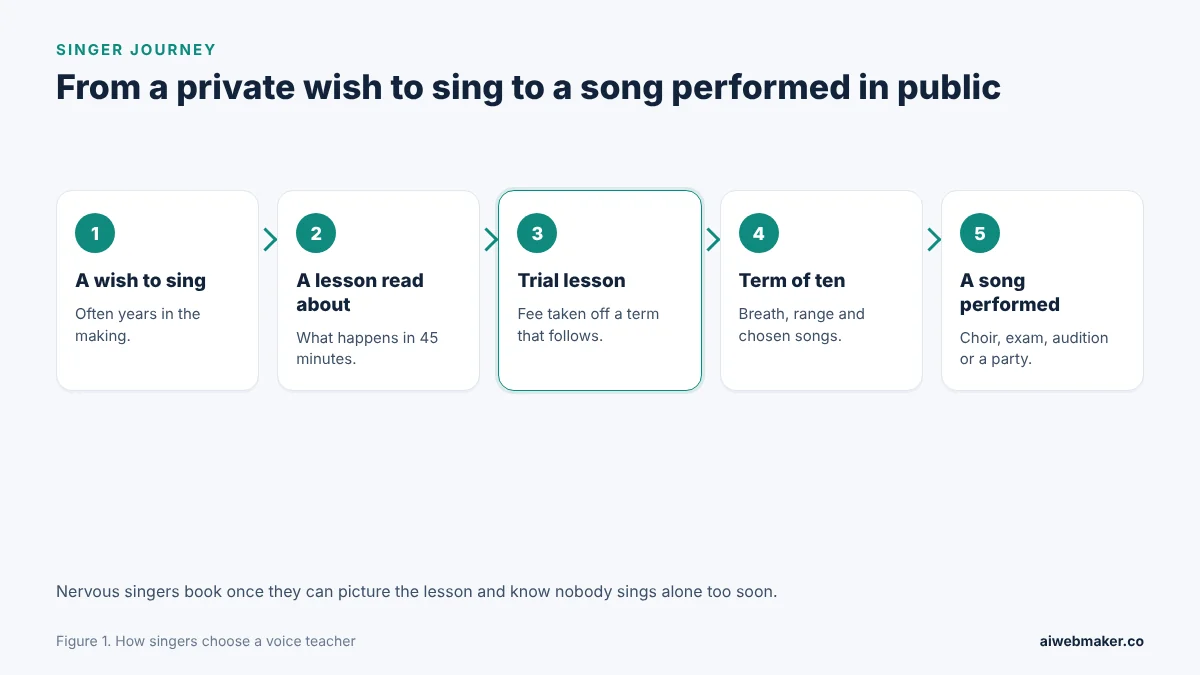
The trial lesson sits at the centre of the journey because it is the low risk step that turns a private wish into a booking. Before it, the singer reads how a lesson unfolds, often more than once, looking for signs that nobody will be put on the spot. A trial fee that comes off the first term rewards the singer who decides to continue. The term then builds breath control, range and repertoire towards something the singer wants to do. That final performance, in a choir, an exam room or a family celebration, is what brings the next singer through a recommendation.
A lesson, who it suits, fees, voice care and the trial request
A singing teacher's site needs few pages, but each one has to lower the nerves a little further. The home page shows the studio, the teacher and the kinds of singer taught, with a button for a trial. A page describing one lesson minute by minute answers the question beginners worry about most. The fees page lists the trial, single lessons, terms and exam blocks with the cancellation rule beside them. Voice care, a page on repertoire and a short trial request finish the set.
| Page | Singer's question | What it should show |
|---|---|---|
| Home | Is this for someone like me? | Studio photo, teacher, kinds of singer, trial button |
| A lesson | What actually happens? | Warm up, breath, technique, song, notes to practise |
| Who it suits | Beginner, choir, performer or exam? | A starting point for each |
| Fees and terms | What does a term cost? | Trial, single lesson, term of ten, exam block, cancellation |
| Voice care | Will lessons strain my voice? | Warm ups, colds, no singing through pain, when to see a doctor |
| Trial request | How does a first lesson start? | Lesson type, level, day, what the singer wants to sing |
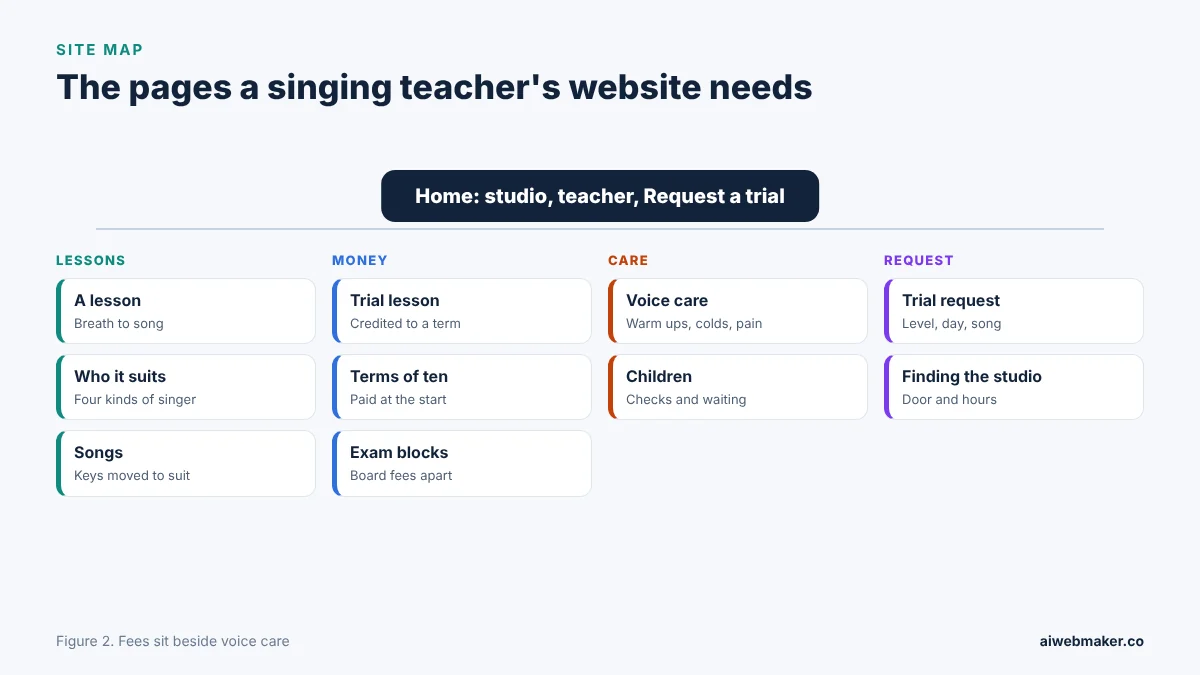
Fees and voice care neighbour each other in this plan, since a singer weighing a term also wonders whether the voice will cope. The lessons group explains a lesson and the four kinds of singer, the money group carries the trial, terms and exam blocks, and the care group covers warm ups, colds and children. Open Throat Voice Studio, the made up studio behind our sample, teaches First time singers, Choir singers, Performers and auditions and Graded singing exams. Its fees run from a Trial lesson and a Single lesson to a Term of ten and an Exam or audition block, after a section that walks through a lesson minute by minute. The singing teacher website example with a minute by minute lesson and term fees closes with a trial request and directions to the studio.
Trial lessons, terms of ten and the cancellation rule
Voice teachers usually sell time in three shapes, a trial, lessons paid one at a time and a prepaid term, and each needs its own rule printed beside the price. A term of ten paid at the start gives the teacher a predictable timetable and gives the singer a lower price per lesson. Missed lessons are where disputes start, so the page should state the notice period, what happens when the teacher cancels and how illness is handled. Singing through a heavy cold can do harm, so many teachers waive the late fee for illness or offer a gentler lesson on listening and technique. Refund rules for prepaid services differ between countries, and the wording deserves a local check before it goes live.
| Option | How it is usually priced | Who it suits | Rule worth printing |
|---|---|---|---|
| Trial lesson | A single fee, sometimes shorter | Anyone unsure | Whether it comes off the first term |
| Single lesson | Per lesson | Irregular schedules, top ups | Booking and notice period |
| Term of ten | Paid at the start, lower per lesson | Steady progress | What happens to missed lessons |
| Exam or audition block | Set lessons before a date | Exam and audition candidates | Whether accompanist time is included |
| Choir sectional | Per session for a group | Choir directors | Group size and notice needed |
Forty five minutes, from breath to song
Describing a lesson in minutes is the most persuasive thing a singing teacher can publish, because it replaces fear with a plan. A typical lesson opens with a chat and gentle physical warm ups, moves to breathing and vocal exercises across the singer's comfortable range, then spends its longest stretch on a song. The last minutes go on notes for practice, often with a recording of the warm ups so the singer can repeat them at home. The balance shifts with the singer, with more breath work for a first timer and more repertoire for someone weeks from an audition. Saying plainly that nobody sings alone in front of others until ready removes the biggest barrier for adult beginners.
Exam boards, accompanists and audition deadlines
Graded singing exams and auditions bring costs that a teacher does not control, and listing them prevents an unpleasant surprise in the final weeks. Exam boards set their own entry fees and syllabus, and some require a live accompanist rather than a backing track, which adds rehearsal time. Audition panels for drama schools, choirs and shows often ask for set song lengths or contrasting pieces, and preparing those cuts takes lessons of its own. Deadlines belong to the board or the institution, so the teacher can promise preparation, never a grade or a place. A table of these extra costs and who sets them shows parents and performers the full price before they commit.
| Cost or task | Who usually sets it | What the page should say |
|---|---|---|
| Exam entry fee | The exam board | Paid separately, at the board's rate |
| Accompanist | The teacher or a hired pianist | Rehearsal and exam day costs |
| Sight reading and aural work | The board's syllabus | Whether it fits in lessons or needs extra time |
| Audition songs and cuts | The school, choir or show | Choosing and timing each cut |
| Backing tracks | The singer or the teacher | Who prepares them, and any cost |
Colds, strain and the line between teaching and medicine
Voice care pages must stay practical and stop short of medical advice, because a singing teacher is neither a doctor nor a speech therapist. Sensible content covers warm ups and cool downs, speaking habits that tire the voice, drinking enough water and resting before a big performance. A firm rule that no lesson pushes through pain protects the singer and the teacher alike. Hoarseness lasting more than a few weeks, pain when singing or a sudden change in the voice are reasons to see a doctor, who may refer the singer to a voice specialist or a speech and language therapist. Signposting like this, kept general, earns trust because it shows the teacher knows where their expertise ends.
Children, choirs and studio safeguarding
Teaching children brings duties that vary by country, and parents look for them before they look at fees. Many countries expect adults teaching children one to one to hold a background check, such as those run for people working with children in England or in Australia, and the page can name the check held without implying it applies everywhere. A clear policy on where parents wait, how video lessons are run and how messages to young singers are handled reassures families. Choir directors booking a sectional for altos or tenors need to know group sizes, notice and whether the session happens at the studio or the rehearsal room. Written policies for both groups show that the studio takes care as seriously as technique.
Trial requests that land in the right slot
A trial request should ask what the singer wants to sing and where they are now, because those two answers shape the first lesson. The booking website builder for singing teachers and their trial lessons drafts the studio pages and a lesson request once the teacher describes the singers, the fees and the timetable. Each request arrives for the teacher to accept, to move to an evening or Saturday slot that is still open, or to decline politely when the timetable is full. Lesson and term fees are paid to the teacher directly, with no slice of them kept by AI Web Maker. Replies can go out in the morning before teaching starts, which keeps every lesson uninterrupted.
Singing lessons for adults and other searches voices type
Singers search with phrases such as singing lessons for adults, voice lessons near me, musical theatre singing coach or graded singing exam preparation, mostly with a town. Parents type singing lessons for kids, and choir directors look for vocal coaching for choirs. Each kind of singer deserves a page or a heading that carries their phrase, so a search for audition coaching meets the performer page. A map listing with the studio's real location, lesson hours and photos of the room helps nervous beginners picture arriving. Articles on warming up before choir, choosing an audition song or singing through nerves bring readers who often book a trial weeks later.
Sheet music, a piano tuning and the website: a voice studio's yearly bill
Piano tuning, sheet music, exam syllabuses and studio rent all weigh more on a voice teacher's budget than the website. With AI Web Maker, a year of hosting is $119 paid once, or $19 a month for teachers budgeting around terms, while the domain carries whatever price its ending sets, from about 400 choices. Twelve articles on warm ups, audition songs and exam preparation, each drafted for roughly 65 cents of AI credit, add up to about $7.80. Changing fees or adding a summer timetable is never billed. The $189 tier shows up below purely as a yardstick.
| Item | Yearly | Monthly |
|---|---|---|
| Hosting the voice studio pages | $119 | $228 over twelve months |
| Domain | Depends on the ending | Depends on the ending |
| Higher plan, for comparison | $189 a year | Not needed |
| Twelve warm up and audition articles at about $0.65 | About $7.80 | About $7.80 |
| Fee and timetable changes | No charge | No charge |
| Year before the domain | About $126.80 | About $235.80 |
Hidden fees, no lesson plan and other reasons singers hesitate
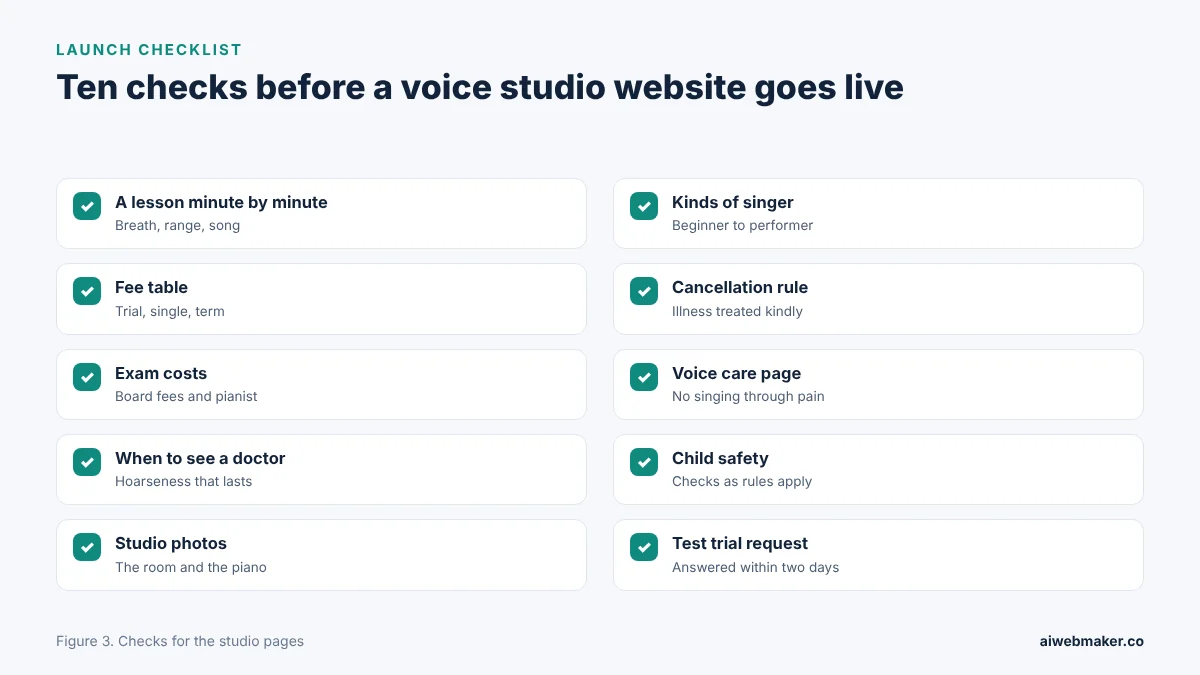
Singers hesitate most when a site gives no idea of what happens in the room, because the fear of singing alone in front of a stranger runs deep. A missing fee table leaves adults guessing whether a term is affordable. No word on exam entry fees or accompanists catches parents out in the final month. Silence about voice care keeps away singers who have strained their voice before. Ten repairs for these gaps follow in the image below, card by card.
Frequently asked questions
Can someone who feels tone deaf learn to sing?
Most people who believe they are tone deaf can learn to match pitch with patient teaching, although a small number do have genuine difficulty hearing pitch. Many adults were told as children that they could not sing and simply never practised. A teacher can start with simple pitch matching, humming and short phrases inside a comfortable range. Progress varies from person to person, and a teacher should never promise a particular result. Explaining this gently on the site encourages people who have avoided singing for years.
How much practice should a singer do between lessons?
Short, regular practice usually helps more than long sessions, since the voice tires and strain builds when practice runs too long. Many teachers suggest a few minutes of warm ups most days and some time on the current song, adjusted to age and level. Recordings of the warm ups from the lesson make practice at home easier. Children and complete beginners may need much less than performers preparing for a date. The page can state the teacher's usual advice without making it sound like homework.
Do online singing lessons work as well as lessons in the studio?
Lessons by video can work well for technique, repertoire and coaching, but delay on the connection makes live accompaniment difficult. Many teachers have the singer play a backing track at their end to get around the lag. Microphones on laptops and phones compress the sound, so a teacher may hear less detail than in the room. Some singers mix the two, with most lessons in person and video lessons when travelling or unwell. Stating which format suits which singer helps people choose honestly.
Are graded singing exams necessary?
Exams are optional for most singers and suit those who like a structured goal, a certificate or a route into further study. Some singers prefer to work towards a performance, a choir place or simply singing with more confidence. Exam boards and their syllabuses differ by country, and each board sets its own entry fees. The page can explain which boards the studio prepares for and what the extra costs usually are. Offering exams as a choice rather than a requirement keeps adult beginners from feeling pushed.
A term of ten against a year of hosting
One term of ten lessons earns a voice studio several times its $119 hosting year. Where the teacher prefers monthly billing, a single lesson usually covers the $19 with room to spare. Each trial that turns into a term, and each choir director who books sectionals after reading the site, adds income the teacher did not have to chase. Singers who arrive having read the lesson page and the voice care rules settle faster and stay for more terms. A timetable whose evening slots fill through trial requests is proof the pages are being heard.
Build your website in Minutes and get the AI Tools that work
Start Building Your Website →