Running Coach Website Cost and the Plans Runners Pay to Follow
A running coach can host a full website for $119 a year, or $19 a month, plus a domain. Covered: who hires a coach, plans by distance, pricing models, gait checks, race seasons, requests, search and the yearly budget.
- No coding required
- Live in minutes
- Blog, SEO and chatbot tools included
Running coaches pay AI Web Maker $119 to keep plans and group run times online for a year, with a $19 monthly option, and a domain completes the bill. No fee applies while the plan pages, the gait check section and the race week guide are written and tested in the preview. One marathon plan, or a single month of coaching for one runner, covers the year. The trickier problem is that runners want to buy a finish time, and an honest coach cannot sell one. The website has to sell structure, patience and judgement instead, through a real sample week and clear limits on what a gait check can tell. Topics ahead: who hires a coach, plans by distance, pricing models, gait checks, race seasons, requests, search and the yearly budget.
This article is part of our complete guide: Fitness Website Builder.
First timers, returners and marathon hopefuls: who pays a running coach
Runners hire a coach at turning points, and the website should recognise each one. A first timer wants to run five kilometres without stopping and fears injury or embarrassment more than slowness. A regular runner stuck at the same 10k time wants structure, intervals and someone to say when to ease off. A half or full marathon entry often triggers the search, because a long build with a fixed date feels too big to plan alone. People returning after injury, pregnancy or years away want a gradual plan that bends with real life.
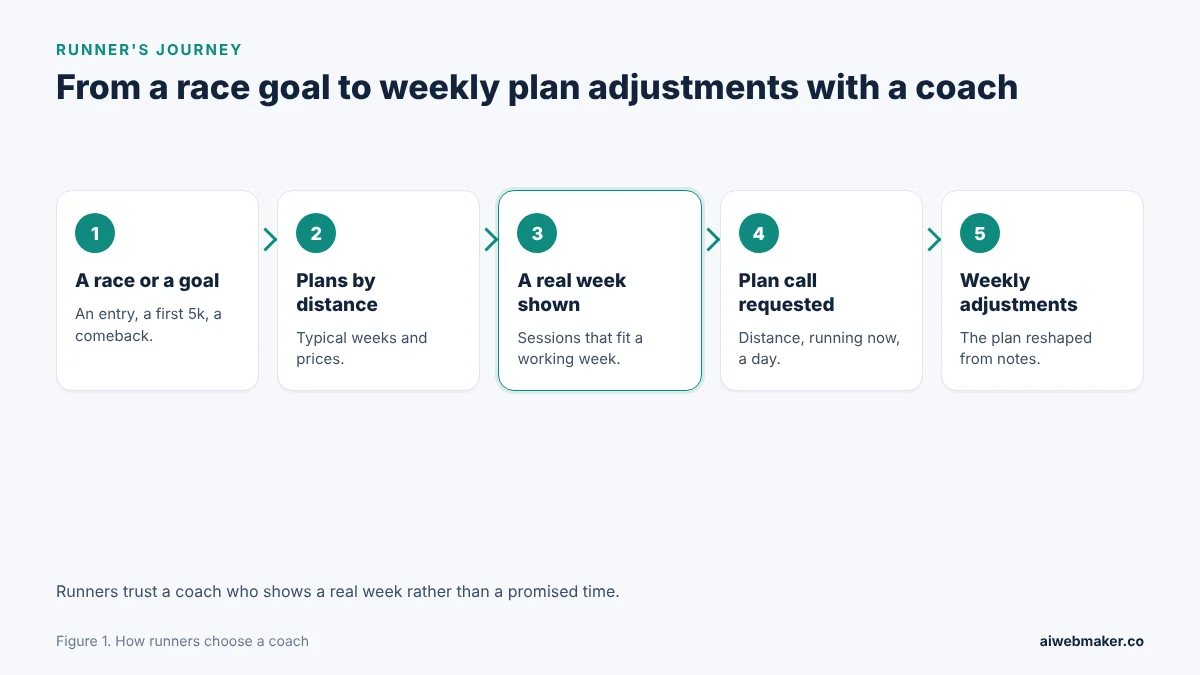
A goal starts the journey, often a race entry or a birthday promise, and the runner then looks for a plan matching that distance. The highlighted step is a real sample week, because runners judge a coach by whether the sessions look sensible for someone with a job and a family. A plan call follows, short and practical, where the coach asks what the runner does now. The final step is the rhythm of weekly adjustments, which is what runners actually pay for. Websites that show this rhythm sell coaching better than any photo of a finish line.
Plans, a sample week and group runs: pages a running coach needs
A running coach's site should be built around distances and levels of support rather than a long biography. The home page names the distances coached and the next group sessions. A plans page covers each distance with its typical length and price, and a sample week shows what a block actually looks like. Separate sections on gait checks, group runs and race preparation explain the extra services. A request for a plan call, a gait check or a group session closes the route.
| Page | Runner's question | What it should include |
|---|---|---|
| Home | Is my distance coached here? | Distances, group times, a request button |
| Plans | How long, and how much? | Typical weeks per distance, prices, check ins |
| A sample week | What will training look like? | Each day of one real week, effort described by feel |
| Gait check | What can filming show? | What is filmed, what is explained, its limits |
| Group runs | Will slower runners be left behind? | Pace groups, meeting points, winter kit |
| Race preparation | What happens before race day? | The last fortnight in steps |
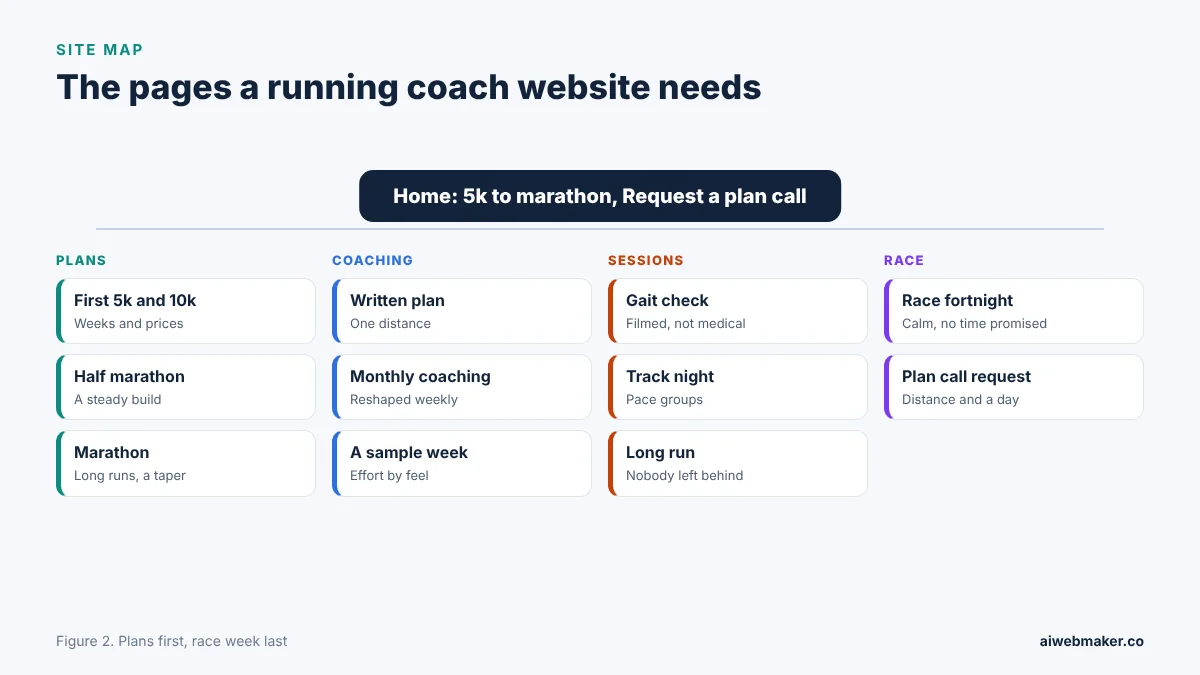
Plans sit first in this layout, followed by the coaching options, the sessions a runner can attend and the race preparation that ends every build. Plan pages cover each distance, coaching pages compare a written plan with monthly support beside a sample week, and session pages describe the gait check, the track night and the long run. The race group carries the final fortnight and the plan call request. Stride Theory Running, the invented coach in our sample, lists a First 5k, a Faster 10k, a Half marathon and a Marathon, then offers a Written plan, Monthly coaching, a Gait check and a Group session. Its single page prints week seven of a half marathon build, and the running coach website example with plans by distance and a filmed gait check finishes with a request for a call, a gait check or a run.
Plans by distance and the weeks each build needs
Each race distance asks for a different length of build, and a coach's website should give typical ranges rather than fixed promises. A first 5k from run and walk sessions often takes around two months, while a marathon build for a runner with a base usually spans several months including a taper. Those figures depend on the starting point, so the page should say that every plan begins from current running and changes when life intervenes. Describing effort by how talking feels, rather than by pace alone, suits runners whose speed shifts with heat, hills and sleep. A table of distances, typical lengths and the runners each plan suits lets a reader place themselves in seconds.
| Distance | Typical build | Suits | Key sessions |
|---|---|---|---|
| First 5k | Around 8 weeks | New or returning runners | Run and walk intervals, three days a week |
| 10k | Around 10 weeks | Runners already covering 10 km | Intervals, tempo runs, an easy long run |
| Half marathon | Around 12 weeks | Runners with a steady base | A growing long run, strength work |
| Marathon | Around 16 weeks or more | Experienced runners with time to train | Long runs, fuelling practice, a taper |
Written plans, monthly coaching and group runs: three ways to charge
Running coaches usually earn from a mix of one off plans, ongoing coaching and group sessions, and each needs its own explanation. A written plan sells once and suits self motivated runners, but it caps the coach's income per runner and allows little adjustment. Monthly coaching, with plans reshaped each week from the runner's notes, produces steadier income and keeps runners for whole seasons. Group sessions at a track or a park bring small fees from many runners and feed the other two, because people who run with the group often ask for a plan. The page should say how each option is paid, how monthly coaching stops and what a check in includes.
| Model | What the runner gets | What the page must state |
|---|---|---|
| Written plan | One plan for one distance | Weeks covered, check ins included |
| Monthly coaching | Weekly changes and messages | How to stop, reply times, calls |
| Group session | A coached track night or long run | Pace groups, meeting point, what to bring |
| Gait check | Filmed running, reviewed together | Length, what it covers, what it does not |
Gait checks described as coaching, not diagnosis
A filmed gait check is a popular product, and also the one most likely to be oversold. The page should describe what happens: running filmed from the side and from behind at an easy pace and at effort, then slowed down and discussed. It can say what the coach looks at, such as posture, arm swing, cadence and how each foot meets the ground, and that the runner leaves with a few drills to try. It must also say that a gait check is not a medical assessment and cannot diagnose an injury. Pain that changes how someone runs, swelling that does not settle or pain at rest belongs with a physiotherapist or a doctor before any drills.
Shoe advice deserves the same caution, because the running world is full of confident claims. A coach who sells no shoes and recommends no brands can say so, and that independence is persuasive. The runner can leave with notes on what to try on and what to ask in a running shop. Claims that a particular shoe prevents injury are best avoided, and anyone already injured should take footwear questions to a qualified clinician. Restraint on this page protects both the runner and the coach's name.
Race calendars, tapers and the seasons a coach plans around
Running coaching follows the race calendar, and the website should be refreshed ahead of each season's demand. Many popular road races fall in spring and autumn in temperate regions, while hotter countries often race through the cooler months, so the busy periods depend on where the coach works. Entries for large marathons often open many months ahead, and runners start looking for a coach soon after they secure a place. A page on the final fortnight, explaining how training drops, kit is tested and the pace plan is agreed, reassures runners who have never tapered. That page should promise calm preparation and never a finish time, because weather, illness and the day itself decide the result.
Requests for a plan call, a gait check or a track night
Every coaching relationship starts with a short conversation, and the request page should make that conversation easy to ask for. The runner picks a plan call, a gait check or a group session, a target distance and a day that suits. With the booking website builder for running coaches and their plan calls, that choice reaches the coach as a request to answer, not a slot already taken. The coach can agree, propose a different evening or decline when a track night is full, and runners pay the coach directly, while AI Web Maker stays out of that money entirely. Plan, gait and group pages are drafted by the same builder after the coach outlines the coaching in a few sentences.
What runners type once a race entry is confirmed
Runners search with phrases such as running coach near me, marathon training plan, beginner 5k coach, half marathon coaching or gait analysis, often adding a city or a race name. A page per distance, with the distance in its heading, matches each search to the right plan. The map listing should show where track sessions and long runs meet, along with the hours they run. Reviews from runners who mention a calm race week, an injury handled sensibly or a first unbroken 5k carry more weight than finishing times. Articles about tapering, fuelling on long runs or running through winter attract runners months before race day.
Track hire, cones and the website: a coach's annual web costs
Beside track hire, insurance and coaching courses, the website barely registers in a running coach's year. The hosting costs $119 if paid in one go, or $19 in each of twelve months, and the domain varies with its ending, of which there are about 400. AI credits for twelve articles on training and racing add up to less than eight dollars. Changing plan prices or adding a new group run costs nothing further. As for the $189 tier, its row is there to let a coach compare the two prices, nothing more.
| Item | Yearly | Monthly |
|---|---|---|
| Hosting the running coach pages | $119 | $228 over twelve months |
| Domain | Depends on the ending | Depends on the ending |
| Higher plan, for comparison | $189 a year | Not needed |
| Twelve training and racing articles at about $0.65 | About $7.80 | About $7.80 |
| Plan, price and group run changes | No charge | No charge |
| Year before the domain | About $126.80 | About $235.80 |
Promised finish times, missing weeks and other reasons runners keep scrolling
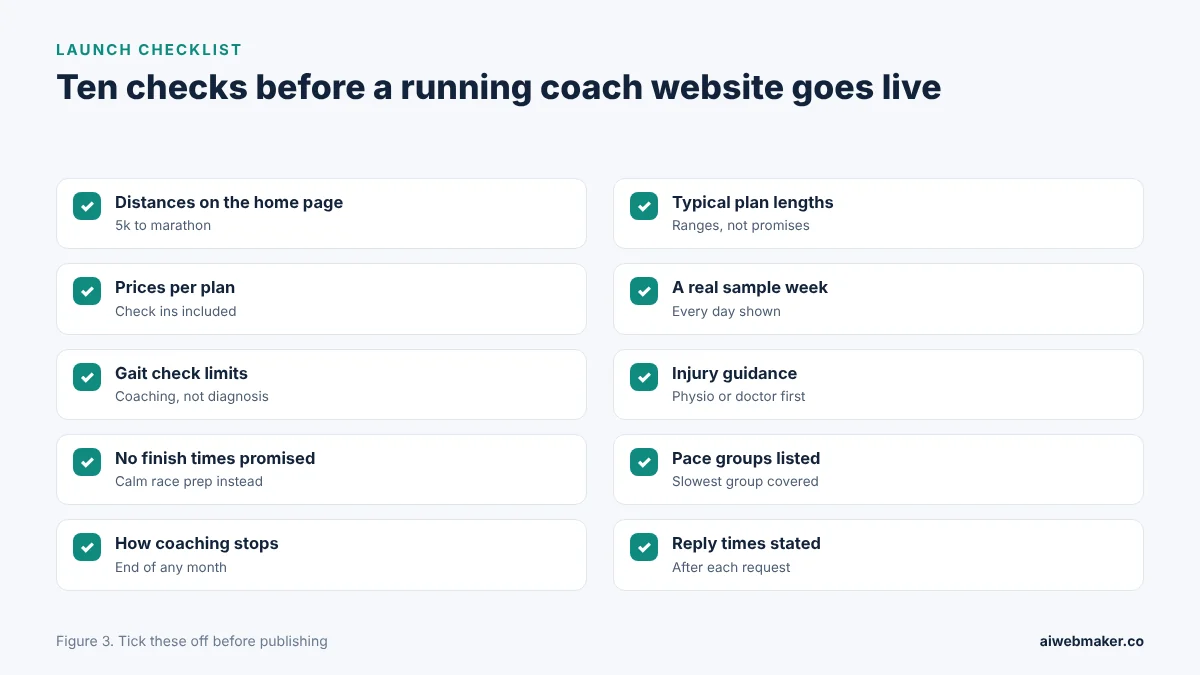
Runners leave a coach's website when every page promises a personal best and none shows a real training week. A plans page without lengths or prices makes people suspect an expensive bundle. Gait checks that claim to fix injuries or prescribe shoes raise doubts among experienced runners. Group runs with no pace groups suggest that slower runners will be left behind on the first long run. The ten fixes drawn beneath answer those doubts before a runner signs up elsewhere.
Frequently asked questions
Is a written plan enough, or is monthly coaching worth it?
A written plan suits runners who are self motivated, have a clear target and rarely need to change their week. Monthly coaching suits runners whose weeks are unpredictable, who are returning from a break or who are training for a first marathon. The difference is adjustment, since a coach reshaping the plan each week can respond to illness, travel or a niggle. The website should explain both honestly so runners can choose without pressure. Clear comparisons tend to bring runners back for the next race.
What should a runner do if an injury appears mid plan?
Stopping hard sessions and telling the coach is the first step, because a plan can be paused or reshaped. A coach should not diagnose injuries, so pain that changes how someone runs, swelling or pain at rest should be seen by a physiotherapist or a doctor. Chest pain or sudden breathlessness needs the local emergency number without delay. The website should state this guidance plainly on the plans page. Runners respect a coach who puts health ahead of the training schedule.
Are group runs suitable for slow runners?
Good group sessions are organised around pace groups, so runners of very different speeds can train together safely. Coaches often keep someone with the slowest group, especially on long runs. The page should list the approximate pace range and say that newcomers are welcome. Winter sessions need reflective kit and head torches, which the page can mention. Clear pace information brings slower runners who would otherwise never attend.
Are federation awards and first aid training expected of running coaches?
Coaching awards are offered by national athletics federations and other bodies, and the recognised routes differ between countries. Many clients expect a coaching qualification, first aid training and insurance, and some venues ask for them before allowing group sessions. A coach's own racing history can be mentioned, but teaching and planning skill matter more to most runners. The website can list qualifications in plain words without long abbreviations. Checkable details reassure runners that their training is in capable hands.
A single plan against a year of the coach's hosting
A single written marathon plan tends to outearn the $119 a running coach's pages need for the year. Seen month by month, $19 sits well below what one runner pays for a month of coaching. Each runner who stays for a second race, and each group regular who moves on to a plan, adds income that honest pages helped earn. A real sample week, a careful gait check page and a calm race fortnight persuade runners better than any promised time. Runners who send the plans page to a training partner before entering their next race show the website is earning its place.
Build your website in Minutes and get the AI Tools that work
Start Building Your Website →