Pilates Studio Website Cost, Weighed in Mat Spots and Reformer Beds
Pilates studio hosting comes to $119 a year, while $19 billed monthly suits studios easing in, and the domain is extra. From there: who books, mat and reformer formats, levels, health screening and pregnancy, instructor training, packs and cancellations.
- No coding required
- Live in minutes
- Blog, SEO and chatbot tools included
Reformer studios and mat studios alike pay AI Web Maker $119 per year for hosting, or $19 per month where spreading costs helps, and the domain is purchased on top. Class descriptions, the questions page and the studio photos can be refined in the preview for as long as needed, and AI Web Maker charges nothing for that. A handful of reformer classes covers the whole year, which makes hosting tiny next to the cost of a single machine. Coreline Pilates, the invented studio in our pilates studio website example, lists reformer and mat classes separately with a class size for each, all on pages AI Web Maker produced. The challenge is that Pilates sells two very different products, affordable mat classes for many and premium reformer sessions limited by the number of beds, and newcomers rarely know which to choose. Many arrive with a sore back, a past injury or a pregnancy, and they need careful, honest answers before they book. The guide works through who books, mat and reformer formats, levels, health questions, instructor training, packs and cancellations, search and the yearly cost.
This article is part of our complete guide: Fitness Website Builder.
Who books Pilates, and what do newcomers need to hear first?
Pilates students arrive with a wide range of goals, and many carry a question about their body that they want answered first. Complete beginners fear being the stiffest person on the mat and want reassurance that nobody will notice. People returning to exercise after an injury often come on the advice of a physiotherapist and want an instructor who will adapt each exercise. Pregnant and postnatal clients look for classes designed for them and for instructors trained to teach them. Athletes, dancers and runners use Pilates for strength and control alongside their main sport. Office workers and older adults come for posture, strength and balance, and the site should describe benefits carefully rather than promise results.
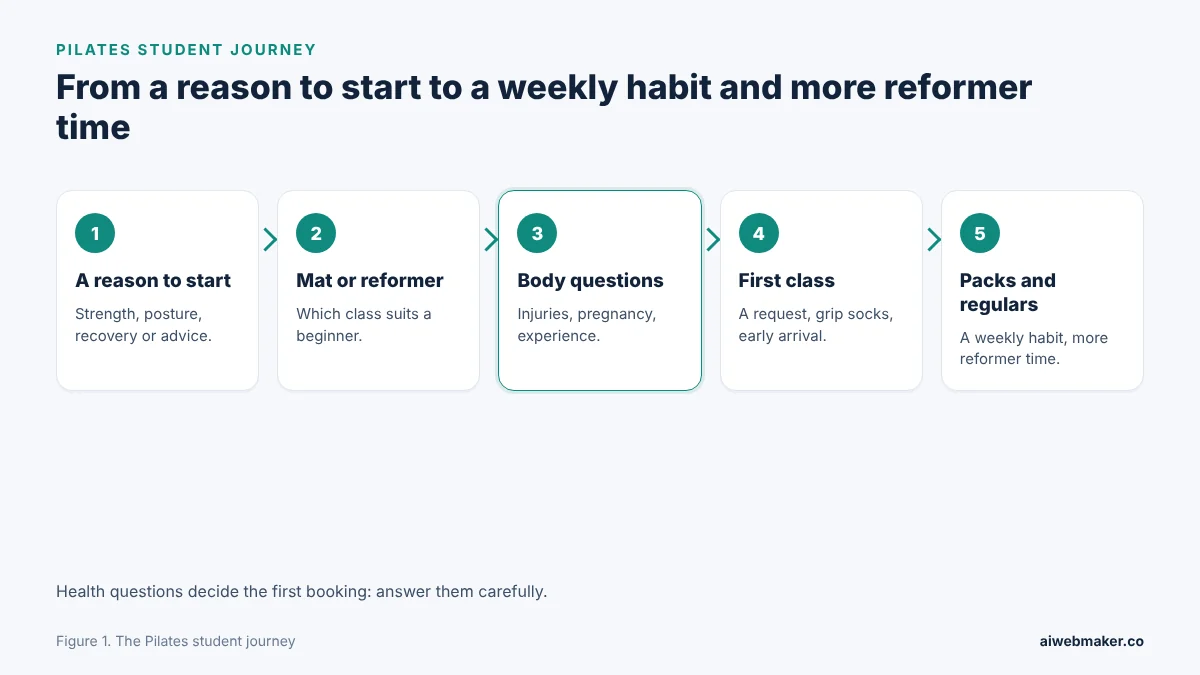
The highlighted step holds the questions that decide whether a newcomer books at all. A reason to start comes first, often a sore back, a sport or a friend's recommendation. Choosing between mat and reformer follows, and beginners need a plain comparison. Once questions about injuries, pregnancy and experience are answered, the first class feels safe to request. A weekly habit and a move into reformer classes are where a studio's income steadies.
Which pages guide a newcomer from mat class to reformer bed?
A Pilates studio site needs pages that compare the formats, answer health questions and make booking clear. The home page needs photos of the studio and of real classes, the formats on offer and a clear button for a first visit. A classes page describes each mat and reformer class with its level, length and price. A questions page covers experience, first visits, injuries, pregnancy and cancellations. An about page introduces the instructors, their training and the studio space.
| Page | What the visitor checks | What belongs there |
|---|---|---|
| Home | Is this studio right for a beginner? | Real classes, formats, a first class route |
| Classes | Mat or reformer, and which level? | Each class, level, length, price |
| Questions | Is it safe for my body? | Experience, injuries, pregnancy, first visit |
| Instructors | Who will adapt the exercises? | Training, qualifications, specialisms |
| Policies | What if plans change? | Cancellations, late arrival, packs |
| Visit | Where and when? | Address, parking, hours, what to bring |
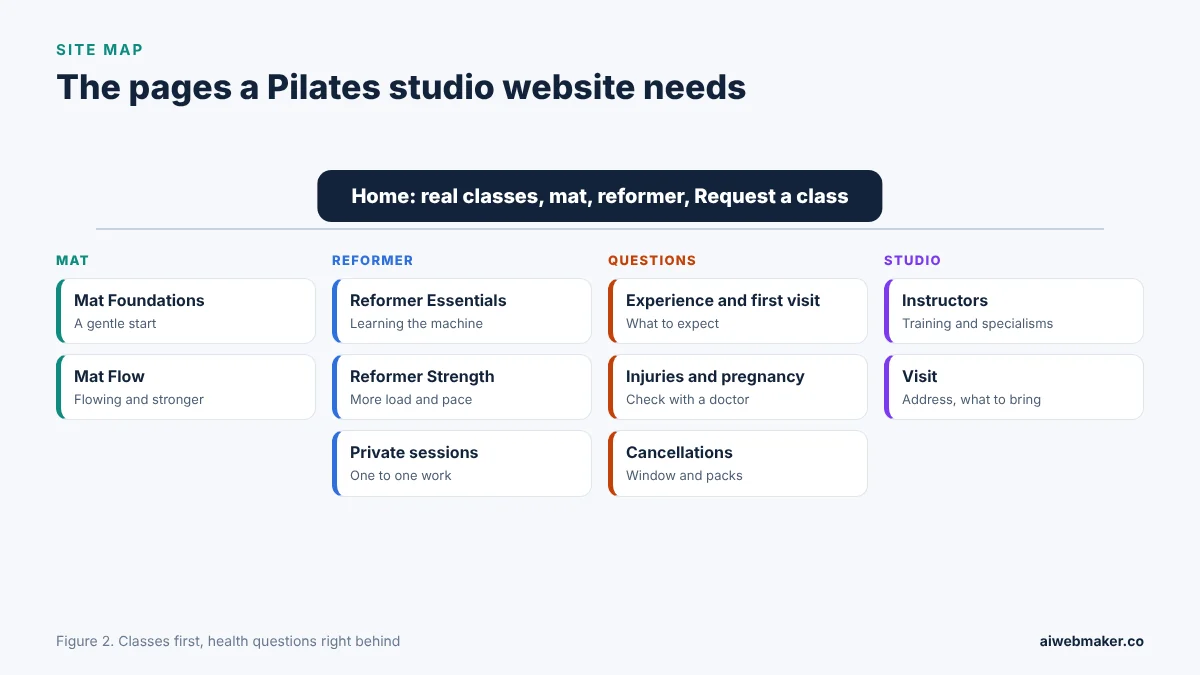
The Pilates site falls into four groups, with the classes first and the health questions right behind. The classes groups split mat from reformer, each with levels and prices. The questions group handles experience, injuries, pregnancy and first visits, and the studio group introduces the instructors and the room. Our sample, Coreline Pilates, offers Mat Foundations, Mat Flow, Reformer Essentials and Reformer Strength as four bookable classes, with the reformer sessions priced higher, and its questions page covers whether experience is needed, what happens at a first visit, injuries and pregnancy, cancellation rules and how to enquire or reserve a place. Its about page presents the instructors with their training and qualifications, the studio's story and approach and the space itself, and the Pilates studio website example with mat and reformer classes to request was generated in 42 seconds.
Mat, reformer or private: how do the Pilates formats compare?
Each format suits different students, and a plain comparison saves newcomers from guessing. Mat classes use body weight and small props such as balls, bands and rings, and they can take larger groups at a lower price. Reformer classes use a sliding carriage with springs that add or reduce resistance, so the number of places is limited by the machines. Private and duet sessions suit people with specific needs, such as recovery from injury, and they let the instructor build a programme around one body. Other apparatus, such as the trapeze table, the chair and the barrel, appear in fully equipped studios and usually in private sessions. Explaining what each format feels like helps students pick the class they will enjoy.
| Format | Equipment | Class size | Suits |
|---|---|---|---|
| Mat | Body weight, small props | Larger groups | Beginners, tighter budgets, home practice |
| Reformer | Sliding carriage and springs | Limited by machines | Strength, control, variety |
| Private | Any apparatus | One person | Injury recovery, specific goals |
| Duet | Shared apparatus | Two people | Friends or couples with similar goals |
| Other apparatus | Trapeze table, chair, barrel | Usually private | Deeper or specialist work |
How should class names and levels guide a beginner?
Class names should tell a newcomer exactly where to start, because a clever name with no level attached leaves people unsure. Names such as foundations or essentials signal a starting point, while strength, flow or advanced suggest more load or pace. Each class description should say what experience it expects and whether it follows the classical repertoire or a contemporary approach. Studios that require an introduction session before reformer classes should explain why, because learning the springs and straps safely matters. Pathways from mat to reformer, or from essentials to strength, give students a reason to stay. Clear levels keep classes safe and stop beginners feeling lost.
How should injuries, pregnancy and health questions be handled?
Health questions need careful, modest answers, because Pilates instructors are not doctors and the website should never diagnose. Students with injuries, chronic pain or recent surgery should be encouraged to speak with their doctor or physiotherapist before starting and to tell the instructor at every class. Pregnancy and the months after birth call for medical clearance and, ideally, an instructor trained in prenatal and postnatal work. A health questionnaire at the first visit lets the instructor adapt exercises, and the site can say this happens without promising particular outcomes. Wording about benefits should stay general, such as building strength and control, rather than claiming to cure back pain or any condition. Careful answers build trust with exactly the clients who need it most.
| Situation | What the page should say |
|---|---|
| New injury or pain | Speak to a doctor or physiotherapist first, then tell the instructor |
| Recent surgery | Wait for medical clearance before booking |
| Pregnancy | Medical approval and a trained instructor, with adapted classes |
| After birth | Return after clearance, starting gently |
| Long term conditions | Share details at the first visit so exercises can be adapted |
What training should a Pilates instructor's profile mention?
Instructor profiles should name the training each teacher has completed, because the depth of Pilates training varies widely. Some instructors hold mat qualifications only, while others have completed comprehensive programmes covering the reformer and other apparatus. Specialist training in prenatal work, rehabilitation or teaching older adults deserves a line of its own. In many countries Pilates is not regulated by a single official body, so naming the training organisation helps students judge the qualification. Continuing education, workshops and years of teaching show an instructor who keeps learning. Honest, specific profiles reassure the students who most need a careful teacher.
How should class packs, requests and late cancellations work?
Reformer places are limited, so the booking rules need to be as clear as the class descriptions. A student chooses a class and sends a request, and the studio confirms the place, offers another time or declines when every reformer is taken. Class packs and memberships are sold and paid for directly with the studio, and AI Web Maker takes no slice of the fee. The Pilates booking website builder for mat and reformer requests produces the class request pages with the questions and instructor pages after the studio writes a short outline of its classes. Pack expiry dates, which classes each pack covers and the late cancellation window should all be stated, because a reformer place lost at the last minute rarely gets filled. Fair, visible rules protect the busiest classes without putting newcomers off.
Which searches lead beginners and regulars to a Pilates studio?
Pilates clients search for phrases such as reformer Pilates near me, beginner Pilates classes, prenatal Pilates, Pilates for back pain or private Pilates sessions, often with a neighbourhood. Mat and reformer classes each deserve a heading that uses those exact words, and pages answering the back pain search should describe careful, adapted classes rather than promise relief. On the map, pictures of the reformer room and up to date class times help the listing stand out. Reviews from students who arrived nervous or recovering from injury carry real weight, provided they describe experience rather than medical results. Articles comparing mat and reformer for beginners, or describing a first prenatal class, find readers who are weighing up whether to start. Physiotherapists, midwives and gyms that recommend the studio add trusted routes in.
What will the site cost a Pilates studio over twelve months?
Only two items recur on a Pilates studio's web bill, hosting and a domain, while a first class or reformer article drafted with credits costs about $0.65. A studio with a loyal core of regulars spends least when the whole year is paid up front. A studio waiting for its reformer room to fill may choose $19 a month instead. Changing class times, adding an instructor or editing the questions page costs nothing. Pilates owners can set one yearly payment against twelve monthly ones using these figures, and the $189 tier sits there only as a reference.
| Item | Yearly | Monthly |
|---|---|---|
| Hosting the Pilates studio pages | $119 | $228 over twelve months |
| Domain | Depends on the ending | Depends on the ending |
| Higher plan, for comparison | $189 a year | Not needed |
| Twelve beginner and reformer articles at about $0.65 | About $7.80 | About $7.80 |
| Class, instructor and policy updates | No charge | No charge |
| Year before the domain | About $126.80 | About $235.80 |
Why do cautious newcomers leave a Pilates site without booking?
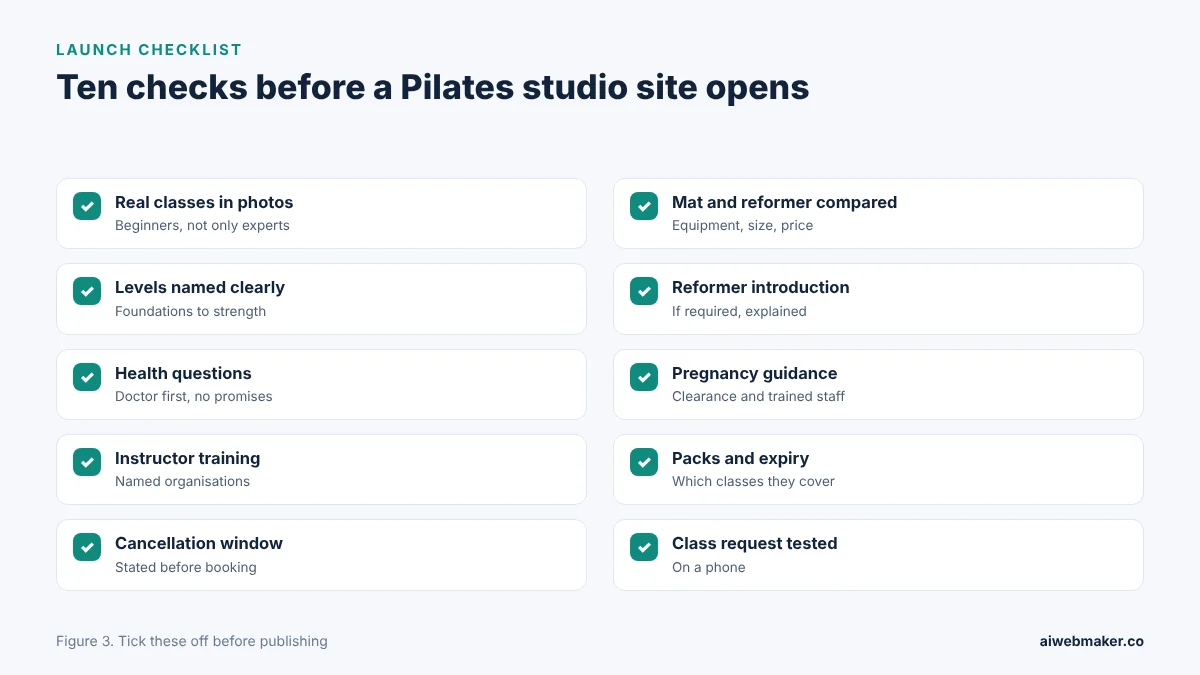
Cautious newcomers leave when every photo shows advanced students in difficult positions, because they assume the studio is not for them. No explanation of mat versus reformer leaves them unsure what to book. Silence about injuries or pregnancy, or bold health promises, both undermine trust in different ways. Packs and cancellation rules that appear only after booking feel like a trap. Instructor profiles without any training details give careful students no reason to choose this studio. The figure just after this paragraph covers each fix in ten short points.
Frequently asked questions
Is Pilates suitable for complete beginners?
Pilates suits complete beginners when the class is designed for them, and the website should point newcomers to those classes clearly. Foundations or essentials classes teach the breathing, alignment and basic movements that every other class builds on. No particular flexibility or fitness is needed to start, and instructors offer easier versions of each exercise. Anyone with a health condition should check with a doctor first and tell the instructor before class. A clear beginner route turns curiosity into a first booking.
Do reformer classes need an introduction session first?
Many studios ask complete beginners to take an introduction session before joining a group reformer class, so they learn the springs, straps and carriage safely. The website should explain the requirement and how to request the introduction. Students with reformer experience elsewhere may be allowed to skip it, at the instructor's discretion. The rule protects both students and machines. Explaining it openly avoids disappointment at the door.
Can people with back pain take Pilates classes?
Many people with back pain take Pilates, but they should speak to a doctor or physiotherapist first, especially if the pain is new, severe or follows an injury. The studio should ask about pain and injuries before the first class and adapt exercises or suggest a private session. The website should avoid promising that Pilates will cure or fix back pain, because results vary and claims like that can mislead. Instructors with rehabilitation training are worth naming on their profiles. Careful wording protects students and the studio's reputation.
How long do Pilates class packs usually last?
Each studio sets its own expiry period, and because students compare this closely the website should spell it out. Larger packs often come with longer expiry periods, and some studios allow a pause for illness or travel. The page should also say whether a pack covers mat and reformer classes or only one of them. Memberships with a set number of classes each month suit students who attend regularly. Clear pack terms prevent disputes over unused classes.
How many reformer places must a studio fill to cover its site?
Three or four reformer classes generally earn back the $119 of yearly Pilates hosting. On monthly billing, one or two mat classes pay each $19 bill. Every newcomer who starts on the mat and moves to reformer classes adds months of bookings the website helped begin. Clear formats, careful health answers and honest instructor profiles persuade cautious students more than glossy promises. Studios that keep timetables and policies current give regulars no reason to wander. Reformer beds that fill days in advance suggest the pages are guiding the right people through the door.
Build your website in Minutes and get the AI Tools that work
Start Building Your Website →