Piano Teacher Website Cost: Lesson Lengths, Recitals and Home Visits
Every piano teacher's site rests on hosting at $119 a year, or $19 if paid one month at a time, with the domain's cost decided by its ending. Inside: pupils, pages, lesson lengths, places, billing, exams and recitals, practice and parents, search and sums.
- No coding required
- Live in minutes
- Blog, SEO and chatbot tools included
Every piano teacher's site rests on hosting at $119 a year, or $19 if paid one month at a time, with the domain's cost decided by its ending. Not a single AI Web Maker charge attaches to drafting the lesson length cards, the table of places or the lesson request while the teacher tries them out in preview. A single month of weekly lessons for one pupil covers the hosting year. The harder part is that families choose a piano teacher for years rather than weeks, so they look closely at lesson lengths, the place of each lesson and the way missed weeks and holidays are billed. Adults returning to the piano after decades add a different worry, which is being taught as if they were seven. Inside are the pupils, the pages, lesson lengths, places, billing, exams and recitals, practice and parents, search and the yearly sums.
This article is part of our complete guide: Fitness Website Builder.
Five year olds, returning adults and families with siblings: who looks for a piano teacher
Piano pupils span a wider age range than almost any other lesson, so each group needs words aimed at it without confusing the others. Parents of five and six year olds want short, playful lessons and a teacher patient with small hands. Families with two or three children want siblings taught back to back, ideally at home. Teenagers working towards exams want a teacher who knows the syllabus, while adults returning after a long break want a piece they abandoned years ago. Pupils who move away look for online lessons so they can keep a teacher they trust. Whatever their age, they first look for the minutes per lesson, the room or screen it happens in and the monthly total.
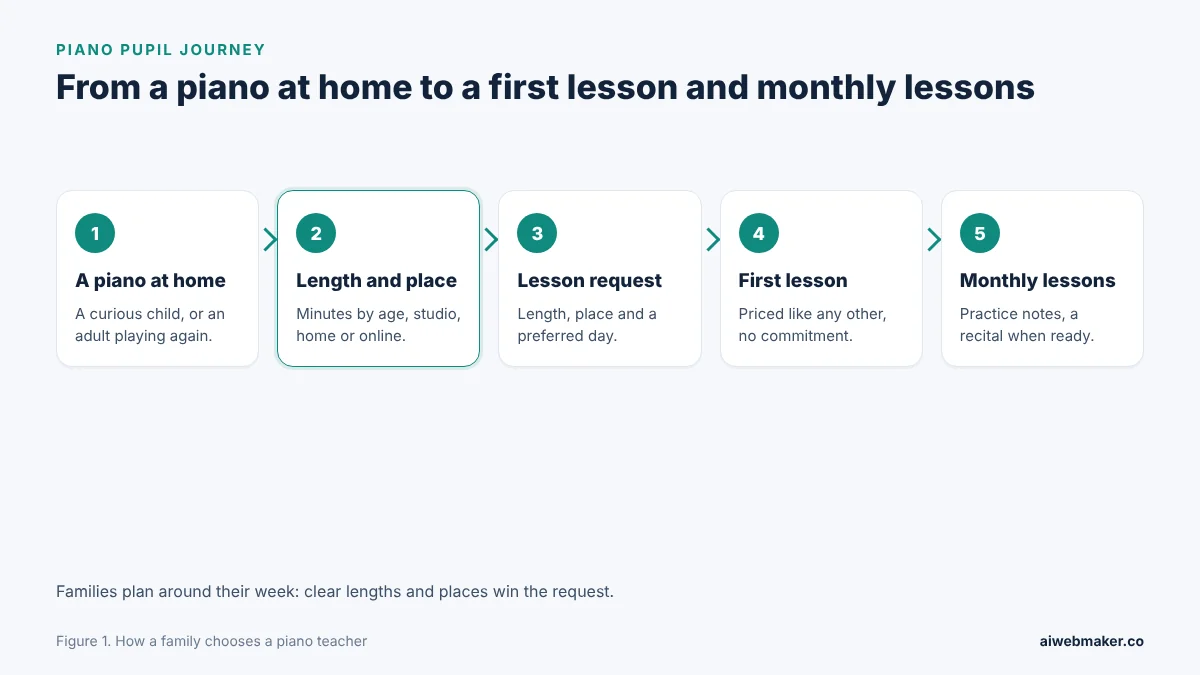
Length and place carry the second stage of this route, and a family that cannot match them to its week rarely reads the fees. The route starts with a piano at home and a child's curiosity, or an adult's wish to play again. In the highlighted stage the family finds a lesson length suited to the pupil's age and a place that fits the household, whether a studio, the sitting room or a screen. A lesson request and a first lesson follow, with the first one priced like any other and no commitment beyond it. Monthly lessons with written practice notes, and a recital once the playing is ready, complete the route.
Lengths, places, billing and recitals: the pages a piano teacher publishes
A piano teacher's pages should answer practical questions first and leave the teacher's story for later. Lesson lengths by age tell parents how long their child will sit at the keys, while a table of places explains the studio, home visits and online lessons side by side. Billing deserves its own section, because termly fees, holiday weeks and missed lessons cause most disputes in music teaching. Exams and recitals need a clear statement that both are optional. A section for parents on checks, sitting in and home visits completes the set.
| Page | Family's question | What it should state |
|---|---|---|
| The teacher | Who sits beside the pupil | Experience, styles, every lesson taught in person |
| Lesson lengths | How long for this age | 30, 45 or 60 minutes, ages and content |
| Places | Studio, home or online | The piano used, what to have ready, travel charge |
| Fees and billing | How payment works | Billed monthly, holidays, notice to move a lesson |
| Exams and recitals | Whether they are required | Optional, boards vary, recital dates |
| For parents | Whether it is safe | Checks, sitting in, an adult at home, messages |
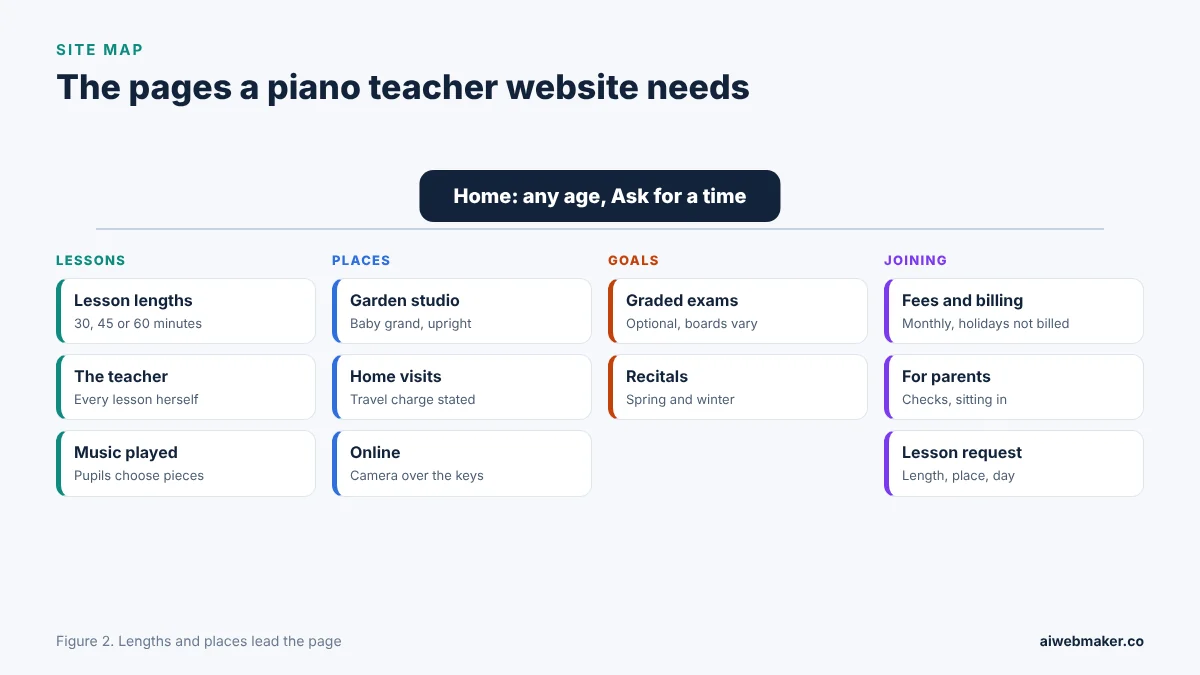
Lessons, places, goals and joining are the four branches here, with lesson lengths placed before anything about the teacher. Middle C Piano Lessons, the sample, presents Mira Castell, a piano teacher for twenty six years, under the line piano lessons that start where the pupil is. Its opening facts promise pupils from age five with no upper limit, three places to learn and two recitals a year where playing is optional. The piano teacher website example with studio, home and online lessons sets out a garden studio, home visits and online lessons in a table, then prices 30 minutes at $32, 45 minutes at $46 and 60 minutes at $60. Music on the stand this term, a section for parents, exams and recitals, reviews, questions and a lesson request follow, with the recital dates near the end.
Thirty, forty five or sixty minutes: lesson length by age and stage
Lesson length is the first decision a family makes, and the page should link it to age and stage rather than leave it to guesswork. The sample offers 30 minutes for ages five to eight, with short pieces, songs and rhythm games for a young attention span. Its 45 minute lesson, chosen by most pupils, suits ages nine and up and fits pieces, scales, sight reading and time for theory at the piano. The 60 minute lesson serves advanced pupils and adults, with room for longer works, recital pieces and the questions adults bring. Saying which length suits which pupil saves an awkward first month spent in the wrong slot.
| Length | Usually suits | What fits in | Sample fee |
|---|---|---|---|
| 30 minutes | Ages 5 to 8 | Short pieces, songs, rhythm games | $32 |
| 45 minutes | Ages 9 and up | Pieces, scales, sight reading, theory | $46 |
| 60 minutes | Advanced pupils and adults | Longer works, recital pieces, aural | $60 |
Garden studio, sitting room or webcam: three places to learn
Many piano teachers now teach in more than one place, and a table makes the differences clear without long paragraphs. The sample's garden studio suits every age and exam pupils, with a baby grand and an upright to play. Home lessons suit young children and families with siblings, using the family's own piano or keyboard, with an adult at home for pupils under twelve. Online lessons suit teenagers, adults and pupils who move away, provided a camera is angled over the keys in a quiet room. Home visits within about five miles add $8 a lesson for travel, a figure worth stating before the request rather than on the first invoice.
| Place | Suits | Piano used | What to have ready |
|---|---|---|---|
| Garden studio | Every age, exam pupils | Baby grand and upright | Music books and the practice notebook |
| The pupil's home | Young children, siblings | The family's piano or keyboard | An adult at home for pupils under 12 |
| Online | Teenagers, adults, pupils who move away | The family's piano or keyboard | A camera over the keys, a quiet room |
Billing by the month for the lessons that fall in it
Billing causes more friction in music teaching than any other subject, so the page should explain the method chosen and the reason for it. Teachers commonly bill by the term in advance, by the month or lesson by lesson, and each suits a different kind of practice. The sample bills each month for the lessons that fall in that month, so holiday weeks are never charged, and the first lesson is priced like any other with no commitment to continue. Fees reach the teacher directly as each month opens, two days of warning lets a lesson move to another slot that week or the next, and an unannounced absence is still billed. A family that reads these rules before booking rarely argues about them later.
| Billing model | How it works | Often suits |
|---|---|---|
| By the term | A set number of lessons paid in advance | Teachers with school term timetables |
| By the month | Lessons that fall in the month, paid at its start | Families who travel in holidays |
| Lesson by lesson | Paid on the day | Adults with irregular weeks |
Families send a lesson request through the booking website builder for piano teachers with studio, home and online pupils, giving the length, the place and a preferred day. Mira then accepts that time, offers the closest slot she has or says the week has no room, so the after school hours stay under her control. Fees pass from the family to the teacher with nothing deducted on the platform's side. The request also asks about the piano at home and the pieces the pupil loves, which shapes the first lesson. A family that has already chosen a length and a place usually turns up ready to begin.
Graded exams and two recitals a year, offered when the playing is ready
Exams and recitals motivate many pupils, but a page that presents them as compulsory frightens away families who just want music in the house. The sample prepares pupils for graded exams only when they want them, noting that exam boards, syllabuses and fees differ by country and that the board sets and marks the exam. Entry fees are set by each board, so the page should say they are separate from lesson fees and that no teacher can promise a result. Two recitals a year, on a Sunday afternoon in a community hall each spring and winter, give pupils of every age a reason to polish one piece, with pupil places at no charge. Nobody is marked or compared, and pupils who prefer to listen are just as welcome.
The piano at home, practice minutes and the parents' role
The instrument at home and the habit of practice decide progress more than any single lesson, so the page should give practical guidance on both. The sample suggests a digital piano is fine for the first year or two if it has 88 full size weighted keys and a sustain pedal, and its teacher offers to look at a listing before a family buys. Practice works best little and often, with about ten minutes a day for five and six year olds rising to twenty or thirty as pieces grow. A practice notebook says exactly what to do, so even a parent who cannot read music knows what to listen for. Mira holds the background check that the law sets for child pupils in her area, under rules that differ between countries, and a parent is welcome on the bench beside any pupil while lesson messages go only to the family.
Piano lessons for adults and a teacher who comes to the house: searches by learner and place
People rarely search for a piano teacher in the abstract. They type piano lessons for adults, lessons for a five year old, a piano teacher who comes to the house or online piano lessons. Most of those searches carry a town, which is why the studio's district and the home visit radius belong in the text. Separate rows for each place, and separate mentions of children and adults, answer those searches without stuffing the page. Reviews from returning adults and from parents of young pupils persuade their own groups best. Articles on choosing a digital piano, practising with young children or preparing for a first recital attract families long before they request a lesson.
The piano studio's website budget, from hosting to articles
The piano studio's pages cost a year of hosting and a web address, while twelve practice and repertoire articles drafted through credits come close to $7.80. A teacher with a full after school timetable keeps costs lowest through one yearly payment of $119. A teacher building a new studio may choose $19 a month while the first pupils arrive. Changing a fee, adding a recital date or rewriting the places table is not charged. Listed beside them, the $189 plan is there to measure the piano studio's two routes against.
| Item | Yearly | Monthly |
|---|---|---|
| Hosting the piano lesson pages | $119 | $228 over twelve months |
| Domain | Depends on the ending | Depends on the ending |
| Higher plan, for comparison | $189 a year | Not needed |
| Twelve practice and repertoire articles at about $0.65 | About $7.80 | About $7.80 |
| Fee, recital and place updates | No charge | No charge |
| Year before the domain | About $126.80 | About $235.80 |
No lesson lengths and no word on billing: why families ring a different teacher
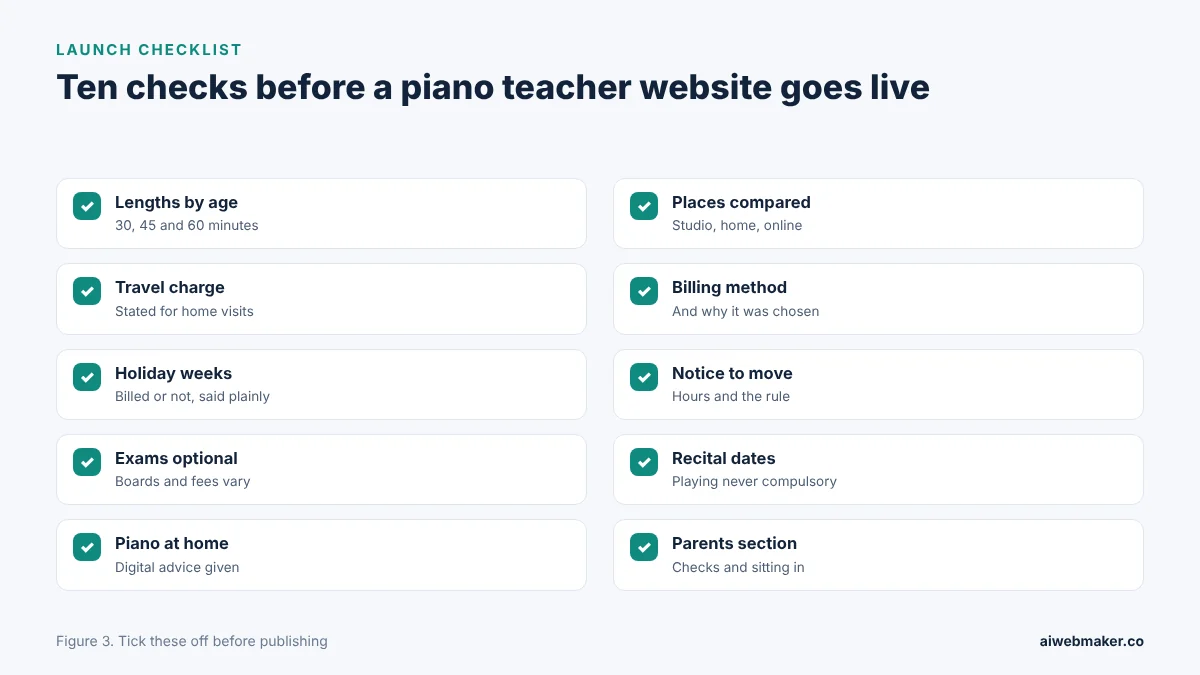
Families ring a different teacher when a page talks about passion for music but never says how long a lesson lasts or what it costs. Silence on billing makes parents fear paying for holiday weeks or long notice periods. Presenting exams as compulsory deters families who simply want their child to enjoy playing. No mention of checks, sitting in or home visit rules worries parents of young pupils. Adults looking for lessons leave when every photo shows a small child. Every one of those piano page gaps earns a line on the launch card that follows.
Frequently asked questions
Is a digital piano good enough for a beginner's practice?
For the first year or two, a digital piano is usually enough if it has 88 full size weighted keys and a sustain pedal. Lighter keyboards without weighted keys make it harder to build finger strength and control. A teacher can look at a listing with a family before they buy. Pupils who progress far may eventually outgrow a digital piano, and a good teacher says so honestly. The page can give this advice so families buy sensibly from the start.
How many minutes should a young child practise the piano each day?
Little and often works best for young pupils. Around ten minutes a day suits most five and six year olds, rising to twenty or thirty minutes as pieces grow longer. A practice notebook that says exactly what to do makes short sessions productive. Parents do not need to read music to help, only to listen and encourage. Regular short practice usually achieves more than one long session a week.
Can brothers and sisters have lessons on the same day?
Siblings can usually have lessons back to back on the same day, which suits home visits especially well. Each child still gets a full lesson of their own and their own notebook. Families should mention siblings when they request lessons so the slots can be planned together. Back to back lessons also save travel for the teacher. The page can describe this option so larger families know it exists.
Do piano pupils have to take graded exams?
Graded exams are optional, and many pupils learn happily without ever taking one. Exams suit pupils who like a clear goal and a certificate, and they follow a syllabus set by an exam board. Boards and their fees differ by country, and the board marks the exam, so no teacher can guarantee a result. A teacher should suggest an exam only when the playing is ready. Making this clear on the page reassures families who simply want music at home.
One month of weekly lessons, and the piano teacher's hosting year is paid
Four weekly 45 minute lessons for one pupil add up to $184, comfortably above the piano teacher's $119 hosting year. For teachers paying monthly, $19 stays under the fee for one short lesson of 30 minutes. Families who settle with a teacher often stay for many years, and younger siblings follow the older ones onto the stool. Clear lesson lengths, honest billing and optional exams persuade families more than any list of diplomas. A request that already names the lesson length and the place shows the pages have answered the practical questions before the first scale.
Build your website in Minutes and get the AI Tools that work
Start Building Your Website →