Personal Training Website Cost, From First Consultation to Results
A personal trainer's hosting bill is $119 for the year, coaches preferring monthly bills pay $19 each time, and a domain is bought to match. The guide then turns to clients, coaching formats, screening, credentials, results, session requests, search and the sums behind a year online.
- No coding required
- Live in minutes
- Blog, SEO and chatbot tools included
A personal trainer's website needs $119 of AI Web Maker hosting each year, or $19 per month for coaches who like smaller payments, with the domain added separately. Programme pages and prices can be drafted, read through and adjusted while still in preview, a stage AI Web Maker never invoices. During that stage, the personal training business website sample is worth a look, since it shows the plans and proof of Forge Fit Coaching, a fictional trainer whose site AI Web Maker generated. A single block of sessions, or one month of online coaching, usually pays for the full year. What takes more effort is winning over someone who may feel self conscious about their body, their fitness or past attempts to get fit. Clients are choosing a person for something private, and they look for warmth, competence and safety before price. What follows covers who hires a trainer, the pages and formats a coach needs, the first consultation and health screening, qualifications, honest results, session requests, search and the sums behind a year online.
This article is part of our complete guide: Fitness Website Builder.
Who hires a personal trainer, and what makes them pick one coach?
People hire a personal trainer at turning points, and each turning point brings its own worry about whether the coach will understand. Beginners who find gyms intimidating want a patient guide who will not judge them. People preparing for a wedding, a race or a hiking trip want a plan with a deadline. Older adults often look for strength and balance work, while new parents want training that fits around broken sleep. People returning after an injury need a coach who works within the advice of their doctor or physiotherapist. Busy professionals and clients in other cities increasingly choose online coaching because it fits their week. Whatever the starting point, specialism, personality, qualifications and price decide who receives the first message.
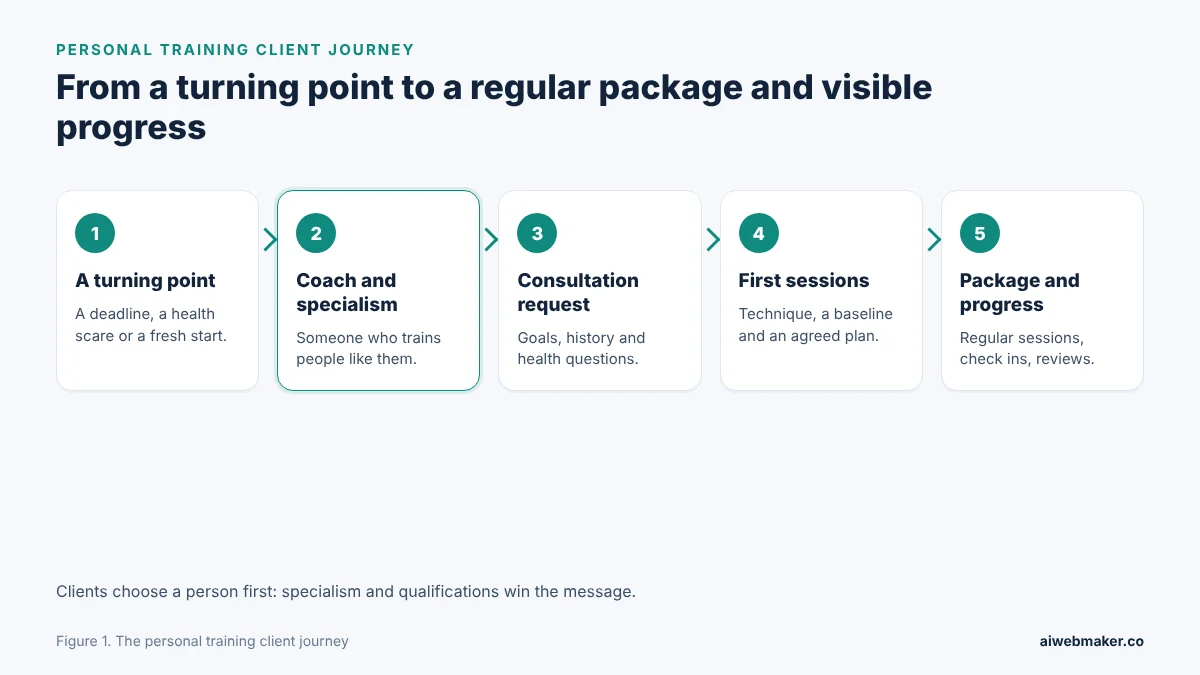
Five steps carry a client from a private decision to a regular slot in the coach's week, and the second step is where most trainers win or lose them. The turning point often comes months before the search itself. At the coach and specialism step, visitors compare profiles and look for someone who has trained bodies, ages and goals like theirs. A consultation request follows, and the health questions asked there set the tone for a safe working relationship. The first sessions establish technique and a baseline, which the coach later uses to show progress. Trainers who make each step visible on their pages convert far more of those long considered decisions.
Coaching options, the coach's story and results: the pages a trainer needs
A trainer's website should follow the decisions a client makes, starting with the format of coaching and ending with a consultation request. Each format deserves its own page, because a client weighing online coaching asks different questions from one wanting a coach in the gym. The about page carries more selling weight than on most sites, since clients are choosing a person. A results page shows that people with similar starting points have progressed. A page explaining the first consultation removes the fear of the unknown.
| Page | What the visitor asks | What to include |
|---|---|---|
| Home | Can this coach help someone like me? | Specialism, a real photo, formats, consultation button |
| One to one coaching | What happens in a session? | Location, length, what a session includes, price |
| Online coaching | How does remote coaching work? | Check ins, video feedback, programme updates, price |
| Training plans | Is there a cheaper way to start? | Plan length, equipment needed, level, price |
| About the coach | Is this person qualified and kind? | Story, qualifications, insurance, specialisms |
| Results | Have clients like me progressed? | Consented stories, realistic outcomes, context |
| First consultation | What will be asked at the start? | Health questions, goals, what to bring |
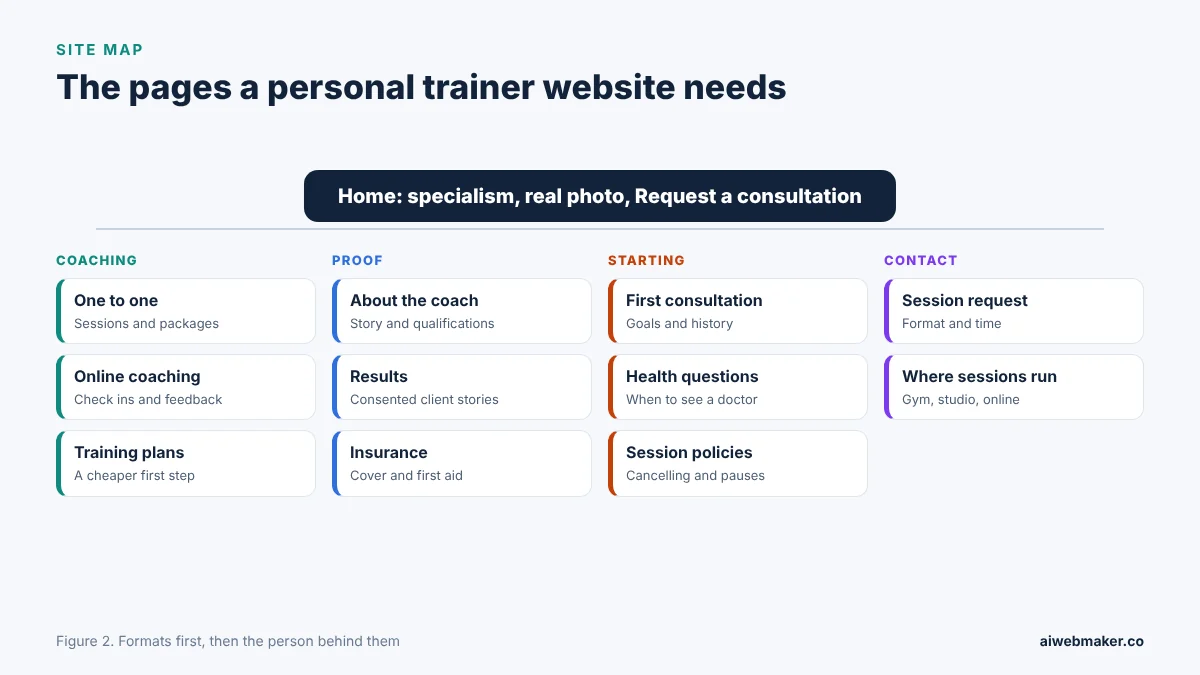
Beneath the home page, this trainer's site map splits into four groups that answer a client's questions in the order they arise. Coaching pages hold one to one sessions, online coaching and training plans, each with its own price. Proof pages hold the coach's story, qualifications and consented client results. Starting pages explain the consultation, the health questionnaire and session policies, while the contact group carries the request route. Forge Fit Coaching, the sample business, lists one to one coaching, online coaching and training plans as bookable services, with the plans priced well below the coaching options; the personal trainer website example with online coaching and training plans took 48 seconds to build. Its coach page has sections for the coach's story and for qualifications and experience, and its results page, headed Real Clients, Real Results, points visitors to the programme options after the stories.
In person sessions, remote programmes or a written plan: weighing the formats
Each coaching format trades the coach's attention against price and flexibility, and the website should make those trades obvious. In person sessions give the closest supervision, which matters most for beginners and for anyone relearning movement after time away. Online coaching relies on a written programme, regular check ins and video of the client's lifts, so it suits people who already train with some confidence. Training plans cost least and ask least of the coach, which makes them a gentle first step and a test of the coach's style. Small group and hybrid options sit between these for clients who want company or a lower price. A clear comparison lets each visitor choose the right level of support without a sales call.
| Format | How it runs | Often suits | What the page should state |
|---|---|---|---|
| One to one in person | Coach present for every session | Beginners, nervous exercisers, close accountability | Location, session length, package sizes |
| Partner or small group | Two to six people share a coach | Friends, couples, cost conscious clients | Group size and how levels are matched |
| Online coaching | Programme, check ins and video form review | Confident exercisers, clients elsewhere | Check in rhythm, reply times, equipment |
| Training plan | A written programme without ongoing coaching | Self starters, people testing the coach | Length, level, equipment, support included |
| Hybrid | Occasional in person sessions plus online support | Clients wanting both | How the split works across a month |
What should the first consultation and health screening cover?
A first consultation should cover goals, training history, injuries, medical conditions and lifestyle, because a programme is only as safe as the information behind it. Many trainers use a standard pre exercise questionnaire asking about heart conditions, chest pain, dizziness, joint problems, medication and pregnancy. Certain answers mean the client should get clearance from a doctor before training starts, and the website can say so calmly. Health details count as sensitive personal data in many countries, so the page should explain how they are stored and who sees them. The consultation is also where the coach explains how sessions run, takes agreed baseline measures and sets first goals. Clients who see this process described in advance trust that the coach takes their body seriously.
| Question area | Why the coach asks | Usual next step |
|---|---|---|
| Heart problems, chest pain, fainting | Exercise raises the demand on the heart | Doctor's clearance before training |
| Joint or back problems | Some movements may need adapting | Adapt, and follow clinical advice the client shares |
| Recent surgery or injury | Healing tissue needs time | Wait for advice on returning to exercise |
| Pregnancy or a recent birth | Needs change from stage to stage | Check with a midwife or doctor, then adapt |
| Medication | Some affect heart rate or balance | Ask the prescriber whether limits apply |
| Goals and history | Shapes the whole programme | Agree targets and how progress is measured |
Qualifications, insurance and the limits of a trainer's advice
A trainer's qualifications should be named precisely, because the title personal trainer is not protected in many countries and clients cannot tell a weekend course from years of study. The page should give the qualification, its level and the body that awarded it. Where a country runs a register of exercise professionals, membership and a number add accountability, though the rules differ widely. Liability insurance and current first aid training belong on the about page, alongside specialist courses for groups such as older adults or new mothers. Nutrition needs particular care, since in many countries dietitians are regulated and trainers should keep to general healthy eating guidance and refer clients with medical conditions. Clearly drawn limits make a coach look more professional, not less capable.
| Credential | What it tells the client | How to present it |
|---|---|---|
| Recognised training qualification | Core competence to coach | Name, level and awarding body |
| Professional register, where one exists | Accountability to a standards body | Register name and membership number |
| Liability insurance | Protection if something goes wrong | A plain statement that cover is held |
| First aid and CPR | Readiness for an emergency | Date of the latest renewal |
| Specialist courses | Skill with particular groups | Which client groups each course covers |
| Nutrition training | Competence in general guidance | When the coach refers to a dietitian |
How can a results page persuade without promising too much?
A results page persuades when it tells real stories with context, permission and realistic numbers rather than dramatic transformations. Strength gained, a first race finished, steadier balance or better sleep often convince more than a weight loss figure. Every photo and quote needs written consent, and clients should be able to withdraw it later. A short note that results vary with starting point, consistency and health protects clients from false expectations. Advertising rules on health and fitness claims are strict in many countries, so promises of a set loss in a set time are best avoided entirely. Honest stories attract clients who stay, because they arrive with expectations the coach can meet.
How do session requests, packages and cancellations work?
A client requests a session or consultation by choosing a format and a time, then sending it to the coach. The trainer confirms it, shifts it to a slot that suits both, or declines it when the goal falls outside the coach's specialism. The booking website builder for personal trainers and online coaches lists each coaching format as a service a visitor can request. Package fees and monthly coaching fees are settled directly between client and coach, and none of that money passes to the platform. Late cancellation terms, the life of a package and what happens when a client falls ill or travels should sit beside those services in plain words. Clients accept firm terms when they can read them before committing.
What do people type when they want a coach for strength, rehab or a race?
Clients search for phrases such as personal trainer near me, female personal trainer, online strength coach, postnatal personal trainer or personal trainer for over fifties, often with a district. A page for each specialism, with those words in its heading, reaches people the generic home page misses. Trainers who work from a studio benefit from a map listing with real photos and accurate hours, while mobile trainers can list the areas they cover. Reviews that mention patience, careful technique or confidence regained are especially persuasive. Articles on starting strength training later in life, or on what a first session involves, reach people still deciding. Practical writing builds the reputation a coach needs before strangers trust them.
How small is the website bill beside a trainer's other costs?
Against gym rent, insurance and equipment, the website is among the lightest costs a personal trainer carries. Coaches with a settled client list spend less on the yearly route. A trainer building a first roster may prefer the monthly route while income settles. A monthly technique article, written with credits, totals under eight dollars for the year. Yearly and monthly figures sit side by side in this table, while the $189 tier appears purely so the two plans can be compared.
| Item | Yearly | Monthly |
|---|---|---|
| Hosting the personal training pages | $119 | $228 over twelve months |
| Domain | Depends on the ending | Depends on the ending |
| Higher plan, for comparison | $189 a year | Not needed |
| Twelve technique and training articles at about $0.65 | About $7.80 | About $7.80 |
| New programmes, prices and client stories | No charge | No charge |
| Year before the domain | About $126.80 | About $235.80 |
Which warning signs make a visitor close a trainer's site?
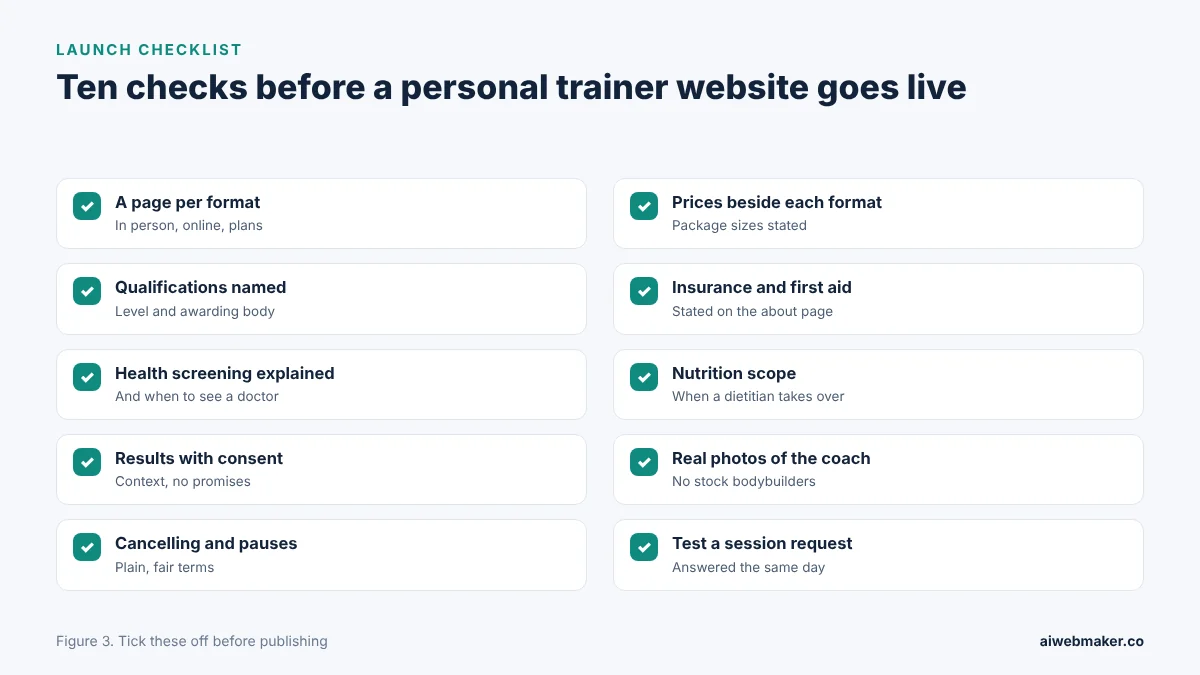
Visitors close a trainer's site when it feels like a pressure sale or when it gives them nothing to check. Missing qualifications or insurance make the coach look like a hobbyist. Stock photos of bodybuilders tell beginners the coach trains a different kind of person. Dramatic transformation claims, with no context, put off the cautious people most likely to stay for years. Hidden prices and vague online coaching details leave visitors unsure what they would buy. Those gaps, and the fixes for them, appear in the ten points pictured next.
Frequently asked questions
How many sessions a week does a new client usually need?
The right number depends on the client's goals, budget and recovery, so the coach agrees it at the consultation rather than prescribing it online. Many clients start with one or two supervised sessions a week and train alone in between with a written plan. Beginners often progress well with modest frequency, because consistency matters more than volume. The website can describe typical starting patterns without suggesting that one number suits everyone. Flexible guidance reassures visitors who fear being pushed too hard at the start.
Can a personal trainer write a meal plan?
Whether a trainer can write a detailed meal plan depends on their qualifications and on the rules in their country. Many trainers give general healthy eating guidance, such as regular meals, enough protein and plenty of vegetables. Clients with diabetes, eating disorders, allergies or other medical conditions should be referred to a registered dietitian or doctor. Stating this scope on the website shows responsibility. Coaches who know where their expertise ends protect both their clients and their reputation.
Does online coaching work for complete beginners?
Online coaching can work for beginners when the coach reviews video of each exercise and keeps the programme simple at first. Some beginners prefer a few in person sessions to learn the basics before moving online. The website should explain how technique is checked remotely and how quickly the coach responds to questions. Equipment needs, such as gym access or a few home weights, should be stated. Honest guidance helps each beginner pick the format that will actually keep them training.
Is a gym membership needed to train with a coach?
The answer depends on where the coach works, so the website should state it plainly. Some trainers work inside a commercial gym where clients need their own membership, while others use a private studio, parks or clients' homes. Online clients may train at home with minimal equipment or in their own gym. Entry fees or travel charges belong beside the session prices. Clear answers prevent surprises that could sour the first week.
Does one coaching package repay the trainer's website for the year?
One package of sessions, or a single month of online coaching, typically brings in more than a trainer's whole year of hosting at $119. The $19 on monthly billing is recovered by a fraction of one session. Each client who stays for a year is worth many years of hosting, and satisfied clients tend to bring friends and family. Precise qualifications, honest results and a simple consultation request earn that loyalty from the very first visit. Coaches who keep their programmes and client stories current give every new visitor a reason to send a request. A full diary built partly from website requests shows the pages repaying their modest cost.
Build your website in Minutes and get the AI Tools that work
Start Building Your Website →