Mobile Personal Trainer Website Cost and the Travel Zone Behind It
A mobile personal trainer's pages cost $119 a year to host, or $19 a month, with a domain added. Covered: who trains at home, travel zones, kit and floor space, packs and moving rules, parks and insurance, first visits, search and the yearly budget.
- No coding required
- Live in minutes
- Blog, SEO and chatbot tools included
On AI Web Maker, a trainer who drives to clients pays $119 for a hosted year, or $19 in monthly steps, and buys a domain too. Drafting and rearranging the pages in preview, as many times as the trainer likes, costs nothing at all. A single pack of sessions sold to one new client pays for that hosting several times over. The harder sum hides in the diary, because every mile driven and every minute spent parking is time nobody pays for unless the website sets the rules. Clients also need to picture a stranger arriving at the door with kettlebells, and the pages have to make that feel ordinary. Covered here: who books training at home, travel zones and fees, kit and floor space, packs and their terms, parks and insurance, the first home visit, search and the yearly budget.
This article is part of our complete guide: Fitness Website Builder.
Living rooms, lunch breaks and parks: who asks a trainer to come to them
Clients who hire a trainer to travel to them are usually buying back time rather than avoiding effort. Parents with young children fit a session into the gap after the school run, and shift workers train when a gym would be packed or closed. Older adults and people returning after illness often prefer their own living room to a mirrored gym floor. Offices book lunchtime groups, and some clients simply want sunrise sessions in a nearby park. Each of them checks the same things: whether the trainer reaches their street, what turns up with the kit and how much room a session needs.
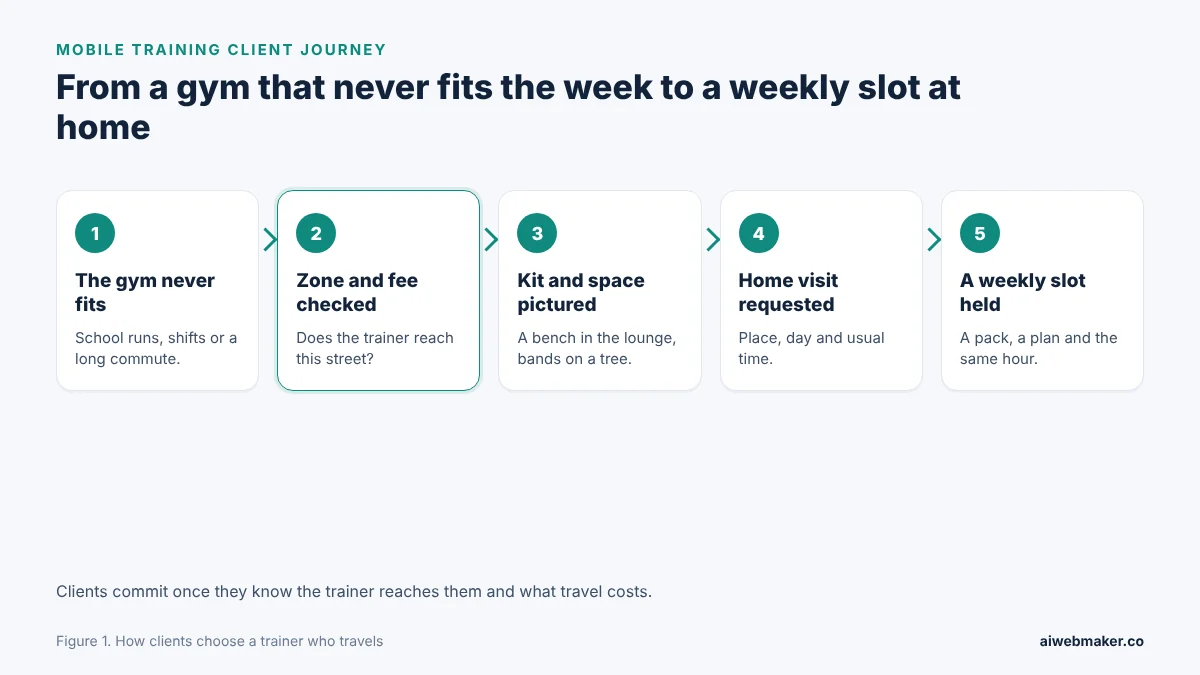
Most trainer websites skip the highlighted step, and that gap quietly loses requests. A client who has decided to train at home first wants to know whether the trainer comes to their part of town and whether that adds a fee. Only then do they look at the kit and the space. The home visit request follows, and the last step is a weekly slot that both sides keep. A website that settles the travel question early lets the rest of the journey run without phone calls.
Zone, kit, space and packs: pages a travelling trainer needs
A mobile trainer's website is mostly logistics, and every page should remove one reason to phone before requesting a visit. The home page states the travel zone and the kinds of place served, such as homes, parks and offices. A kit page lists what arrives, and a space page measures the floor each setting needs. Session types and packs follow with their prices and their moving rule. A first visit page and the request close the route.
| Page | The client's question | What it should show |
|---|---|---|
| Home | Do you come to my area? | Travel zone, places served, a request button |
| The kit | What arrives at the door? | Each item with weights, cleaning between clients |
| Space needed | Is the flat big enough? | Floor size per setting, noise and floor protection |
| Sessions and packs | What does each session cost? | Single prices, pack prices, expiry, moving rule |
| First visit | What happens before training starts? | Length, health questionnaire, space check |
| Request and contact | How does it begin? | Place, times, stairs or parking notes |
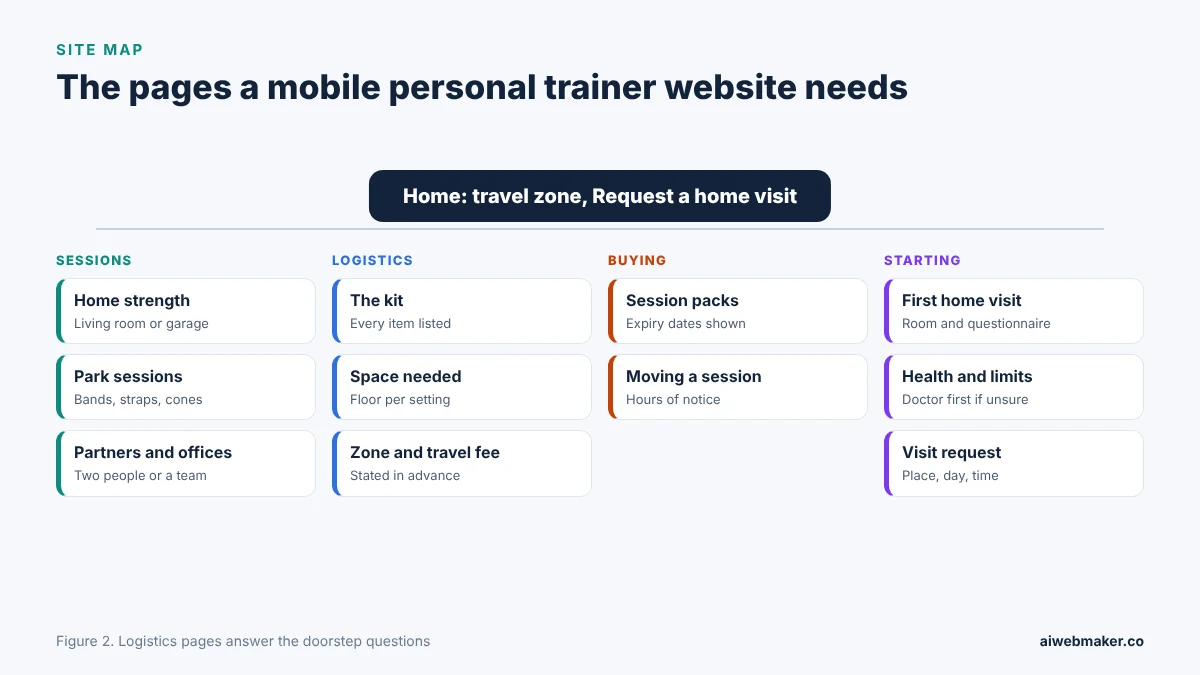
Read from left to right, the plan moves from what is offered to how it arrives, what it costs and how it begins. Session pages cover training at home, in parks, with a partner and for office groups, while logistics pages hold the kit, the space table and the zone. Buying pages carry the packs and the moving rule, and the start group holds the visit and the request. Doorstep Strength Training, the invented trainer in our sample, lists Home strength, Park sessions, Partner sessions and an Office lunch group, then prices packs of Five sessions, Ten sessions and Twenty sessions. Its single page also measures the room each setting needs, and the mobile personal trainer website example with a travel zone and session packs finishes with a request for a first home visit.
Travel zones, travel fees and the minutes lost between doorsteps
Travel is the cost that separates mobile training from a gym, and the website is where a trainer turns it into rules rather than awkward conversations. A zone drawn as a distance from a town centre, or as a list of neighbourhoods, tells clients at a glance whether they are inside it. Outside the zone, a flat fee per session stated in advance is easier to accept than a mileage sum worked out later. The diary matters as much as the fuel, because two clients twenty minutes apart can cost the trainer an unpaid hour every day. Grouping sessions by district, one area in the mornings and another in the evenings, protects the hours that actually earn.
| Zone setup | How it reads to a client | Watch for |
|---|---|---|
| A radius from the town centre | Simple to check on a map | Rivers and ring roads that make short trips slow |
| Named neighbourhoods | Familiar names, no measuring | Clients just over the border asking for exceptions |
| No travel fee inside the zone | The price is the session price | Zones drawn too wide to fill |
| A flat fee outside the zone | Known before any request | Fees that do not cover the extra time |
| Area days | Sessions grouped by district | Clients who cannot move their slot |
The kit in the boot and the floor each setting needs
Clients booking training at home worry about two things: buying equipment and running out of room. A kit page that lists every item, with the weight range of the dumbbells and kettlebells, answers the first worry before it is voiced. A space table answers the second by giving a rough floor size for a living room, a garage, a park and an office, with the kit that suits each. Notes on mats that protect the floor and on keeping heavy weights low reassure people who live above neighbours. A line asking clients to mention stairs, lifts and parking saves the trainer from carrying a full bag up five floors unannounced.
| Setting | Space | Kit that travels | Good to mention |
|---|---|---|---|
| Living room | A clear patch of floor about the size of a rug | Dumbbells, bands, a bench, mats | Floor protection and noise below |
| Garage or garden | Flat ground with room to swing a kettlebell | The full kit | Where the session goes in heavy rain |
| Park | Flat grass near a meeting point | Bands, straps, lighter kettlebells, cones | Permits and other park users |
| Office | A meeting room or roof terrace | Bands, dumbbells, mats | Building rules and who books the room |
Packs, expiry dates and the notice to move a session
Session packs are how most mobile trainers smooth an uneven income, and their terms deserve more care than their prices. A pack lowers the price per session in return for commitment, and an expiry date keeps that commitment real. The moving rule, often a set number of hours' notice, protects the trainer's travel time as much as the slot itself. Illness, bad weather and a client who simply forgets all need an answer written beside the packs rather than invented on the doorstep. Consumer rules on prepaid services and refunds vary between countries, so the wording should be checked against local law before it goes live.
Parks, offices and other people's homes: permits, insurance and conduct
Training outside a gym brings rules that a studio owner never meets, and mentioning them makes a trainer look professional rather than cautious. Many towns ask trainers to hold a permit before coaching paying clients in public parks, while others have no such rule, so the trainer should check locally and say which permits are held. Liability insurance covering clients' homes and public spaces is widely expected, and offices may ask to see it before booking a lunch group. Inside a home, a note on children, pets and weights kept on the mat answers questions families rarely ask aloud. Trainers working alone also benefit from simple safety habits, such as sharing the day's diary with someone they trust.
Health screening belongs on the website too, framed as caution rather than diagnosis. A questionnaire at the first visit, covering conditions, medicines, injuries and pregnancy, lets the trainer plan sensibly. Heart trouble, raised blood pressure, a recent operation or simple uncertainty about exercise are all reasons for a doctor's view before the first session. The trainer then works within that advice and never offers medical opinions of their own. Promises about weight or appearance belong nowhere on the site, and advertising rules in some countries restrict them anyway.
A half hour visit before any pack is sold
Meeting the client and seeing the room before selling anything is the mobile trainer's version of a gym tour, and the website ought to walk through it in order. It usually lasts around half an hour and covers the room, the health questionnaire and a few easy movements. Within a day or two, the client receives a plan for the first sessions that fits the kit and the floor. Describing that visit removes the fear of a sales pitch on the sofa. Clients who know exactly what the first meeting involves are far more willing to request it.
On the booking website builder for mobile personal trainers and home visits, the client sends a request naming the place, a preferred day and the usual time. The trainer can confirm that visit, suggest a time that suits the route better, or decline when the address lies outside the zone. Clients pay for packs and single sessions straight to the trainer, without the platform touching a cent. The builder writes a first draft of the session, kit and pack pages once the trainer has described the business in a few lines. Asking for the full address only after confirmation keeps the request short and respects the client's privacy.
Searches that start with at home, in the park or near me
People looking for a trainer who travels type phrases such as mobile personal trainer, personal trainer at home, outdoor personal training or a trainer who comes to you. A page for each kind of session, with those words in its heading, matches the search to the right offer. The map listing should name the areas served rather than a home address, since there is no studio for visitors, and many listing services allow a service area instead. Reviews from clients who mention their small flat, their office or their park make the next reader feel their situation is covered. Articles about training in a small space, kit worth owning between sessions or staying active through winter bring steady readers between requests.
Fuel, kit and the website: where the $119 sits
Against the fuel, the insurance and the kit in the boot, the website is one of a mobile trainer's smallest yearly costs. Hosting is $119 paid annually or $19 paid each month, and the domain price follows whichever of about 400 endings is chosen. Twelve articles about home training, written with AI credits, add roughly the price of a coffee. Moving the zone, repricing packs or adding a park brings no extra charge. A $189 tier is listed beside them only to show the comparison.
| Item | Yearly | Monthly |
|---|---|---|
| Hosting the mobile training pages | $119 | $228 over twelve months |
| Domain | Depends on the ending | Depends on the ending |
| Higher plan, for comparison | $189 a year | Not needed |
| Twelve home training articles at about $0.65 | About $7.80 | About $7.80 |
| Zone, pack and session changes | No charge | No charge |
| Year before the domain | About $126.80 | About $235.80 |
Missing zones, mystery kit and other reasons a client looks elsewhere
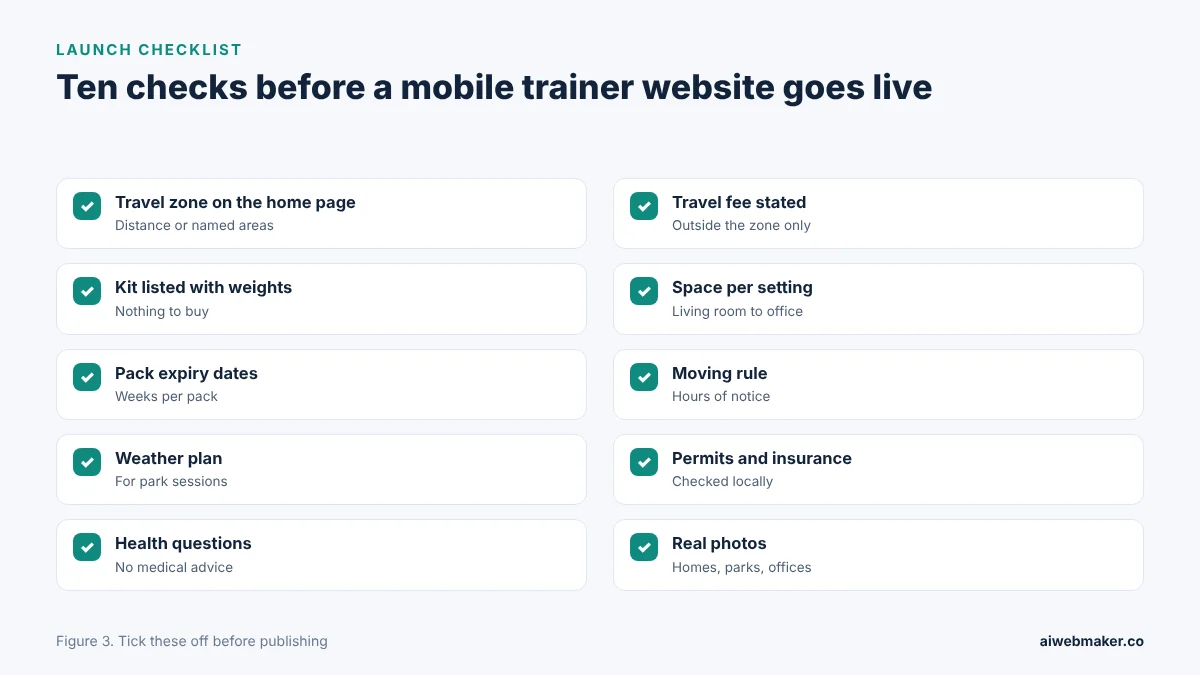
A client looking for training at home leaves quickly when the website never says which areas the trainer covers. Silence on the kit makes people fear they will have to buy equipment or train with nothing but a mat. A pack price without an expiry date or a moving rule looks like a trap, and a travel fee mentioned only on the phone feels like a surprise. Photos taken in a gym the trainer does not use undermine the whole idea of training at home. Ten launch checks, pictured next, settle those doubts one by one.
Frequently asked questions
Does rain cancel a session in the park?
Most mobile trainers keep training in light rain and move the session in heavy rain, lightning or high winds, and the website should say exactly that. The usual alternatives are the client's home, a covered space nearby or another day without any charge. Clients appreciate knowing who makes the call and how early they will hear. A short weather rule written beside the park sessions prevents arguments on wet mornings. Clear rules keep outdoor clients loyal through the seasons when park training is hardest.
Does a client need to own any equipment?
A good mobile trainer brings everything a session needs, so clients only need trainers, water and a clear patch of floor. Some clients like to buy a pair of bands or a single kettlebell for the days between sessions, and the trainer can suggest what to look for without selling anything. The kit page should say that nothing has to be bought. That line removes one of the commonest reasons people hesitate. Honest advice about equipment makes the trainer look like a coach rather than a salesperson.
Can a mobile trainer run sessions for office teams?
Office sessions are a natural extension for a trainer who already travels, and a lunchtime group can earn more per hour than a single client. The page should state the group size, the room needed, whether people train in work clothes and who pays, the company or each person. Building rules, insurance and health questions for each participant should be settled before the first session. A regular weekly slot suits both the office and the trainer's route. Clear terms turn one office booking into a standing arrangement.
Should a trainer's insurance be mentioned on the website?
Mentioning insurance is sensible because clients are inviting a professional into their home or onto public land. The page can say that the trainer holds liability insurance suited to mobile work, without printing policy numbers that change each year. Offices and park authorities may ask to see a certificate, so offering one on request saves time. Requirements and typical cover differ between countries, so the wording should reflect what applies locally. A single calm line on insurance does more for trust than a long list of qualifications.
One pack, one client and the year's hosting
One pack of sessions, sold once, outweighs a full year of the trainer's hosting by a wide margin. Paid monthly instead, the $19 still falls below one hour of training at nearly any doorstep. Each client who keeps a weekly slot for a season is income the zone and kit pages helped secure. Clear logistics persuade busy people that training at home will actually happen, which is the promise they are paying for. A diary filled street by street, with less driving between doorsteps, shows the website is shaping the business as well as filling it.
Build your website in Minutes and get the AI Tools that work
Start Building Your Website →