Maths Tutor Website Cost and the First Session That Finds the Gap
Maths tutoring pages need $119 of hosting each year, with $19 as the cost of each month when paid monthly, plus whichever domain ending is chosen. Covered: families, pages, topics by age, the first session, the hour, fees and blocks, anxiety and safeguarding, search and sums.
- No coding required
- Live in minutes
- Blog, SEO and chatbot tools included
For a maths tutor, the yearly hosting comes in at $119, the monthly route at $19, and the domain on top at whatever its ending costs. Setting out the topic table, the fee cards and the first session request in preview costs the tutor nothing. Three online hours of homework help already pay for the hosting year. A tougher test is that a parent searching for maths help is often watching a child in tears over homework, and wants proof that the tutor will find the real problem rather than repeat the class topic more loudly. Maths trouble usually starts with one topic that never landed years earlier, and a website that explains how that gap is found wins the first session. Covered here are families, pages, topics by age, the first session, the hour, fees and revision blocks, anxiety and safeguarding, search and the yearly sums.
This article is part of our complete guide: Fitness Website Builder.
Homework tears, exam terms and the student who has given up: who looks for a maths tutor
Families look for a maths tutor at three predictable moments. Homework becomes a nightly battle, an exam year begins or a student announces they are simply bad at maths. Parents of ten and eleven year olds bring fractions, times tables and word problems. Parents of teenagers bring algebra, trigonometry and exam timing, often with a date already circled. College students arrive with calculus, statistics or mechanics and less patience for anything that feels like school. Some families want evening sessions online because the week is too full for travel. Every one of them wants to know whether the tutor understands the course and how the first session will work.
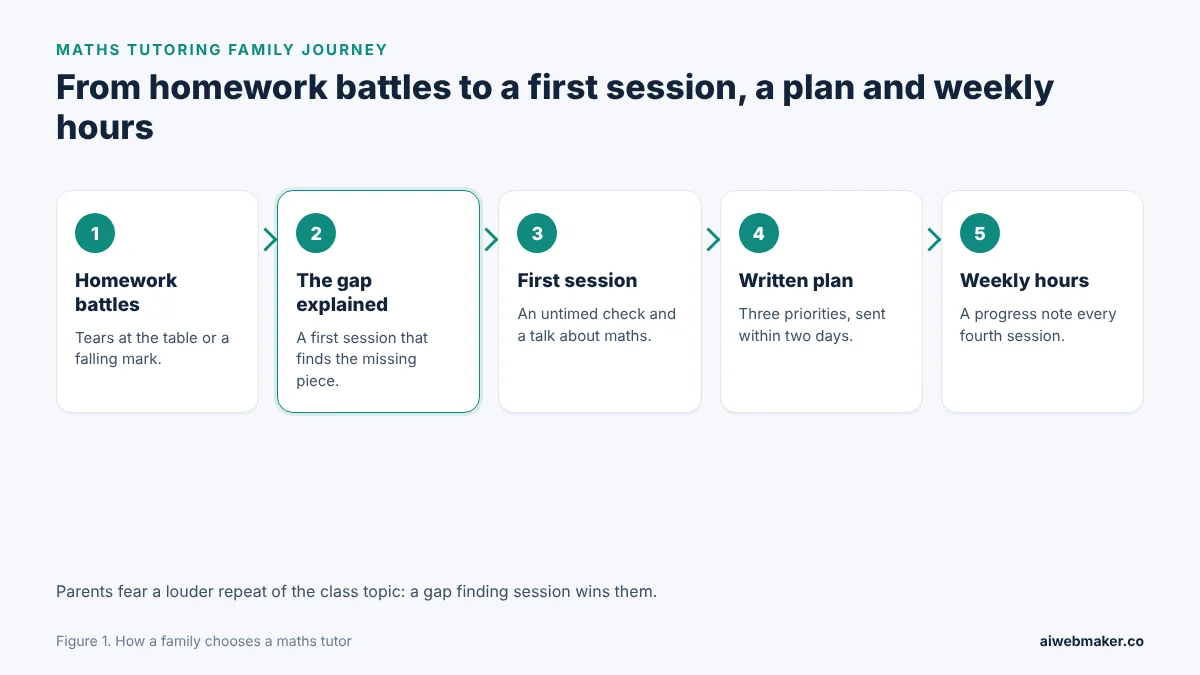
A parent's trust is won at the second card of this path, where the page explains how the real problem is found. The path begins with homework battles or a falling mark that nobody at home can fix. In the highlighted card the parent reads that the first session is an untimed check for the missing piece rather than a test. The first session follows, then a written plan with three priorities sent to the parent within two days. Weekly hours with a progress note every fourth session complete the path, and families who see the plan working tend to stay until the exams are over.
Topics, help, the first hour and fees: the pages a maths tutor needs
A maths tutor's pages should show that the tutor knows the course, has a method and keeps parents informed. A topics page lists what students bring at each age and maps it to the courses followed locally. A page on the kinds of help separates homework support, exam revision and confidence rebuilding, since each family arrives with one of those in mind. The first session and the structure of an hour deserve their own sections, because they show how the tutor actually works. Fees, safeguarding and the session request complete the set, with notice periods and formats written plainly.
| Page | Parent's question | What it should state |
|---|---|---|
| Topics by stage | Whether the tutor knows this course | Ages, topics, focus, courses mapped |
| Kinds of help | Homework, exams or confidence | Three services with starting prices |
| First session | What happens at the start | An untimed check and a written plan |
| The hour | What a session looks like | Four parts and the minutes in each |
| Fees | What tutoring costs | Online, in person, revision blocks, notice |
| Safeguarding | Whether a child is safe | Checks, open doors, camera on, parents welcome |
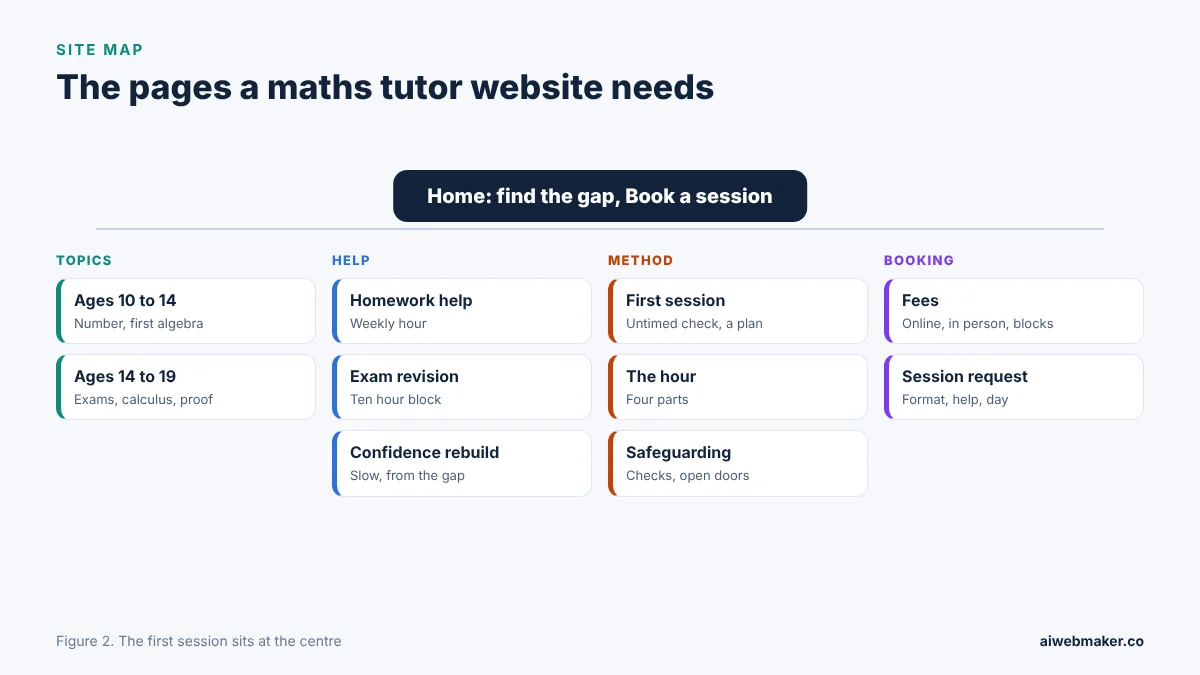
Topics, help, method and booking divide this plan into four, with the first session at the centre of the method group. Proof Point Maths Tutoring, the sample, presents Leila Haddad, who taught secondary maths for eleven years, under the line maths that makes sense one line at a time. Its opening facts cover ages 10 to 19, sessions of 60 minutes and a first session that finds the gaps. The maths tutor website example with a first session that finds the gap then shows a table of topics by age, three kinds of help from homework support to a confidence rebuild, and an hour broken into four parts. Fees cover an online hour at $50, an in person hour at $58 and a ten hour revision block at $480, followed by safeguarding, reviews, questions and a session request.
Topics by age, mapped to the course the student actually follows
A topics table tells parents the tutor knows what their child is studying, which matters more to them than any qualification listed on its own. The sample groups topics into four age bands, from fractions and place value at ten to calculus and proof at nineteen, and adds what sessions focus on at each stage. Because curricula, course names and exams change between countries, the sample's note says the first session maps every topic to the course the student follows. Parents can then match the table against the homework sheet on the kitchen table. That practical match persuades more than a generic list of subjects.
| Ages | Typical topics | What sessions focus on |
|---|---|---|
| 10 to 11 | Fractions, place value, times tables, word problems | Number fluency and reading the question |
| 11 to 14 | Negative numbers, first algebra, ratio, angles | Neat working and lasting habits |
| 14 to 16 | Quadratics, simultaneous equations, trigonometry, probability | Exam style questions and timing |
| 16 to 19 | Calculus, statistics, mechanics, proof | College courses and longer problems |
The first session as a search for the missing piece
Most maths trouble starts with one earlier topic that never quite landed, and everything built on it wobbles. The sample's first session is a relaxed, untimed check of earlier topics mixed with a conversation about how maths feels, so the student is never put on the spot. Afterwards parents receive a short written note within two days, saying what is secure, where the gap seems to be and the three priorities for the coming weeks. That note becomes the plan and is updated every fourth session. A first session described this way tells parents the tutor will diagnose before teaching, which is exactly what a struggling student needs.
Sixty minutes in four parts
Parents rarely see inside a tutoring session, so a page that shows how an hour is spent builds trust quickly. The sample opens each hour by asking the student to redo last week's hardest question without help, to check it stuck. A new idea follows, explained two ways and drawn on the board or a shared screen. Guided questions then grow gradually harder, with every line of working shown, and the hour ends with a recap in the student's own words and three questions for the week. Structure like this turns a vague promise of help into a routine a parent can picture.
| Minutes | What happens |
|---|---|
| First 10 | Last week's hardest question, done again without help |
| Next 20 | One new idea, explained two ways |
| Next 20 | Guided questions that grow harder, working shown |
| Last 10 | A recap in the student's words and three questions to try |
Hourly rates, ten hour revision blocks and the exam calendar
Maths tutoring fees should separate steady weekly help from the concentrated work of an exam term. The sample charges $50 for an online hour with a shared whiteboard and $58 for an in person hour at its study room or at home within about four miles. Its revision block costs $480 for ten hours over six to ten weeks, with a topic plan worked back from the exam date and a progress note halfway through. Sessions are paid to the tutor before each month or block begins, and moving or cancelling with 24 hours notice costs nothing, while a missed session without notice is charged. Starting about two terms before an exam leaves time to fix gaps, whereas a block in the final weeks can only cover the most important topics.
| Format | Sample fee | What it includes |
|---|---|---|
| Online hour | $50 | Video, a shared whiteboard, marked homework photos |
| In person hour | $58 | Study room or home within about four miles |
| Revision block | $480 for ten hours | Topic plan from the exam date, timed questions |
Through the booking website builder for maths tutors who teach online and at home, a parent or student picks the format, the kind of help and a day. The tutor confirms it, proposes another slot or explains that the week is full, so no session lands in a gap the tutor cannot keep. Every fee travels from the family to the tutor in full, with no slice kept by the platform. The request also lets a parent describe the hardest topic in a sentence, which shapes the first hour. Families who arrive with that sentence written tend to get more from the first session.
Maths anxiety, home visits and a camera that stays on
Many students who need a maths tutor have decided they are bad at maths, and the page should speak to them as gently as it speaks to their parents. The sample starts sessions with something the student can already do, keeps questions untimed until the student is ready and treats mistakes as the useful part. Parents may sit in while trust builds, beside the desk or on the screen. Leila holds the background check that local law demands of anyone tutoring children, and a copy is shown to any parent who asks, though such rules differ between countries. Its study room door has a glass panel, home visits only go ahead with another adult in the house, online sessions use a camera in a shared room and messages go to parents of students under 18.
Maths tutor for a twelve year old and algebra help online: searches by age and topic
Parents search for maths help by age, topic and format, typing a maths tutor for a twelve year old, help with algebra, revision before exams or a maths tutor online. Pages that name each age band, the main topics and both formats answer those searches without repeating one phrase. A map listing showing the study room's area and the radius for home visits helps local families. Reviews describing homework arguments ending or a student explaining their working persuade other parents more than general praise. Articles on fractions, exam timing or calming maths nerves attract parents months before an exam term.
Topic tables and hosting: a maths tutor's annual website figures
A maths tutor's website year is hosting and a web address, and twelve maths help articles cost about $7.80 if written with AI credits. A tutor with a full evening timetable pays least with the yearly $119. A tutor building a first list of students may opt for $19 each month instead. Updating a topic, a fee or the revision block wording costs nothing. The $189 plan stands in the table as a benchmark only.
| Item | Yearly | Monthly |
|---|---|---|
| Hosting the maths tutoring pages | $119 | $228 over twelve months |
| Domain | Depends on the ending | Depends on the ending |
| Higher plan, for comparison | $189 a year | Not needed |
| Twelve maths help articles at about $0.65 | About $7.80 | About $7.80 |
| Topic, fee and block updates | No charge | No charge |
| Year before the domain | About $126.80 | About $235.80 |
Grade promises and no word on the first session: why parents keep scrolling
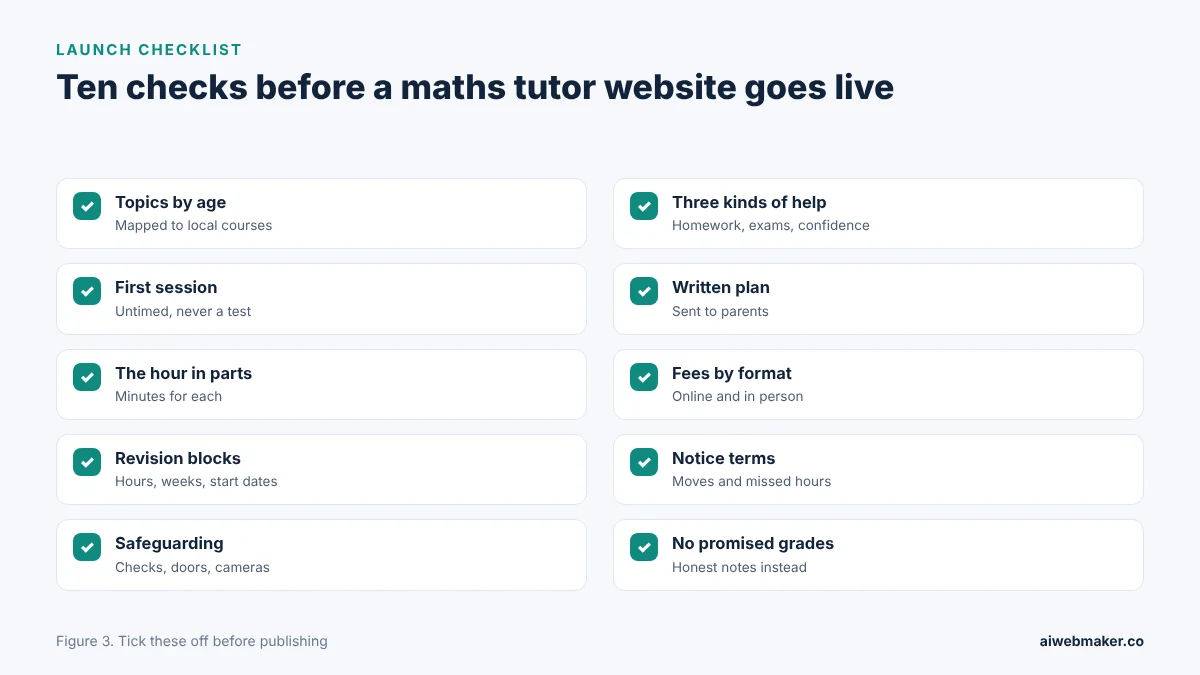
Parents keep scrolling when a maths tutor promises a grade, because they know nobody can guarantee one. A page with no topics table leaves them unsure whether the tutor knows the course. No description of the first session suggests the tutor will simply repeat the class topic. Silence about checks, home visits or cameras worries any parent of a younger child. Fees without notice terms or block lengths make comparison impossible. A ten line launch card, pictured next, deals with each of these before the first request.
Frequently asked questions
How soon do maths marks usually improve with tutoring?
Every student moves at a different pace, and no tutor can honestly promise a mark or a grade. What a tutor can promise is an honest note at regular intervals saying what is secure, what still wobbles and what comes next. Students with one old gap often improve quickly once it is fixed. Students preparing for exams benefit most when they start well ahead. A page that says this plainly sets expectations parents can trust.
Does maths tutoring work as well online as in person?
For most students over eleven, online maths tutoring works well. A shared whiteboard shows every line of working, and photographed homework can come back marked. Younger children and very anxious students often settle better in person at first. Many families mix both, using online sessions in busy weeks. The page should explain both formats so families can choose.
What does a student need at home for an online maths session?
A student needs a laptop or tablet with a camera, a quiet corner of a shared room and a steady connection. Squared paper, a pencil and the student's own calculator are useful too. A phone works for the video but is small for a shared whiteboard. Younger students should have a parent nearby during the session. Listing these on the page saves time at the first session.
When is the right time to start tutoring before maths exams?
Starting about two terms before an exam leaves time to fix old gaps before revision begins. A block of sessions in the final weeks still helps, but it can only focus on the most important topics. Students with a known weakness benefit from starting even earlier. Exam dates differ by country and course, so the plan should be worked back from the actual date. Parents appreciate a tutor who gives this advice honestly.
Three online hours, and the maths tutor's hosting year is covered
Three online hours of maths tutoring earn the tutor more than the $119 the tutoring pages need for a full year online. Billed monthly instead, $19 is under half the fee for a single online hour. Families who see a homework battle end tend to keep their weekly slot until the exams, and they pass the tutor's name to other parents. A topics table, a first session that finds the gap and honest progress notes persuade more families than any promise of grades. A request that already names the hardest topic shows the pages have started the diagnosis before the first hour.
Build your website in Minutes and get the AI Tools that work
Start Building Your Website →