Dojo Website Cost, Counted in Trial Classes and Junior Gradings
A martial arts school's pages stay hosted at $119 per twelve months, or $19 per single month, with a domain added. Later sections cover who trains, programmes by age, the arts taught, the trial class, belts and gradings, safety and safeguarding.
- No coding required
- Live in minutes
- Blog, SEO and chatbot tools included
A martial arts school spends $119 a year hosting its website, or $19 a month for dojos that like the bill to match their monthly fees, and buys the domain alongside. Writing the programmes, setting out the timetable and rehearsing the trial page in the preview cost the school nothing with AI Web Maker. One family that stays after a trial covers the year, so the website is a minor line beside mats and insurance. To gauge how the trial page might read once finished, look at AI Web Maker's martial arts school website sample, which presents an invented school with its belts and trial classes. The real work is persuading two very different visitors: a parent wondering whether a child will be safe and encouraged, and an adult wondering whether they are too old, too unfit or too nervous to start. Both decide on the strength of the trial class, so a site that explains it clearly fills the mats. The guide covers who trains, programmes by age, the arts taught, the trial, belts and gradings, safety and safeguarding and the yearly website cost.
This article is part of our complete guide: Fitness Website Builder.
Who steps onto the mats, and what does each group fear?
Martial arts schools draw students from every age group, and each arrives with a different hope and a different fear. Parents of young children want confidence, focus and a safe outlet for energy, and they worry about rough play and pushy instructors. Teenagers often come for fitness, self defence or a competitive sport, and they want classes with people their own age. Adult beginners want to learn without being thrown in with experts, and many worry about fitness and injury. Experienced martial artists moving to a new town look for lineage, rank and a club that trains seriously. A site that speaks to each group in its own section turns curiosity into a trial.
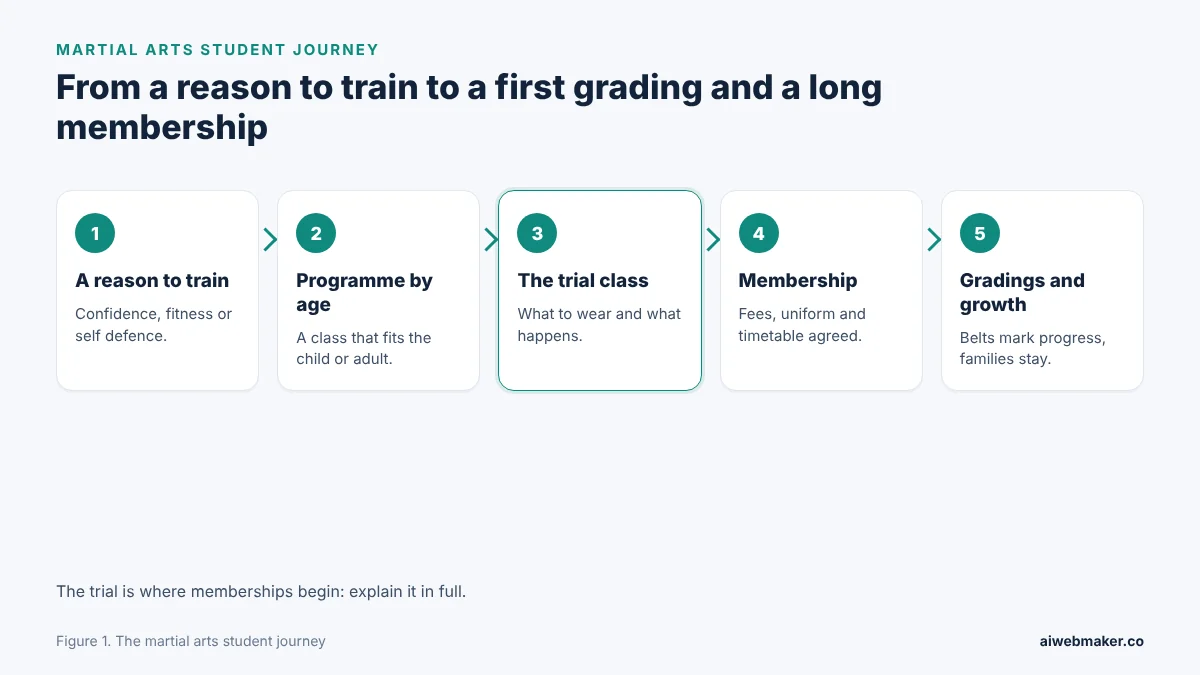
The trial class is the highlighted step, because almost every membership starts with one. A reason to train comes first, whether a parent wants confidence for a shy child or an adult wants fitness and self defence. Finding the right programme by age and level follows, and a clear split by age makes that quick. After the trial, the conversation turns to fees, uniform and the timetable. Gradings then mark progress and keep families training for years.
Which pages should a dojo build around programmes, trials and the timetable?
A martial arts site needs pages that separate programmes by age, explain the trial and show the timetable clearly. The home page should show real classes, the arts taught, the age groups and a route to request a trial. Each programme deserves its own description with the age range, what a class involves and the price. An instructors page introduces the head instructor and the team, with ranks, experience and safeguarding. Directions, parking and a spot for waiting parents round off the site on a visit page.
| Page | What the visitor checks | What belongs there |
|---|---|---|
| Home | Is this the right dojo for us? | Real classes, arts taught, ages, a trial route |
| Programmes | Which class fits my child or me? | Age range, level, class content, price |
| Timetable | When can we train? | Days, times, programme, instructor |
| Trial class | What happens the first time? | What to wear, what to expect, parents watching |
| Instructors | Who will be teaching? | Ranks, experience, safeguarding, first aid |
| Visit | How do we get there? | Address, parking, waiting area |

Four groups organise the dojo's pages, starting with the programmes because families look for their age group first. The programmes group holds each age and level with its price and class content. The trial group explains the first class, the timetable and gradings, and the people group introduces the instructors and the community. The visit group covers directions, parking and contact details. Our sample, Iron Crane Martial Arts, lists Little Cranes, a junior programme, adult fundamentals and advanced training as four bookable programmes priced one by one, and its home page puts programmes for every age and level up front. Its classes page explains what to expect in a typical class, the weekly timetable and how a trial class works, and the about page introduces the head instructor, the teaching team and the community, as the martial arts school website example with programmes by age and level shows.
Karate, judo or jiu jitsu: how should each art be explained?
Each art should be explained by how it trains, how much contact it involves and what a beginner can expect, because many visitors cannot tell them apart. Karate and taekwondo focus on strikes, forms and discipline, with sparring added gradually. Judo and Brazilian jiu jitsu are grappling arts built on throws, holds and ground work, which many people find less frightening than striking. Kickboxing and Muay Thai suit people who want fitness and striking, while arts such as aikido or kung fu emphasise movement and tradition. Self defence courses focus on awareness and simple techniques rather than sport. Plain explanations help each visitor pick the art that fits their goals.
| Art | Main focus | Contact for beginners | Uniform |
|---|---|---|---|
| Karate | Strikes, forms, discipline | Light, controlled sparring later | Gi and belt |
| Taekwondo | Kicks, forms, sport sparring | Pads and protective gear | Dobok and belt |
| Judo | Throws, holds, falling safely | Close contact from the start | Heavy gi |
| Brazilian jiu jitsu | Ground work, control, submissions | Close contact, light rolling | Gi or fitted sportswear |
| Kickboxing or Muay Thai | Punches, kicks, fitness | Pad work before sparring | Shorts, gloves, wraps |
How should programmes be split by age and stage?
Programmes split by age let a parent or adult find the right class in seconds, and they keep each class safe and focused. Young children learn through games, balance and listening skills, with short classes and plenty of encouragement. Junior classes add technique, forms and controlled partner work, while teen classes can bring in more sparring for those who want it. Adult fundamentals give beginners a gentle start, and advanced training lets experienced students push further without slowing newcomers. Each programme page should state the age range, the class length and how students move up. A clear age structure reassures parents and keeps adults from feeling out of place.
What should a trial class page explain before the first visit?
A trial class page should remove every small unknown, because nerves stop more people than price. It should say what to wear, whether a uniform is needed at first, what happens in the class and how long it lasts. Parents want to know whether they can watch, and adults want to know whether they will be paired with someone their own size and level. A visitor requests a trial for a chosen programme, and the school accepts it, moves it to a better suited class or declines when the mat is full. Any trial fee, and later membership fees, are arranged by the school directly with the family, and AI Web Maker receives none of that money. The martial arts booking website builder with trial class requests creates the trial request alongside the programme and instructor pages after the school outlines its arts and age groups in a few sentences.
How do belts, gradings and their fees work?
Belt systems differ between arts and between schools, so the website should explain its own path rather than assume visitors know it. Gradings usually happen at set intervals, and students need a minimum number of classes and the instructor's approval before they test. Grading fees, new belts, association membership and any insurance should be listed, because these extra costs surprise many families. Some schools award stripes or tags between belts to keep young students motivated. Black belt timelines vary greatly, and promising one by a date undermines trust. A clear grading page shows that progress is earned and fairly assessed.
| Grading detail | What the page should state |
|---|---|
| Belt order | The colours and ranks used by the school |
| Timing | How often gradings run and who decides readiness |
| Fees | Grading fee and the cost of a new belt |
| Membership and insurance | Association or licence costs where they apply |
| Stripes or tags | Any steps between belts for juniors |
How does a dojo keep children and adults safe on the mats?
Safety is the first concern for parents and many adults, so the website should describe how the school protects students. Background checks for anyone coaching minors, along with safeguarding courses and current first aid, are expected in many places, though what the law demands depends on the country and the governing body. Sparring rules, protective gear and the gradual introduction of contact should be explained for each programme. Mats should be cleaned regularly, and students with cuts or skin infections asked to sit out, because skin conditions spread easily in grappling arts. Any blow to the head or suspected concussion should end training for the day and lead to medical advice. Visible safety practice is often what persuades a cautious parent to book the trial.
Which phrases do families and adult beginners search for a dojo?
Dojo searches tend to be specific, such as karate for kids, Brazilian jiu jitsu near me, kickboxing classes or judo club, often with a suburb. Giving every art and every age group a heading of its own sends each of those searches to the matching programme. On the map listing, class times, photos from the mats and a link to the trial page do the most work. Reviews from parents describing a shy child who grew in confidence carry more weight than any claim the school could make. Articles on choosing a first martial art for a child, or what happens at a grading, reach families while they are still deciding. Local schools, community centres and sports directories that link to the site add steady routes in.
Is the website a large cost next to a month of memberships?
Two items make up a dojo's yearly website bill, hosting and a domain, and each parent guide or grading explainer written with credits costs about $0.65. Schools with a stable membership pay least by covering the year at once. A new club renting hall time may prefer $19 a month. Changing the timetable, adding a programme or updating grading dates costs nothing. A dojo can set one payment a year against twelve smaller ones in this table, where the $189 tier appears only as a yardstick.
| Item | Yearly | Monthly |
|---|---|---|
| Hosting the dojo pages | $119 | $228 over twelve months |
| Domain | Depends on the ending | Depends on the ending |
| Higher plan, for comparison | $189 a year | Not needed |
| Twelve parent guides and grading articles at about $0.65 | About $7.80 | About $7.80 |
| Timetable, programme and grading updates | No charge | No charge |
| Year before the domain | About $126.80 | About $235.80 |
Why do parents and adult beginners leave a dojo's site?
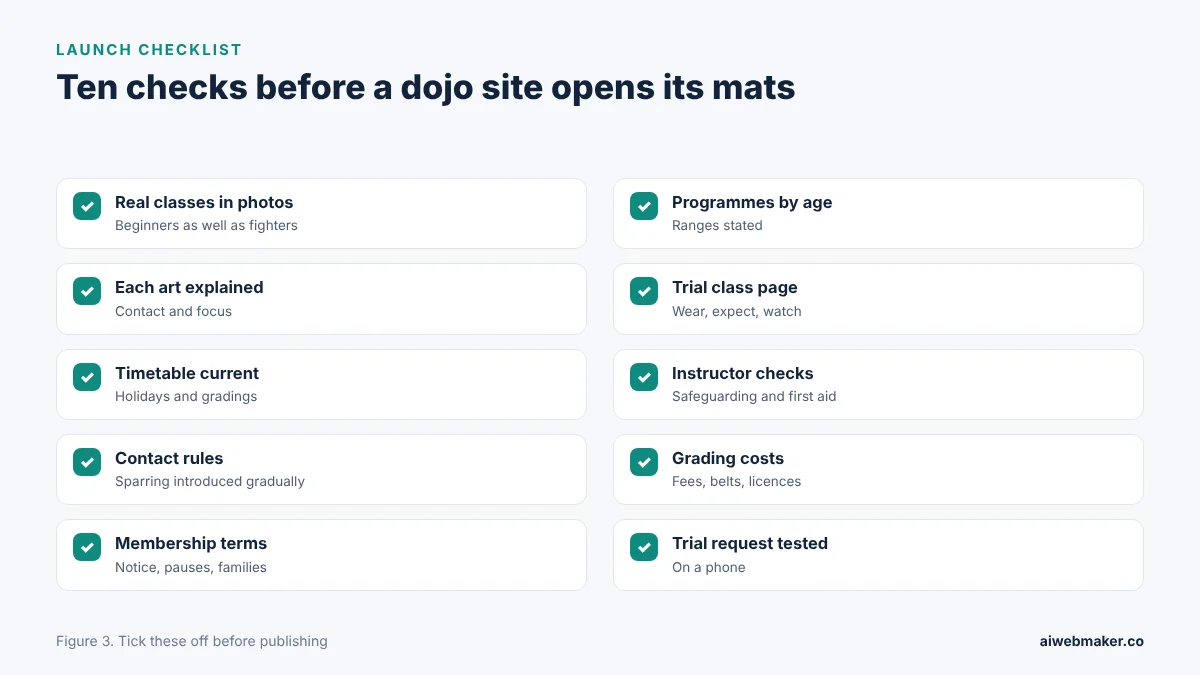
Parents leave a dojo's site when the photos show only hard sparring or fighters in competition, because they cannot picture their child in the room. Programmes without age ranges make it hard to know where to start. A trial class that is mentioned but never explained leaves the biggest question unanswered. No word on instructor checks, first aid or contact rules worries cautious families. Fees that appear only at the front desk, with uniforms and gradings on top, feel like a trap. Ten fixes for those faults are set out in the picture that follows.
Frequently asked questions
At what age can a child start martial arts?
Many schools accept children from around four or five in programmes built around games, balance and listening, though the starting age varies by art and by school. Classes for young children are short and focus on coordination and confidence rather than contact. The website should state the age range for each programme and say whether younger siblings can try. A trial class lets parents see whether their child is ready. Clear age guidance helps families start at the right moment.
Do beginners need to be fit before their first class?
Beginners do not need to be fit, because classes build fitness gradually and instructors adapt drills to each student. Adult fundamentals classes are designed for people starting from scratch, and the page should say so plainly. Anyone with a heart condition, a recent injury or another health concern should check with a doctor before training. Instructors should be told about injuries at the start of each class. Reassuring words here bring in adults who would otherwise never try.
Should a dojo tie families into long contracts?
Long contracts are a choice each school makes, but families respond better to clear, flexible terms. Monthly memberships with a reasonable notice period, family discounts and the option to pause for injury are approaches many schools use. Whatever the school offers, the website should state the notice period, any joining fee and what happens if a student stops. Uniform and equipment costs belong on the same page. Transparent terms keep goodwill high and complaints low.
How long does it take to earn a black belt?
The time to a black belt varies widely by art, by school and by how often a student trains, and it is usually measured in years. Schools should describe their grading path rather than promise a date. Attendance, technical skill, attitude and the instructor's judgement all play a part. Junior black belts, where offered, often carry their own rules. Honest expectations attract students who value the journey.
How many trial classes turn into enough members to pay for the site?
A single family signing up after its trial normally clears the $119 of yearly hosting for a martial arts school. On monthly billing, a single membership pays several $19 bills. Every student who stays from the first trial to a first grading adds months of fees the website helped begin. Clear programmes by age, an honest trial page and visible safety practice reassure more parents than any promise of confidence. Schools that keep the timetable and grading dates current give families one less reason to hesitate. A waiting list for the junior programme is a welcome hint that families trust what they read.
Build your website in Minutes and get the AI Tools that work
Start Building Your Website →