Kickboxing Gym Website Cost and the Sparring Rules Beginners Look For
Hosting a kickboxing gym's pages costs $119 a year, or $19 a month, with a domain on top. Inside: how beginners choose, streams and contact rules, sparring safety, trial nights, passes and memberships, search and the yearly budget.
- No coding required
- Live in minutes
- Blog, SEO and chatbot tools included
Keeping a kickboxing gym's timetable and trial request online costs $119 a year through AI Web Maker, payable instead as $19 a month, and the gym's own domain sits beside that fee. Nothing is billed while those pages are drafted and checked on screen. One new member who stays for a couple of months more than covers the year. The real work lies in a fear that never appears on a timetable, because most newcomers assume someone will hit them on their first night. Gyms that answer that fear in writing fill their beginners' courses, while gyms that stay vague lose people on the stairs. What follows takes each part in turn: how beginners choose, streams and contact rules, sparring and safety, trial nights, memberships against passes, search and the yearly budget.
This article is part of our complete guide: Fitness Website Builder.
Who climbs the stairs to a kickboxing class, and what do they fear?
Kickboxing gyms draw a wider crowd than their fight posters suggest, and most of it has no wish to compete. The largest group wants a hard workout with a skill attached. Others have boxed or done karate years ago and want to know whether the coaching is technical or merely loud. Teenagers of sixteen or seventeen often arrive with a parent who reads every line about contact and age. A smaller group wants to fight, and those people look for a fight team, coached sparring and a record of amateur bouts. All of them weigh the same few points: when classes run, who gets hit, what the first night costs and whether the coaches look like teachers.
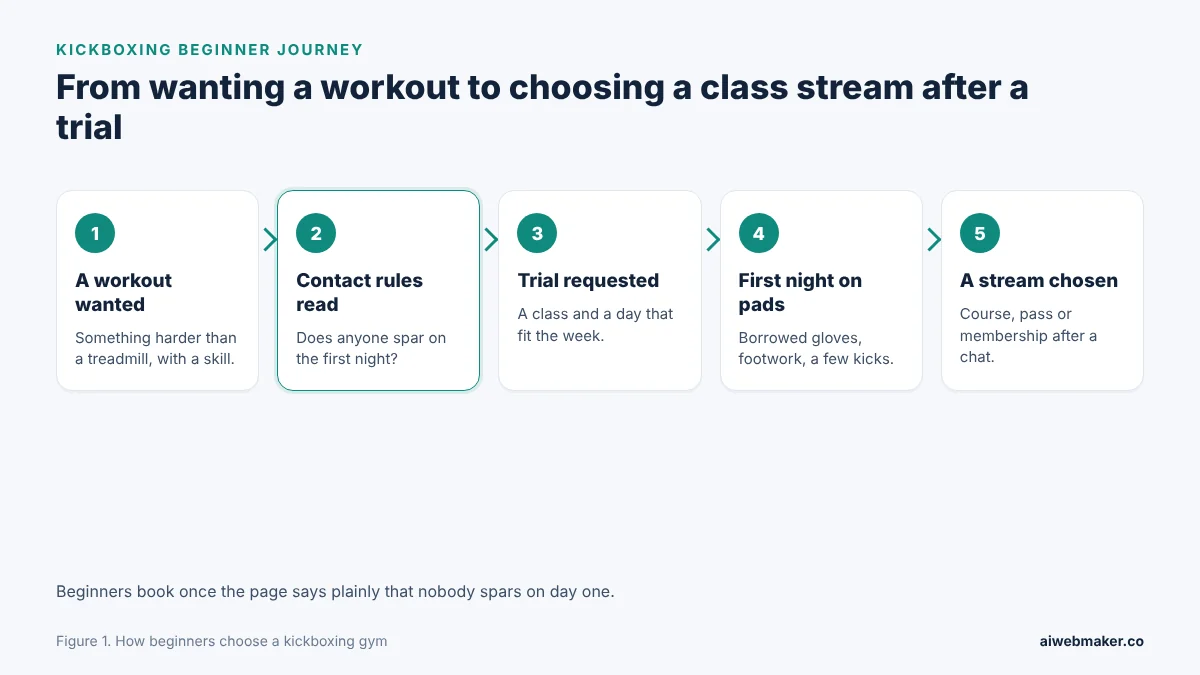
Five steps carry a curious visitor from a search to a chosen stream, and the second step decides most trials. It begins with a wish for a workout that teaches a skill. The highlighted step is reading the contact rules, because a beginner who cannot tell whether sparring is compulsory simply closes the page. A trial request follows once the rules are clear, and the first night on pads in borrowed gloves has to match what the website promised. The chat with a coach afterwards then turns a good trial into a course, a pass or a membership.
Streams, sparring and prices: pages a kickboxing site should carry
A kickboxing website needs fewer pages than a large gym, but each page has to settle one worry before the next one surfaces. The home page should say in its opening lines whether beginners spar, because that answer outweighs any photo. A streams page files every class under a rule on contact, and a sparring page explains who spars, when and under whose eye. Kit advice, prices and the trial walkthrough answer the practical questions that come next. The timetable belongs on the site as text, with the trial request closing the route.
| Page | Question it settles | What it should include |
|---|---|---|
| Home | Will anyone hit me on day one? | A plain line on sparring, the trial price and a request button |
| Class streams | Which class suits a beginner? | Each stream with its contact rule, level and age limit |
| Sparring and safety | Who spars, and how is it run? | Invitation rules, kit worn, coach supervision, a local rules note |
| Timetable | Does a class fit the week? | Days and times as text, grouped by stream |
| Trial class | What happens on the first night? | Arrival, health form, borrowed gloves, the chat afterwards |
| Prices and passes | What will training cost? | Trial, course, membership, pass and notice period |
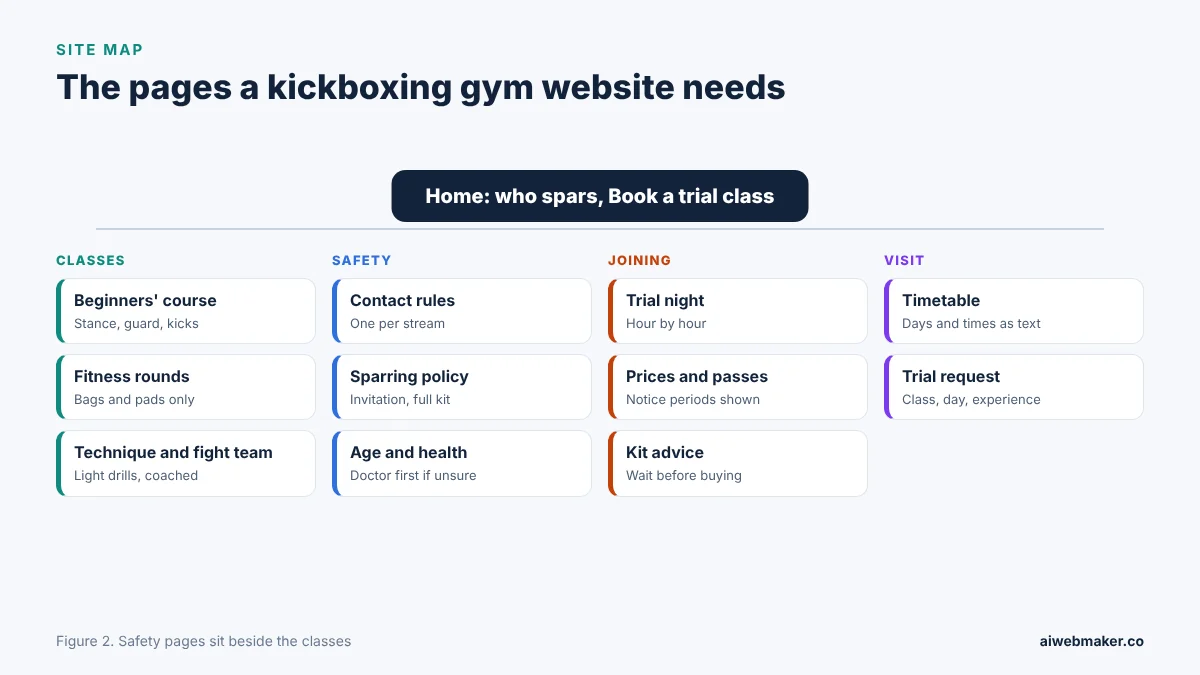
Grouped by the question each one answers, the kickboxing pages fall into classes, safety, joining and visiting. Class pages describe the beginners' course, fitness rounds and fight team, while safety pages hold the contact rules, the sparring policy and notes on age and health. Joining pages carry the trial walkthrough, prices and kit list, and the visit group pairs the timetable with the trial request. Roundhouse Kickboxing, the invented gym behind our sample, fits all of this onto one long page, where Kickboxing Basics, Fitness Kickboxing, Morning Bag Rounds, Technique, Fight Team and One to one pad work each sit under a stated rule on contact. Its prices run from a trial class to a monthly unlimited membership and a ten class pass, and the kickboxing gym website example with a contact rule for every stream ends with a request for that first trial class.
Contact rules that a beginner can find in ten seconds
Every kickboxing class carries a level of contact, and the website should state it in words a stranger understands. No contact means pads, bags and shadow work, with a partner holding pads but never striking a person. Light contact means controlled partner drills at a pace both people agree, in gloves and shin guards. Sparring means two people exchanging strikes under a coach, and full contact competition is a separate matter, governed by rule books that differ from one country and sanctioning body to the next. A table of streams, contact levels and sparring rules does more for a nervous reader than any mission statement.
| Stream | Contact level | Sparring | Best suited to |
|---|---|---|---|
| Beginners' course | None between people | Never | Anyone new, often aged 16 and over |
| Fitness kickboxing | Bags and pads only | Never | People after a hard workout |
| Technique | Light, controlled drills | Not in class | Members a few months past the course |
| Fight team | Coached sparring | At an agreed pace | Members invited by the head coach |
Style names confuse beginners as much as contact levels, so the gym should say which rule set it actually teaches. Some kickboxing styles allow kicks to the legs, while others score only above the belt. Muay Thai adds knees, elbows and clinching. A short paragraph naming the strikes taught, and those left out, stops a boxer or a karate student from arriving with the wrong expectations. Clear naming also helps search engines match the gym with the exact style people type.
Sparring, protective kit and medical checks that differ by country
A sparring policy shows whether a kickboxing gym takes injuries seriously. The page should say that sparring happens only in named sessions, by invitation, after a stated period of regular training. It should list the kit worn for every round, typically a fitted gum shield, sparring gloves, shin guards, a groin guard and head guards where the rules ask for them. A coach watching every pair, matching partners by size and experience and stopping rounds when control slips, is the promise beginners want to read. Medical checks for amateur bouts and fighter licences vary by country and governing body, so the page should say that the coaches explain the local rules.
Health questions deserve a short section of their own, because a coach is not a doctor and should never sound like one. Anyone with a heart condition, high blood pressure, a past head injury, a recent operation or a pregnancy needs a doctor's go ahead before training. A member who takes a knock to the head and then feels dizzy, sick or confused should stop and seek medical advice, and the page can say that coaches end a session for exactly that reason. Liability insurance and background checks for coaches who teach under eighteens are expected in many countries, though the requirements vary. Each of these lines tells a careful reader that safety is planned rather than improvised.
Trial nights, and the request that books one
The trial night is the product a kickboxing website sells most often, so it deserves a walkthrough from the doorway to the drive home. The page should say how early to arrive, what the health form asks, which gloves and wraps are lent and whether there are showers. It should describe the class itself in ordinary words: stance, guard, a few punches and a kick or two on pads, with water breaks whenever needed. Beginners should also hear that borrowed kit is fine for the first month. If the trial fee comes off a first month for anyone who joins soon afterwards, that sentence belongs beside the button.
On the booking website builder for kickboxing gyms and their trial classes, a visitor chooses a trial, a day and a class time and sends them as a request. A coach then says yes, shifts the newcomer into a class with spare mats, or refuses politely when the beginners' course is already full. Trial fees and memberships are settled between the member and the gym, and the platform claims nothing from either. The builder drafts the class, safety and price pages as well, once the owner has described the gym and its streams in a few sentences. Nothing is booked until a coach says yes, which suits gyms that cap class sizes.
Monthly unlimited, class passes and notice periods
Kickboxing gyms usually sell training in a few shapes, and the website should explain each one with its terms in plain view. A beginners' course of a few weeks teaches a group that starts together, giving the gym a natural intake point each month. A monthly unlimited membership suits people who train two or three times a week and gives the gym predictable income. A class pass, valid for a set number of months, suits shift workers and travellers, usually at a higher price per class. Consumer rules on contracts, cooling off periods and renewals vary between countries, so notice periods and pause rules should be checked locally.
| Option | Suits | Terms worth printing |
|---|---|---|
| Beginners' course | Newcomers who want a structured start | Number of sessions, group size, what follows |
| Monthly unlimited | Members training most weeks | Notice period, pause rules, classes included |
| Class pass | Shift workers and travellers | Classes included, validity, which streams |
| One to one pad work | Members sharpening one skill | Length, how to request it, cancellation notice |
| Fight team | Invited competitors | Any extra cost, kit checks, medical rules |
Phrases typed by people who want to learn to kick
People looking for a kickboxing gym type phrases such as kickboxing classes near me, kickboxing for beginners, fitness kickboxing, Muay Thai or kickboxing, and kickboxing for teenagers. Each stream's heading should carry the words its members would use. Its map listing ought to repeat the website's hours, carry photos of real classes and of the entrance, and link straight to the trial walkthrough. Reviews that mention patient coaches and sparring that stays optional carry weight with the next nervous reader. Articles on the questions coaches hear every week, from what happens at a first class to how kickboxing differs from boxing, bring visitors long before they feel ready for a trial.
The yearly bill behind a kickboxing timetable
A kickboxing gym's website bill has two lines, the hosting and a domain whose price depends on which of roughly 400 endings the owner picks. Settling the year in one go costs $119, and spreading it out means twelve payments of $19 instead. Twelve articles on gloves, first classes and rule sets cost under eight dollars in AI credits. Changing the timetable, the prices or the contact rules adds nothing at all. For comparison only, the $189 tier has a row of its own below.
| Item | Yearly | Monthly |
|---|---|---|
| Hosting the kickboxing gym pages | $119 | $228 over twelve months |
| Domain | Depends on the ending | Depends on the ending |
| Higher plan, for comparison | $189 a year | Not needed |
| Twelve training and kit articles at about $0.65 | About $7.80 | About $7.80 |
| Timetable, price and rule changes | No charge | No charge |
| Year before the domain | About $126.80 | About $235.80 |
Blurred timetables, fight posters and other reasons beginners leave
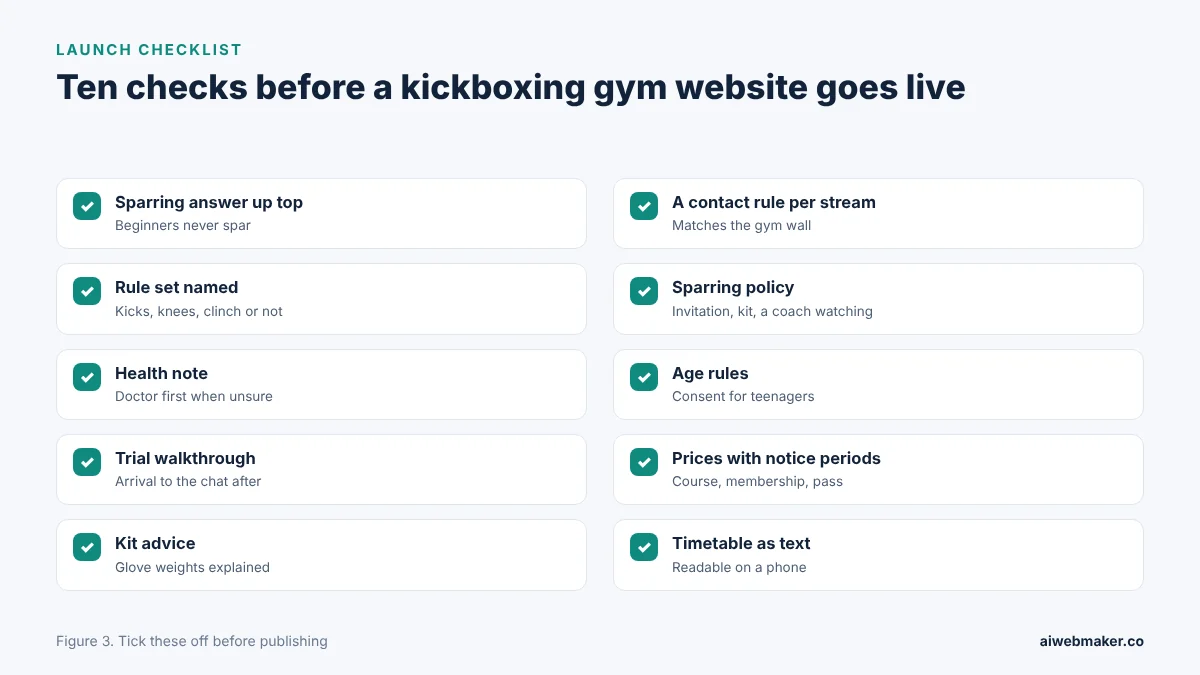
A beginner closes a kickboxing website fastest when nothing on the first screen says whether sparring is compulsory. Photos of bloodied fighters and fight night posters, with no pictures of ordinary classes, confirm the fear instead of easing it. A timetable posted as a blurred image cannot be read on a phone at the bus stop. Prices hidden behind a call to the desk suggest a hard sell, and a missing notice period suggests a membership that is difficult to escape. Ten repairs for those gaps appear in the picture beneath this paragraph.
Frequently asked questions
Is kickboxing safe for someone who has never trained?
Kickboxing for beginners is usually built around pads, bags and technique, and a well run gym keeps newcomers away from sparring entirely. The main risk for a new member is a strain from doing too much too soon, which coaches reduce by building up slowly and encouraging rest. Anyone with a heart condition, high blood pressure, a past head injury or a pregnancy should ask a doctor before starting. The website can describe how sessions are kept safe, from warm ups to coaches who stop careless drills. Honest wording about safety helps more beginners take the first step than any bold promise could.
At what age can teenagers join the adult classes?
Age rules differ from gym to gym, and some set sixteen as the age at which teenagers may join adult classes with a parent's written consent. Younger children usually train in junior classes with their own coaches, contact rules and ratios. Safeguarding requirements, such as background checks for coaches working with under eighteens, vary by country and should be followed wherever the gym trades. The page should state the gym's own rule, what a parent signs and whether parents may stay to watch. Clear age rules save the desk from awkward conversations on a busy evening.
Which gloves should a beginner buy, and when?
A beginner can usually wait a month before buying gloves, because most gyms lend gloves and wraps to newcomers. Glove weight is measured in ounces, and the right weight depends on body size and purpose, with heavier gloves normally worn for sparring so that strikes land more softly. Hand wraps, shin guards that cover the instep and a gum shield fitted to the mouth come next on most lists. A coach can check the fit before anything is bought. Advice that protects a beginner's wallet in the first month is repaid with loyalty for years.
Do kickboxing coaches need a qualification?
Coaching qualifications for kickboxing are not regulated the same way everywhere, and the recognised awards differ between countries and governing bodies. Many gyms list coaching certificates, first aid training, insurance and, for anyone teaching under eighteens, the background checks that apply locally. A coach's own fight record can be mentioned, but teaching skill and safety training matter more to most beginners. The coaches page should describe what each person teaches and how long they have coached. Verifiable details build more trust than titles that visitors cannot check.
How few trial nights pay for a kickboxing gym's year online
One member on a monthly plan usually pays more in a single month than the $119 that hosts the whole kickboxing timetable for a year. Billed by the month, the gym's $19 is less than what a single regular member pays for a month of training. Every full beginners' course is income the website helped to bring through the door. Clear contact rules, an honest sparring policy and a trial walked through step by step win over nervous beginners better than any fight poster. A beginners' course that is full a week before it starts tells the owner more about the website than any visitor counter.
Build your website in Minutes and get the AI Tools that work
Start Building Your Website →