Guitar Teacher Website Cost, From the Taster to the First Full Song
Guitar lesson pages cost less to host than three single lessons: $119 per year, or $19 whenever a teaching month is paid alone, plus a domain priced by ending. Next: players, pages, instruments, songs, the first weeks, prices, young players, search and sums.
- No coding required
- Live in minutes
- Blog, SEO and chatbot tools included
A guitar teacher's lesson pages cost less to host than three single lessons: $119 for twelve months, or $19 for any single month, with the domain priced extra by ending. Writing the instrument cards, the eight week plan and the lesson request in preview adds nothing to the teacher's bill from AI Web Maker. One block of six lessons sold to a single beginner covers the hosting year and leaves most of the block's fee untouched. The real challenge in guitar teaching is not finding beginners but keeping them through the first few weeks, when fingertips hurt, chord changes feel impossible and enthusiasm fades. A website that shows how those weeks will go, and promises real songs rather than exercises, keeps more pupils past that point. Next come the players, pages, instrument choice, songs first, the first eight weeks, prices, young players and gear, search and the yearly sums.
This article is part of our complete guide: Fitness Website Builder.
Returning players, curious teenagers and adults with a playlist: who books guitar lessons
Guitar pupils arrive with a song in their head more often than a plan, and the pages should start from that song. Adult beginners want to play the music they already love, usually around a campfire or with friends. Returning players have a guitar that spent years in a loft and fingers that remember a few chords. Parents look for lessons for children from about eight, while teenagers often want electric guitar or bass rather than anything their parents suggest. Band players want to tighten their timing or learn a style they cannot fake. Each of them asks the same things first: will lessons use real songs, which guitar is best to start on, and how soon will it sound like music?
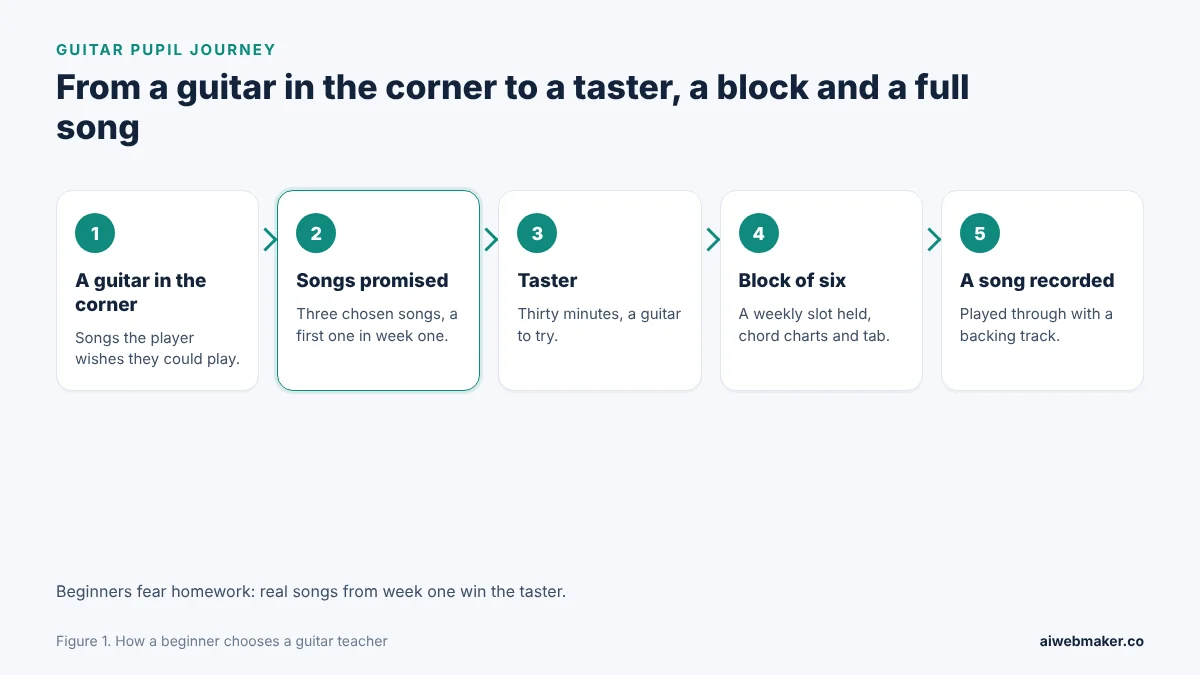
Songs carry the second stage of this path, because a beginner deciding between teachers is really deciding whether lessons will feel like music or homework. The path opens with a guitar in the corner and a list of songs the player wishes they could play. In the highlighted stage the page promises three chosen songs and a first one played through in week one. A short taster follows, with a chance to try a guitar before buying one. A block of six with a held weekly slot and a full song recorded by the sixth lesson complete the path, and a pupil who hears that recording rarely stops at six.
Instruments, method, first weeks and the amp room: what a guitar teacher's site holds
A guitar teacher's pages should answer the beginner's doubts in order, starting with the instrument and the method before the price. An instrument page explains what acoustic, electric and bass lessons each cover first and who teaches them. A method page shows how chosen songs become lessons, and a first weeks page sets out what a complete beginner will manage month by month. Prices follow, with the taster, single lessons, blocks, online lessons and shorter lessons for children. A page on young players and the teaching room, with the kit provided, closes the set.
| Page | Player's question | What it should state |
|---|---|---|
| Instruments | Acoustic, electric or bass | What each covers first, who teaches it |
| Method | Will lessons use my songs | Songs first, theory when needed, tab or notation |
| First weeks | How soon it will sound like music | A plan for complete beginners |
| Prices | What lessons cost | Taster, single, block, online, children |
| Young players | Whether it suits a child | Ages, guitar sizes, parents, checks |
| The room | What to bring | Amps and tuners provided, loan guitars, parking |
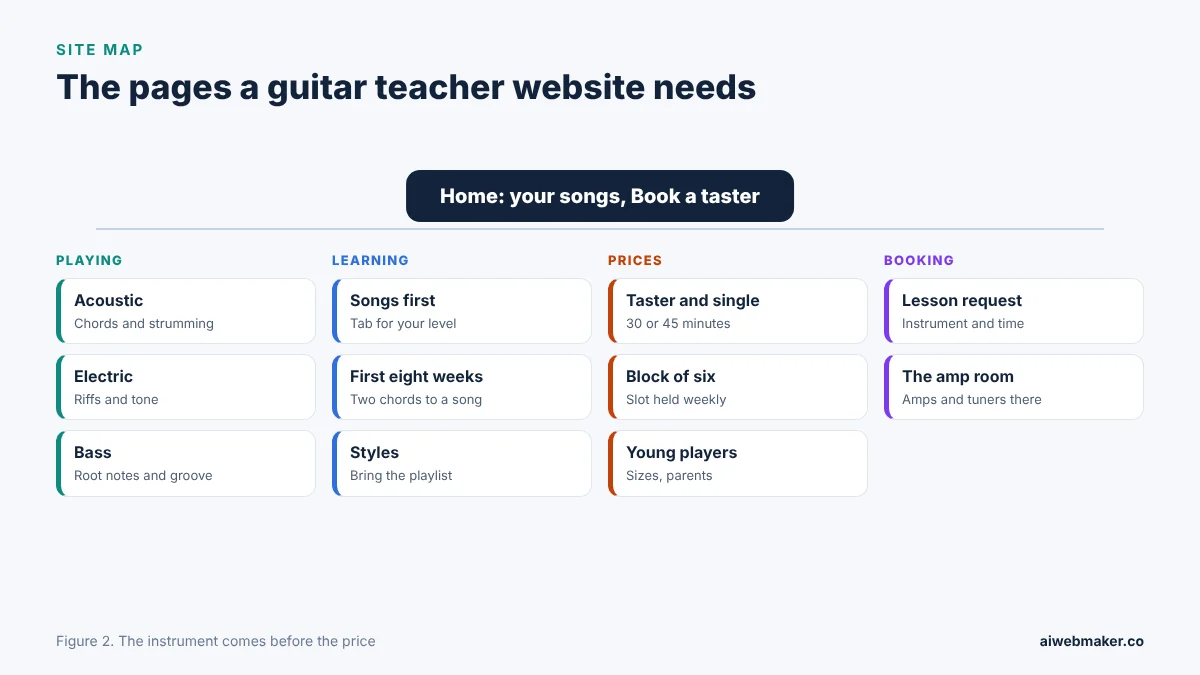
Playing, learning, prices and booking form the four columns of this teacher's plan, with the instrument choice at the head of the first. Six Strings Guitar Lessons, the sample, opens with the line learn the songs you keep on repeat and three facts: a first song played through in week one, two teachers covering guitar and bass, and pupils from age eight. The guitar teacher website example built around the songs pupils choose shows Jonah teaching acoustic and electric and Priya teaching bass and electric, each card listing 45 minute lessons from $36. Prices run from a 30 minute taster at $20 and a single lesson at $40 to a block of six for $216 and online lessons at $36, with children aged 8 to 11 taking 30 minutes for $28. A plan for the first eight weeks, the amp room, young players, styles, reviews, questions and a lesson request complete the page.
Acoustic, electric or bass: guiding the first choice
Beginners often agonise over which guitar to start on, and the honest answer is whichever plays the music they love. The page can explain the practical differences without turning them into rules. Electric strings are lighter and kinder to new fingertips, while an acoustic needs no amp and goes anywhere. Bass appeals to players who feel the groove more than the melody, and teenagers sometimes surprise their parents by choosing it. Letting pupils borrow an instrument for the first few weeks, and saying that changing their mind later is normal, removes the fear of buying the wrong guitar.
| Instrument | First skills | Often suits |
|---|---|---|
| Acoustic | Open chords, strumming, fingerpicking, a capo | Singers and campfire players |
| Electric | Riffs, power chords, palm muting, first solos | Rock and indie fans, sore fingertips |
| Bass | Root notes, groove, locking in with a drummer | Players who feel the rhythm first |
Songs first, theory when a song needs it
Song based teaching is the strongest promise a guitar teacher can make, as long as the page explains how it works in practice. In the sample, each pupil names three songs at the first lesson, and the teacher writes each one out as a version the pupil can manage now. The arrangement grows harder as the pupil's hands catch up, so the pupil is always playing real music rather than exercises. Theory arrives when a song needs it, such as why a chord sounds sad or what the numbers in a tab mean, and notation is taught to anyone who wants it. Backing tracks for home practice and a phone recording at the end of each lesson keep progress audible.
The first eight weeks, when beginners decide whether to stay
Most beginners who give up do so early, so a page that shows the first eight weeks in plain steps is a retention tool as much as a sales page. The sample sets out a typical start in four pairs of weeks, from two chords and a simple song to a whole song played with a backing track and recorded. It warns that fingertips hurt for a week or two and says short daily practice builds calluses faster than one long session. Early songs use chords that are kind to new hands, and a song that is too hard gets simplified rather than dropped. Returning players skip ahead to wherever their hands remember.
| Weeks | What a beginner works on |
|---|---|
| 1 and 2 | Tuning, holding the pick, two chords and a simple song |
| 3 and 4 | Changing chords in time, a strumming pattern, more chords |
| 5 and 6 | A first riff or bass line and a short daily routine |
| 7 and 8 | A whole song with the backing track, recorded |
Taster, single lesson or block of six: prices that protect the weekly slot
Guitar lesson prices should reward the weekly habit that makes pupils improve, without forcing anyone into a long commitment on day one. The sample's taster lasts 30 minutes for new players, includes a borrowed instrument if needed and ends with one chord and one plan. A single lesson costs $40 and is paid on the day, while a block of six costs $216, works out at $36 a lesson, holds the pupil's slot every week and must be used within ten weeks. Online lessons cost $36, with a camera pointed at the fretting hand and backing tracks sent beforehand. A lesson moved with a day's notice is rebooked, while one missed without notice counts as taught.
| Lesson | Length | Sample price | What it includes |
|---|---|---|---|
| Taster | 30 minutes | $20 | Try a guitar, one chord, one plan |
| Single lesson | 45 minutes | $40 | Chord charts and tab, same slot if wanted |
| Block of six | 45 minutes each | $216 | Slot held weekly, used within ten weeks |
| Online lesson | 45 minutes | $36 | Camera on the fretting hand, backing tracks |
| Child's lesson | 30 minutes | $28 | Ages 8 to 11 |
Players pick the guitar, the kind of lesson and a time on the booking website builder for guitar teachers who sell tasters and blocks. The teacher confirms the slot or replies with the closest open hour in the teaching room, and can turn the request down when the week is already full. Payment goes straight to the teacher, never through the platform, so every lesson and block fee stays whole. Keeping that decision with the teacher protects the weekly slots that blocks depend on. A pupil who books a taster at a time that already suits their week is far more likely to come back for the block.
Young players, guitar sizes and the parents' chair
Children need lessons pitched at their age, hand size and attention span, and parents need to see that the room is safe and open. The sample takes children from about eight on a smaller guitar or a short scale bass, with 30 minute lessons. Most eight to ten year olds manage a three quarter size guitar and many eleven year olds move to full size, so a taster includes a reach check before anyone buys. Both teachers hold the background checks the law requires for teaching children where they work, and those requirements differ between countries. Parents of pupils under 16 can stay in a chair by the door, the door has a glass panel, and lesson messages go to a parent rather than the child.
Guitar lessons near me and bass lessons for a teenager: searches by instrument and player
Guitar searches split by instrument and by player, such as acoustic lessons for adults, bass lessons for a teenager, electric guitar for beginners or guitar lessons online. Many add a town or a district, so the teaching room's area should appear as text near the top. Separate headings for acoustic, electric and bass give each search a section that matches it exactly. Reviews from returning players and parents mentioning a first song in week two speak to the next beginner better than any list of credentials. Short articles on choosing a first guitar, toughening fingertips or reading tab attract players who are still deciding whether to book.
Strings, songs and sums: the teacher's website year
Hosting and a web address are the whole of a guitar teacher's website year, unless practice tips articles are added, and a dozen of those cost about $7.80 in credits. A teacher with a full week of regular pupils keeps the cost lowest by paying the year outright at $119. Someone just starting to teach may prefer paying $19 monthly until the first blocks sell. Editing a price, adding a style or rewriting the eight week plan is not billed. Next to them, the $189 tier appears only so the figures have a benchmark.
| Item | Yearly | Monthly |
|---|---|---|
| Hosting the guitar lesson pages | $119 | $228 over twelve months |
| Domain | Depends on the ending | Depends on the ending |
| Higher plan, for comparison | $189 a year | Not needed |
| Twelve practice tips articles at about $0.65 | About $7.80 | About $7.80 |
| Price, style and plan updates | No charge | No charge |
| Year before the domain | About $126.80 | About $235.80 |
Scales before songs and no prices: why beginners skip the taster
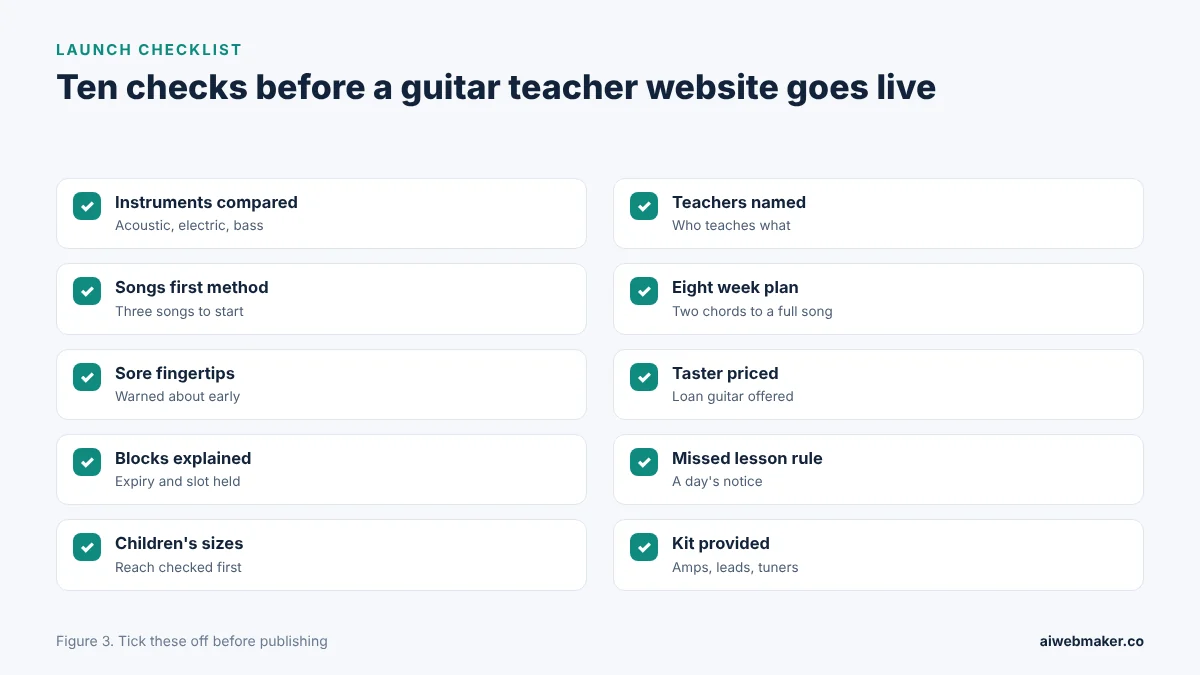
Beginners skip the taster when a guitar teacher's page talks about scales, theory and discipline before it mentions a single song. A page with no prices makes them assume lessons are expensive or that the teacher dislikes beginners. Silence on which instrument to start with leaves them stuck before they have even booked. Parents look elsewhere when nothing is said about ages, guitar sizes or where they can sit. A page without any sign of the first few weeks makes the sore fingertips stage feel like failure rather than progress. The list pictured below fixes those gaps one tick at a time.
Frequently asked questions
Should a beginner start on acoustic or electric guitar?
A beginner should start on whichever guitar plays the music they want to make. Electric strings are lighter and easier on new fingertips, which helps in the first weeks. An acoustic needs no amp and can be played anywhere, which suits singers and travellers. A taster lesson lets a beginner try both before buying. The choice matters less than practising regularly on the one they enjoy.
How long do sore fingertips last for new guitar players?
For most new players fingertips feel sore for a week or two. Short daily practice builds calluses faster than one long session a week. Lighter strings and chords that are kind to new hands help in the early weeks. The soreness fades as the skin toughens, and it rarely returns once playing becomes regular. A teacher who warns pupils about this keeps more of them past the first month.
Can guitar lessons use tab instead of sheet music?
Most guitar pupils learn from chord charts and tab, which a teacher can write out for each song. Tab shows which string and fret to play, so beginners read it quickly. Notation is still useful for pupils who want to read music, sit graded exams or play with other instruments. A good teacher offers it without forcing it. The page should say which is used so pupils know what to expect.
What size guitar suits an eight year old?
Most eight to ten year olds manage a three quarter size guitar, while many eleven year olds move to full size. The right size depends on the child's reach and hand size rather than age alone. A teacher can check the reach at a taster before the family buys anything. Short scale basses suit younger bass players for the same reason. Getting the size right makes early lessons far less frustrating.
Six lessons sold as a block cover a year of the teacher's pages
At $216, a single block of six lessons is worth nearly twice the guitar teacher's $119 hosting year. On monthly billing, $19 is less than half a single lesson. Pupils who reach a full song in their first weeks tend to keep their weekly slot for years and bring friends to the termly open mic. Songs first, an honest first eight weeks and clear prices persuade beginners more than any list of styles. A request that names three songs before the taster shows the pages have already started the first lesson.
Build your website in Minutes and get the AI Tools that work
Start Building Your Website →