Functional Fitness Gym Website Cost, From Foundations to Membership
Coached strength gyms can run their class pages for $119 per twelve months, or on a rolling $19 monthly charge, with the domain bought to suit the gym's name. Covered: newcomers, pages, the beginners' course, memberships, coach ratios, scaling and safety, start requests, search and yearly sums.
- No coding required
- Live in minutes
- Blog, SEO and chatbot tools included
Coached strength gyms can run their class pages for $119 per twelve months, or on a rolling $19 monthly charge, with the domain bought to suit the gym's name. The class hour, the beginners' course and the membership cards can be rebuilt in the preview between sessions, and AI Web Maker bills the gym nothing for those rebuilds. One beginners' course sold covers the year. The harder task is fear: videos of heavy lifts and collapsed athletes have convinced many capable people that this style of training is only for the already fit. A gym's income depends on persuading those people that every movement scales, that a coach will teach them first and that nobody will be thrown into a full class on day one. What follows covers newcomers, pages, the beginners' course, memberships and passes, coach ratios, scaling and safety, start requests, search and the annual sums.
This article is part of our complete guide: Fitness Website Builder.
Who walks into a coached strength gym, and what scares them off?
The people who join a functional fitness gym are more varied than its videos suggest. Former team players miss training with others and want structure. Gym members bored with machines want to learn the barbell properly. Complete beginners want to get strong but fear the intensity and the jargon. People returning after an injury, an operation or pregnancy want careful coaching once their doctor agrees. Experienced athletes moving to a new town, or visiting for a week, want a gym that runs classes the way they already train.
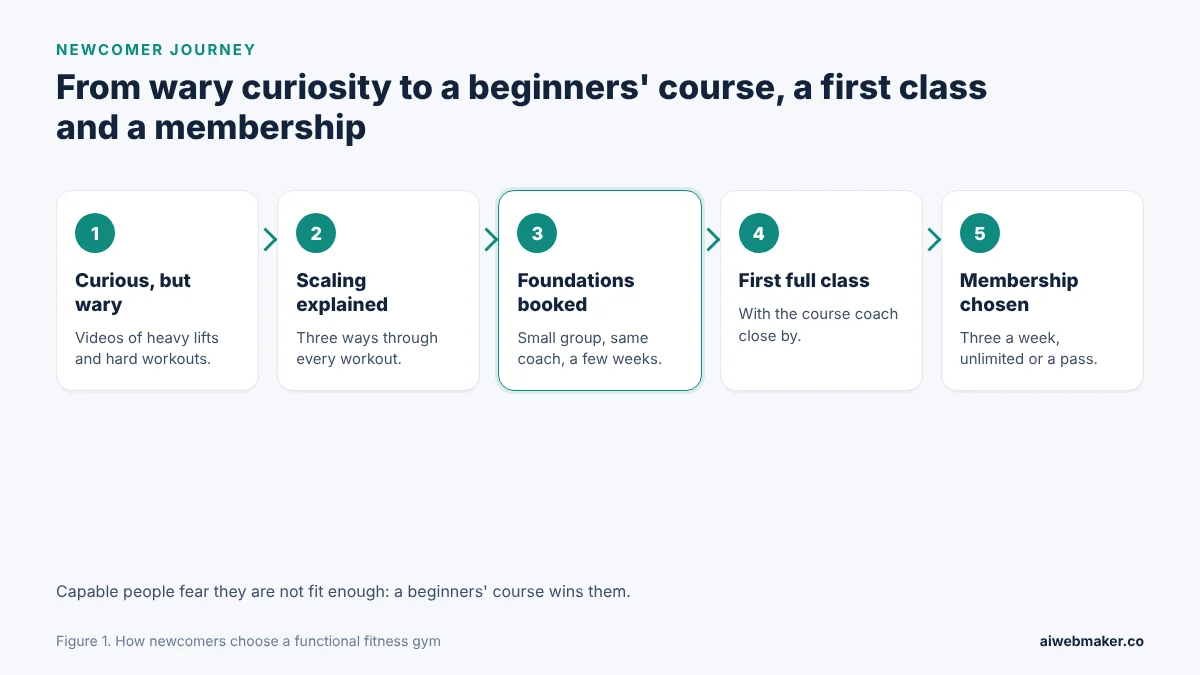
Wary curiosity opens the five steps, and the coloured third step, booking the beginners' course, is where most of a gym's members are won. Before it, the visitor needs to see that every workout has easier versions and that coaches choose weights with each person. The course then teaches the main lifts in a small group over a few weeks, with the same coach throughout. The fourth step is a first full class, ideally with that coach close by. Choosing a membership closes the journey, and a clear site makes that decision feel like the natural next step rather than a sales pitch.
Which pages carry a newcomer from the whiteboard to the beginners' course?
A functional fitness site needs pages that remove fear before they show prices, because the people most likely to stay are often the most nervous. A scaling page shows how one workout can be done three ways. A beginners' course page lays out each session, the group size and who coaches it. A class hour page explains what happens minute by minute, and a timetable lists each class type. A memberships page compares monthly options, passes and drop ins, while a start request page completes the core.
| Page | Visitor's worry | What it should state |
|---|---|---|
| Scaling | Will this be too hard? | Full, scaled and beginner lines |
| Beginners' course | Will someone teach me? | Sessions, group size, same coach |
| Inside one class | What actually happens? | Briefing, warm up, strength, workout, cool down |
| Classes | Which are open to newcomers? | Each type, length, any entry rule |
| Memberships | What will it cost? | Monthly, passes, drop ins, notice |
| Start request | Where does a newcomer start? | Start date, usual time, experience |
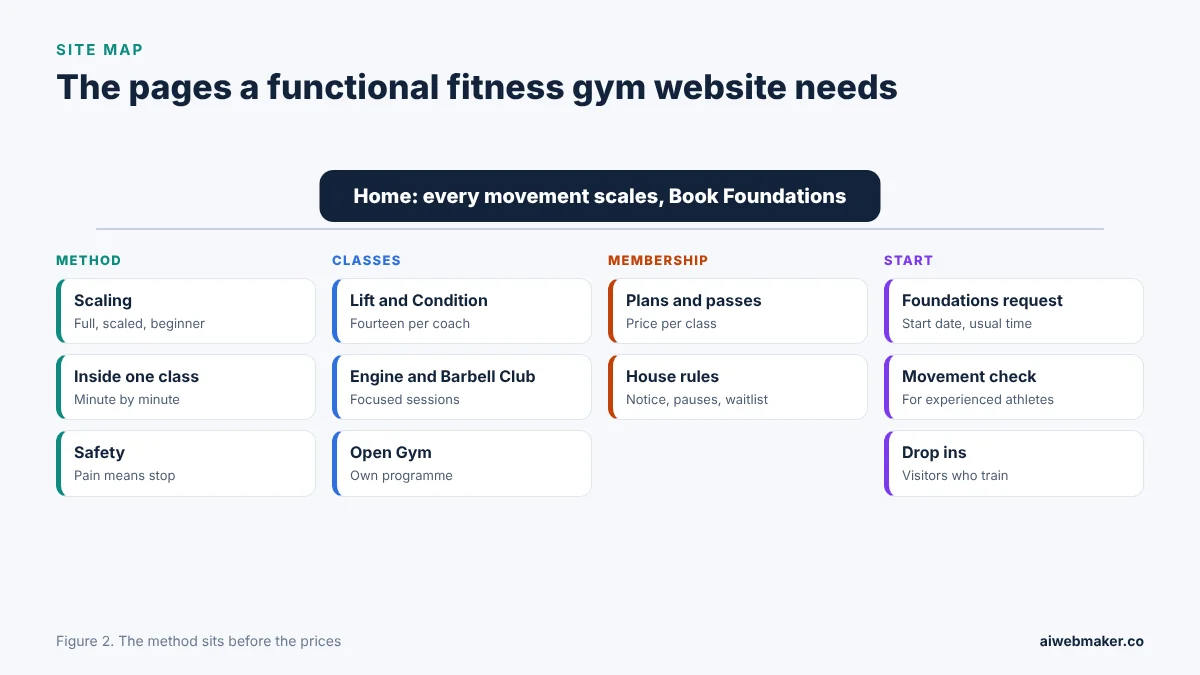
Four branches organise this plan: the method, the classes, membership and getting started. Forgeline Functional Fitness, the fictional gym in the functional fitness gym website example with a Foundations course request, opens with coached classes where every movement scales to the person. A section shows one workout on the board with three ways through it, and six Foundations sessions in groups of four or fewer teach the lifts before any class. A table breaks one class hour into briefing, warm up, strength or skill, workout and cool down. Six class types follow, namely Lift and Condition, Engine, Barbell Club, Gymnastics Skills, Mobility and Open Gym, and chips list the equipment on the floor. Membership cards set the Foundations course beside Three a week, Unlimited and a Ten class pass. The request form asks what the visitor would like, a preferred start date, a usual training time and their training so far.
Why does a paid beginners' course protect both members and revenue?
A paid beginners' course protects members because it teaches the squat, hinge, press, pull and pacing before anyone faces a clock. It protects revenue too, since newcomers who learn the movements in a small group tend to feel they belong before their first full class. Charging for the course signals that it is real coaching, and it brings in money from the first week rather than after a trial. Experienced athletes can be offered a shorter movement check instead, and visitors a drop in with a quick check beforehand. Each route should state what it includes, how long it lasts and whether its fee counts towards a first month. A clear entry path sets the tone of the whole membership.
| Entry route | Who it suits | What to state |
|---|---|---|
| Beginners' course | Anyone new to this style | Sessions, weeks, group size, coach |
| Movement check | Experienced athletes | Lifts watched, classes suggested |
| Drop in | Visitors who already train this way | Notice needed, quick check first |
| Open Gym | Members with their own programme | Coach on the floor for safety only |
How should memberships, passes and drop ins sit side by side?
Membership options should be laid out so a visitor can see the price per class and the commitment at a glance. A plan of three classes a week suits people with busy diaries, while unlimited suits those who train most days and want extras such as a regular goal check. A pass of ten classes valid for a few months suits members who travel or train elsewhere. Each option should state the booking window, any pause allowance and the notice needed to stop, since month to month terms with a notice period are common. Late cancellation rules belong here too, because a class cancelled shortly before the start keeps someone on the waitlist from training. Plain terms printed beside each price prevent most disputes at the front desk.
| Option | Suits | What to state |
|---|---|---|
| Three a week | Busy diaries | Classes a month, booking window, pause |
| Unlimited | Most days | Extras included, pause, notice |
| Class pass | Travellers, part time members | Classes, months valid |
| Drop in | Visitors | Price, notice, movement check |
How many members can one coach watch, and why should the site say so?
The number of people one coach can watch safely shapes both the quality of coaching and the economics of each class. A cap such as fourteen per coach for general classes, and fewer for technical sessions such as Olympic lifting, tells visitors they will be seen. It also tells the gym how much each class can earn against the coach's pay and the rent for that hour. Classes that regularly fill create waitlists, which is why late cancellation rules matter. Early morning and evening slots usually fill first, so a timetable that marks spare capacity at quieter times helps spread members. Publishing the cap turns an operating limit into a selling point.
How should scaling, safety and health questions be presented?
Scaling should be presented as the normal way to train rather than the lesser option, because it is how a coached group keeps everyone moving well. Every workout can show a full line, a scaled line and a beginner line, with weights chosen with the coach. The safety page should say that pain means stopping and telling the coach, every time. People who are pregnant, recovering from an operation, living with a heart condition or raised blood pressure, or nursing an unhealed injury are best asked to clear training with their doctor first. Health details are best discussed in person rather than through a website form, and coaches should be described as giving no medical advice. Coaching qualifications differ from country to country, and listing the ones each coach actually holds is more honest than a vague claim of certification.
What should a start request ask, and how does the gym reply?
A start request should ask only what the coach needs to place a newcomer, such as the preferred start date, usual training times and training so far. The booking website builder for functional fitness gyms and their beginners' courses lets a visitor send that request, after which a coach can place them in a course group, suggest a later start or decline if the gym is not the right fit. Once a place is confirmed, the gym settles payment with the member directly and keeps every cent of the fee. The page should say how quickly a coach replies and that medical questions are asked in person at the first session. Answering before the next working day ends stops a newcomer's resolve from cooling.
Which search words bring a would be lifter to the gym's pages?
People looking for this kind of training search with phrases such as functional fitness near me, beginner strength classes, small group training, barbell class or conditioning class. Some type a branded name for the style, which in many countries only licensed affiliates may use, so an unaffiliated gym should describe its training in its own words. Class pages titled with the training style and the district attract the right visitors. On the map listing, early opening hours, parking and the start request link matter more than slogans. Reviews from members who arrived nervous and found patient coaching persuade beginners more than any leaderboard. Articles on scaling, a first deadlift or how to pace a workout reach people weeks before they book.
How does a year of hosting compare with one beginners' course?
Racks and rowers cost more than the website ever will. Its only fixed lines are the hosting and the web address, while a technique article drafted through AI credits each month adds roughly $7.80 a year. A gym with a settled membership spends least by paying the hosting annually. A box in its first year might prefer monthly billing while numbers grow. Timetable edits, new membership prices and fresh class descriptions are all included. The table places both billing methods beside the $189 tier, which appears purely as a yardstick.
| Item | Yearly | Monthly |
|---|---|---|
| Hosting the gym's class pages | $119 | $228 over twelve months |
| Domain | Depends on the ending | Depends on the ending |
| Higher plan, for comparison | $189 a year | Not needed |
| Twelve technique and scaling articles at about $0.65 | About $7.80 | About $7.80 |
| Timetable, class and membership updates | No charge | No charge |
| Year before the domain | About $126.80 | About $235.80 |
Why does a nervous beginner close a strength gym's website?
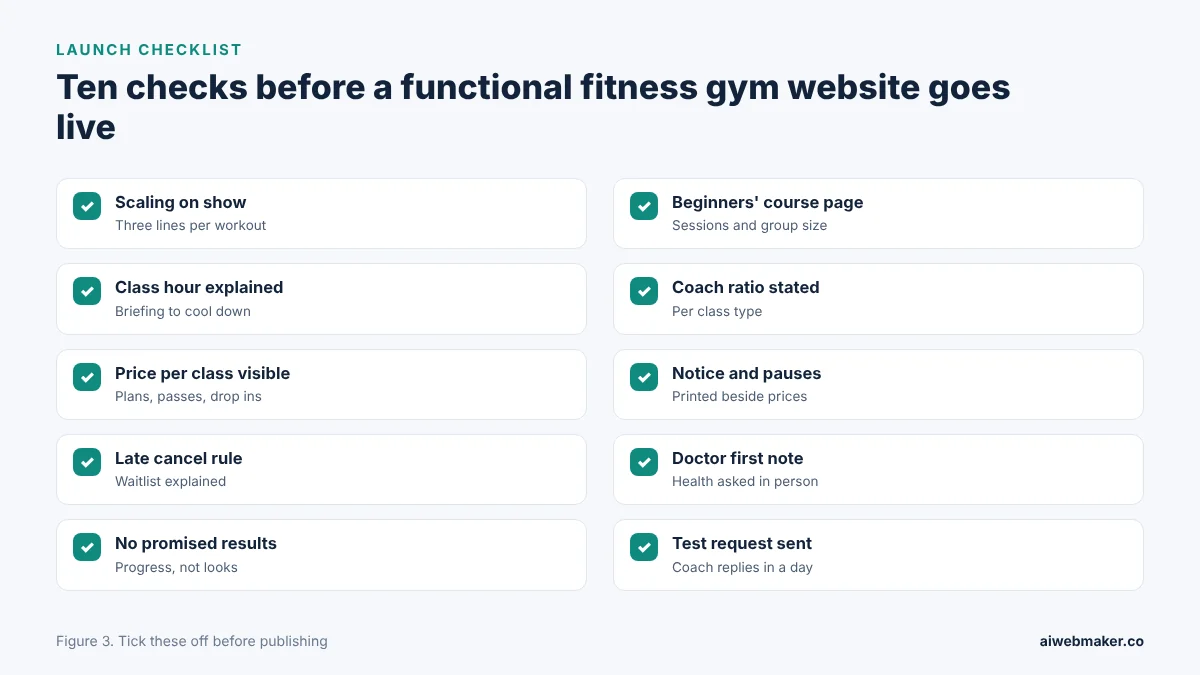
A nervous beginner closes the site when the first image is someone collapsed on the floor after a brutal workout. Leaderboards and personal records on the home page suggest a club for the already fit. No mention of a beginners' course leaves people imagining their first visit as a full class of strangers. Membership prices without notice periods or pause rules feel like a trap. No word on scaling or on health questions suggests nobody will notice if something hurts. Each of those exits is closed by a check among the ten launch items in the graphic.
Frequently asked questions
Is this style of training too intense for a complete beginner?
Every workout can be scaled to the person doing it, and a beginners' course teaches each movement before it appears in a class. Coaches usually care more about good form than about finishing fast. Rest is allowed whenever it is needed, and nobody has to post a score. The website should say this early, because intensity is the main fear. Beginners who understand scaling arrive ready to learn rather than afraid.
Can experienced athletes skip the beginners' course?
Many gyms let people who have trained this way for some months book a shorter movement check instead. A coach watches a few key lifts and a short workout, then suggests which classes suit. The website should state the experience needed and what the check costs. This keeps standards consistent without boring experienced members. A clear rule saves awkward conversations at the door.
Can visitors drop in while travelling?
Visitors who already train this way can often drop in, usually with a request a day or so ahead. The gym can hold a place and run a quick movement check before class. The website should list the drop in price, the notice needed and what to bring. Travellers often leave reviews that reach other travellers. A simple drop in page brings steady extra income from people passing through.
What happens when a class is already full?
When a class is full, the gym can offer a waitlist or suggest another time with space. Late cancellation rules matter here, since a place released early lets someone on the waitlist train. The website should explain how the waitlist works and how members hear about an opening. Marking quieter classes on the timetable helps spread attendance. Fair, visible rules keep full classes from becoming a source of frustration.
How few new starters pay for a year online?
A single beginners' course outearns the $119 that keeps a coached gym's class pages online for the year. One visiting athlete's drop in fee clears the $19 monthly charge. Every newcomer who finishes the course and joins on a monthly plan is worth many years of hosting. Clear scaling, a patient beginners' course and honest membership terms persuade capable people who feared they were not fit enough. Gyms that keep their timetable and course dates current fill early and late classes alike. Start requests that arrive with training history and usual times filled in show the scaling page has already done its reassuring.
Build your website in Minutes and get the AI Tools that work
Start Building Your Website →