English Tutor Website Cost, From Trial Lesson to Ten Lesson Pack
Hosting an English tutor's lesson pages comes to $119 settled yearly, or $19 for any month of lessons, with the web address priced by its ending on top. Topics: learners, pages, strands, levels, the trial, fees and packs, safeguarding, exam English, search and the budget.
- No coding required
- Live in minutes
- Blog, SEO and chatbot tools included
Hosting an English tutor's lesson pages comes to $119 settled yearly, or $19 for any month of lessons, with the web address priced by its ending on top. Drafting the goal list, the fee cards and the trial request in preview leaves the tutor's AI Web Maker bill at zero. A single ten lesson pack sold to one adult learner pays the hosting several times over. The real challenge for an English tutor is that learners arrive with very different goals, from a job interview next week to a child's reading, and an online tutor competes with teachers everywhere. The website has to show quickly that this tutor understands the learner's exact situation. Coming up are the learners, pages, strands, levels and the trial, fees and packs, safeguarding, exam English, search and the yearly sums.
This article is part of our complete guide: Fitness Website Builder.
Interviews, essays and a move abroad: who searches for an English tutor
People look for an English tutor when a specific situation is coming and their English feels like the weak point. Adults prepare for job interviews, meetings in English or emails that need to sound natural rather than translated. Others are moving to a new country and want small talk, phone calls and paperwork to stop feeling frightening. Parents look for help with a child's reading, spelling or confidence, while teenagers need essays and the English their school course demands. Exam candidates want preparation for proficiency tests used for study, work or moving abroad. Each of them looks for one sign above all: that the tutor recognises their situation and has taught it before.
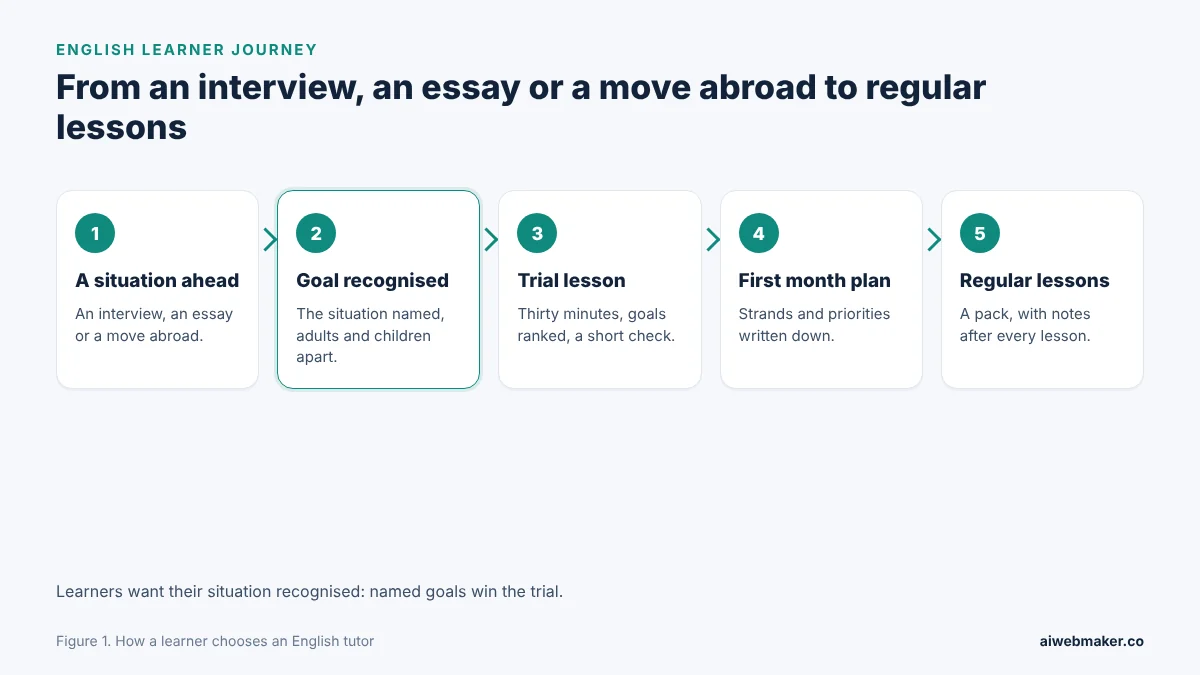
Recognition carries the second card of this journey, because a learner who sees their own situation named reads on and one who does not leaves. The journey opens with something specific on the horizon, such as an interview, an essay deadline or a move abroad. In the highlighted card the learner finds that goal on the page, with adults and children treated separately. A short trial lesson follows, ranking the goals and checking the current level. A plan for the first month and regular lessons, often bought as a pack, complete the journey, and learners who feel progress within a few weeks usually stay for months.
Goals, adults, children and exams: the pages an English tutor's site holds
An English tutor's pages should be organised around what learners want to do with the language rather than around grammar topics. A goals section names the common situations, so a learner can point to the one that worries them. Adults and children need separate sections, because the lessons, the safeguards and the parents' role differ completely. Exam English deserves its own page, explaining the skills practised and why no score can be promised. Fees and the trial request close the set, with lesson lengths and pack terms stated in full.
| Page | Learner's question | What it should state |
|---|---|---|
| Goals | Does this tutor handle my situation | Common goals named, from interviews to essays |
| Adults | Will lessons fit my week | Real situations, early slots, a running phrase list |
| Children | Is it safe and suitable | Age range, parents present, checks, shorter lessons |
| Exam English | Can the tutor prepare me | Skills by part, formats that differ, no promised scores |
| Fees | What a lesson costs | Trial, online, in person, packs and expiry |
| Trial request | How to start | Who is learning, the focus, the level, a time |
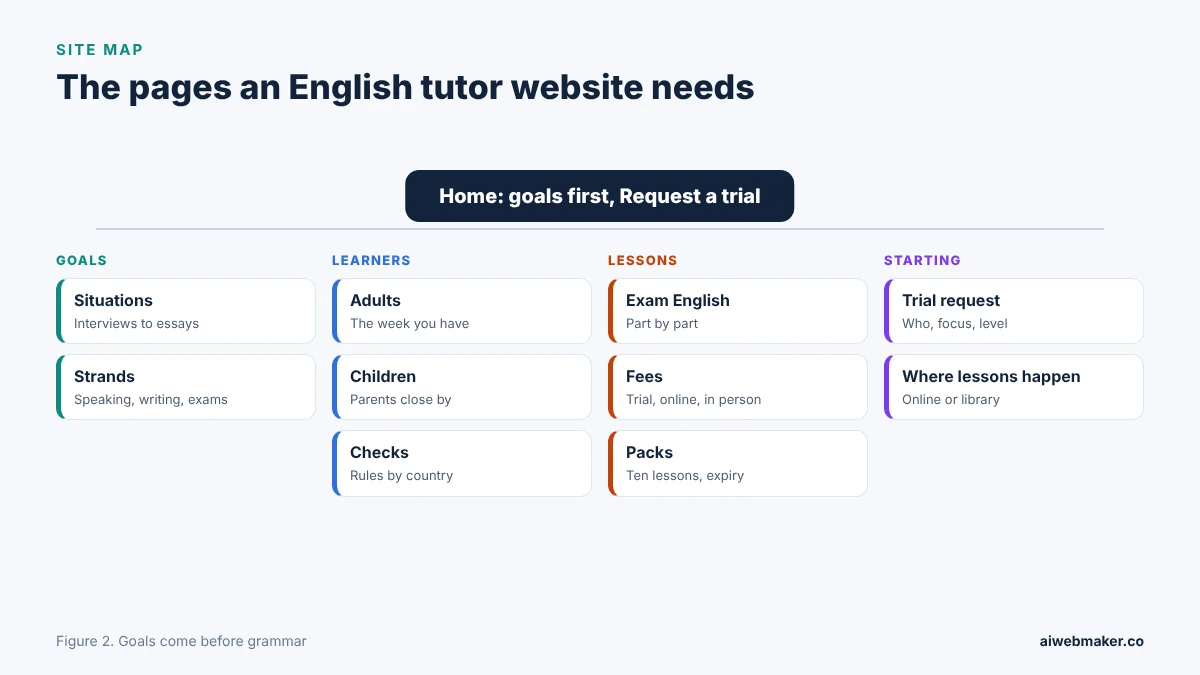
Goals, learners, lessons and starting are the four groups in this tutor's plan, and the goals group sits first because it is what visitors scan for. Wordwise English Tutoring, the sample, presents a tutor called Ines Duarte with the line say it clearly, write it well, and three facts: ages 7 to adult, 50 minute lessons and three strands covering speaking, writing and exams. The English tutor website example with lessons for adults and children lists twelve goals, from job interviews and natural emails to old grammar gaps, before separate sections for adults and for children. Fees run from a 30 minute trial at $20 to an online lesson at $44, an in person lesson at $52 in a library meeting room and ten online lessons for $400. Exam English part by part, reviews, questions and a trial request complete the page, with in person lessons held only in the library room.
Speaking, writing or exam English: one strand for each goal
Sorting lessons into strands helps a learner see what a lesson will actually involve, and it helps the tutor plan without a fixed textbook. Speaking lessons rehearse the situations of the learner's real week, with the tutor playing the other side and noting phrases that trip them up. Writing lessons start from the learner's own drafts, corrected with the reason behind each change so the same mistake is fixed for good. Exam lessons follow the format of the test the learner actually faces. Most learners bring two or three goals, and the trial lesson ranks them so the first month has a clear focus.
| Goal | Strand | How the lessons work |
|---|---|---|
| A job interview | Speaking | The interview rehearsed with real questions |
| Emails that sound natural | Writing | The learner's drafts corrected with reasons |
| Meetings and video calls | Speaking | The week's meetings played out in advance |
| Essays and reports | Writing | Planning and paragraphs, one piece a week |
| A speaking test | Exam | Mock speaking parts with gentle interruptions |
| Reading aloud for a child | Reading | Books the child chooses, short word games |
Levels, the trial lesson and the first month's plan
Learners rarely know their level in the terms a teacher would use, so the page should describe levels in everyday words. The sample's request asks whether a learner is just starting, gets by in daily life, is comfortable but stuck or is advanced and polishing. Learners in Europe often describe their level with the CEFR scale, and naming it alongside plain descriptions helps those who already know their grade. The trial lesson then does the real placing, with a short speaking and writing check and the goals ranked together. A plan for the first month follows, which turns a nervous enquiry into a sequence of lessons the learner can picture.
Fifty minutes online, thirty for a child and ten in a pack
English tutoring fees work best when each card states the length, the format and what happens outside the lesson. The sample charges $44 for a 50 minute online lesson, $28 for a child's 30 minutes and $52 in person, where the extra covers the library room. Its ten lesson pack costs $400, works out at $40 a lesson and must be used within fourteen weeks, which rewards regular learners without locking anyone in forever. Lessons move without charge given 24 hours notice, and a lesson missed without notice is not refunded. Online tutors teaching across borders should state their teaching hours with a time zone, because a 07:30 start means different things in different countries.
| Lesson | Length | Sample fee | Notes |
|---|---|---|---|
| Trial lesson | 30 minutes | $20 | Goals ranked, a plan for the first month |
| Online lesson | 50 minutes | $44 | Shared notes after each lesson |
| Child's online lesson | 30 minutes | $28 | For children under eleven |
| In person lesson | 50 minutes | $52 | In the library meeting room |
| Ten online lessons | 50 minutes each | $400 | Used within fourteen weeks |
Learners and parents ask for a trial or a lesson through the booking website builder for English tutors who teach online and in person. The request names who is learning, the focus and a preferred time. The tutor then takes the slot, offers one close to it or explains that it has gone, all decided by the tutor rather than by any automatic rule. Fees go to the tutor directly, before the lesson or the pack starts, and the platform claims no part of them. This keeps the timetable firmly in the tutor's hands while saving the back and forth of messages. A learner who has chosen a time before writing tends to turn up ready to start.
Adults and children need different safeguards
Lessons for children carry responsibilities that adult lessons do not, and the page should set them out calmly rather than in small print. The sample's tutor holds the background check required for teaching children where she works, and the page notes that such rules vary by country. Parents may sit in on any lesson, learners under 18 join video lessons from a family room with an adult at home, and lesson messages and video links go to parents. In person lessons happen only in a booked library meeting room, never in a private home. Adults get none of these restrictions, which is one more reason to keep the two sections separate.
Exam English, part by part, without a promised score
Exam candidates want proof that the tutor knows the format, and the most honest proof is a clear account of how each skill is practised. Reading, writing, listening and speaking are tested in every major English exam, though the tasks and timings differ by country and by purpose. The sample practises reading with timed passages, writing with one timed piece a week, listening with short recordings played twice and then once, and speaking with mock parts. Learners are asked which exam they face, and the trial goes through its published format. No tutor can promise a score or a grade, and saying so plainly attracts serious candidates rather than putting them off.
English lessons for adults and English tutor online: the phrases learners type
Learners search by purpose and by person, typing English lessons for adults, English tutor for a child, help with essays, business English or speaking practice online. Pages that name those purposes, with separate headings for adults and children, give each search the part of the site that fits it. For in person lessons, a map listing showing the town and the library or room used helps local learners find the tutor. Reviews that mention a specific result, such as a first meeting abroad going smoothly, carry more weight than general praise. Short articles on common confusions, interview phrases or writing a polite email draw learners who are still deciding whether they need lessons.
Lesson pages, language articles and a domain: the tutor's yearly sums
Lesson pages cost an English tutor their hosting and a web address each year, while twelve language tips articles written with credits stay near $7.80. With a timetable already full, the yearly $119 is the cheaper route. A newcomer to online teaching can pay $19 monthly until the first pack is sold. Rewriting a goal, adjusting a fee or adding a pack costs nothing extra. The $189 line is included only as a yardstick for the other two.
| Item | Yearly | Monthly |
|---|---|---|
| Hosting the tutoring pages | $119 | $228 over twelve months |
| Domain | Depends on the ending | Depends on the ending |
| Higher plan, for comparison | $189 a year | Not needed |
| Twelve language tips articles at about $0.65 | About $7.80 | About $7.80 |
| Goal, fee and pack updates | No charge | No charge |
| Year before the domain | About $126.80 | About $235.80 |
No goals named and no word on children: why learners pick another tutor
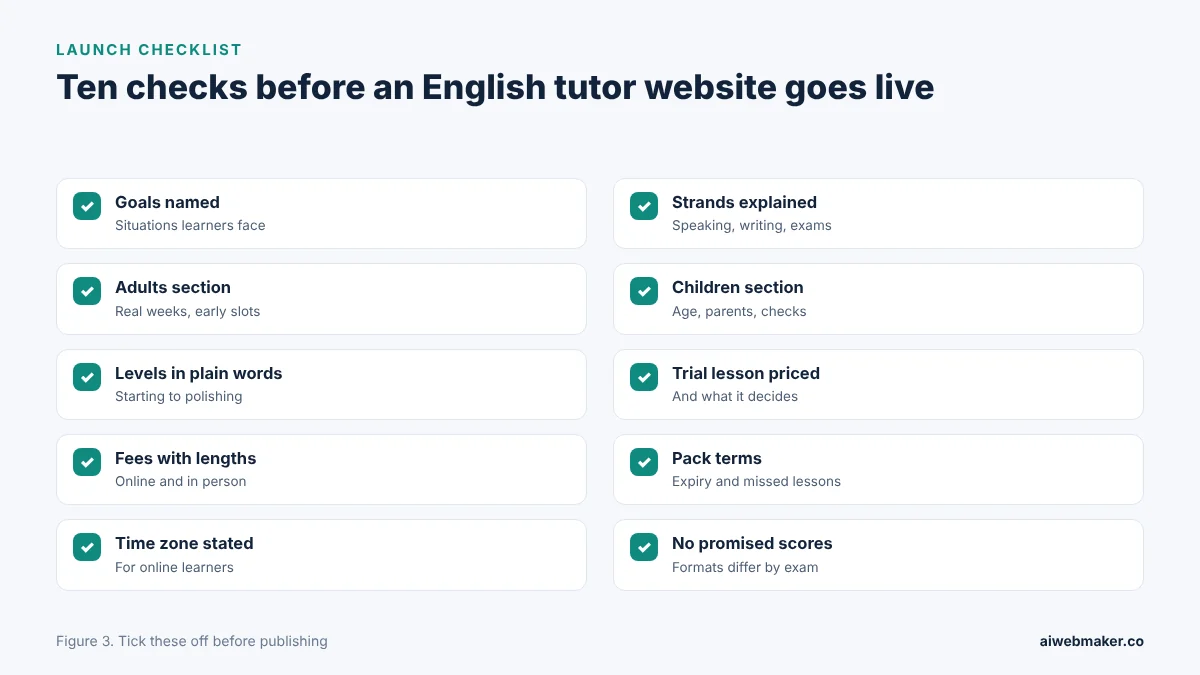
Learners pick another tutor when a page talks about grammar and methods but never names a situation they recognise. Parents leave when nothing is said about checks, where lessons happen or whether they can sit in. Fees without lesson lengths or pack terms make comparison impossible. Promises of guaranteed exam scores put off careful candidates who know nobody can guarantee them. A page with no trial lesson asks a learner to commit before they have heard the tutor speak. Ten short checks below cover all of these before the trial request goes live.
Frequently asked questions
Can English lessons focus on speaking only?
Many adults choose conversation only, and lessons can stay spoken from start to finish. The tutor usually sends a short written list of new phrases afterwards so nothing is lost. Speaking lessons work best when built on the learner's real week, such as a meeting or a phone call. Shy learners begin with low pressure tasks like describing a photo. Most find their confidence grows within a few weeks.
How are writing mistakes corrected in an online lesson?
In an online lesson the learner's draft is usually read together on a shared screen. Corrections are made in a different colour with a short reason beside each one. The learner keeps the corrected version and the list of reasons. Understanding why a sentence changed helps the same mistake disappear for good. The page can describe this process so learners know what to expect.
What level does a child need before starting lessons?
A child needs no particular level, because the trial lesson sets the starting point. A seven year old learning to read and a fourteen year old writing essays can both begin with the same trial. Lessons for younger children are shorter and use games and books they choose. Parents are welcome to sit in, especially at the start. The page should make clear that every child begins where they are.
Can a tutor promise a score in an English proficiency test?
No tutor can honestly promise a score or a grade, because the exam board sets and marks the test. What a tutor can offer is practice in the published format, timed work and clear feedback. Learners should check which exam their university, employer or visa route requires. Formats differ by country and purpose, so preparation must follow the right one. Candidates trust a tutor who admits this far more than one who guarantees a band.
One ten lesson pack, and the tutor's hosting year is paid several times
A single pack of ten online lessons brings in more than three times the $119 that hosts an English tutor's pages for a year. Taken monthly, the $19 is less than half of one online lesson. Adult learners who reach their goal often return for the next one, and parents pass a good tutor's name to other families at the school gate. Goals named plainly, separate care for children and honest exam preparation persuade learners more than any list of qualifications alone. A trial request that already names the learner's situation shows the pages have done the first part of the teaching.
Build your website in Minutes and get the AI Tools that work
Start Building Your Website →