Driving School Website Cost Explained Through Lessons and Pickups
A driving school keeps its lesson pages hosted for $119 a year, or $19 per month, with the domain extra. Covered here: lesson types, instructor profiles, prices and blocks, the first lesson request, pickup areas, policies, learner progress, search and the yearly budget.
- No coding required
- Live in minutes
- Blog, SEO and chatbot tools included
A driving school keeps its lesson pages hosted for $119 a year, or $19 per month for instructors who pay as the diary fills, with the domain on top. Putting the pages together and checking them in the AI Web Maker preview is not billed. A useful reference while you do that is the driving school website example, a fictional driving school whose AI Web Maker pages sort lessons into clear blocks. A couple of lessons cover the monthly fee and a single block covers the year, so the website's price is rarely the issue. The challenge is that learners compare several schools in one evening, judging patience, price, pass record and availability from a few pages. Many are nervous, some have failed a test before, and parents often pay and want reassurance about safety. This guide explains the lesson types, instructor profiles, prices, pickup areas, policies, progress tracking and request setup that win those comparisons.
Who searches for driving lessons, and what worries them?
People searching for driving lessons range from first time learners to experienced drivers who need a refresher, and each brings a specific worry. Young learners want a patient instructor and a realistic idea of how many lessons they will need. Parents who pay want to know the car is safe and the instructor properly licensed. Adults learning later in life are often anxious and want someone who will not rush them. Learners who have failed a test want focused preparation, while new residents may need lessons to convert a foreign licence. The home page should acknowledge these groups and point each one to the right lesson type.
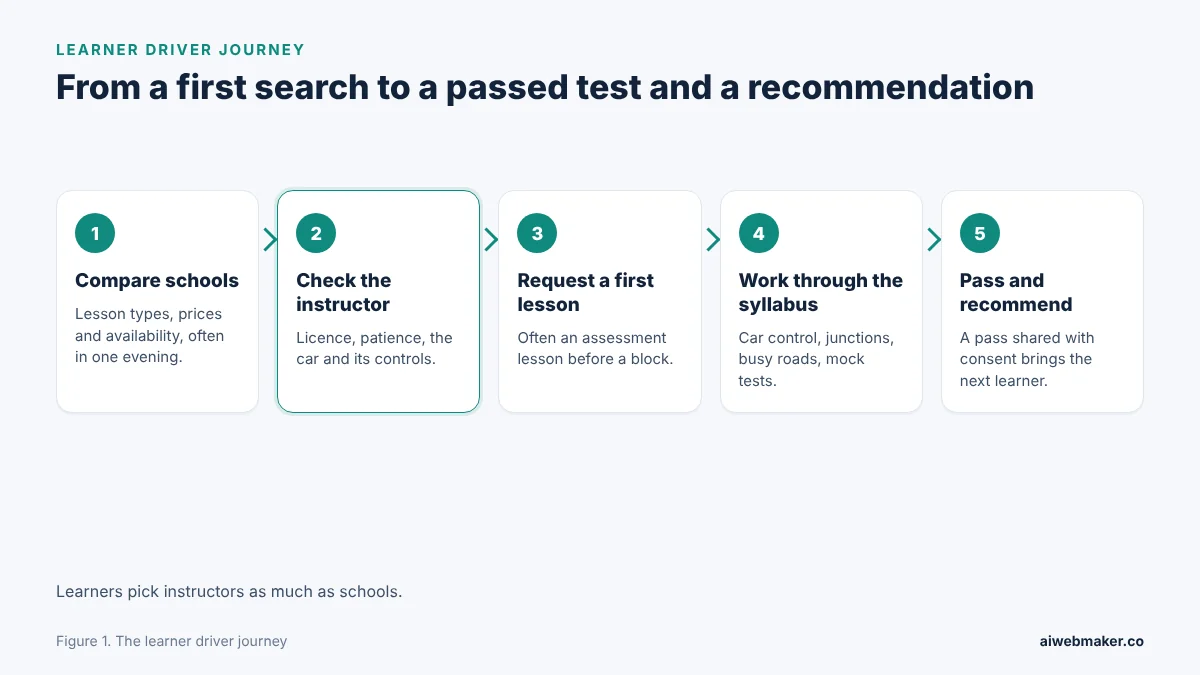
The figure traces the path from a first search to a passed test, and most of the decisions happen in the first few minutes on the site. Learners compare lesson types and prices, then look closely at the instructor. Availability matters greatly, because a school that cannot start for two months loses learners eager to begin. A first lesson request follows, often for a single assessment lesson before committing to a block. Steady progress through the syllabus builds confidence for the test itself. A pass, shared with the learner's consent, becomes the proof that attracts the next learner.
Which lesson types should a driving school list?
A driving school should list each lesson type separately, because learners search for exactly what they need, such as automatic lessons or an intensive course. Manual and automatic lessons deserve clear separation, since many learners choose automatic for a quicker route to a licence. Intensive courses compress learning into days or weeks for those with a deadline. Test preparation, including mock tests on local routes, suits learners close to their test date. Refresher lessons help qualified drivers regain confidence after a break, and motorway or highway lessons build skills that the basic test may not cover. Each page should state the lesson length, price and who the lesson suits.
| Lesson type | Who it suits | What the page should state |
|---|---|---|
| Manual lessons | Learners wanting the widest licence where that applies | Car model, lesson length, price |
| Automatic lessons | Learners wanting simpler car control | Car model and any licence restriction |
| Intensive course | Learners with a deadline | Total hours, schedule, test arrangements |
| Test preparation | Learners near their test date | Mock tests, local routes, test day car use |
| Refresher lessons | Qualified drivers returning after a break | Flexible content, pickup options |
| Motorway or highway lessons | New drivers building confidence | Where the lessons take place |
| Licence conversion support | New residents with a foreign licence | Local rules explained, typical lesson count |
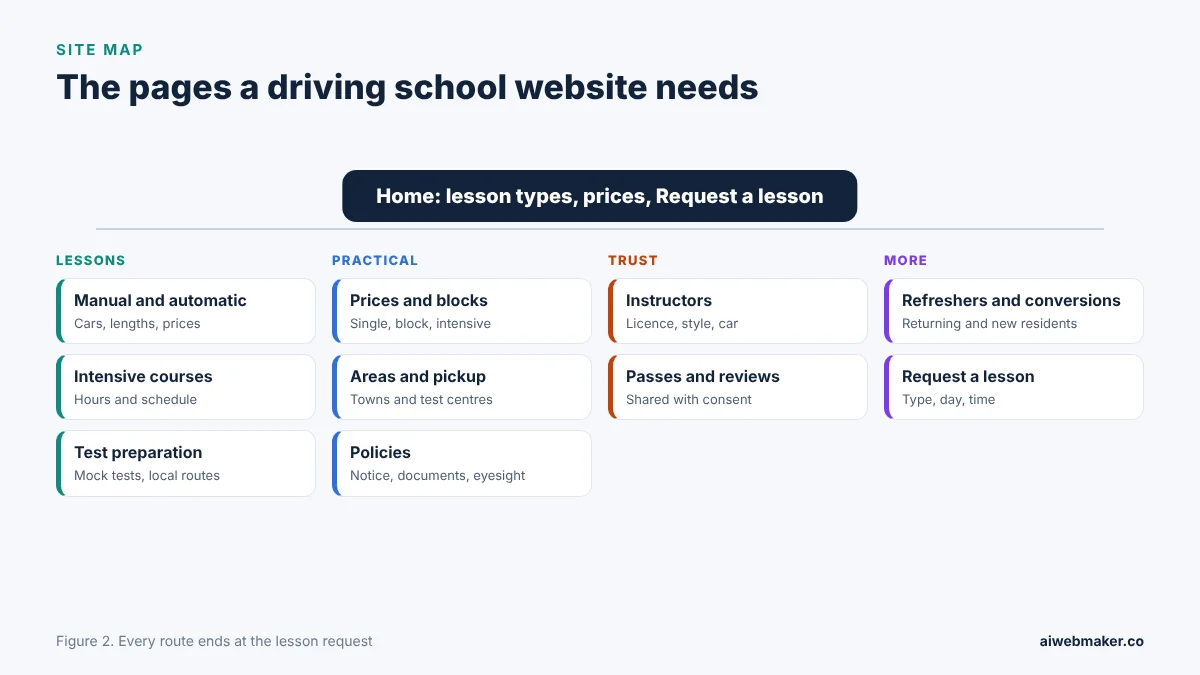
On a site map, a driving school's pages gather into lessons, practical details, trust and the lesson request, as the figure shows. Lesson pages separate manual and automatic tuition, intensive courses and test preparation, with refreshers and licence conversions beside them. Practical pages carry prices and blocks, the areas and pickup points covered, and the school's policies. Trust pages introduce each instructor and share passes and reviews. The request page sits at the end of every route, so a learner never has to search for it. A structure this simple suits learners who are often reading on a phone between classes or shifts.
What should instructor profiles tell learners and parents?
Instructor profiles should tell learners and parents who will be sitting in the passenger seat, how qualified that person is and how they teach. A photo, a name and years of experience make the instructor feel familiar before the first lesson. The licence or registration required to teach driving in the school's country should be stated, along with any background checks completed for teaching young people. Teaching style matters, so a few lines on how the instructor handles nerves, mistakes and slower progress help anxious learners choose. The car, its transmission and its dual controls deserve a mention and a photo. Learners pick instructors as much as schools, so these profiles often decide the first request.
| Profile detail | Why learners look for it |
|---|---|
| Photo and name | Makes the first lesson feel less daunting |
| Instructor licence or registration | Confirms the instructor may legally teach |
| Years teaching | Signals experience with all kinds of learners |
| Teaching style | Helps nervous learners choose |
| Car and transmission | Manual or automatic, with dual controls |
| Languages spoken | Helps learners more at ease in another language |
| Areas and hours | Shows whether lessons fit the learner's week |
How should lesson prices and blocks be shown?
Lesson prices should be shown openly, with single lessons, blocks and intensive course totals side by side, because learners compare these first. A single lesson price lets new learners try the school without a large commitment. Blocks of five or ten lessons at a lower hourly rate reward commitment and help the school plan its diary. Intensive courses should show the total price and what it includes, such as the number of hours and the use of the car for the test. Extra charges, such as test day car use or lessons outside the usual area, should be listed rather than mentioned later. Honest, complete pricing earns the trust of learners and the parents who fund them.
| Option | What it usually includes | Who it suits |
|---|---|---|
| Single lesson | One lesson of a stated length | New learners trying the school |
| Assessment lesson | A first lesson to judge the starting level | Learners unsure how many lessons they need |
| Block of lessons | Five or ten lessons at a lower rate | Committed learners |
| Intensive course | A set number of hours over days or weeks | Learners with a deadline |
| Test day package | Warm up lesson and car use for the test | Learners with a test booked |
What makes the first lesson easy to arrange?
The first lesson becomes easy to arrange when learners can choose the lesson type, pick a day and time and send a request in a minute. The instructor accepts the slot, proposes another or declines it if the pickup point is outside the area. Lesson fees are paid however the school arranges them, and the platform takes nothing from them. The booking website builder for driving instructors and schools presents manual, automatic and test preparation lessons as separate choices a learner can request. Learners and parents can see what each lesson costs before they ask. A clear first step converts curious visitors into learners behind the wheel.
How should pickup areas and test centres be described?
Pickup areas and test centres should be described precisely, because learners need to know whether the instructor can collect them from home, school or work. A list of towns or districts covered, with any extra charge for distant pickups, prevents wasted requests. Naming the test centres the school uses, and offering lessons on the routes around them, attracts learners preparing for a specific test. Notes on where lessons start and finish, such as home pickup and drop off at a college, help busy learners plan. Instructors who cover several areas can show which days they work in each. Precise coverage information turns local searches into requests.
Which policies prevent disputes with learners?
Clear policies on cancellations, lateness, documents and payment prevent most disputes between instructors and learners. A cancellation notice period, such as a full working day, protects the instructor from empty slots and should be stated plainly. Lateness rules explain whether a lesson is shortened or extended when a learner arrives late. Learners must carry the right documents, such as a learner permit or provisional licence, and meet the eyesight standard, and the school should explain these requirements. Rules for lessons when a learner seems unwell or unfit to drive protect everyone's safety. Policies written kindly but firmly set a professional tone from the start.
| Policy | What the website should state |
|---|---|
| Cancellation notice | How much notice is needed and what happens without it |
| Lateness | Whether the lesson is shortened or the time recovered |
| Documents | The learner permit or licence to carry on every lesson |
| Eyesight | That learners must meet the legal eyesight standard |
| Fitness to drive | When a lesson will not go ahead, for safety |
| Payment timing | When lessons and blocks are paid |
| Test bookings | Who books the test and how the school's car is used |
How can learner progress be tracked and shown?
Learner progress can be tracked against a clear syllabus, and showing that syllabus on the website reassures learners that lessons follow a plan. A syllabus breaks driving into stages, from controlling the car to handling complex junctions and independent driving. Learners can see where they are and what comes next, which keeps motivation high. Parents paying for lessons appreciate the same visibility. Mock tests near the end show whether a learner is ready to book the real test. A visible plan answers the common question of how many lessons are needed.
| Stage | Skills covered | Sign of readiness to move on |
|---|---|---|
| Car control | Moving off, stopping, steering, gears or drive selector | Smooth control on quiet roads |
| Junctions | Approaching, turning, emerging | Safe observation without prompts |
| Busy roads | Roundabouts, lane discipline, traffic | Confident decisions in traffic |
| Manoeuvres | Parking, reversing, turning in the road | Accurate and safe without help |
| Independent driving | Following signs or directions | Calm driving without instruction |
| Test readiness | Mock tests on local routes | Consistent passes on mock tests |
Which searches bring learners to a driving school?
Learners find driving schools with searches such as driving lessons near me, automatic driving lessons, intensive driving course or driving instructor with a town name. Each lesson type page should name its phrase in the heading so the right searcher arrives at the right page. Area pages for the main towns covered help local searches without repeating the same text. Map listings with the school's area, hours and photos of the car support local results. Articles on topics such as what to expect on a first lesson or how to calm test nerves bring learners researching before they commit. Reviews mentioning the instructor's name and the pass strengthen every page.
What does a driving school pay each year to keep its lesson pages live?
Keeping the lesson pages live means hosting and a domain each year, while learner articles drafted with credits cost only a few dollars more. An established school pays less by choosing yearly billing. A newly qualified instructor building a diary may prefer the flexibility of monthly payments. Changing prices, areas and lesson types never adds to the bill. The table shows both routes, with the $189 tier alongside.
| Line item | Yearly billing | Monthly billing |
|---|---|---|
| Hosting the lesson pages | $119 | $228 in a year |
| Domain for the school | Priced by the ending | Priced by the ending |
| Higher plan, for comparison | $189 a year | Not needed |
| Twelve learner articles at about $0.65 | About $7.80 | About $7.80 |
| Price, area and lesson changes | No charge | No charge |
| Year before the domain | About $126.80 | About $235.80 |
Why do learners pick another school after visiting the site?
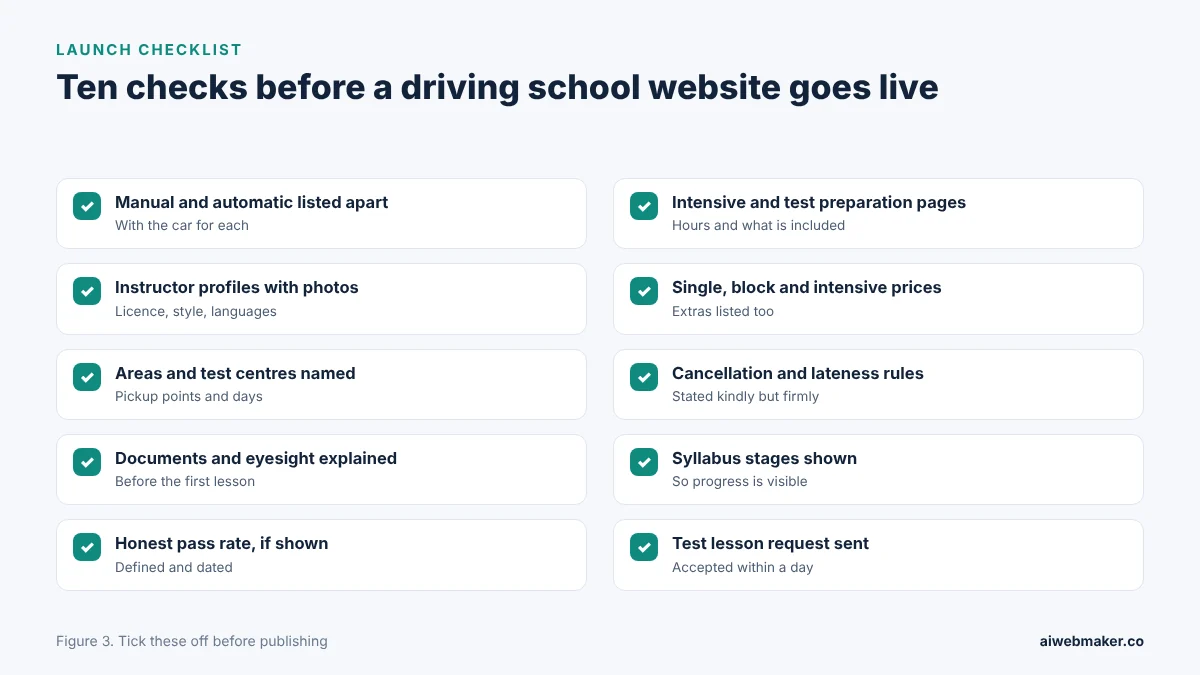
Learners often pick another school when prices are hidden, because they assume the worst and move on. A site that never mentions automatic lessons loses the many learners who want them. Vague areas leave learners unsure whether pickup is possible. Instructor pages without photos or licence details fail to reassure parents. No sign of availability suggests a long wait, which sends eager learners elsewhere. The ten points in this figure deal with every one of them.
Frequently asked questions
Should a driving school publish its pass rate?
A pass rate can reassure learners, but it should be published honestly, with a clear definition and period. First time pass rates and overall pass rates measure different things, and the website should say which is shown. A school that teaches many nervous or older learners may have a lower first time rate despite excellent teaching. Context, such as the number of learners and the period covered, makes the figure meaningful. An honest number, explained well, earns more trust than an impressive one without detail.
How many lessons does a typical learner need?
The number of lessons varies widely with age, confidence, practice outside lessons and local test standards, so the website should avoid promising a fixed number. An assessment lesson gives the instructor a sound basis for an estimate. Learners who practise with a family member between lessons often need fewer professional hours. Automatic learners often progress faster on car control. A realistic range, with an honest explanation, sets expectations that keep learners motivated.
Can nervous learners ask for a calm, slower approach?
Nervous learners can and should ask for a calm approach, and the website should welcome them openly. A dedicated section can describe how the instructor starts on quiet roads, explains each step before it happens and never raises their voice. Shorter first lessons can help some anxious learners settle. Stories from previously nervous learners, shared with consent, are especially reassuring. Schools that welcome anxious drivers often build a loyal reputation through word of mouth.
Should lessons be offered in more than one language?
Lessons in a second language help new residents and learners who understand road rules more clearly in their first language. If an instructor speaks another language, the website should say so on their profile and on a short page in that language. The test itself may still have language rules, which the page can explain. Offering lessons in several languages widens the school's reach in diverse towns. It also helps learners grasp safety instructions accurately.
Is one block of lessons enough to fund the school's website?
A single block of ten lessons typically earns several times the $119 hosting fee for a year. On monthly billing, part of one lesson covers the $19. Each learner who passes and recommends the school to a friend adds income that began with a search and a page. The fitness website builder for driving instructors and lesson providers section shows how coaches, tutors and other instructors present their lessons. Schools that show prices openly, introduce instructors properly and make requests simple keep their diaries full. A steady run of passed tests and new learners is the measure of the site's success.
Build your website in Minutes and get the AI Tools that work
Start Building Your Website →