Drama School Website Cost: Trial Classes, Term Shows, Safeguarding
A drama school's website costs $119 a year to host, or $19 a month, with the domain on its own bill. Inside: how families choose, the pages to build, classes by age, safeguarding, term shows, trial requests, coaching, search and costs.
- No coding required
- Live in minutes
- Blog, SEO and chatbot tools included
For a drama school, AI Web Maker charges $119 to host the site through the school year, or $19 in any month the school prefers, plus a domain. The class pages, the timetable and the trial request can be rehearsed in the preview like a scene, run after run, and none of those runs is billed. A single child joining for one term usually pays for the hosting several times over. Trust is the harder part, because parents are handing their children to adults they have never met, often in the evenings and on show nights. Adults joining a class carry a different worry, usually the fear of being pushed onto a stage before they are ready. What follows covers how families and adults choose, classes by age, safeguarding, term shows, trial class requests, audition coaching, search and the hosting sums.
This article is part of our complete guide: Fitness Website Builder.
How do families and adult beginners choose a drama school?
Families usually choose a drama school by age group, timetable and safety, while adult beginners choose by atmosphere and the promise of no pressure. Parents of young children want confidence, play and a short, gentle showing rather than a full production. Parents of teenagers look for real plays, voice work and sometimes audition preparation. Teenagers themselves often read the site to see whether the classes look fun and whether backstage roles are available. Adults returning to acting after years away want to know that beginners and returners share the room comfortably. A drama school site written for each of these readers turns curiosity into a booked trial.
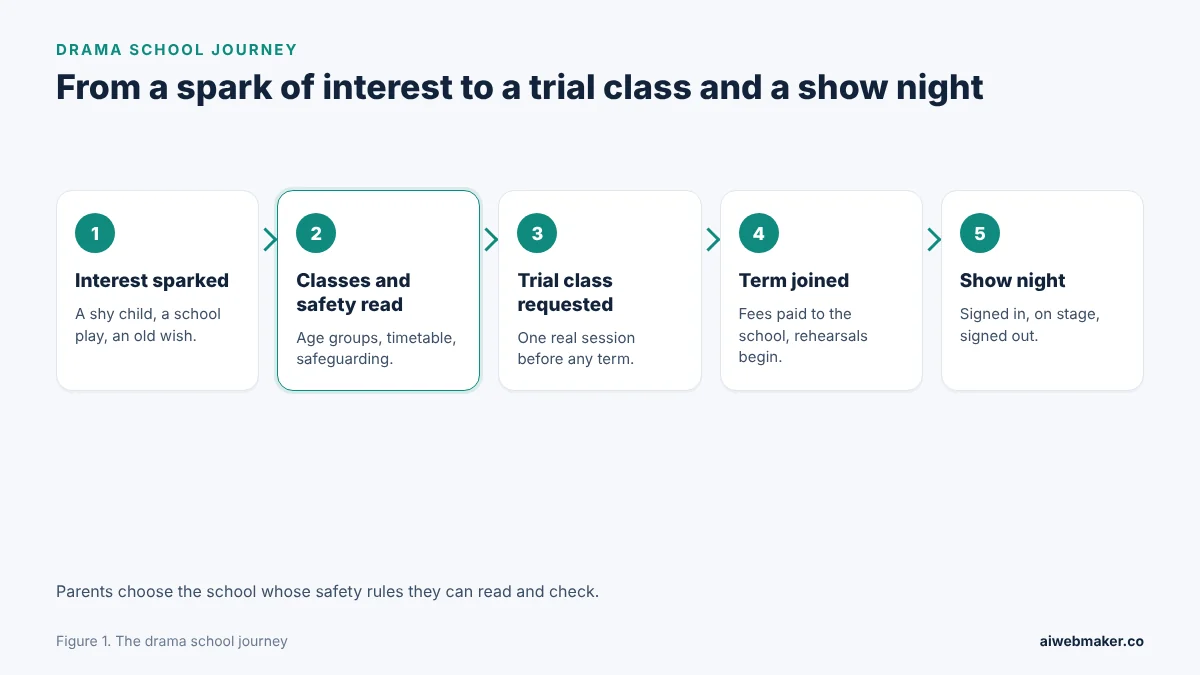
This journey follows a family or an adult from the first spark of interest to signing out after a show night. The marked step is reading the classes and the safety rules, because parents decide there whether the school feels careful enough. A trial class follows, which lets the student join a real session before any term is paid. Joining the term comes next, with fees paid directly to the school and rehearsals beginning. The final step is the show, where a child is signed in, performs and is handed back to the same adult who arrived with them. At every step, a parent's next question should already have an answer on the page.
Classes, timetable, safety: the pages a drama school needs
A drama school can manage with six pages, provided each one settles a single family question clearly and kindly. The classes page groups students by age and explains what each group works on. The timetable shows the day, time and ages for every class in one table. The shows page explains what happens at the end of each term, and the safety page sets out the policies parents look for. An audition coaching page serves older students with specific goals, and the trial class request starts everything. With these pages in place, a parent can decide in one sitting.
| Page | What families check | What it should include |
|---|---|---|
| Classes by age | Which group suits this child | Ages, focus, term fee, class size |
| Timetable | When classes run | Day, time and ages in one table |
| Term shows | Whether the child will perform | Venue, parts, backstage roles, tickets |
| Safety | How children are protected | Staff checks, signing in and out, chaperones, photos |
| Audition coaching | Preparation for auditions | One to one sessions, ages, honest limits |
| Trial class | How to start | Class, day, age, experience |
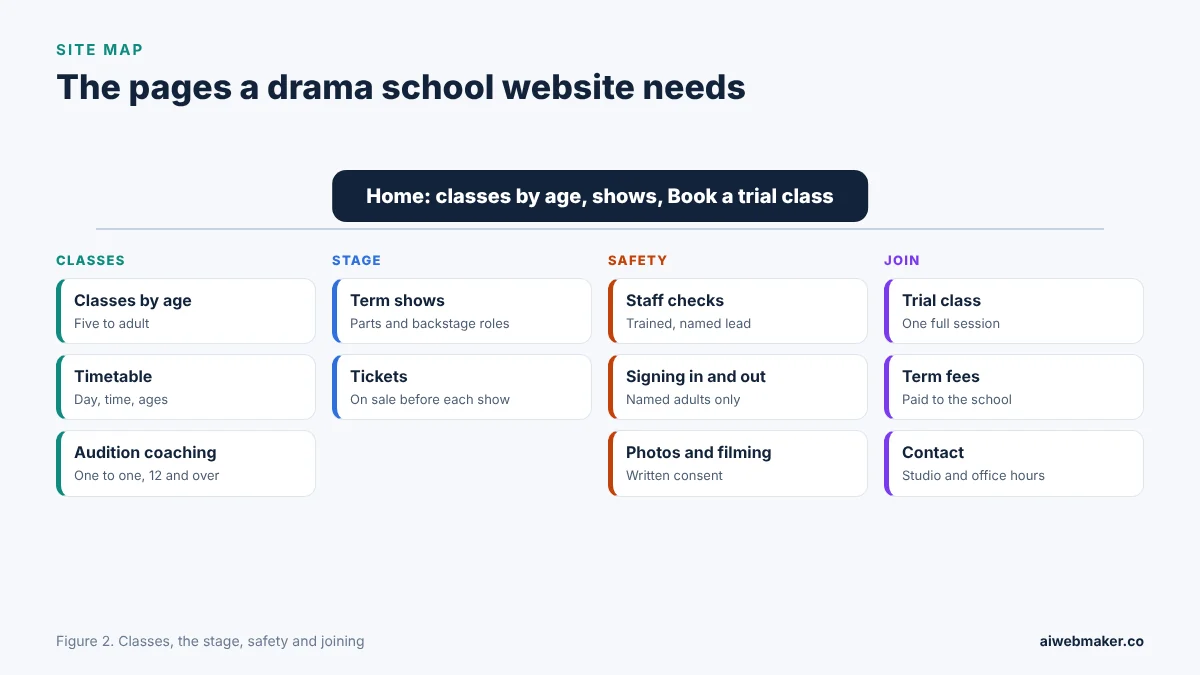
Four groups open from the home page here, in the order a parent tends to read them: classes, the stage, safety and joining. Class pages hold age groups, the timetable and audition coaching, stage pages hold term shows and tickets, safety pages hold staff checks, signing in and photo rules, and joining pages hold the trial class, term fees and contact details. Our sample school, Limelight Drama School, runs four classes: First Steps, Juniors, Youth Theatre and an Adult Evening Course. Its safety section covers checked and trained staff, signing in and out, backstage and dressing rooms, and photos and filming. The drama school website example with a safeguarding section and trial bookings also carries a weekly timetable, a section on term shows, reviews from parents and adults, questions and a trial class request. Any school can borrow that order, because it answers the parent's worries in the sequence they arise.
Classes by age and how a term is structured
Classes should be grouped by age and described by what students actually do, because parents struggle to compare vague promises about creativity. Young children usually start with games, movement and storytelling before they meet scripts. Juniors move on to improvisation, voice and short scenes, often with a speaking part in the term show. Teenagers work on full plays, devised pieces and classic scenes, and some prepare for auditions. Adult classes suit beginners and returners, with text and character work and an informal sharing rather than a forced performance. A clear table of ages, focus and shows helps families find the right room in seconds.
| Class | Ages | What students work on | End of term |
|---|---|---|---|
| First Steps | 5 to 7 | Games, movement, storytelling | A short showing for families |
| Juniors | 8 to 12 | Improvisation, voice, scene work | A speaking part in the term show |
| Youth Theatre | 13 to 18 | Full plays, devised work, classics | Performance on a theatre stage |
| Adult Evening Course | 18 and over | Text, character, scene study | An informal sharing |
Safeguarding policies parents read twice
Safeguarding is the part of a drama school's website that parents read most carefully, so it deserves its own page written in calm, specific language. Staff who work with children should be background checked and trained, though the checks required and the bodies that run them vary by country. A named safeguarding lead and a trained first aider on site give parents someone concrete to ask for. Signing in and out by a named adult, and clear rules on when older students may leave alone, show that nobody slips through the gaps. On show nights children should wait with chaperones in dressing rooms for their age group and never be alone with an adult. Where the law asks for licensed chaperones or performance licences for children, the page should say the school arranges them, while noting that these rules differ between countries.
| Policy | What parents want to know |
|---|---|
| Staff checks and training | Who is checked, and how often training is refreshed |
| Safeguarding lead | A named person who attends classes and shows |
| Signing in and out | Who may collect, and when students leave alone |
| Dressing rooms | Chaperones, age groups, no lone adults |
| Photos and filming | Written consent, no full names published |
| Performance licences | Arranged where the law requires them |
Term shows, parts for everyone and backstage roles
Term shows are the reason many children join, and the shows page should explain what each age group performs and where. Juniors and teenagers often perform at a local theatre with lights, sound and costumes, while the youngest share a short piece in the studio. Families want to know whether every child gets a speaking part, and the honest answer should be on the page. Students who prefer not to perform can often help with props, lighting or stage management, which keeps them part of the company. Ticket prices, sale dates and performance times help families plan around the show weeks. A clear shows page turns a nervous child's first term into something the whole family looks forward to.
Trial classes: the request that starts most enrolments
A trial class is the single most effective step in a drama school's enrolment, because it lets a child or adult join a real session before committing to a term. The trial page should explain what happens, such as joining an ordinary class for the whole session and talking with the teacher afterwards. The booking website builder for drama schools that run trial classes lets a family send a trial request, which the school then confirms, moves to another class with space or declines. Term fees and any trial charge are paid directly to the school, and the platform takes no cut of either. Before the first session, the school should confirm the details that help a teacher welcome the newcomer. A smooth trial request is often the moment a hesitant family becomes a loyal one.
| Detail confirmed before the trial | Why it helps |
|---|---|
| Class and day | The right age group and an open place |
| Student's age | Placement in the right group |
| Experience | New to acting, school plays or audition work |
| Who collects | Signing out by a named adult |
| Anything the teacher should know | Shyness, access needs or medical notes |
Audition coaching and promises a school should never make
Audition coaching serves older students preparing for drama school, youth theatre or college auditions, and the page should describe it with care. One to one sessions usually cover choosing a speech, preparing it, handling nerves and presenting confidently in the room. The page should state who the coaching suits, how sessions are booked and how they differ from weekly classes. No coach can promise a place at an audition, and a responsible school says so plainly. Families respect that honesty more than claims of guaranteed success. A careful coaching page attracts committed students without raising expectations the school cannot meet.
The words families type when looking for acting classes
Families type phrases such as drama classes for kids near me, acting classes for teenagers, youth theatre, acting classes for adults or audition coaching, usually with their town. Class pages should use these words naturally, alongside the ages and days they cover. On the map listing, the studio's location, class times and photos of rehearsals help parents judge whether the school is local and welcoming. Reviews from parents that mention growing confidence and careful handling on show nights carry great weight. Articles on what happens in a first drama class, how to calm stage fright or choosing an audition speech attract families before they decide. Writing of this kind makes the school the obvious next step for a curious child.
The drama school's hosting bill, term by term
A drama school's website bill is mostly hosting, either annual or monthly, plus a domain, which costs more or less depending on its ending. Established schools usually pay for the year, while a newly founded company may prefer monthly payments while it fills its first classes. Twelve articles on acting, confidence and auditions add roughly $7.80 to the year through AI credits. Adding a new class, changing the timetable or posting show dates brings no extra charge. Annual and monthly billing are compared below, and the $189 tier is given a row of its own simply as a benchmark.
| Item | Yearly | Monthly |
|---|---|---|
| Hosting the drama school pages | $119 | $228 over twelve months |
| Domain | Depends on the ending | Depends on the ending |
| Higher plan, for comparison | $189 a year | Not needed |
| Twelve acting and audition articles at about $0.65 | About $7.80 | About $7.80 |
| New classes, timetables and show dates | No charge | No charge |
| Year before the domain | About $126.80 | About $235.80 |
Which gaps send parents to another acting class?
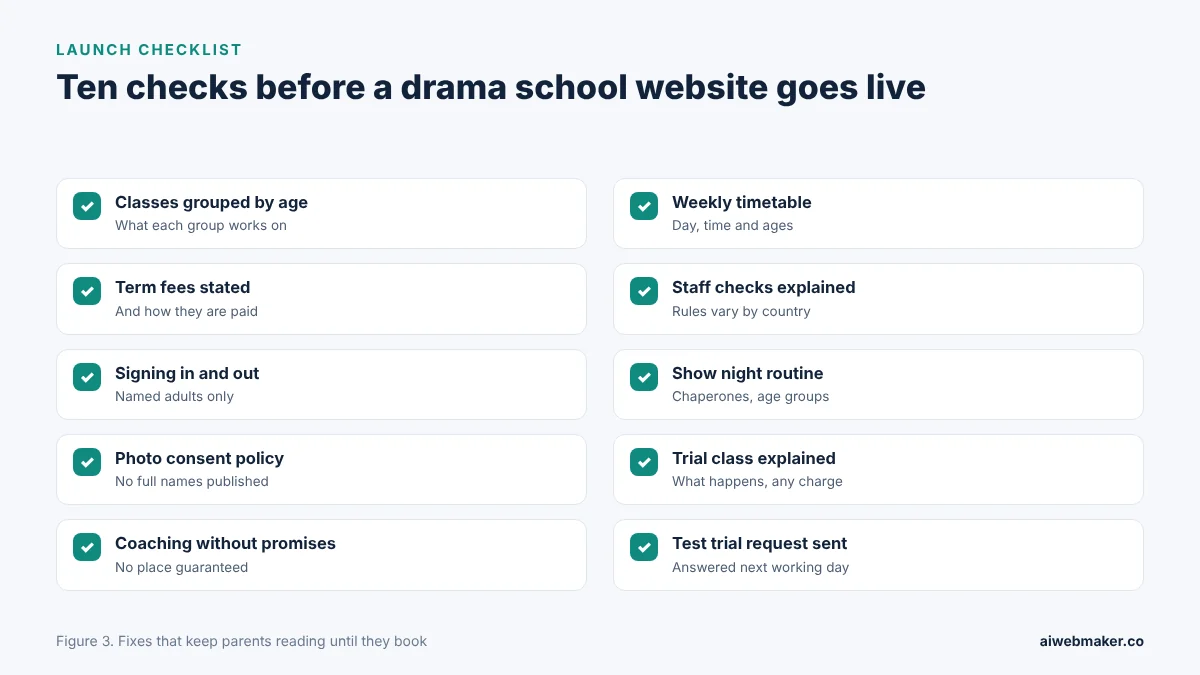
A parent closes a drama school's page when there is no word on staff checks, signing out or who looks after children on show nights. Classes described only as fun, with no ages or content, make comparison impossible. A missing timetable forces a phone call that many busy parents never make. No mention of a trial class leaves families facing a full term fee without seeing a session. Photos that show children's faces with no consent policy worry careful parents. The figure pairs every gap with a quick repair, so parents keep reading until they book a trial.
Frequently asked questions
Does a child need experience to join a drama class?
Most children join drama classes without any experience, and good schools build the first weeks of each term around games that help newcomers settle. Shy children often watch for a session or two before joining in, and patient teachers allow for that. The class page should say clearly that no experience is needed. Parents may also want to know how the school helps children who find groups difficult. Reassurance on this point brings in many families who were unsure.
What happens during a trial drama class?
A trial usually means joining an ordinary class for the whole session, taking part in warm ups, games and scene work with the group. Some schools let parents of younger children watch the last few minutes. The teacher often talks with the family afterwards about the best class for the student. The website should explain whether the trial is charged and whether that charge comes off the term fee. Clear expectations make the first visit relaxed for everyone.
Who looks after children backstage on show nights?
On show nights, children should be signed in by a parent at the stage door and stay with a chaperone in a dressing room for their age group. They should never be alone with an adult, and parents usually do not go backstage, which keeps every child's space private. After the performance, each child is signed out to a named adult. Where the law requires licensed chaperones or performance licences, the school should arrange them. A page describing this routine reassures parents before the first show.
Can audition coaching guarantee a place?
No coach can guarantee a place at a drama school, youth theatre or college audition, because panels make their own decisions. Coaching can help a student choose suitable material, prepare thoroughly and manage nerves. The website should describe what coaching covers and state honestly that results are never promised. Families who understand this set realistic goals and value the preparation itself. Honest wording protects both the school and the student.
A single term fee against the hosting year
One child joining for a single term usually brings in more than the hosting and the domain cost across twelve months. On the monthly route, a single trial class fee in many schools exceeds the $19. Every family that books a trial after reading the safeguarding page and stays for several terms adds income for years. Clear classes by age, honest show policies and careful safety rules persuade parents who would otherwise choose the school nearest home. A waiting list for the Saturday classes is a fair sign the website is doing its share.
Build your website in Minutes and get the AI Tools that work
Start Building Your Website →