Dive Shop Website Cost: Courses, Depth Limits and Health Forms
A dive centre's website is hosted at $119 for the year or $19 for a single month, plus a domain. What follows: who books, the training ladder, depth limits, health and flying, guided dives and hire, requests, search and costs.
- No coding required
- Live in minutes
- Blog, SEO and chatbot tools included
A dive centre's website is its cheapest piece of kit, with AI Web Maker charging $119 to host it through the year, or $19 for one month. Course pages, the depth table and the health notes deserve the care of a dive plan, and every draft of them shown in the preview stays unbilled until launch. A domain comes on top, yet a single beginner course still covers several years of hosting. The real challenge is safety communication, because a dive centre must welcome nervous beginners while staying firm about health, depth limits and sea conditions that no instructor can overrule. Certified divers, meanwhile, judge a centre on its boats, its group sizes and how carefully it checks their level and their last dive. What follows: who books, the pages, the training ladder, depth limits, health and flying, guided dives and hire, requests and the weather call, search, the year's hosting maths and the gaps that lose divers.
This article is part of our complete guide: Fitness Website Builder.
First timers, certified divers and families: who books a dive centre
Dive centre websites serve readers ranging from people who have never breathed through a regulator to divers with hundreds of logged dives, and each needs to find their level. First timers on holiday look for a try dive, what it involves, the minimum age and whether they need to swim well. People ready to learn compare beginner courses by length, what is included and where the certification will be accepted later. Certified divers look for boat schedules, dive sites, group sizes and equipment hire, and returning divers check refresher options. Families want junior ages, depth limits for children and whether a certified parent can dive with them. A site that sorts these readers by experience on the first screen turns browsing into booked places.
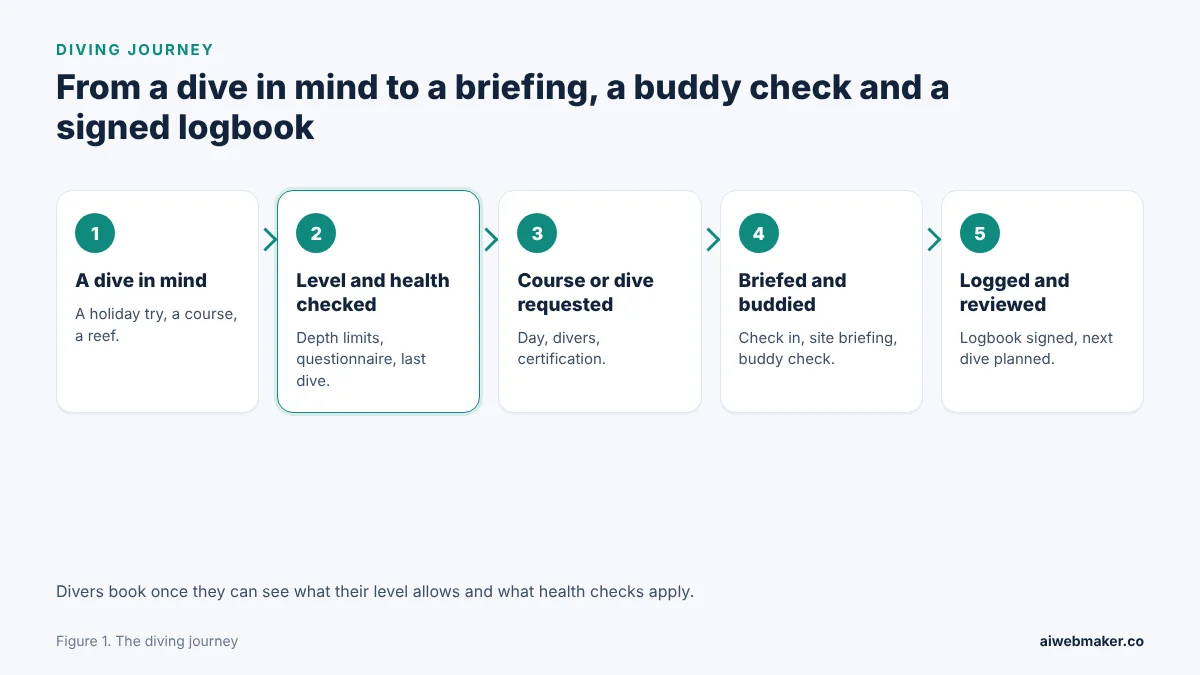
Matching level and health is the pivotal step in this diving journey, since a diver who cannot see what their certification allows will hesitate to book. It usually starts with a holiday try dive, a course or a reef someone has long wanted to see. A request follows, with the course or dive, the day, the number of divers and the highest certification held. Check in, the site briefing and the buddy check then turn the booking into a well planned dive. Logbooks signed after the dive, and a plan for the next day, are where repeat bookings start. Each page of the site should help a diver reach the right level, on the right day, with the right preparation.
Courses, depth limits and health pages a dive centre should carry
A dive centre's website needs pages that sort visitors by experience and settle safety questions before anyone pays. Course pages describe the training ladder from a first try to rescue level, with what each includes and its price. A depth limits page explains how deep each level may go and who accompanies the diver. A health page explains the medical questionnaire, flying after diving and when a doctor's note is needed. Guided dives and equipment hire serve certified divers, and the request page with directions rounds things off. Once these pages exist, a nervous beginner and a seasoned diver can both find their way in one visit.
| Page | Diver's question | What it should state |
|---|---|---|
| Courses | Which course suits a beginner | Steps from try dive to rescue, inclusions, price |
| Depth limits | How deep may each level go | Planned depth per level, who dives alongside |
| Health | Is the diver fit to dive | Questionnaire, doctor's note, flying after diving |
| Guided dives | Where and when certified divers go | Boat times, sites, group sizes |
| Equipment hire | What kit can be borrowed | Full kit, sizes, servicing, fills |
| Booking request | How is a place held | Course or dive, day, divers, certification |
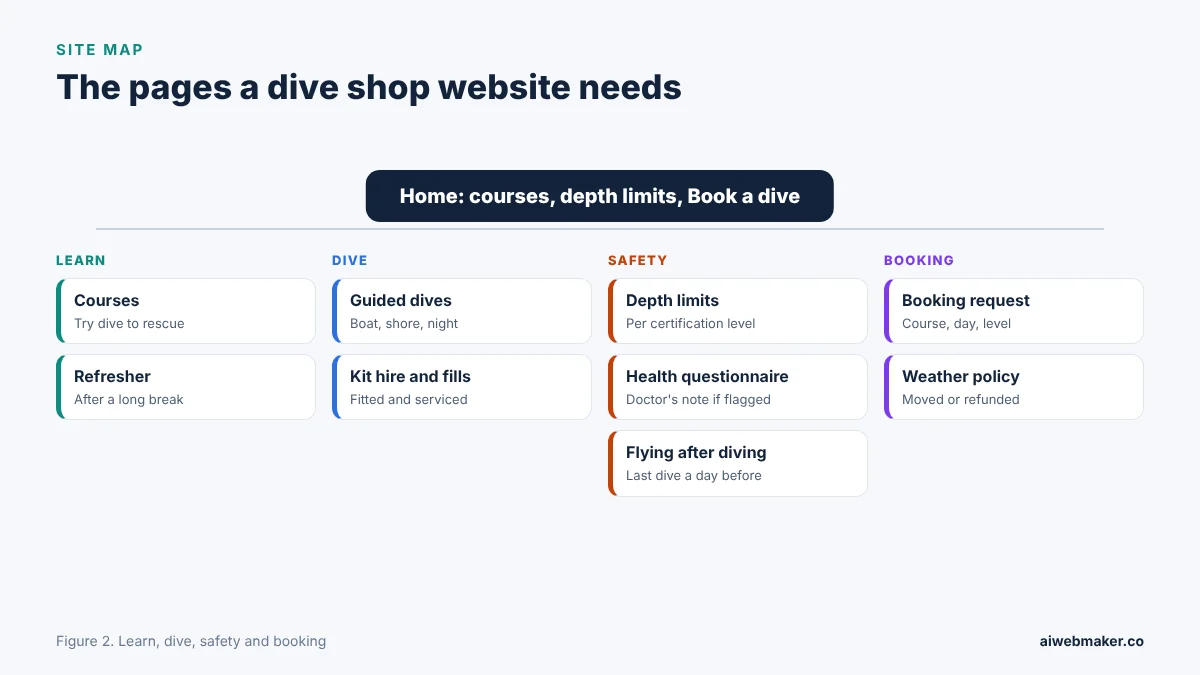
Learn, dive, safety and booking are the four branches of this dive centre's plan, with the health page linked from every course. Our sample, Blue Reef Dive Centre, prices four courses: a try dive, a beginner diver course, an advanced diver course and a rescue course. A table sets out how deep each level may go, and a section asks every diver to complete a health questionnaire before entering the water. For certified divers it lists a two dive boat morning, a house reef shore dive, a night dive, a refresher session, full kit hire and tank fills with kit servicing. The dive shop website example with depth limits by level and a health questionnaire closes with a booking request asking for the course or dive, the day, the number of divers, the highest certification and the last dive. Putting depth and health between the courses and the request mirrors the order an instructor would follow in person.
From try dive to rescue course: setting out the training ladder
Dive training follows a ladder, and the website should show each rung with what it involves, what it qualifies a diver to do and what comes next. A try dive, sometimes called a discovery or introductory dive, lets beginners breathe underwater with an instructor close by, usually in a pool and then in shallow sea. The beginner course combines theory, pool sessions and open water dives, and leads to a certification for diving with a buddy to a set depth. Advanced training adds deeper dives, navigation and often a night dive, while rescue training focuses on spotting problems and helping other divers. Course names differ between training agencies, so the page can explain its own names in plain terms and say which agency certifies them. A clear ladder shows beginners that the first step is small and that the next ones wait until they are ready.
| Level | What it involves | What it leads to |
|---|---|---|
| Try dive | Pool skills, then a shallow sea dive | A taste of diving, no certification |
| Beginner course | Theory, pool sessions, open water dives | Diving with a buddy to a set depth |
| Advanced course | Deep, navigation and specialty dives | Deeper planned dives with a buddy |
| Rescue course | Problem spotting, rescues, first aid | Readiness to help other divers |
| Refresher | Skills review after time away | A safe return to the diver's level |
Depth limits by certification, stated before anyone boards
Depth limits by certification protect divers and the centre, and stating them before the booking avoids disappointment on the boat. Try dives are kept shallow, junior divers usually have lower limits than adults, and each certification level carries its own planned maximum. Recreational diving generally stops at around 40 metres, and deeper dives belong to specialist technical training. Divers who have not dived for a year or more are often asked to complete a refresher before returning to their usual depth. Local rules and marine park regulations may be stricter and vary by country, and instructors can set shallower limits on any day. Clear depth tables let divers book the right trip and spare everyone an argument at sea.
| Diver | What the table should state |
|---|---|
| Try diver, no certification | A shallow planned maximum and an instructor alongside |
| Junior diver | A lower limit and who must accompany them |
| Beginner certified | The planned maximum with a buddy and guide |
| Advanced certified | The deeper planned maximum, with conditions |
| Returning after a break | A refresher before diving at the usual level |
The medical questionnaire, flying after diving and what instructors cannot judge
Diving places real demands on the heart, lungs and ears, so a dive centre's health page should be careful and plain and should never sound like medical advice. Many training agencies use a standard diving medical questionnaire, and a yes to certain questions means a doctor must sign the diver off before any water session. The page should state that instructors are not doctors and cannot judge fitness, and suggest speaking to a doctor, ideally one familiar with diving medicine, well before the trip. Medical answers belong on the separate questionnaire rather than in a general booking form, which respects the diver's privacy. Flying after diving needs a line of its own, since many centres plan the last dive a full day before a flight as a cautious reading of diving medicine guidance. Careful health guidance protects divers and shows that the centre puts safety before sales.
Boat mornings, shore dives and kit hire for certified divers
Certified divers judge a centre by its boats, its sites, its group sizes and how carefully it checks their level, so the guided dive page should be specific. Boat departure times, the number of dives per trip, the surface interval and what is served on board help divers plan their days. Shore dives on a house reef suit divers returning after a break or practising skills, and night dives need a clear level requirement. Equipment hire should list each item, how it is fitted, how often regulators and jackets are serviced and the price per day. Divers bringing their own kit look for tank fills and servicing, and the page should mention which gases are available. Reef etiquette, such as no touching and careful buoyancy, belongs here too, along with any marine park fees or rules that apply locally.
Course and dive requests, deposits and the weather call
A dive request should ask for enough to place each diver correctly and nothing more. The sample's form asks for the course or dive, the day, a start time, the number of divers, the highest certification and the last dive. With the booking website builder for dive centres and their boat mornings, a diver submits that request and the centre weighs it against boat space and instructor numbers. The centre can confirm the place, suggest a nearby date or decline when a boat or course is full. Course deposits and any payment on the day are arranged by the centre directly with the diver, and AI Web Maker takes no part of either. Weather terms belong beside the request, explaining that boats sail only when the skipper and dive leader judge it safe and whether cancelled trips are moved or refunded.
What holiday divers and learners search for
Divers type phrases such as scuba diving near me, try dive, learn to dive or night dive, often with an island, bay or town named. Course and dive pages that lead with those phrases help search engines match holidaymakers with the right level. The map listing should carry the opening hours, the boat times, photos from the boat and the reef, and a link to the courses. Reviews from beginners who felt safe, and from experienced divers who praise the guiding, persuade both audiences at once. Articles on what to expect on a first dive, how depth limits work or the marine life at local sites attract holidaymakers who plan weeks ahead. Those planners often reserve their course before they board the plane.
Compressors cost more: a dive centre's website year
Against compressors, boats and regulators, a dive centre's website line is barely visible, made up of hosting, a domain and a few dive site articles paid for in credits. Paid as one sum, hosting is $119 for twelve months, or $228 spread across twelve $19 months. Domain endings number around 400, and each is priced differently. Credits for twelve articles on dive sites and training come to about $7.80. For comparison the table names the $189 tier, while course, depth table or boat time updates are never charged for.
| Item | Yearly | Monthly |
|---|---|---|
| Hosting the dive centre pages | $119 | $228 over twelve months |
| Domain | Depends on the ending | Depends on the ending |
| Higher plan, for comparison | $189 a year | Not needed |
| Twelve dive site and training articles at about $0.65 | About $7.80 | About $7.80 |
| Course, depth and boat time updates | No charge | No charge |
| Year before the domain | About $126.80 | About $235.80 |
Missing depths and silent health pages that lose divers
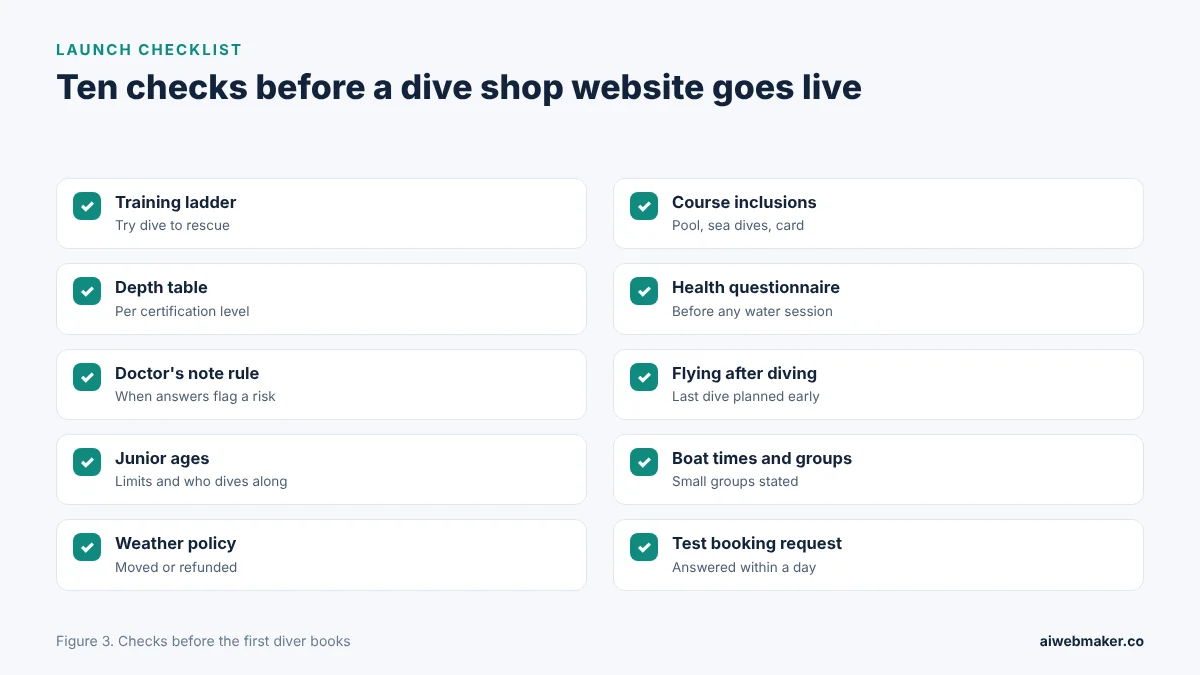
Divers leave a dive centre's website when they cannot find what their certification allows or how deep a trip will go. Beginners turn away when a course is listed without what it includes or how long it takes. No health information makes careful divers suspect the centre cuts corners. Missing boat times and weather terms leave visitors unable to plan around flights. Photos of reefs from somewhere else undermine trust as soon as divers notice. Repairs for all five problems, and five more, fill the ten tiles below.
Frequently asked questions
Does a beginner need to be a strong swimmer?
Beginners do not need to be fast swimmers, but they do need to be comfortable in water. Many training agencies ask students to show basic water skills before a course, such as a continuous swim and a spell of floating or treading water. The website should state the centre's own requirement in plain words. Try dives usually ask less, since an instructor stays close throughout. Clear expectations help nervous swimmers prepare rather than give up.
Can people with a medical condition learn to dive?
Some people with medical conditions can dive safely, but only a doctor can decide, ideally one who knows diving medicine. The medical questionnaire identifies conditions that need a doctor's sign off before any water session. The website should explain this process without offering medical opinions of its own. Divers should be encouraged to see their doctor well before their trip. A clear process protects both the diver and the centre.
How old must children be to dive?
Training agencies and countries set different minimum ages, which is why the centre should publish its own. Many agencies offer junior courses from around ten years old, with lower depth limits and closer supervision than adults. Some centres also run pool sessions for younger children. The page should explain who must dive with a junior and how deep they may go. Clear rules help families plan holidays that include everyone.
Will a certification be recognised in other countries?
Certifications from recognised training agencies are accepted by dive centres in many countries, though each centre still checks a diver's card, logbook and recent experience. The website can name the agency that certifies its courses and explain how divers receive their cards. Divers returning after a long break may be asked to complete a refresher, wherever they trained. Explaining this saves surprises on future trips. Clear information makes the course feel like an investment that travels.
One beginner course set against the hosting bill
A single beginner diver course at the sample centre's price is worth more than four years of $119 hosting. One house reef shore dive on the sample's price list clears a $19 month twice over. Boat mornings, kit hire, refreshers and advanced courses then build steady income from divers who trust the centre. A clear training ladder, honest depth limits and careful health guidance persuade divers better than any underwater photo. Centres that keep courses, boat times and weather terms current see divers return year after year. A full boat leaving the jetty at eight is the result worth working towards.
Build your website in Minutes and get the AI Tools that work
Start Building Your Website →