Wedding DJ Website Cost, From Ceremony Microphones to the Curfew
A wedding DJ keeps the date request page live for $119 a year, less than one hour of a Saturday booking, or for $19 monthly, and a domain is bought alongside. Then: who books, the pages, packages by the hours of the day, microphones, limiters and curfews, song lists, dates and deposits, search and the yearly figures.
- No coding required
- Live in minutes
- Blog, SEO and chatbot tools included
A wedding DJ keeps the date request page live for $119 a year, less than one hour of a Saturday booking, or pays $19 monthly through a first season, plus a domain. Drafting the package cards, the running order and the lighting colours, then checking each screen in the preview, never reaches the DJ's AI Web Maker invoice. A single Evening only booking would pay that hosting seven times. The hard part of the trade is selling a limited stock of Saturdays to couples who cannot hear the work in advance. They must trust that the vows will reach the back row, the speeches will stay clear and the floor will fill before the venue's curfew. In order below: who books, the page set, pricing by part of the day, microphones, limiters and curfews, song lists, Saturdays and deposits, searches and a year of costs.
This article is part of our complete guide: Website Builder for Creative Businesses.
Couples, venue coordinators and the parents paying the balance
Couples make the booking, but several people shape the choice of a wedding DJ before any contract is signed. Venue coordinators keep lists of DJs they trust, because a DJ who ignores the limiter or overruns the curfew causes them trouble. Planners look for suppliers who answer quickly and turn up with backup kit. Parents who contribute to the budget often read the package page closely and ask what the extra hours actually buy. Couples themselves care about music, but they worry even more about microphones, announcements and whether the night will feel like theirs.
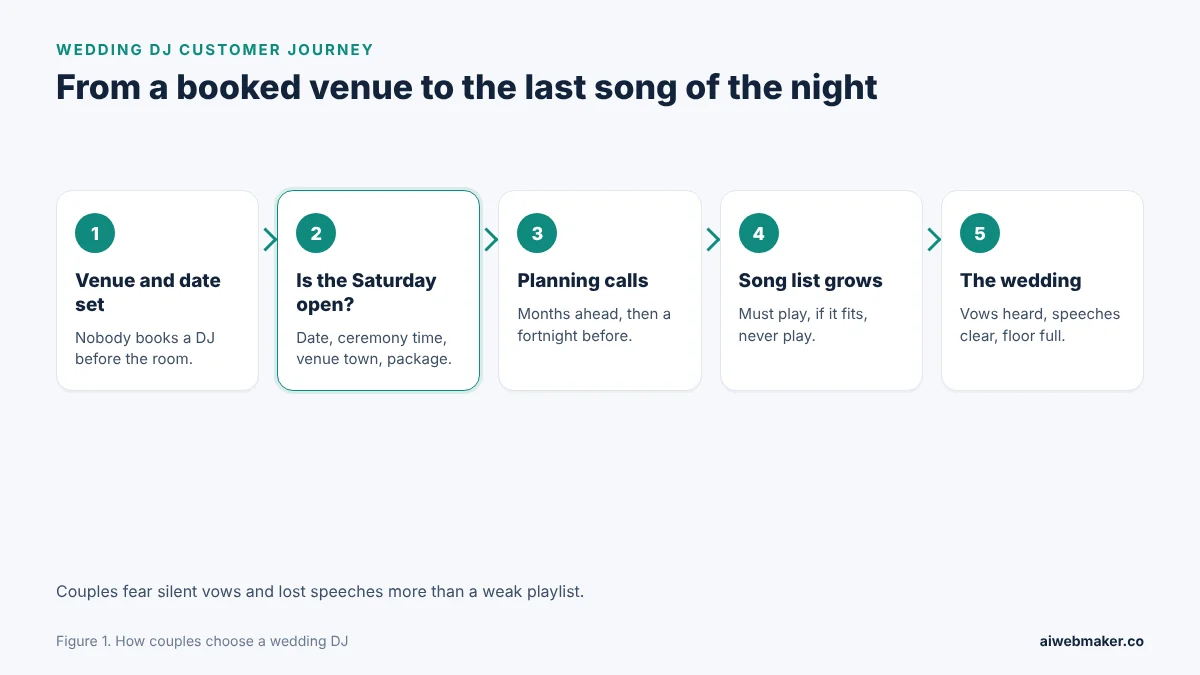
A confirmed venue and date start the path, since nobody books a DJ before knowing where the party happens. The highlighted second step is the date check, when the couple asks whether a particular Saturday is still open and which package fits. Planning calls follow, one months ahead and one a fortnight before, which turn a booking into a running order. The song list grows between those calls, with must play tracks and firm refusals. The wedding itself is the final step, where every earlier page is either proved right or quietly wrong.
Packages, the running order and the date check: a DJ's page set
A wedding DJ's site sells a day, not a playlist, so its pages follow the shape of that day from the aisle to the last song. Couples want to see which parts of the day the DJ covers and what each part requires. A running order shows how the music, microphones and announcements fit around the venue's timings. Packages need hours, guest numbers and equipment spelled out, while a page on venue rules answers the coordinator's questions. The date request closes the set, asking only what the DJ needs to say yes or no.
| Page | What couples look for | Detail that matters |
|---|---|---|
| The day | Which parts are covered | Ceremony, dinner, speeches, dance floor |
| Running order | How the timings work | Times, cues, what the DJ does at each |
| Packages | What the money buys | Hours, guests, microphones, lighting |
| Planning | How the music is chosen | Calls, song list, requests policy |
| Lighting | Whether the room will look right | Colours, uplighters, dance floor lights |
| Venue rules | Whether the DJ is a safe pair of hands | Limiters, curfews, insurance, backup kit |
| Date request | Whether the Saturday is open | Date, ceremony time, venue town, package |
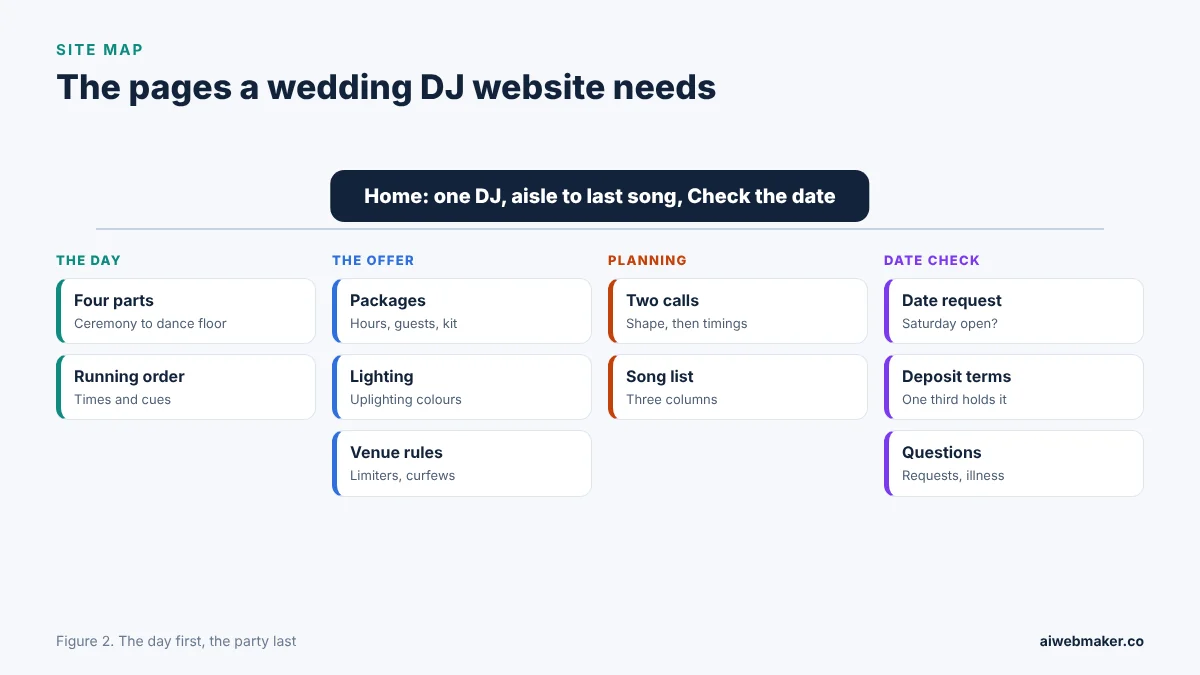
Beneath the home card in this drawing hang four branches: the day, the offer, the planning and the date check. First Dance DJ Services, the invented DJ in the wedding DJ website example with packages and a running order, opens with three microphones, two planning calls and one DJ from the ceremony to the last song. Its day is split into the ceremony, drinks and dinner, speeches and the dance floor, followed by an example running order from guests arriving at 12:30 to the last song at 23:45. Three packages follow: Ceremony to last song at $1,850, Speeches and party at $1,200 and Evening only at $850, all within 120 km. Planning calls, a three column song list, uplighting in eight colours and a short set of questions lead to a request headed "Is your Saturday still open?".
Packages priced by the parts of the day played
A wedding DJ prices by the parts of the day covered, because the ceremony and dinner add set up, a second room and hours of attention long before the party. A ceremony often needs its own compact speaker, a lapel microphone and cued entrance and exit songs. Drinks and dinner call for quiet sets that guests can talk over, and the system may move rooms while people are outside. Speeches need two wireless microphones and someone who rides the volume for nervous speakers. The evening set is what most couples picture, but it is often the shortest part of the DJ's working day.
| Package | Hours covered | What the DJ brings | Who it suits |
|---|---|---|---|
| Ceremony to last song | Up to eleven hours | Ceremony sound, dinner sets, speeches, evening, uplighting | Couples marrying and partying at one venue |
| Speeches and party | Speeches to curfew | Microphones, first dance edit, evening set, floor lights | Couples using the venue's ceremony sound |
| Evening only | Up to five hours | Evening set, first dance, one microphone | Evening receptions and second celebrations |
| Travel beyond the radius | Quoted at the start | Fuel and time on the road | Venues far from the DJ's base |
Vows and speeches: the microphone work couples forget to ask about
The microphones decide more weddings than the music does, because a vow nobody heard cannot be repeated and a speech lost in feedback spoils the room. A celebrant or registrar can wear a lapel microphone so the words reach the back row, while readers use a handheld. Some officiants refuse microphones altogether, so a careful DJ asks them before the day. Before the meal, each speaker should be shown how to hold the microphone and tested quickly. During the speeches, the DJ rides the volume so quiet voices are heard and loud ones never hurt, which is a skill worth describing on the site.
Sound limiters, curfews and the paperwork venues ask for
Many venues control noise with a limiter, which cuts the power when sound passes a set level, so a DJ who knows the limit keeps the party running. Curfews matter just as much, because a venue may need the music to end at a fixed time for its licence or its neighbours. Many venues also ask suppliers for proof of liability insurance and, in some countries such as the United Kingdom, recent safety tests on portable electrical equipment. Haze and smoke machines can set off fire alarms, so they are often banned or need approval. Requirements differ between countries and between venues, so the honest promise is to read each venue's own rules rather than claim to know them all.
| Venue question | Why the venue asks | What the DJ page can state |
|---|---|---|
| Sound limit | Neighbours and the venue's licence | Limit checked in advance, system set below it |
| Curfew | Licensing hours and staff | Last song agreed, pack down time stated |
| Liability insurance | Damage or injury during the event | Cover held, certificate sent on request |
| Electrical safety | Portable kit plugged into the venue | Tested equipment, where local rules ask |
| Haze or smoke | Fire alarms | Used only with written venue approval |
| Load in and access | Timings around other suppliers | Arrival time, parking and lift needs |
Two planning calls and a three column song list
Planning calls turn a booking into a night that feels personal, and the site should explain them in enough detail that couples see the care involved. A first call months ahead covers the shape of the day, the rooms and the music the couple loves or dislikes. A second call a fortnight before fixes the running order, the names for every announcement and how each one is pronounced. Between the calls, a shared list with must play, play if it fits and never play columns lets the couple steer without writing a full playlist. A clear policy on guest requests, agreed on the call, avoids awkward moments when an uncle asks for the song the couple banned.
Saturday scarcity and the deposit that holds it
A DJ can play only one wedding on a Saturday, so the date is the product and the request page is the till. A good request asks for four things: the wedding date, when the ceremony starts, the venue's town and the package wanted, which is all the diary and the route planner need. The booking website builder for wedding DJs taking Saturday date requests carries that request to the DJ, who then says yes to the Saturday, proposes another start time or declines. The deposit and the balance pass straight from the couple to the DJ, with no percentage kept by AI Web Maker. A clear deposit rule, such as one third to hold the date and the rest fourteen days before, gives couples confidence that the date is truly theirs.
Searches that pair a wedding DJ with a venue name
Couples often search for a DJ together with the venue they have just booked, so pages that name venues played, with permission, meet that search directly. Other common phrases include wedding DJ near a named town, DJ for ceremony and reception, wedding DJ with uplighting and evening reception DJ. The map listing should show weekday call hours, real photos of set ups and the website, since Saturdays are spent behind a desk. Reviews that mention clear speeches, a full floor and calm handling of a limiter carry more weight with coordinators than vague praise. Articles on first dance edits, running orders or what a limiter means for the party bring couples who are still comparing.
A DJ's yearly hosting, set against one Saturday
Only the hosting and the domain recur on a wedding DJ's web bill, and a venue guide costs about sixty five cents of AI credit to draft. Annual billing suits a DJ with a full season ahead, since it gives the lowest total. Monthly billing helps a DJ in the first season who would rather match costs to bookings. Changing package prices, adding a lighting colour or updating the running order costs nothing extra. The grid below holds both routes, and the $189 row is there only as a marker.
| Item | Yearly | Monthly |
|---|---|---|
| Hosting the wedding DJ and date request pages | $119 | $228 over twelve months |
| Domain | Depends on the ending | Depends on the ending |
| Higher plan, for comparison | $189 a year | Not needed |
| Twelve running order and venue articles at about $0.65 | About $7.80 | About $7.80 |
| Package, lighting and running order updates | No charge | No charge |
| Year before the domain | About $126.80 | About $235.80 |
Why couples skip a DJ's site and ask the venue for another name
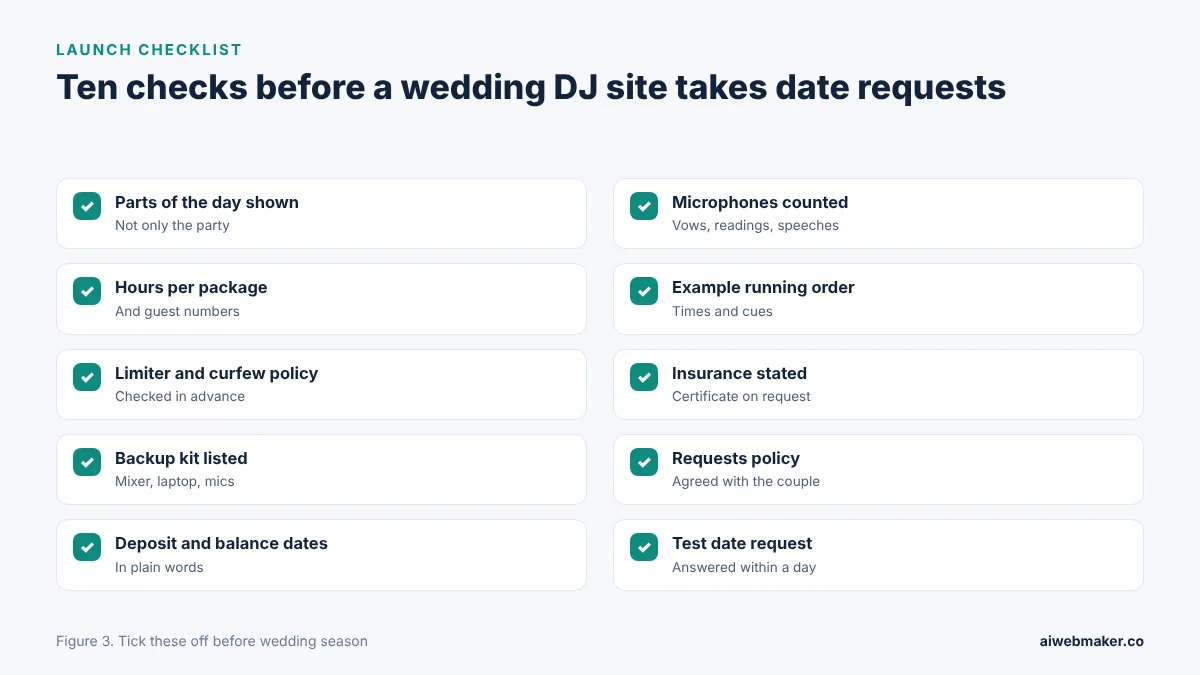
Couples move on when a DJ's site shows only party photos and says nothing about the ceremony or the speeches, the parts they fear most. Packages without hours, guest numbers or microphone counts make every option look the same. No word on limiters, curfews or insurance worries the venue coordinator who is asked for a second opinion. A request page that asks for too much, or never answers within a working day, loses the date to a quicker DJ. Missing backup equipment details leave couples wondering what happens if a laptop fails, and the ten points on the next card answer each worry.
Frequently asked questions
Will guest requests be played on the night?
That is the couple's decision, and a good DJ agrees the policy on a planning call before the day. Some couples welcome requests, while others keep strictly to their own list. A never play column protects the couple from songs they dislike. The DJ can still read the floor and choose tracks within the agreed style. Writing the policy on the website shows couples that their wishes come first.
What happens if the DJ falls ill before the wedding?
A careful DJ keeps a short list of trusted colleagues who play in a similar style and can step in. Saying so on the site matters, since illness is a fear couples rarely voice out loud. Backup equipment in the van covers technical failures, but only a second DJ covers illness. The couple should be told as early as possible and offered the stand in's details. A clear plan here turns a frightening question into a reassuring answer.
Does a sound limiter spoil the party?
Not when the DJ knows the limit in advance and sets the system below it. A full floor depends more on track choice and timing than on sheer volume. Limiters cut the power only when the level stays too high, which a careful DJ avoids. The venue can usually confirm the limit before the wedding. Couples who know this stop worrying about a rule they cannot change.
How early do couples reserve a wedding DJ?
Many couples reserve a DJ soon after the venue, often a year or more ahead for popular Saturdays. Weekday and winter weddings can usually be booked with shorter notice. The date is held only when the DJ confirms it and the deposit is paid. A quick reply to each request matters, because couples often ask several DJs at once. Early answers win dates that slower DJs never get to discuss.
A seventh of one evening's fee pays for the year
At the sample's prices, the $119 yearly hosting is about a seventh of a single Evening only booking. Paid monthly, each $19 is earned back within the first minutes of a reception set. Every Ceremony to last song booking that arrives through the site covers fifteen years of hosting. Clear microphones, honest venue rules and packages that show the hours persuade couples and coordinators alike. Saturdays that fill a season ahead are the result a DJ's site should produce.
Build your website in Minutes and get the AI Tools that work
Start Building Your Website →