Tattoo Studio Website Cost, Weighed in Healed Work and Consults
Tattoo studios spend $119 each year on hosting, or $19 in a month, plus a domain. After that come how clients pick an artist, styles, healed work, enquiries and consults, age and health rules, hygiene, aftercare and search.
- No coding required
- Live in minutes
- Blog, SEO and chatbot tools included
Tattoo studios are charged $119 a year to host their website, or $19 a month for shops that prefer a lighter monthly bill, and the domain is extra. Swapping in healed photos, writing artist profiles and checking the process page in the preview carries no fee from AI Web Maker. A single half day session covers that bill with room to spare, so cost is not what keeps a studio offline. What the finished pages can look like is shown on the tattoo studio website sample, an invented studio's site from AI Web Maker with healed work and a consultation route. The harder problem is that clients choose an artist rather than a shop, often after following their work for months, and then hesitate over price, pain, safety and whether their idea will be taken seriously. A website that sorts work by artist and style, explains the route from enquiry to session and treats safety plainly turns that long interest into a booked chair. What follows covers how clients choose, styles and profiles, healed photos, enquiries and deposits, age and health rules, hygiene, aftercare and the yearly cost.
This article is part of our complete guide: Website Builder for Creative Businesses.
Who walks into a tattoo studio, and how is the artist chosen?
Tattoo clients choose by style and by artist, and each kind of client needs a different kind of reassurance. First timers usually want a small piece, worry about pain and want to know they will not be judged for asking simple questions. Collectors planning a sleeve or a back piece look for an artist whose style they love and whose healed work holds up over years. Clients seeking a cover up or a rework need proof that the artist can transform old ink, which is skilled and specialised work. Walk in clients and flash fans want to know which days the door is open and which designs are available. Memorial pieces and meaningful designs bring clients who need a calm, patient conversation before anything else.
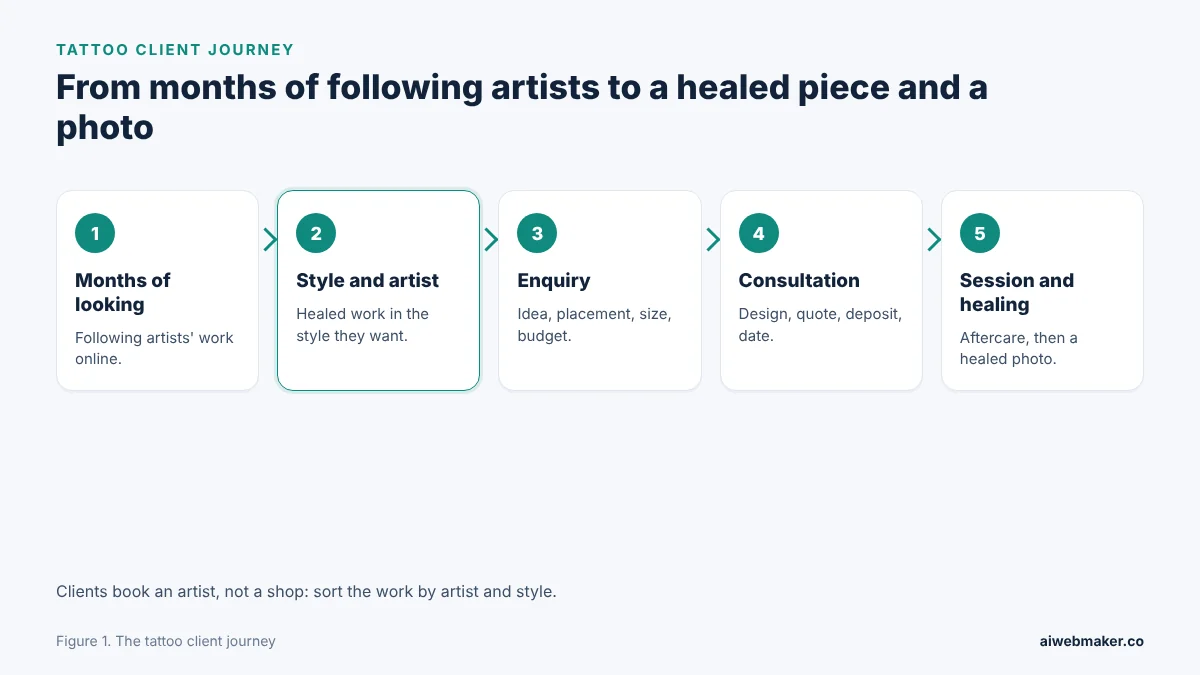
The highlighted second step is the real decision, when a client compares artists by style and by how their healed work looks. The first step can last months, because many people follow an artist online long before they feel ready. Once the artist is chosen, the enquiry sets out the idea, the placement, the size and a rough budget. A consultation turns that into a design plan, a quote and a date, with a deposit agreed directly. Healing completes the journey, and a good healed photo often ends up in the portfolio that persuades the next client.
Which pages should a tattoo studio give each artist and style?
A tattoo studio site needs pages that put the work first and the practical rules close behind. The home page should show strong healed pieces, the styles the studio is known for and a clear route to enquire. Each artist deserves a profile with their style, their portfolio and whether their books are open. A process page explains the route from enquiry to session, the deposit and aftercare. A studio page shows the room, the hygiene routine and the house rules on age and identification.
| Page | What the client checks | What belongs there |
|---|---|---|
| Home | Does this studio do my style? | Healed pieces, styles, an enquiry route |
| Artists | Who should tattoo me? | One profile per artist, style, books open or closed |
| Portfolio | Will it still look good in years? | Healed and fresh work, labelled by artist |
| Process | What follows an enquiry? | Steps, consultation, deposit, design time |
| Aftercare | How should it heal? | Care steps, warning signs, touch up policy |
| Studio and rules | Is it clean and properly run? | Hygiene, age rules, ID, location |
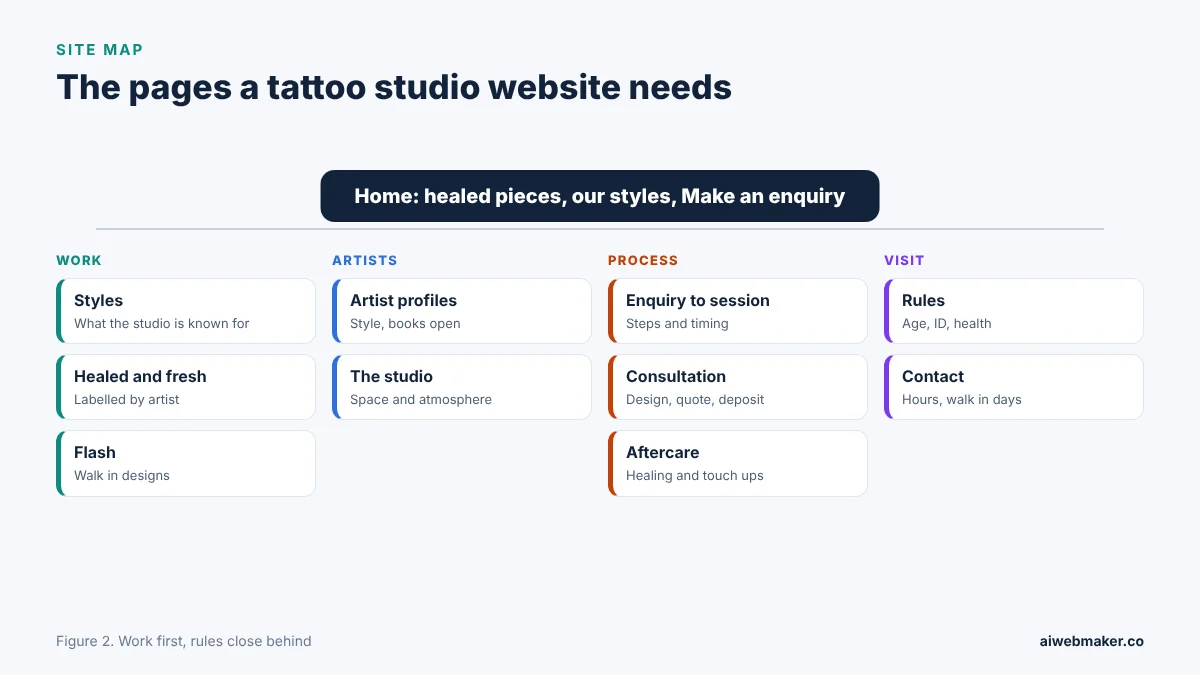
The tattoo site splits into four groups, with the work given the most room. Work pages hold the styles, the healed and fresh galleries and flash, all labelled by artist. Artist pages give each person a profile, while process pages cover the enquiry, the consultation, deposits and aftercare. Our sample, Black Lantern Tattoo, divides its portfolio into the styles it is known for, a gallery of finished work, healed work and fresh work, and offers a tattoo consultation as a bookable service beside a tattoo enquiry form. Its studio page introduces the artists, the studio story and the space and atmosphere, its process page runs from enquiry to session and aftercare for a new tattoo, and the tattoo studio website example with healed work and consultations came together in 37 seconds.
How should styles be sorted so clients reach the right artist?
Styles should be named the way clients search for them, because a person who wants fine line botanicals will not book an artist known for bold traditional work. Traditional, neo traditional, blackwork, fine line, realism, Japanese, lettering and dotwork each have their own followers and their own vocabulary. Grouping the portfolio by style, with each piece labelled by artist, lets a client move from a style they love to the person who does it best. Each profile should say which styles the artist takes on, which they avoid and whether they draw custom designs or tattoo flash. The portfolio website builder for tattoo studios and their artists drafts the pages from a short note about the studio, and each artist then rewrites their profile in their own words. A clear style map saves clients from asking the wrong artist and saves artists from turning work away.
| Style | What clients usually ask for | Portfolio tip |
|---|---|---|
| Traditional | Bold lines, solid colour, classic motifs | Show colour that has healed for years |
| Fine line | Delicate script, botanicals, small pieces | Show healed lines up close |
| Blackwork | Solid black, geometric and ornamental | Show large areas healed evenly |
| Realism | Portraits, animals, detailed shading | Show contrast once healed |
| Japanese | Large flowing pieces with traditional imagery | Show full sleeves and back pieces |
| Lettering | Names, dates, quotes | Show spacing at different sizes |
What makes a healed photo trustworthy?
A healed photo is trustworthy when it is taken weeks or months after the session, in daylight and without filters that hide blur or patchy colour. Fresh tattoos look bold and sharp under studio lights, but swelling and redness can hide how lines will settle. Healed shots prove that the artist's lines stay crisp, colours hold and shading reads well once the skin has recovered. Asking regular clients to send a photo once healed builds a steady supply, and each one should be published only with the client's permission. Labelling each photo with the artist, the style and roughly how long ago it was done helps clients compare like with like. Honest healed work is the evidence collectors look for before committing to a large piece.
What should happen between an enquiry and the first session?
The route from enquiry to session should be written down step by step, because unanswered questions are what make clients hesitate. A useful enquiry describes the idea, the placement, the rough size and any reference images, along with the budget and any dates the client cannot make. The artist then replies with a quote range or an invitation to a consultation, where the design, size and placement are agreed. A deposit secures the date and often counts towards the final price, and the studio and client settle it between themselves. Many studios also set a shop minimum for small pieces and charge larger custom work by the hour or the day, which the page can explain without quoting exact figures. A clear route turns a nervous enquiry into a confident booking.
| Stage | What the page should explain |
|---|---|
| Enquiry | Idea, placement, size, references and budget |
| Reply | How long the studio usually takes to answer |
| Consultation | What is discussed and whether it is charged |
| Deposit | How much, how it is paid and whether it counts towards the price |
| Design | When the client sees the drawing, and how changes work |
| Touch ups | Whether a touch up after healing is included |
What age, identification and health rules should the studio state?
Age and health rules belong in plain view, because the law and good practice both demand care before anyone is tattooed. In many countries the minimum age for a tattoo is 18, and in some places parental consent cannot lower it, while other jurisdictions allow younger clients with written consent. The studio should state the rule that applies where it works and say that photo identification will be checked. Clients should be asked about pregnancy, blood thinning medicines, skin conditions and conditions such as diabetes, and anyone unsure should speak to a doctor before booking. Many studios also refuse to tattoo anyone who appears to be under the influence of alcohol or drugs. Clear rules protect clients, artists and the studio's standing with local authorities.
How are needles, ink and the station kept clean?
Hygiene is the unseen part of tattooing, so the site should describe the routine a client will see in the room. Single use needles and cartridges, opened in front of the client and disposed of in a sharps container, are standard in professional studios. Surfaces, machines and cables are covered with barrier film, and ink is poured into fresh caps for each client. Gloves are changed whenever the artist touches anything outside the clean area. Premises and artists may need registration or a licence from local health authorities, and the requirements vary widely between countries and regions. Showing the certificate or registration where one exists gives careful clients the proof they want.
How should a new tattoo be cared for while it heals?
Aftercare instructions decide how a tattoo heals, so they deserve a clear page that clients can find again at home. Most studios advise keeping the new tattoo clean, washing it gently with mild soap and applying a thin layer of the product they recommend, or leaving a protective film on for the time stated. Swimming, long baths, saunas and strong sun should be avoided while the skin heals, and picking at flakes can pull out ink. Surface healing usually takes a few weeks, though the deeper layers take longer. Spreading redness, heat, swelling, pus or a fever are warning signs, and the page should tell clients to seek medical advice if they appear. Good healing is half of a good tattoo, and this page is where it starts.
Which searches lead collectors and first timers to a tattoo artist?
Tattoo clients search by style and place, typing phrases such as fine line tattoo artist, Japanese tattoo, cover up tattoo, tattoo studio near me or walk in tattoo. Style pages and artist profiles whose headings carry those words meet those searches directly. The map listing should show opening hours, walk in days and healed work, and it should link to the enquiry page. Reviews that mention a calm artist, a clean studio and how well the tattoo healed carry far more weight than star ratings. Articles on preparing for a first tattoo, choosing a placement or caring for a new piece in summer reach people months before they book. Social profiles that link back to the portfolio turn followers into enquiries.
How small is the hosting bill next to one half day session?
A tattoo studio's fixed web costs stop at hosting and a domain, and each aftercare or first tattoo guide written with credits adds about $0.65. Studios with full books save by paying the year at once. A new shop still building its client base may find $19 a month easier. Adding healed photos, new flash or an extra artist profile costs nothing. Below, the yearly and monthly figures appear together, with the $189 tier listed purely to compare.
| Item | Yearly | Monthly |
|---|---|---|
| Hosting the tattoo studio pages | $119 | $228 over twelve months |
| Domain | Depends on the ending | Depends on the ending |
| Higher plan, for comparison | $189 a year | Not needed |
| Twelve aftercare and first tattoo articles at about $0.65 | About $7.80 | About $7.80 |
| Healed photos, flash and artist updates | No charge | No charge |
| Year before the domain | About $126.80 | About $235.80 |
Which gaps send tattoo clients to another shop's portfolio?
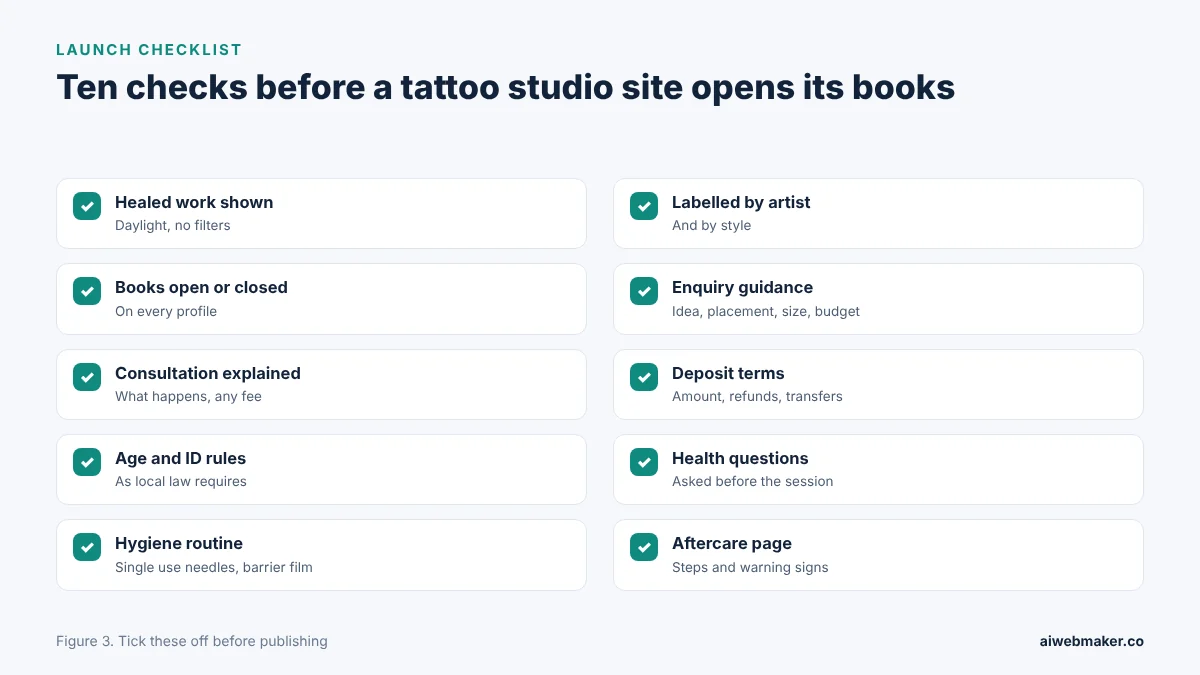
Tattoo clients move on when the portfolio shows only fresh work under harsh light, because they cannot judge how pieces heal. Work that is not labelled by artist leaves them unsure whom to ask. No mention of age rules, deposits or the consultation makes the process feel improvised. A site with no word on hygiene worries first timers more than any price. An enquiry page that gives no idea what to include, or how long a reply takes, invites silence. The ten points in the following image put each of these right.
Frequently asked questions
Is a deposit refundable if a client cancels a tattoo appointment?
Deposit rules are set by each studio, and the site should state them plainly before a client pays anything. Many studios keep the deposit when a client cancels at short notice or misses the appointment, because the artist has drawn the design and blocked the time. Moving the date with reasonable notice often carries the deposit over to the new session. The deposit is usually taken off the price of the final session. Clear terms prevent disputes and keep the diary fair for everyone.
How do walk in days and flash work at a tattoo studio?
Walk in days let clients turn up without an appointment and choose from a sheet of ready drawn designs called flash. The website should say which days and artists take walk ins, and update this whenever the plan changes. Flash designs can be shown with their sizes and fixed prices, so clients know what to expect. Age and identification rules apply exactly as they do for booked work. Clear walk in details bring in clients who decide on the spot.
Can a studio tattoo someone who is pregnant or taking medication?
Many studios postpone tattoos during pregnancy and ask clients taking blood thinning or immune affecting medicines to speak to their doctor first. The website can say that a short health questionnaire is completed before every session and that the artist may delay work for safety reasons. These rules are about safety rather than judgement, and saying so kindly helps clients accept them. Requirements on health questions vary by country and by local licence conditions. A calm, clear policy shows the studio puts clients' wellbeing first.
How should a tattoo studio handle cover up enquiries?
Cover up enquiries need a clear photo of the existing tattoo, taken in daylight, along with its size and age. The artist can then judge whether a cover up, a rework or some fading first would give the best result. Laser fading is carried out by specialist clinics, and the rules on who may offer it vary by country, so the studio should refer clients rather than advise on it. Showing healed cover ups in the portfolio proves the skill involved. Honest advice at this stage prevents disappointment later.
How many sessions pay for the tattoo studio's site?
One half day session usually pays for the $119 that keeps a tattoo studio hosted for a year, with plenty left over. On monthly billing, a small flash piece covers several $19 payments. Every client who books after studying healed work and a clear process is trade the site helped win, and a large back piece can mean many sessions. Healed photos, honest rules and a calm enquiry route earn the trust that permanent work requires. Studios that add new healed pieces every few weeks keep collectors coming back to look. Books that stay full months ahead show the portfolio earning its keep.
Build your website in Minutes and get the AI Tools that work
Start Building Your Website →